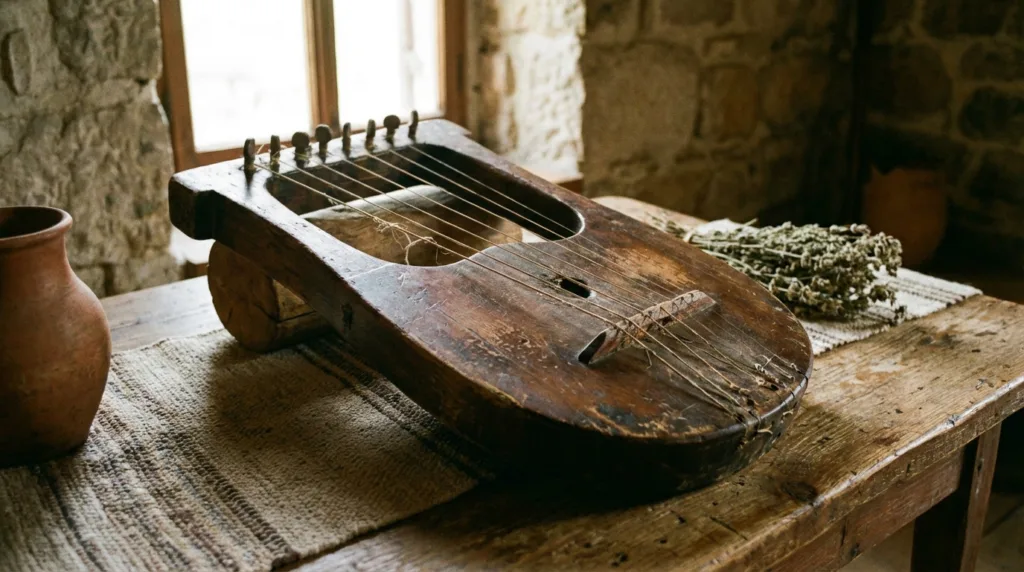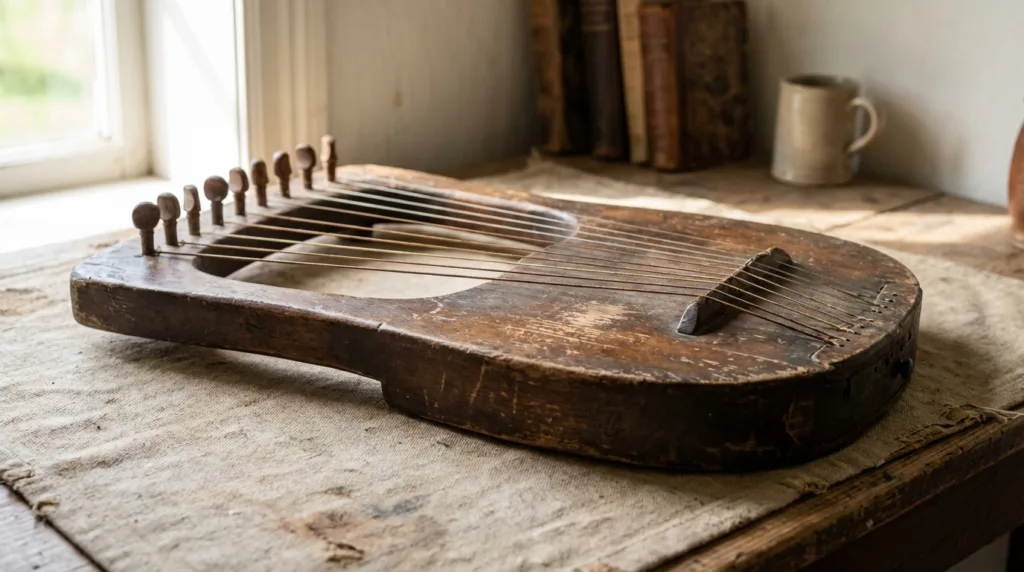
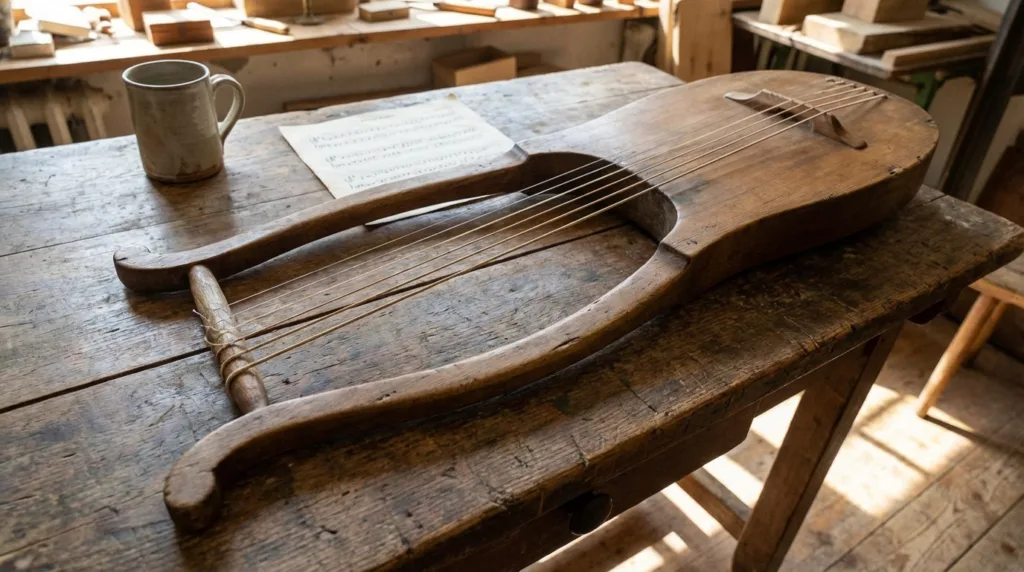
- 🏺 A deep-voiced member of the lyre family, often described as a longer, lower-sounding cousin of the small handheld lyres.
- 🧵 Built around string length: longer vibrating length tends to pull the pitch downward and adds a slower “bloom” to the attack.
- 🎶 Loved for a rounded timbre—less “sparkle,” more shadow and warmth—especially when played with a gentle, confident right hand.
- 🔧 A maker’s instrument: tiny choices in yoke stiffness, bridge footprint, and soundbox mass noticeably change projection and feel.
Some instruments announce themselves with volume. The Barbiton does it with gravity. You feel it in the way a plucked note arrives—not rushed, not sharp—then settles like warm air in a small room (and yes, it can be oddly addictive). A longer frame and longer strings shift the whole personality: the sound leans lower, the sustain often feels steadier, and the right hand can relax into a slower pulse without the tone collapsing.
What The Barbiton Is Made Of and Why It Matters
- Core Structure: a yoke-like frame (arms + crossbar) that holds string tension, plus a resonating body (soundbox).
- Strings: historically organic strings (commonly discussed as gut in reconstructions), with modern builds sometimes using nylon or fluorocarbon for stability.
- Sound Path: string vibration travels through a bridge into a soundboard, then into the cavity where air movement adds body to the tone.
| Material Choice | What You Hear | What You Feel While Playing |
|---|---|---|
| Stiffer Yoke (harder, denser wood) | Clearer pitch center; more definition on attack | More “spring” under the fingers; intonation feels more locked |
| Lighter Soundboard (thin, responsive top) | Faster response; richer overtones at low volume | Less effort to speak; rewards a softer touch (almost whispers back) |
| Heavier Body (more mass) | Often more fundamental, fewer “shimmer” partials | Stable in the lap; dynamic range feels wider, but needs a firmer pluck |
| Smoother, denser bridge wood | Tighter bass; cleaner separation between strings | More consistent touch across strings; less “wolfy” wobble |
The Barbiton’s secret is not one “magic” wood. It’s the relationship between stiffness, mass, and string length. A slightly heavier frame can keep low strings from feeling floppy; a more responsive top can keep the bass from turning into a soft thud. And when the balance is right—oh—each note lands with confidence. Short pause. Then it stays.
Timbre, Touch, and That Slight Resistance
- Timbre: often described as dark, rounded, and voice-like in the lower strings.
- Attack: less “ping,” more “pluck-then-bloom,” especially with thicker strings or softer plectra.
- Resistance: the right hand meets a gentle pushback; the left hand feels spacing that invites slower, deliberate fingering.
Here’s the tactile truth: the Barbiton makes you play differently. Not because it forces you—more like it suggests it. A fast, sharp pluck can sound brittle on some builds, while a confident, slightly slower stroke draws out a fuller core. (And yes, you’ll catch yourself repeating a phrase just to feel that response again.)
Try this: pluck near the center of the string length, then closer to the bridge. The same pitch, two personalities. Near the bridge you get more edge; nearer the middle you get roundness. That’s not theory—that’s wood, air, and tension negotiating in real time.
Strings, Tuning Logic, and Musical Range
- String Count: in historical discussion and iconography, the lyre family commonly centers around seven strings, though makers and reconstructions may vary.
- Why Longer Strings Matter: for the same string type and tension, increasing vibrating length tends to lower pitch.
- Stable Ratios: traditional interval logic often references simple ratios such as 2:1 (octave), 3:2 (fifth), 4:3 (fourth).
You don’t need to live in a tuning diagram to enjoy a Barbiton, but understanding the tuning logic helps you set it up with less fuss. Longer strings give you a comfortable low register, yet they also make small changes in tension feel more dramatic. Sometimes you turn the peg a hair and—whoops—too far. It happens. The trick is to approach pitch slowly, then confirm intervals by ear, not just by numbers.
In practice, many modern players treat the Barbiton like a “bass lyre” and tune it to fit a piece, an ensemble, or a voice. That flexibility is part of the charm: the instrument can support melody, or it can become a soft foundation under singing. Different builds respond differently, though, so it’s smart to test the lowest string carefully before you commit to a very low target pitch.
How It Plays: Hand Position, Plectrum Choices, and Control
- Resting Position: most players stabilize the body against the torso or in the lap; stability improves consistency.
- Right Hand Options: fingers for softer edges; a plectrum for clearer articulation and repeatable attack.
- Left Hand Role: damping, selective muting, and shaping sustain; sometimes light touches to control ringing.
- Dynamic Control: the Barbiton likes graduated force—small increases in pluck strength can open the tone dramatically.
A good Barbiton does not demand brute strength. It demands control. You can play it quietly and still get a real note—no apologizing tone, no thin whisper. Then you push a little more and it responds with a broader, room-filling body. Not loud in a modern sense. More… present.
And damping matters. A lot. Without damping, low strings can overlap and smear the phrase (beautiful sometimes, messy other times). With clean left-hand muting, each pitch reads as a choice, not an accident. That’s when the instrument feels serious.
History, Names, and Cultural Footprints Without the Dusty Lecture
- Name Forms: you may see barbiton and barbitos used for the same instrument family in different contexts.
- Setting: frequently linked in literature and art discussions to lyric performance and social music-making.
- Identity: often contrasted with the more formal kithara, with the Barbiton framed as more intimate in character.
The Barbiton sits in that sweet spot between object and idea. It’s an instrument, sure, but it also became a symbol: a certain kind of song, a certain kind of gathering, a certain kind of taste. Not “better.” Not “worse.” Just distinct. The longer form hints at a role in lower accompaniment and a different vocal pairing—more supportive, more draped, less bright.
What’s exciting today is how makers and performers approach it with fresh tools while keeping a respectful mindset. Experimental archaeology, museum education, instrument-building workshops—these spaces keep the Barbiton alive without turning it into a prop. People want playable history now. And honestly, good. It deserves that.
Barbiton Vs. Small Lyre: Where The Extra Length Changes Everything
- Pitch Center: the Barbiton often leans lower because longer strings make low tuning easier to achieve with playable tension.
- Attack Shape: small lyres can give a brighter snap; the Barbiton tends toward a slower, rounder bloom.
- Role: small lyres often shine for clear melodic lines; the Barbiton easily supports drones, bass motion, and vocal underpinning.
If you’ve played a compact lyre, the Barbiton can feel like moving from a quick sketch to charcoal on textured paper. The note edges soften. The middle thickens. You might lose a touch of sparkle, yes—but you gain a kind of authority in the low register that a smaller frame simply can’t fake.
Also, the physical spacing changes your phrasing. You reach a bit farther, you breathe a bit longer, you let notes finish their thought. It’s subtle. Then it’s not.
Barbiton Vs. Kithara: Intimacy Vs. Projection
| Feature | Barbiton | Kithara |
|---|---|---|
| Primary Character | Warm, rounded, supportive | Bright, projecting, articulate |
| Best Use Case | Voice pairing, low accompaniment, intimate rooms | Formal performance, clearer projection, rhythmic clarity |
| Right Hand Feel | Gentle resistance; rewards controlled plucks | More immediate response; crisp articulation |
| Tone Decay | Often steadier, low notes linger | Cleaner decay, strong separation between notes |
This comparison is less about “which is better” and more about which job you need done. A kithara-like build tends to favor projection and clarity. The Barbiton, at its best, offers a lower voice that can sit under a melody like a well-fitted coat—comfortable, supportive, quietly stylish.
Choosing A Modern Barbiton Replica Without Regret
- Ask About Scale Length: longer string length usually helps low tuning feel stable, but too long can feel slow and floppy if the build is light.
- Check Peg Smoothness: tuning should be predictable; “sticky” pegs make the instrument feel fussy, fast.
- Listen For Pitch Focus: in the lowest string, you want a note that stays centered, not a waver that turns into a vague rumble.
- Confirm Bridge Fit: a clean, stable bridge contact improves clarity and reduces strange buzzes.
- Test Damping: a playable Barbiton lets you mute cleanly; if everything rings forever, phrasing can get messy (unless you like that, which… fair).
Many buyers judge a Barbiton by volume. That’s a trap. Judge it by response. Does it speak at low dynamics? Does it hold a low pitch without collapsing? Can you shape silence between notes? If yes, you’re in good territory. If no, you’ll fight it—and you shouldn’t have to fight an instrument that’s supposed to feel natural.
Care, Setup, and Long-Term Stability
- Humidity Awareness: wood movement can change action and tuning feel; consistent indoor humidity helps.
- String Changes: change one string at a time to keep bridge position stable and tension balanced.
- Surface Care: a dry, soft cloth is usually enough; avoid aggressive cleaners that can dull finishes or swell wood.
- Transport: support the frame so the yoke doesn’t twist; twisting can cause subtle misalignment and odd buzzing later.
A Barbiton is forgiving—until it isn’t. Treat it like a living object (because it kind of is). Small checks, done regularly, keep the sound consistent: peg friction, bridge seating, string wear, and any new rattle that appears after a weather change. Catch it early and it’s a five-minute fix. Ignore it and it becomes a weekend project.
FAQ
Is it hard to learn the Barbiton if I already play a lyre?
What usually changes first
If you play lyre already, you’ll recognize the basic logic quickly. The biggest shift is timing and touch. The Barbiton often rewards slightly slower phrasing and cleaner damping, especially in the low register. Give it a week of daily short sessions and your hands usually “get it.”
How do I know if a Barbiton has a good low string?
A simple listening test
Pluck the lowest string softly, then moderately. A good low string keeps a clear pitch center and a steady decay. If the note turns into a vague wobble or loses definition fast, the setup may need work (string choice, bridge fit, or top stiffness).
Should I use fingers or a pick on the Barbiton?
Choose based on the sound you want
Fingers give a softer edge and can help when you want rounded tone. A pick (plectrum) helps consistency and articulation, especially for repeated patterns. Many players keep both options ready and switch depending on the piece.
What tuning should I start with on a modern Barbiton?
Start practical, then experiment
Start with a comfortable tension where every string speaks cleanly. Then tune by intervals you can confirm by ear (octaves, fifths, fourths) and adjust to your repertoire. Avoid forcing extremely low pitches until you’re sure the build and strings support them without sluggish response.
Can a Barbiton work with singing in a small room?
Yes, that’s one of its best uses
The Barbiton’s lower voice can support singing without competing for the same frequency space. In a small room, that warmth feels natural and balanced. Clean damping and moderate dynamics help the voice stay forward.