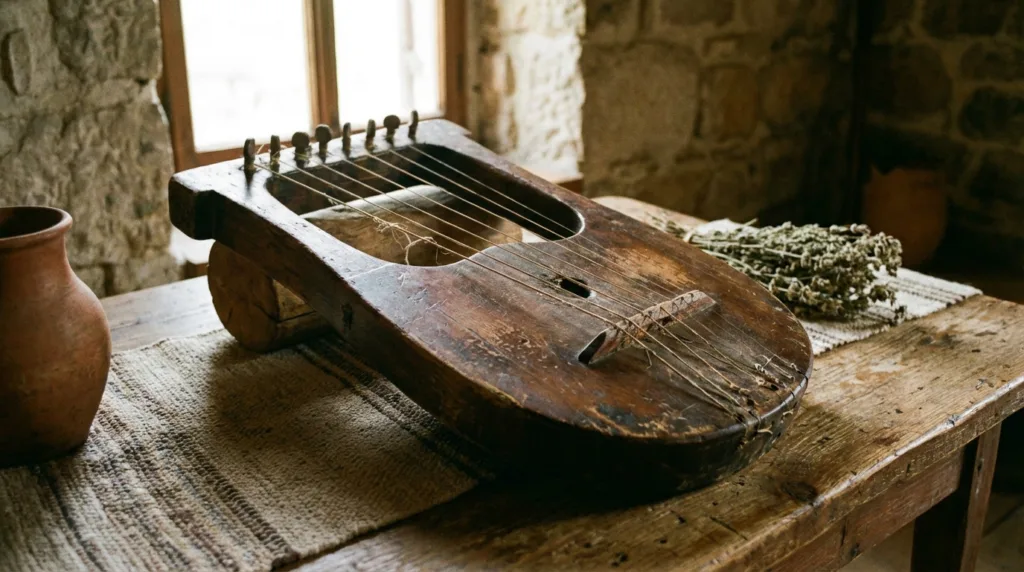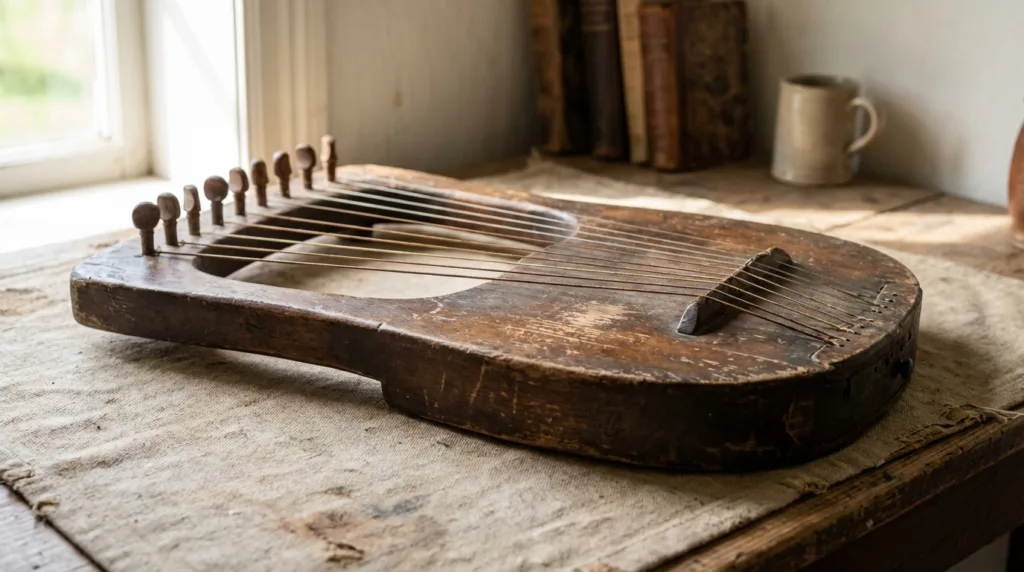
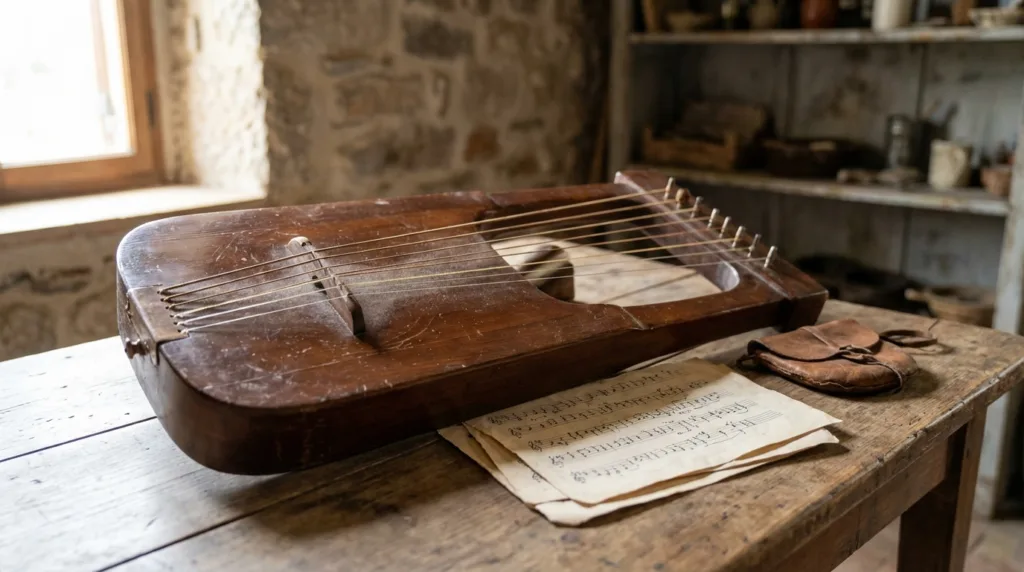
Picture a many-stringed instrument that sits close to the body—almost like a private conversation—yet throws a bright, glassy shimmer into the room when a skilled hand wakes it up. That is the Epigonion (also written as epigonium in later Latin contexts): a famously elusive ancient chordophone, known more from names, descriptions, and musical reputation than from surviving wood and wire.
And yes—its mystery is part of the charm. But it is not just romance. The Epigonion also gives us a practical window into how ancient makers solved a hard problem: how do you manage many strings in a compact instrument without losing clarity?
- 🏺 Identity: An ancient many-string plucked chordophone associated with Greek musical culture (especially the Hellenistic era).
- 🎶 Reputation: Often described as having a shimmering, articulate sound suited to intricate passages.
- 🪵 Reality Check: No universally accepted complete original Epigonion survives; modern knowledge relies on historical testimony and careful reconstruction logic.
- 🔍 Why It Matters Today: Modern builders and performers use it to test ideas about string layout, historical tuning habits, and the feel of ancient plucked technique.
What The Name Suggests and What The Object Likely Was
| Feature | Grounded Description |
|---|---|
| Common Naming | Typically linked to Epigonos (a historically mentioned musician), suggesting the instrument name traveled with a performer’s fame. |
| Family | A plucked chordophone, often discussed alongside psaltery-like or harp-like concepts rather than the lyre/kithara frame family. |
| String Count | Ancient testimony commonly associates it with “many strings” and is frequently reported as around 40 in later retellings; exact counts may vary by source or interpretation. |
| Playing Orientation | Often described as played close to the body—frequently imagined resting on the thigh or supported in a way that allows two-hand access. |
| Sound Character | Expect a quick attack and clean separation between pitches when properly voiced; sustain depends heavily on build and string choice in reconstructions. |
- 🔤 Why the name matters: When an instrument is named after a person, it usually hints at innovation through performance—a new technique, a new repertoire, or a new “sound ideal.”
- 🧭 Why the object is tricky: “Epigonion” can function like a brand name in antiquity: the name points to a known thing, but the physical form may not have been identical everywhere.
As a maker—or even just a careful listener—this is where you lean in. The Epigonion is not only “an ancient instrument.” It is a claim about texture: a dense field of strings that can be mapped under the fingers, one pitch per course, with less of the resonant blur you get from wider, fewer-string systems. It wants clarity. It rewards patience. It also punishes sloppy damping.
Oddly intimate, actually. Then it flashes.
How It Likely Felt Under The Hands
- 🧵 Finger Geography: Many strings mean you navigate by spacing and landmarks—not by big visual cues.
- 🎵 Resistance: The perceived resistance comes from string tension plus how the soundboard “gives” back energy. A lively board can feel springy, while a stiff board feels blunt.
- 🪶 Attack Control: With dense courses, the hand learns micro-angles. A few degrees change in fingertip approach can shift from silvery to thuddy.
Imagine placing your right hand where every movement risks brushing a neighbor string—so you learn to move like a calligrapher, not a drummer. That is the Epigonion promise: precision at close range. You do not “strum” it in the casual sense; you pick choices out of it.
And the left hand? It is not just “the other hand.” It becomes a partner for damping, spacing, and quick shifts. A good player turns unwanted resonance into silence on purpose. Silence is part of the tone.
Construction Logic: What Has To Be True
- 🪵 Stable Frame: Many strings pull hard in aggregate. Even if each string is modest, the total load demands structural honesty.
- 🔧 Predictable Anchors: The instrument must offer consistent anchor points or a repeated system (pins, hitching points, or equivalent) that can handle many strings without chaos.
- 📐 Repeatable Spacing: Dense string fields need spacing that supports accuracy. Too tight and the hand clips; too wide and the “many-string advantage” fades.
This is the luthier’s reality: the Epigonion concept forces you to decide where the instrument “stores” its strength. In a frame lyre (like many lyres and kitharas), the frame carries a big share of the pull. In a board-and-box concept (psaltery-like), the soundbox and its reinforcement do more of that work.
Either way, the Epigonion does not forgive flimsy joinery. The sound might still happen, sure… but it will drift, sag, and lose the crispness that makes the whole idea worth doing.
Materials and Their Sonic Consequences
- 🪵 Soundboard Choices: Light, responsive woods tend to give a quick, bright onset; denser choices often bring steadier fundamentals with less sparkle.
- 🧵 String Materials: Gut-type strings generally offer a rounder core; modern synthetics can be more stable; metal can add brilliance but also increases tension demands.
- 🧰 Hardware: Pin systems and anchors affect tuning feel. A smooth, predictable turn helps keep the player in a musical flow instead of fighting the instrument.
We do not have a single universally agreed “original bill of materials” for the Epigonion. So, here is the honest approach: speak in acoustical principles. A thinner, more responsive board usually gives faster speech and more overtone activity. A heavier build gives more control and sometimes a sweeter center but can feel slower under the fingertips.
It is a trade. Always.
Sound Profile: The Timbre You Should Expect
- ✨ Attack: Often described as clean and immediate, especially in reconstructions that prioritize clarity.
- 🌊 Overtones: Many strings can create a subtle “halo,” but the best builds keep notes separated, not smeared.
- 🧊 Brightness vs Warmth: Dense string layouts tend to sound brighter when played near the anchor and warmer closer to the board’s more flexible zones.
If you want a short, human description: the Epigonion can sound like a carefully tuned shimmer rather than a big wash. It does not try to be a room-filling harp. It behaves more like an articulate voice that sits inside an ensemble texture without swallowing everything.
And when it is played softly—almost under the breath—it can feel like turning pages in a quiet library. Not loud. Just present.
Where The Tone Comes From (In Plain Terms)
- String length shapes pitch and sustain; longer lengths usually give fuller low tones but need more real estate.
- Bridge/termination sharpness affects how clearly the string speaks; a crisp termination often yields clearer articulation.
- Soundboard coupling decides whether the note feels “alive” under the finger or merely audible.
A player hears tone. A maker hears energy transfer. The Epigonion sits right at that meeting point—its reputation depends on a build that can take many small energies (each string) and turn them into something that still feels coherent.
Vs. Lyre and Kithara: Frame Resonance vs String Density
| Point | Epigonion | Lyre / Kithara |
|---|---|---|
| Core Idea | Many strings, tight pitch mapping, fine articulation. | Fewer strings, strong frame identity, bold resonance. |
| Player Feel | Requires careful navigation and damping; “close-in” control. | Often supports rhythmic confidence and broader gestures. |
| Texture | Leans toward filigree detail and quick patterns. | Leans toward strong lines and a more open sonic footprint. |
- 🎻 Why it matters: If you come from lyre/kithara traditions, the Epigonion can feel “busy” at first—too many choices.
- 🧠 The payoff: Once your hand learns the map, that density becomes speed and color, not confusion.
There is a cultural angle here that stays practical: the Epigonion idea fits a world that enjoys virtuosic detail. Not louder. Not bigger. Just more intricate. It is the difference between a bold charcoal sketch and an ink drawing full of deliberate, tiny strokes.
Different appetite. Same love of sound.
Vs. Psaltery and Qanun: Shared DNA, Different Priorities
- 🧭 Shared Concept: Many strings arranged to let the player select pitches quickly.
- 🧷 Different Problem: The qanun tradition (and similar zither families) often centers on micro-adjustments and modal systems, while the Epigonion discussion is usually framed around Greek/Greco-Roman contexts and their own tuning logic.
- 🪶 Touch: Modern qanun technique can employ finger picks; some Epigonion reconstructions favor bare fingertips for a softer grip on articulation.
On the ear, a good Epigonion reconstruction can live in the same neighborhood as a clean, lightly voiced zither: crisp, present, capable of sparkle. But the identity is not only timbre. It is also posture and intention—how the instrument sits, how the hands approach, what the builder expects the player to do.
It can feel strangely modern. Then you remember it is ancient. That’s the fun of it.
Performance Use: What The Epigonion Was Good At
- 🎶 Fast melodic weaving across adjacent strings without constant retuning.
- 🧵 Ornamented figures where the difference between two pitches needs to stay clean.
- 🧊 Controlled dynamics in small spaces; it shines when the room lets you hear detail.
In practical terms, the Epigonion concept suits music that rewards precision: a clean line, quick turns, little flashes of ornament that do not get swallowed by booming resonance. It is not that it cannot be expressive—quite the opposite. Expression just arrives through control instead of sheer volume.
Some instruments beg you to play big. The Epigonion begs you to play exact.
A Note on Tuning and Range (Without Guessing)
- Known pattern: “Many strings” implies the player could access a broad set of pitches without stopping to retune constantly.
- Unknown specifics: Exact historical tuning schemes for the Epigonion are not uniformly documented in a way that yields one universal reconstruction.
- Modern approach: Builders typically choose a tuning that matches the intended repertoire experiment and keeps tension safe.
That last point is important. If you are building one today, your job is not to “claim certainty.” Your job is to build an instrument that behaves musically and structurally, then document the choices so another maker can test a different path.
That is how the craft stays honest.
Modern Reconstruction Mindset: How Makers Keep It Real
- 🧪 Start With Constraints: Decide a safe total tension target, then design the string plan backward from that.
- 🪵 Voice The Board: Tap-tone and stiffness checks matter. A many-string instrument loves even response across the board.
- 🔩 Make Tuning Stable: Use a predictable tuning mechanism so the player can actually practice and perform.
- 🧹 Design For Damping: Leave space where the hands need to mute. If the player can’t damp cleanly, the sound turns messy.
Here is a small truth from the bench: a reconstruction that sounds “historical” but is a nightmare to tune will not survive. Players walk away. The instrument becomes a display object. So the best modern Epigonion builds aim for playability first, then refine the voice toward the historical ideal the builder is testing.
And yes, that means compromise. Always.
Curation and Display: How Museums Make It Understandable
- 🏺 Context Labels: The best displays explain “what we know” and “what we think” separately.
- 🧭 Comparative Neighbors: Curators often place the Epigonion near related chordophones to help visitors hear the idea: many strings, fine articulation.
- 📜 Text as Artifact: For the Epigonion, written testimony can be as valuable as wood fragments, because the name itself is part of the historical object.
In a gallery, a reconstructed Epigonion can look deceptively simple: a body, a field of strings, and a calm geometry. But the true exhibit is the relationship between design and touch. If the display includes an explanation of hand position—where the player rests, how the fingers avoid neighboring strings—the visitor suddenly understands why “many strings” is not just a number. It is a technique.
And technique is history you can feel.
Buying or Commissioning One Today: Practical Questions That Save You
- 🔍 What is the maker claiming? A “historically plausible reconstruction” is different from a “modern inspired” design. Both can be great—just know what you’re getting.
- 🧵 How many strings, and why? If the build uses a high string count, ask how the maker manages tension and stability.
- 🪵 How is the soundboard supported? Many strings demand reinforcement that does not choke the voice.
- 🎶 What music is it meant for? A build optimized for slow, clear lines may feel different than one aimed at fast ornament.
This part can feel awkward, so let’s say it plainly: a serious Epigonion build is not a novelty. It is a system instrument. If the maker cannot explain the system—tension plan, spacing logic, how the tuning stays stable—then you’re buying a pretty object that might not behave under daily hands.
And daily hands matter. That is where tone becomes real.
Where It Touches The Present Day (Without Forcing It)
- 🎧 Historically informed performance culture keeps expanding, and audiences now enjoy hearing “forgotten” timbres alongside modern instruments.
- 🧩 Digital craftsmanship (measurement, modeling, careful documentation) makes it easier for builders to compare reconstruction choices without pretending to have certainty.
- 🧵 Craft communities share string plans and voicing notes—quietly, patiently—helping the Epigonion move from curiosity to playable reality.
There is a gentle modern appetite for rare timbres—not as a gimmick, but as a way to widen what “beautiful sound” can mean. The Epigonion fits that appetite because it offers detail. It gives you a tone you can focus on like you’d focus on handwriting.
It is not loud. It is specific.
FAQ
What exactly is an Epigonion?
Show answer
The Epigonion is an ancient many-string plucked chordophone associated with Greek musical culture. It is often connected by name to a famous musician (Epigonos), and it is typically described as an instrument that offered many available pitches through a dense string layout. Because no single complete original example is universally accepted, modern understanding relies on historical descriptions and careful reconstruction logic.
Does any original Epigonion survive today?
Show answer
No complete, universally confirmed Epigonion is commonly presented as surviving in the way we might have for some other ancient artifacts. What we have is mainly textual testimony, references, and comparative evidence from related chordophones. That is why reconstructions matter—and why good documentation matters even more.
What does an Epigonion sound like?
Show answer
In well-made modern reconstructions, the Epigonion often produces a clean, shimmering tone with quick attack and clear pitch separation. The exact sound depends heavily on build choices (soundboard stiffness, string material, spacing) and the player’s damping technique. Think “articulate detail” more than “huge resonance.”
Is it hard to learn Epigonion if I already play harp or qanun?
Show answer
If you already play harp or qanun, you will recognize the core idea of mapping many pitches across many strings. The challenge is the string density and the need for clean damping so notes do not blur together. Start with slow two-hand alternation and simple patterns. The hands learn the “string geography” over time, and then the instrument starts to feel surprisingly natural.
What strings should a modern Epigonion reconstruction use?
Show answer
Because the exact historical string material is not uniformly documented for the Epigonion itself, modern builders choose strings based on tension safety, stability, and the tone goal. Gut-type strings can offer a rounder core; modern synthetics can help tuning stability; metal can add brilliance but raises total tension demands. A careful maker chooses a plan that keeps the instrument stable and playable first.
How do I know if a museum label about Epigonion is accurate?
Show answer
Look for a label that clearly separates what is known from what is inferred. The most trustworthy displays explain the basis of the identification (text references, comparative instrument families, reconstruction notes) and avoid pretending the physical form is certain. If the label admits uncertainty in a precise way, that is usually a good sign.