
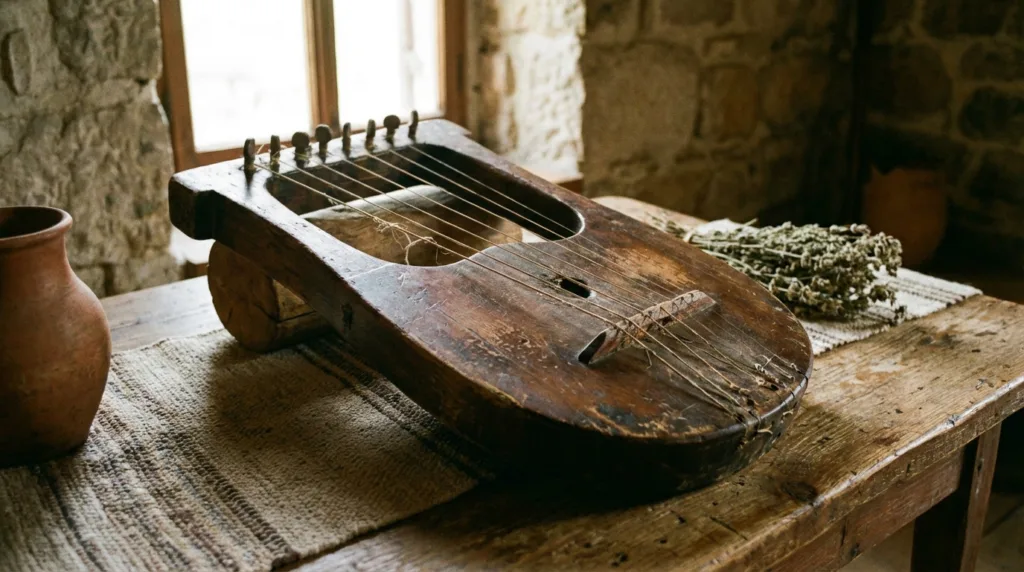
You don’t really “hear” a Kinnor at first—you feel it in the fingertips. The first pluck pushes back a little, then the note opens up like a small lantern in a quiet room. That pushback, that tiny resistance, is where the timbre starts to become personal.
Quiet doesn’t mean weak. A well-built ancient lyre can sound focused, bright, and oddly intimate, especially when you learn to shape the decay (that soft “tail” after the attack) with your hands.
What The Kinnor Really Is
- Instrument family: A lyre-type chordophone (yoke + crossbar + strings over a resonant body).
- Sound identity: Clear attack, fast bloom, and a decay you can “steer” with damping.
- Historical footprint: The term kinnor appears frequently in ancient Hebrew texts, and later tradition often links it with King David (as a symbol of songcraft and devotion).
- Modern reality: You’ll meet it today mostly through reconstructions, museum education, and early-music circles—plus creators who build and play historical instruments on modern stages.
The word kinnor carries a lot of weight, but the object itself is wonderfully direct: a small, portable string voice that rewards careful hands. Don’t expect “concert-harp volume.” Expect detail—little changes in nail angle, skin contact, and damping turn into real musical choices.
And yes, it can sound modern in the best way. A clean timbre cuts through a room even when it doesn’t shout.
Anatomy You Can Feel While Playing
| Part | What It Does | What You Feel / Hear |
|---|---|---|
| Soundbox | Holds air volume and directs resonance | More depth and “chest” when the box is lively |
| Soundboard | Turns string energy into audible sound | Fast response, brighter timbre, clearer articulation |
| Arms + Crossbar | Carry tension and define geometry | Stability in tuning; less “wobble” under the fingers |
| Bridge | Transfers vibration into the body | Attack sharpness; too rigid can sound “pinched” |
| Strings | Primary pitch source | Texture under finger, resistance, and sustain length |
| Tuning system | Sets pitch and stability | How often you “need” to retune, especially with gut |
As a player, you notice the kinnor in three places: the fingertips, the palm heel, and the ear. The fingertips tell you about string tension. The palm heel tells you how the body resonates against you (a lively soundbox almost feels warm). The ear—well, the ear judges everything, even your mood that day.
Try this: pluck, then immediately touch the same string with a relaxed fingertip to shorten the decay. That simple damping move is how a kinnor stops sounding like “notes” and starts sounding like phrases.
Materials and Build Choices That Shape Timbre
- Body woods: Builders often choose stable, resonant hardwoods for structure and a responsive top for projection (choices vary by maker and region).
- Strings: Gut (historically common for many ancient chordophones) emphasizes a complex, slightly “grainy” sweetness; modern nylon can be smoother and more forgiving.
- Surface finish: Thin finishes usually keep the timbre more open; heavy build-ups can dampen quick response.
The kinnor is honest about materials. Change a soundboard from a softer, more responsive piece to a denser one and you’ll hear it immediately: the note may feel tighter, the attack sharper, the sustain more controlled. Sometimes that’s perfect. Sometimes it feels like the instrument is holding its breath.
Strings matter even more. With gut strings, you often get a nuanced “start” to the note—almost a whisper before the pitch locks in. Nylon can sound cleaner and more consistent (and, frankly, easier on humid days). Neither is “better” in a vacuum. Better is what fits your hands and your room.
Kinnor Vs. Greek Lyre
- Similarity: Both are lyre-shaped with yoke and crossbar.
- Feel difference: Many Greek-lyre setups favor a crisp, articulate snap; kinnor reconstructions often aim for a vocal, text-friendly clarity.
- Player takeaway: If you like bright, pointillistic plucks, a Greek lyre mindset fits. If you like singing lines and steady drones, the kinnor approach may feel natural.
Shape can fool you. Two instruments can look like cousins and still behave like strangers once you start working the timbre. Rarely do tiny geometry changes feel so big as they do on a kinnor-style lyre.
Kinnor Vs. Nebel
- Family: The term nebel is commonly associated with harp-like instruments in ancient contexts, while kinnor sits firmly in the lyre idea.
- Sound character: Harp-family instruments often support longer, rounder sustain; lyres tend to give faster, clearer note edges.
- Practical choice: If you want “ring,” you lean harpward. If you want “speech,” you lean lyreward.
It’s a simple contrast: harp-ish instruments can feel like a stream; lyres can feel like stepping stones. Both are musical. They just invite different footwork.
Kinnor: Quick attack → controllable decay → phrasing through damping
Small Lever Harp: Smoother attack → longer sustain → phrasing through resonance
Strings, Tension, and Tuning Without Myth-Making
- What sources can support: Ancient texts, iconography, and comparative archaeology can describe instrument types and playing contexts.
- What often stays uncertain: Exact string counts, exact tunings, and standardized measurements for a specific “one true” kinnor.
- What modern makers do: Build practical reconstructions that behave like a credible lyre, then set them up for real music-making today.
People love a single, confident number for the kinnor—string count, pitch range, “the” tuning. Reality is messier (in a good way). Many modern reconstructions commonly use somewhere around 7–10 strings because that’s playable, musically useful, and plausible for a lyre. But exact historical standardization is not something you can safely promise across time and place.
Here’s the useful part: tension and spacing affect your body first. Higher tension gives a firmer feel and a more immediate, sometimes brighter timbre. Lower tension can sound warmer and more forgiving, but it may lose definition if your touch is heavy. (And yes—some days your touch is heavy. Happens.)
| Setup Direction | What You Notice | Where It Helps |
|---|---|---|
| Lower tension | Softer resistance, gentler attack | Long practice sessions, expressive damping, quieter rooms |
| Moderate tension | Balanced feel, stable pitch | General playing, ensemble blending, consistent articulation |
| Higher tension | Firm response, crisp note edges | Clear projection, rhythmic precision, brighter timbre |
If someone sells you “an ancient kinnor” with a tidy story and no documentation, pause. Responsible collecting favors transparent provenance, clear maker statements for replicas, and honest labeling. The best instruments don’t need tall tales.
How The Kinnor Plays Under The Hand
- Finger pluck: Skin contact softens the front of the note; nails add sparkle to the timbre.
- Plectrum use: Can add clarity and speed; it also makes damping technique more important.
- Muting / damping: The secret sauce of lyre playing; it turns resonance into rhythm.
- Drones: Easy to hold one or two strings as a bed while you shape melody above.
- Double-stops: Simple intervals can sound surprisingly rich when the body resonates well.
The kinnor rewards “small” playing. Not timid playing—small, intentional motion. Keep your fingers close and you’ll get speed without noise. Let your hand fly around and you’ll hear it: tiny clicks, accidental brush sounds, messy attacks. (Some players like that rawness. Fair.)
When the instrument is set up well, the resistance feels consistent across the strings. Inconsistent resistance is a real mood-killer: one string feels like a rubber band, the next feels like wire. A balanced setup makes the touch predictable, and predictable touch lets you relax.
Then the music happens.
Care and Stability In Real Rooms
- Humidity sensitivity: Gut strings react more to moisture changes than many synthetics.
- Seasonal drift: Expect more retuning when weather shifts quickly (it’s normal, not a failure).
- String wear: Fraying near contact points often signals sharp edges or excessive friction.
- Body movement: Wood moves; stable joints and a thoughtful build reduce sudden surprises.
Instruments live where people live: heated apartments, air-conditioned studios, rehearsal rooms that swing from dry to damp. A kinnor doesn’t need precious treatment, but it does need consistency. Let it acclimate when you move between environments. Tune, wait a few minutes, tune again. Boring? Yes. Effective? Also yes.
If your kinnor goes flat every night and sharp every morning (or the reverse), don’t chase it endlessly. Give it a short settling period, then tune once with purpose. Your hands learn the timbre faster when your ears aren’t exhausted.
Commissioning Or Choosing A Modern Kinnor
- Decide your string philosophy: Gut-like warmth or modern stability? Pick one as your baseline.
- Ask about wood behavior: How does the maker choose and season the soundboard and body wood?
- Check balance: Even string spacing and even resistance matter more than fancy decoration.
- Listen for decay control: A good ancient lyre lets you stop notes cleanly without fighting.
- Confirm serviceability: Can you replace strings easily? Can a local luthier service it if needed?
Right now, more builders are making historical instruments visible—workshops share builds online, musicians show real playing tests, and museum education programs commission replicas that survive daily handling. That’s a good thing for the kinnor: more hands means more feedback, and more feedback tends to produce better instruments.
One practical truth: a “perfectly authentic” kinnor is a tricky claim. A credible instrument, though? That’s very achievable. Look for clear design choices, honest materials, and a setup that feels even across the strings. The rest is taste.
FAQ
Is the kinnor the same as a lyre?
Answer
The kinnor is commonly understood as a lyre-type instrument: strings run from a crossbar down toward a resonant body. “Lyre” is the family label; kinnor is a historically specific name used in ancient Hebrew contexts.
How many strings should a kinnor have?
Answer
Exact historical standardization is hard to confirm. Many modern kinnor reconstructions use roughly 7–10 strings because it’s playable and musically flexible. The best choice depends on your repertoire and comfort.
Is it hard to learn kinnor basics?
Answer
You can get simple patterns quickly. The real learning curve comes from damping and consistent tone. Once your hands learn how to control decay, the kinnor starts to feel surprisingly intuitive.
What strings sound closest to an ancient lyre?
Answer
Historically, many ancient chordophones used animal gut in some form, and gut-style strings can give a complex, organic timbre. If you need more tuning stability, modern synthetics can still sound convincing—especially with good damping technique.
How do I know if a kinnor is well built?
Answer
Look for even string spacing, stable tuning behavior, clean joins, and a body that resonates without rattles. A well-built kinnor also lets you stop notes cleanly (damping feels easy, not like wrestling).
Can I use a pick, or should I play with fingers?
Answer
You can do either. Fingers often give a warmer start to the note, while a pick can add clarity and speed. With a pick, you’ll usually need tighter damping to keep the timbre tidy.
How do I keep a gut-strung kinnor stable in different seasons?
Answer
Give the instrument time to acclimate, tune in two passes (tune, wait, tune), and avoid rapid environment changes. Gut reacts to humidity, so a consistent room helps more than constant micro-adjustments.