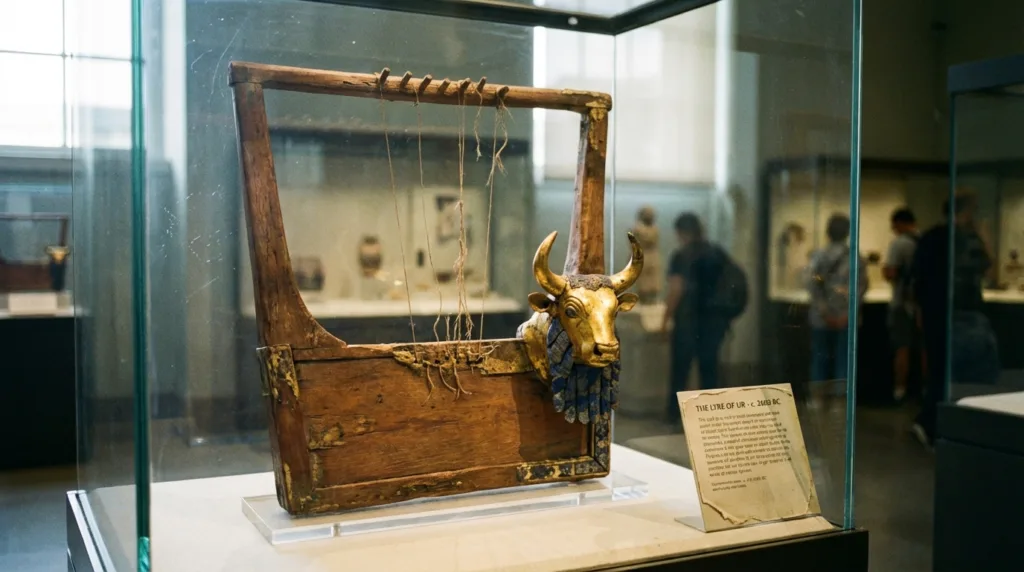
That bearded bull face is not “just decoration.” It is a signpost—sound made visible.
- 🏺 What It Is: A group of Sumerian lyres and one harp found at the Royal Cemetery at Ur (Early Dynastic III, mid–third millennium BCE).
- 🧩 What Survives Best: Inlays, metal sheathing, tuning hardware traces, and signature elements like the bull head—not the original wooden body.
- 🎶 What This Means for You: Most “Lyre of Ur” instruments you see today are reconstructions; the ancient parts are the face, the shimmer, the storytelling panels.
| Piece (Common Name) | Where You’ll See It | Hard Data That Matters | What You Can Infer Safely |
|---|---|---|---|
| Queen’s Lyre | British Museum | Height 112.5 cm; top bar 95.5 cm; 11 gold-headed pegs | Frame and strings are modern; peg count strongly suggests an 11-string setup. |
| Silver Lyre | British Museum | Height 97.5 cm; bar length 103 cm | Metal cladding is ancient; bridge/strings are modern, used to show the original look. |
| Bull-Headed Lyre (Display Reconstruction) | Penn Museum | Object height listed as 35.6 cm (displayed reconstruction) | Often discussed as a “Lyre of Ur” icon; the surviving elements anchor modern replicas. |
| Bull-Head Fragment | Penn Museum | 40 cm (L) × 25 cm (W) × 19 cm (D) for the head | The head’s scale hints at a visually dominant “mask,” built to be read from a distance. |
Collector’s Note: Museum labels often say “reconstruction” for a reason. Treat the ancient decoration and the modern wooden frame as two different objects sharing one silhouette.
What You’re Really Looking At
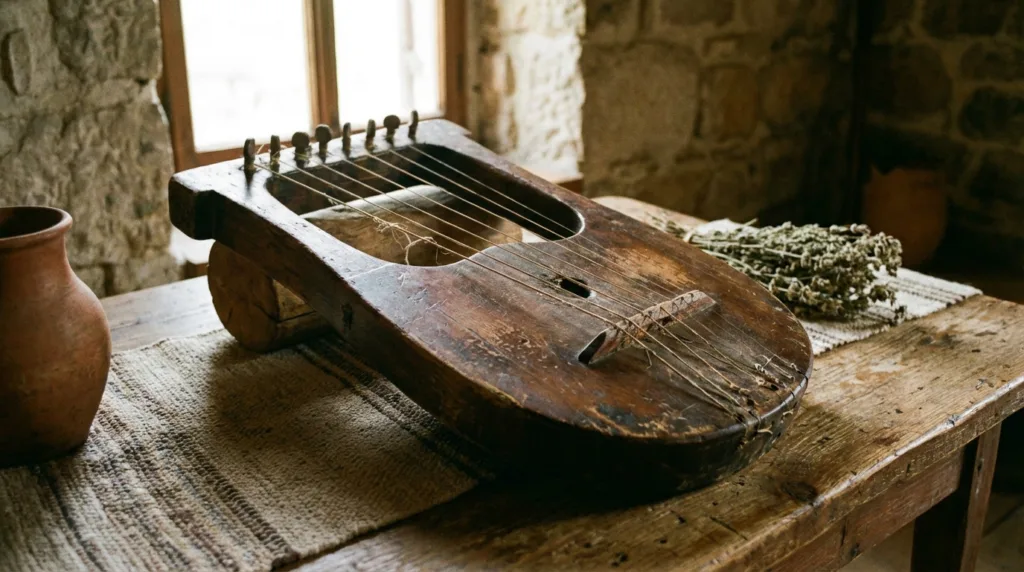
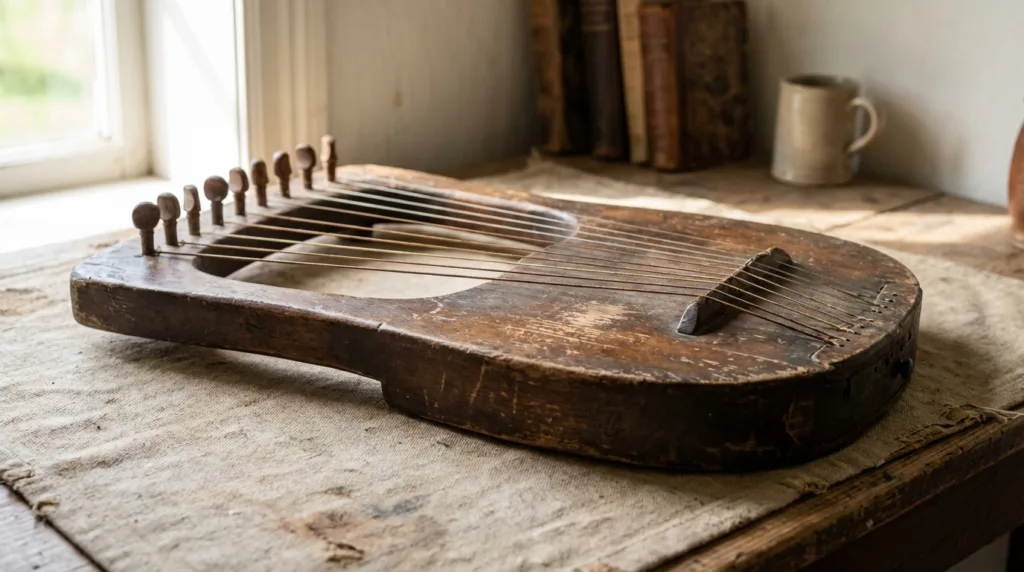
- 🪵 The Soundbox (Mostly Lost): A wooden resonator that carried the instrument’s air and body. The original wood rarely survives, so museums rely on field records and careful reconstruction.
- 🧷 The Yoke and Bar: Two arms with a crossbar—this is where string tension lives. Even a small change in bar thickness changes “give” under your fingers.
- 🧵 Pegs and Bridge (Often Modern): Peg counts (like the Queen’s Lyre’s 11 gold-headed pegs) are not trivia. They define the playing logic—range, tuning options, and hand patterns.
- ✨ The Face and Panel (Ancient, Loud in Meaning): Gold, lapis lazuli, shell, limestone, and bitumen form a surface that reads like a title card: “This instrument belongs.” Belongs to ceremony, status, and skilled hands.
From a maker’s bench, the Lyre of Ur is a lesson in structure versus skin. The skin—metal foil, inlay, the bull’s stare—can survive when the structure doesn’t. Strange, but true.
So when you imagine the sound, imagine it through the logic of the missing box, not the glittering mask.
Timbre, Touch, and String Feel
- 🎵 Attack: In well-made reconstructions, the note speaks fast—more “pluck” than “bloom.” That quick start is a hallmark of lyre-style geometry (short speaking lengths, direct energy transfer).
- 🌬️ Sustain: Expect a clean decay, not a long halo. A lyre can ring, sure, but it usually lets go sooner than a harp.
- 🖐️ Resistance Under the Finger: With multiple strings (often discussed as 11 on several Ur instruments), your right hand tends to “land” into patterns. The feel becomes rhythmic—touch, release, move. Efficient.
Here’s the honest part: no one can hand you the exact original timbre of a 4,500-year-old lyre, because key acoustic parts were organic and decayed. But you can still learn a lot from the instrument’s constraints: peg count, bar size, and the practical needs of tuning.
And tuning matters. A lot. Ancient Mesopotamian music theory texts and modern scholarship often discuss tuning by stacked fourths and fifths; that kind of system favors stable intervals, strong “home” tones, and a slightly architectural sound world—firm, not hazy.
Pro Tip: If you try a replica, ask what the maker used for string material and tension. Gut (or gut-like synthetics) tends to give a warmer bite; high-tension modern strings can make the instrument feel stiff and “too modern.”
Oddly satisfying, the best replicas feel slightly “alive” in the bar. Not floppy. Just human.
Materials and Their Sonic Consequences
| Material | Where It Shows Up | What It Does Physically | Likely Effect on Sound and Feel |
|---|---|---|---|
| Wood | Soundbox, arms, bar (original core) | Defines stiffness, resonance, weight | Main driver of timbre; species and thickness shape brightness and decay. |
| Gold (foil/plating) | Bull mask, decorative elements | Adds mass; protects surface; signals value | Mostly visual; can add slight damping where it overlays surfaces, but it won’t replace the role of the soundbox. |
| Silver | Cladding on some lyres | Stiff surface layer; reflective, fragile when thin | Primarily a skin; in replicas it may subtly brighten reflections of high frequencies, but the box still rules. |
| Lapis Lazuli | Beard, hair, inlay tesserae | Dense stone pieces in a mosaic | No direct “tonewood” role; it changes balance and feel more than sound. |
| Shell and Red Limestone | Front panels, borders | High-contrast inlay surfaces | Acoustically minor; visually major—your brain “hears” with the eyes, and this surface primes expectation. |
| Bitumen | Inlay bedding/adhesive | Holds tesserae; can be slightly flexible | Can absorb micro-vibration in decorated areas, but again—most of the instrument’s sound comes from the wooden cavity. |
A common misunderstanding: precious materials automatically mean a brighter instrument. Not necessarily. On the Lyre of Ur, the precious work often functions as armor and icon, not as a tone engine. The air cavity and the string setup decide the voice.
Still, the maker in me respects the choice: stone and shell near the soundbox front can act like a disciplined weight—steadying the instrument when it’s played in a formal setting. Less wobble. More control.
The Front Panel as Storyboard
- 🔍 Why It Matters: The inlaid panels on Ur lyres do not just “decorate.” They stage the instrument—animals acting like people, hybrid figures, a little universe of roles.
- 🎭 How to Read It: Think of it as a performance program you can carry. When a lyre sits in a room, this panel tells you what kind of room it is.
In practical terms, that means the Lyre of Ur likely lived in spaces where sound had social weight—ritual, ceremony, elite gatherings, maybe storytelling with music. The instrument looks like it expects an audience. It does not whisper.
And yes, there’s a psychological trick here: when you play a replica with a bull head staring forward, you automatically change your posture. Shoulders square. Hands behave. A little theatrical—then again, music often is.
Collector’s Note: On museum-held examples, parts of the horn set or wooden frame can be modern. If you evaluate authenticity, separate ancient inlay from modern supports in your mind before you judge craftsmanship.
Restoration, Replicas, and Modern Listening
- 🧪 Restoration Reality: Some Ur lyres were reconstructed in the 20th century using methods that museums later improved. Conservation notes (heat damage, wax-based reconstructions, later stabilization) show how delicate these composites are.
- 🛠️ Replica Culture Today: Modern builders recreate ancient instruments using careful craft and, sometimes, digital fabrication—laser engraving on shell, precise pattern transfer, and controlled tooling.
- 📱 How People Meet the Lyre Now: Often through short museum videos, gallery highlights, and performances on replicas. A new pathway, but the same hook: touchable history.
One clean way to connect this to the present: the Lyre of Ur sits at the intersection of heritage science and hands-on music. Makers today rebuild ancient silhouettes with modern constraints—safety, stability, reversible materials—while still chasing that older logic of string layout and tuning.
And when you hear a replica played, you notice something unexpected: the sound feels “structured,” like it wants to support voice or story. A lyre often helps speech. That partnership is ancient… and oddly modern, too.
Vs. Comparisons That Actually Help
Ur Lyre Vs. Classical Greek Lyre
- Construction Emphasis: Ur examples lean into monumental front iconography; Greek lyres often read lighter and more “portable” in visual language.
- Sound Expectation: Both are plucked, but reconstructions of Ur-style instruments often aim for a firm, foundational presence rather than airy delicacy.
- Player Experience: With higher string counts discussed for Ur instruments, your hand can move in patterns that feel almost harp-like—then it snaps back to lyre simplicity.
Ur Lyre Vs. Modern Lever Harp
- Mechanics: A lever harp offers fast retuning tools; an Ur-style lyre asks you to live with the tuning logic you set.
- Decay: Harps often sustain longer; lyres commonly give you a cleaner, shorter statement—great for rhythm and text.
- Feel: Harp strings can feel tall and vertical; an Ur lyre’s plane can feel more immediate, more “in your hands.” Close work.
Gold-Clad Showpiece Vs. Plain Wooden Replica
- Weight and Balance: Decorative mass changes how the instrument sits against your body and how stable it feels when plucked.
- Psychology: Players tend to perform “bigger” on a bull-headed replica. It’s silly, but real. Stage posture arrives.
- Sound: If the wooden soundbox and strings match, tone differences are usually subtle; the largest changes come from setup and tension, not the shine.
If You Want a Faithful Replica
- 🪵 Ask About the Box: What wood, what thickness, what bracing? The soundbox is the engine.
- 🧷 Confirm the Peg Logic: If it’s modeled after the Queen’s Lyre, does it keep an 11-peg design? If not, why?
- 🧵 Get a Straight Answer on Strings: Since original string material does not survive reliably, replicas choose modern equivalents. The maker should explain the choice clearly—no mystique.
- 🎶 Check the Bridge: A tiny bridge change can flip the instrument from warm to thin. You want a bridge that supports clean speaking without harshness.
Pro Tip: If a builder promises “the exact ancient sound,” be polite… and skeptical. A serious maker will say, “Here’s what we can know, here’s what we can only test.” That honesty is the green flag.
Small detail, big impact: the spacing between strings. Too tight and your fingers feel clumsy. Too wide and fast patterns break. In a good replica, your right hand feels like it can dance without tripping.
FAQ
Is it hard to learn the Lyre of Ur if I play guitar or harp?
Answer
If you already pluck strings, you’ll adapt quickly to the basic motion. The main new skill is managing open-string patterns and clean damping. A lyre rewards tidy hands—messy resonance shows up fast.
How do I know if a “Lyre of Ur” replica is based on real museum data?
Answer
Ask the maker which museum piece they followed (Queen’s Lyre, Silver Lyre, Bull-Headed Lyre) and whether they matched key constraints like peg count and overall proportions. A solid builder can explain choices without vague mythology.
What strings should I use on a Lyre of Ur replica?
Answer
Since original strings are not reliably preserved, replicas usually use gut, nylon, or other gut-like synthetics. Choose strings that keep moderate tension so the bar and arms feel alive, not rigid. Your maker should help you pick gauges for stable tuning.
Can the Lyre of Ur handle modern tuning or keys?
Answer
It can, but it won’t behave like a lever harp. You can retune, yet frequent key changes slow you down. Many players choose one tuning “home” and explore patterns inside it, which fits the instrument’s design logic.
Why does the bull head matter so much—does it change the sound?
Answer
It mostly changes meaning, posture, and balance rather than tone. The bull head turns the instrument into a social object, not just a tool. In sound terms, the wooden resonator and string setup still do most of the work.