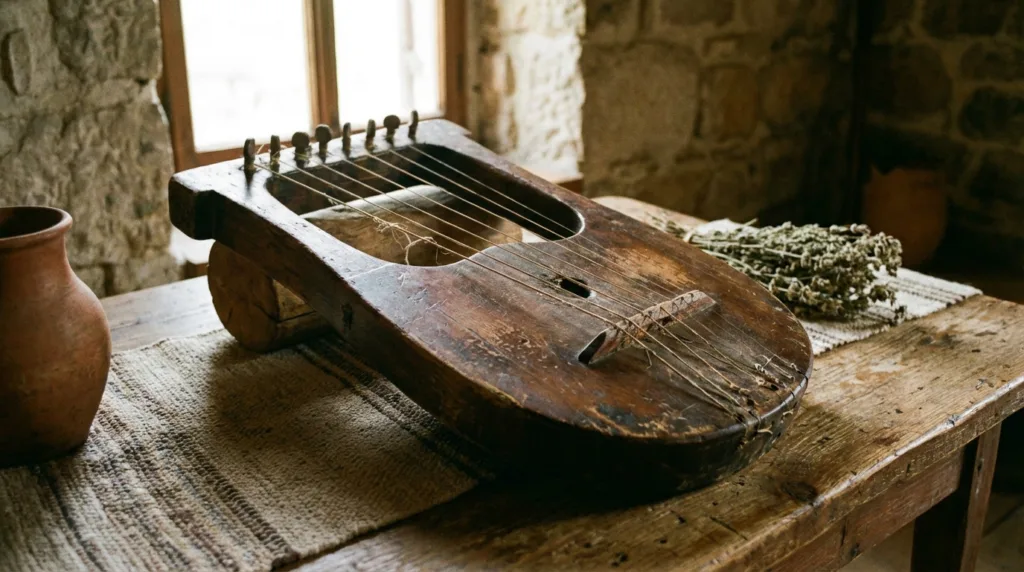
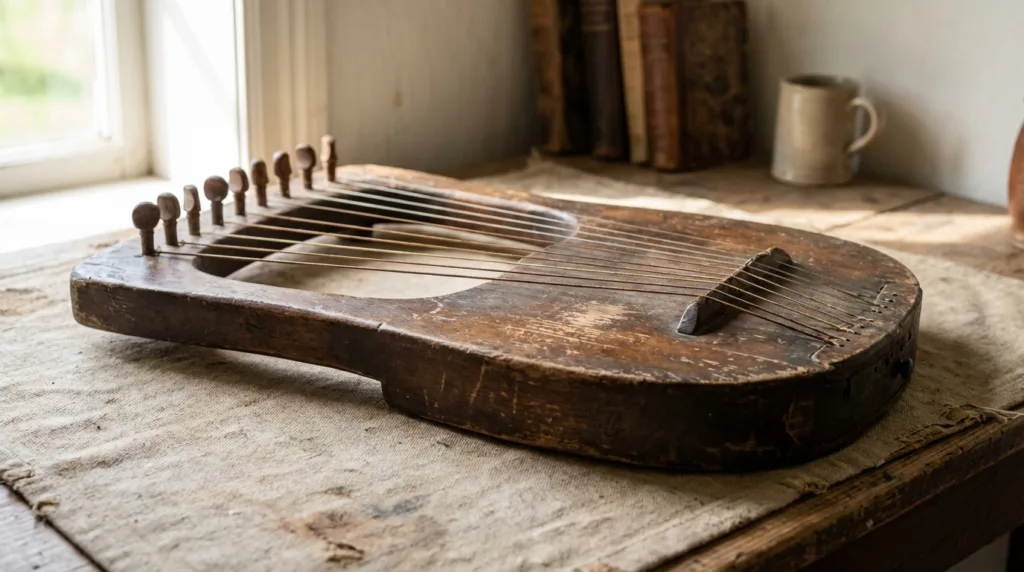
One odd little twist first: Nevel can point to a string instrument in ancient texts, yet the same Hebrew term can also mean a container (like a skin bottle or jar). Shape, sound, and language got tangled together long ago. That’s part of why the biblical Nevel still invites careful listening—and careful claims.
- 🪕 Instrument Family: Plucked strings (not bowed); often discussed alongside the Kinnor.
- 🏛️ Historical Context: Linked with public ceremony, worship settings, and courtly music in the ancient Levant.
- 🧵 Strings in Sources: Ancient descriptions point to ten- and twelve-string traditions; later and modern reconstructions vary.
- 🧰 Modern Reality: Today’s “Nevel” instruments are reconstructions—useful, musical, and educational, but not a single fixed blueprint.
Name, Language, and Meaning
| Term | What It Can Mean | Why It Matters for Builders |
|---|---|---|
| Nevel / Nebel (nēḇel) | A plucked string instrument; also a vessel/container in some contexts | The “vessel” sense hints at a soundbox shape in some interpretations, but the evidence stays mixed |
| Nabla (Greek rendering) | A Greek name used for a “Phoenician harp” idea | Points to a broader Levantine instrument conversation, not a single museum-grade diagram |
| Modern Hebrew usage | Nevel is commonly used for “harp” today | Modern naming can blur ancient specifics; helpful for orientation, not proof of exact construction |
So when you read Nevel, think “a respected ancient plucked instrument name,” not “one standardized model.” The label survived. The exact silhouette? That’s the slippery part.
And yes—this is where a curator’s instinct matters: you separate what a source states from what modern makers prefer.
What We Can Say with Confidence
- It’s a string instrument name used in ancient Hebrew contexts, often paired with other instruments in performance settings.
- It was plucked. Bowed instruments are not part of the ancient Hebrew instrument picture.
- The Hebrew term appears dozens of times in concordances (counts vary by how homonyms are tallied), which signals cultural importance, not technical certainty.
- Ancient writers and later traditions distinguish it from the Kinnor (often treated as a different, typically smaller or more common companion instrument).
That list sounds simple. It is. Good instrument history often is. The moment someone claims a single “proven” body shape for Nevel, that’s usually the moment you should slow down.
Slow down.
How The Nevel Might Have Been Built
- 🧱 Frame Harp Hypothesis: Strings rise from a soundbox up toward a neck or frame; you feel a direct, vertical pull when you pluck.
- 🪵 Lyre Family Hypothesis: Two arms and a crossbar (yoke) with strings descending to the body; the hands work more “inward,” with a distinct snap at release.
- 🎛️ Psaltery-Like Hypothesis: Strings run across a soundboard; the attack can feel quick and the sustain can be tidy, almost “polite,” depending on build.
Here’s the practical luthier’s angle: each hypothesis changes where the tension lives. A frame harp loads tension into a frame geometry; a lyre loads it into the yoke structure; a psaltery spreads it across the board. Same name, different engineering logic.
Touch matters. Resistance matters. If you’ve ever plucked a low-tension gut string, you know that soft “give” before the note speaks—almost like the sound arrives a half-breath after the fingertip.
Sound and Timbre Under Real Fingers
- Attack: Plucked instruments speak fast, but the string material decides whether it’s crisp (nylon) or round (gut).
- Sustain: Short-to-medium sustain is common in many reconstructions; a skin soundboard can add a slightly drier “thump” at the front of the note.
- Overtones: Frame and lyre-style builds often emphasize a clear fundamental with a small halo of harmonics—more “direct voice” than “orchestral wash.”
When a reconstruction leans harp-like, the timbre can feel woody and honest, especially in the low strings—no huge bloom, just a solid tone that sits in a room without pushing it around. When it leans lyre-like, you may hear more pluck in the sound: a little edge, a little articulation, and an almost conversational pacing between notes.
Sometimes the best description is tactile, not poetic: the Nevel family of reconstructions often gives you a note that feels “placed,” not “thrown.”
Wood, Skin, and Strings
- 🪵 Hardwood Frames: Dense woods often support stable tuning and a clean attack. Many traditions associate temple-grade instruments with prized timbers.
- 🥁 Skin Elements: Some reconstructions use skin as a resonant surface, which can shorten sustain and add a percussive front edge.
- 🧵 Gut vs Nylon: Gut strings can sound warm and complex but react more to humidity; nylon stays forgiving and predictable.
A maker’s secret isn’t secret at all: stiffness and mass shape tone. A lighter soundboard answers quickly but may thin out in the lows; a heavier one can deepen the bass but needs more energy to wake up. Choose wrong and the instrument feels sleepy. Choose right and it feels like it’s already humming before you touch it.
And yes, little choices matter—bridge height, string spacing, even the smoothness of the contact points. A slightly rough nut slot can make a string “ping” and then drift. Annoying. Very human, too.
Vs. Kinnor: Two Names, Two Personalities
| Trait | Nevel (Typical Descriptions) | Kinnor (Typical Descriptions) |
|---|---|---|
| Role in texts | Often paired with other instruments; treated as a distinct voice | Frequently mentioned; often treated as a common companion |
| String count traditions | 10 and 12 appear in ancient discussions; modern builds vary | 10 strings are commonly associated in later descriptions |
| Feel | Often built to feel fuller and more resonant in the mid-low range | Often built to feel nimble, quick in response |
Put simply: if a reconstruction makes the Kinnor feel like a musician’s everyday tool, a Nevel-style build often aims for something a touch more “ceremonial” in voice—bigger presence, broader tone, less chatter between notes. Not always. But that’s the intent you’ll often hear in the workshop talk.
Workshop talk is never perfect. Still, it points you in the right direction.
Vs. Psaltery and Zither-Like Builds
- String Direction: A psaltery-like instrument usually runs strings across the board, which encourages a tidy, immediate response.
- Hand Position: Zither-family ergonomics can feel more “surface-based,” while harp/lyre ergonomics feel more “frame-based.”
- Musical Effect: Psaltery-like builds can excel at sparkle and rapid patterns; harp-like builds often excel at a stable melodic line that carries.
If your ear loves clean separation between notes, a psaltery-like interpretation can be a good fit. If you want the note to feel anchored—like it has weight—many harp-leaning reconstructions do that better. Different jobs. Different textures.
Evidence-Based String Counts and Modern Builds
| Stream | Concrete Detail | Safe Takeaway |
|---|---|---|
| Ancient historical description | 12 strings is explicitly stated for Nevel in later historical writing | Twelve-string Nevel is a legitimate reconstruction target |
| Biblical phrasing tradition | A 10-string Nevel idea appears in phrasing used for string instruments | Ten-string versions likely existed or were at least imagined as standard |
| Modern “Nevel harp” market | Common modern models use 15 nylon strings and a compact body around 26 inches | Modern Nevel builds often aim for portability and easy tuning |
| Symbolic modern reconstructions | Some modern temple-themed builds use 22 strings for symbolic alignment | Useful for education and ritual aesthetics, not proof of ancient standard |
Notice what that table does: it keeps ancient claims separate from modern design choices. That’s how you stay honest and still have something practical to hold, tune, and play.
Honesty sounds good. It also sounds like good music.
How To Judge a Nevel-Style Instrument Like a Curator
- Check the string spacing: If it’s cramped, your hands will fight the instrument. A comfortable spacing lets the melody breathe.
- Look at the contact points: Nut and bridge grooves should be smooth and consistent. A rough groove causes pinging, sticking, and tuning drift.
- Tap the soundbox: You want a quick, lively response—more “knock” than “thud.” (Not always loud. Just awake.)
- Ask about tension: A well-made reconstruction won’t feel like it’s straining. If the frame looks anxious under load, it probably is.
- Confirm string material: Nylon behaves. Gut sings. Both can be right, but you should know what you’re buying into.
And don’t ignore the boring part: hardware. Even ancient-inspired instruments live or die by tuning stability. A dependable tuning system keeps you practicing instead of fiddling. Nobody needs the extra drama.
Where The Nevel Lives Today
- 🎙️ Education and Demonstration: Reconstructions help people hear ancient-style plucked timbre in museums, classrooms, and workshops.
- 🎼 Early-Music Circles: Builders and players share patterns, tunings, and experiments—often refining designs through practical playing.
- 🧘 Quiet Practice Culture: Small harps and lyres have become popular as gentle, low-volume instruments for daily playing at home.
The modern “Nevel” world is small, but it’s lively. And it has a nice side effect: it keeps ancient instrument craft from turning into dusty trivia. You hear the notes. You feel the wood. You notice the tiny mechanical choices that decide whether the sound is sweet, sharp, or stubborn.
Stubborn instruments teach patience. Sometimes too much patience.
FAQ
Is Nevel a harp or a lyre?
Show answer
In many scholarly and historical discussions, Nevel is treated as a plucked string instrument that may have been a frame harp. Some interpretations lean lyre-like or psaltery-like. The safest approach is to treat “Nevel” as a respected ancient instrument name with more than one plausible build tradition.
How many strings did a Nevel have?
Show answer
Ancient descriptions point to 12 strings in some historical writing, while biblical phrasing supports a 10-string tradition. Modern reconstructions often use 12 or 15 strings for practical tuning and range.
What does the word Nevel mean in Hebrew?
Show answer
Nevel can refer to a string instrument in musical contexts, and it can also refer to a container in other contexts. That overlap is one reason the instrument’s exact ancient shape is debated.
Is it hard to learn a Nevel-style harp?
Show answer
Most Nevel-style reconstructions are friendly to beginners because you pluck open strings and can build patterns quickly. The main learning curve is clean finger placement, steady timing, and keeping the instrument in tune.
What strings should I use on a modern Nevel-style instrument?
Show answer
Nylon is stable and forgiving, which helps daily practice. Gut can offer a warmer, more complex tone, but it reacts more to humidity. Many players start with nylon, then switch once their hands and ear settle in.
How do I know if a Nevel replica is well made?
Show answer
Look for smooth string contact points, comfortable spacing, a responsive soundbox, and reliable tuning hardware. A good maker can also explain which historical interpretation the build follows and why they chose that string count.