- 🎶 Built for timekeeping and sharp accents, not for long, dreamy sustain.
- 🥁 Commonly seen as a double-bell set, and also as triple or four-bell versions.
- 🧰 Simple design, big payoff: two pitches let you shape rhythmic melodies fast.
Agogo bells sound like metal sunlight. Bright. Focused. They sit on top of drums and claps without fighting for space, and that clean attack makes a groove feel locked even when the band gets loud.
What Agogo Bells Are
- 🔔 A bell idiophone: the body itself vibrates to make sound, no strings, no heads.
- 🪵 Played with a beater (often wood), sometimes with a light metal striker.
- 🎛️ Many sets have two pitches; some add three or four for more melodic lines.
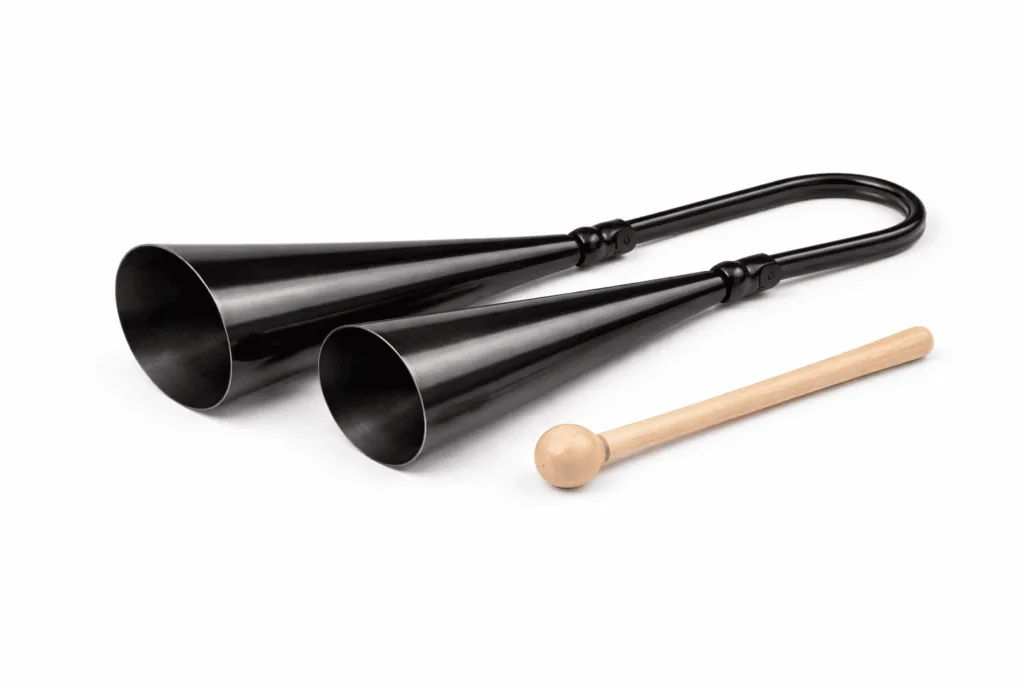
Agogo bells function as portable time-keeping instruments within an ensemble. When struck, they produce a clear tone that guides rhythmic patterns. A typical set consists of two differently sized bells joined by a handle, providing a higher pitch and a lower pitch for outlining interlocking rhythms.
Common Setups
| Setup | Sound And Feel | Where It Shines | Quick Tip |
|---|---|---|---|
| Double (2 bells) | Direct, punchy, easy to control; can do a click on some models | Samba ensembles, capoeira circles, general percussion | Aim near the rim for a brighter note |
| Triple (3 bells) | More melodic options; a little heavier; wider range | Samba phrases, percussion breaks, layered hooks | Keep strokes small for clean timing |
| Four-Bell | Big “bell choir” vibe; can sound wild and joyful | Showy samba lines, call-and-response riffs | Pick one “home” bell to anchor the groove |
| Mounted (stand/kit) | Stable, consistent hits; less hand muting | Drum kits, studio setups, multi-percussion rigs | Use softer beaters for less ring |
Name, Roots, and Cultural Paths
- 🌍 The word agogo is commonly explained as meaning “bell” in Yoruba usage.
- 🛠️ The instrument is closely tied to West African bell traditions and later gained a strong home in Brazilian percussion.
- 🎭 You’ll hear it in festive, community-driven music where time and energy matter.
Agogo bells sit inside a big family of clapperless metal bells used for keeping patterns steady. In Brazil, the agogô became a familiar voice in samba percussion groups, where its high, clear tone can guide a whole section with just a few strokes.
Agogo Bells And Their Close Cousins
- 🔔 In parts of West Africa, you may see double bells sold under local names; they share the same two-pitch idea.
- 🧭 Across regions, builders tweak shape and thickness, so the feel stays familiar while the tone shifts.
This is why collectors love older pieces: small differences become the charm. A slight change in metal thickness, a handmade curve, a different weld or rivet style—each can give the attack and ring its own personality.
Build, Materials, and Shapes
- 🧱 Most are made from iron or steel; modern versions can use other alloys.
- 📐 Many bells are conical, which helps project a focused tone.
- 🖐️ Two bells usually connect with a U-shaped or curved handle; some designs flex slightly.
A good Agogo bell feels sturdy in the hand. The metal should be consistent, the edges should feel smooth, and the connection between bells should not wobble. Builders aim for fast response—you hit it, it speaks—plus enough ring to carry without turning into a long, messy wash.
A Simple Visual Map
     (High Bell)                 (Low Bell)
        __                         ____
      /                         /
     /                         /
    /________                 /__________
                                  /
          ____  Handle/Bridge  ___/
               ______________/
                    ||
                 Beater
           Strike near rim for more bite
🧩 Collector’s Detail Check
- Look for even seams and a solid join between bells.
- Check the rim for chips or sharp burrs that can snag a beater.
- Tap lightly: a healthy bell gives a clear note, not a dull thud.
Pitch, Tuning, and Intervals
- 🎵 The two bells usually form a noticeable interval, but exact tuning varies.
- 🧠 Many sets land around a third or fourth apart; some are intentionally less exact.
- 🔊 Thickness and shape affect volume and brightness as much as pitch.
If you come from melodic instruments, you might want “perfect” notes. With Agogo bells, a slightly rough edge can be part of the flavor. Some Brazilian-style sets aren’t tuned to concert pitches on purpose, and that gives the ensemble a lively street character. Still, you can absolutely choose a set that fits your ear.
A Handy Listening Guide
Pitch Feel (typical double set)
Low Bell  : [##########----] warm, anchored
High Bell : [##############] bright, cutting

Ring Length (depends on metal + thickness)
Short Ring: [######--------] dry, tight
Long Ring : [############--] singing, open
Holding, Striking, and Muting
- 🖐️ Hold the handle so the smaller bell sits higher.
- 🪵 Use a relaxed grip on the beater; let the bell do the work.
- 🤫 Mute by touching the bell lightly with your holding hand for shorter notes.
A clean Agogo sound comes from control, not force. Keep your wrist loose. Strike with a quick snap, then let the bell breathe. If the ring feels too long, you can lightly damp the metal with your fingers to shape a tight note that sits neatly in the groove.
The “Click” Option On Some Double Bells
- Hold the handle with a firm but comfortable grip.
- Between strikes, gently squeeze so the two bell bodies touch and make a click.
- Alternate: strike–click–strike for a crisp two-texture pattern.
✅ Small Technique Fixes That Pay Off
- If notes sound harsh, strike a bit farther from the rim, and keep the beater angle straight.
- If timing feels shaky, practice with only the low bell, then add the high bell as accents.
- If your hand tires, shorten motions. Less travel, more precision.
Patterns, Roles, and Ensemble Spots
- 🥁 Often acts as a time guide in percussion-heavy ensembles.
- 🎶 Adds melodic rhythm: your ear can follow the two pitches.
- 🕺 Fits well in samba settings, Afro-Brazilian traditions, and many world percussion groups.
In a samba-style percussion group, Agogo bells can float above the drums and give the groove a crisp outline. In some capoeira and related Brazilian dance traditions, the bell can add sparkle beside other percussion. The magic is that you can be both steady and playful at the same time—one instrument, two notes, endless phrases.
Three Starter Patterns You Can Use Anywhere
- 🧭 Anchor Pulse (4/4): Low on 1 and 3, High on 2 and 4
| L – H – | L – H – | - 🔁 Offbeat Spark (4/4): Low on 1, High on “and” counts
| L – H H | – – H H | - 🎭 Call And Answer (2-bar): Bar 1 mostly Low, Bar 2 mostly High
| L L – L | H – H H |
Play these slowly first. Make every stroke the same volume. Then add tiny accents. That’s where the rythm starts to feel alive, and your Agogo stops sounding like a metronome and starts sounding like music.
Choosing An Agogo Set
- 🧠 Choose by purpose: timekeeping, melodic lines, or both.
- 🔔 Choose by feel: weight, grip comfort, and response.
- 🎧 Choose by tone: dry vs ringing, smooth vs bright edge.
For most players, a double set is the sweet spot. It’s portable, quick to learn, and flexible in almost any ensemble. If you want richer melodic lines, a triple or four-bell setup can be a blast, especially when you enjoy building riffs on top of drums.
A Practical Checklist For Players And Collectors
- Comfort: Can you hold it for 10 minutes without strain?
- Clarity: Do both bells speak easily at soft and loud dynamics?
- Balance: Is the high bell too piercing, or nicely focused?
- Build: Any rattles, loose joins, or sharp edges that need attention?
- Character: Does it have a tone you’d recognize in a blind test?
🏷️ What “Vintage Feel” Often Means In Bells
- Heft that sits solidly in the hand, with confident projection.
- Subtle irregularities in shape that create a unique voice.
- A finish that looks lived-in, while the bell still rings clean.
Care, Storage, and Gentle Restoration
- 🧼 Wipe with a dry cloth after playing to remove sweat and moisture.
- 🧴 For light grime, use a slightly damp cloth, then dry fully.
- 📦 Store in a dry place; avoid long-term humidity to protect metal.
A little care keeps Agogo bells sounding crisp for years. Moisture is the main enemy. If you notice light surface discoloration, keep it simple: gentle cleaning, full drying, and smart storage. For collectible pieces, a minimal approach often preserves original character while keeping the instrument healthy.
Do’s And Don’ts
- ✅ Do use a soft cloth and mild methods.
- ✅ Do protect the bell in transport so the rims don’t get dinged.
- ❌ Don’t soak it in water or leave it wet.
- ❌ Don’t use harsh abrasives that strip finish or erase patina.
Recording and Stage Tips
- 🎤 Close mics capture attack; a bit of distance captures air.
- 🎚️ If it’s too sharp, soften strokes and try more muting before touching EQ.
- 🔊 On stage, aim the bell slightly away from vocal mics to keep the mix clean.
Agogo bells can be wonderfully present on a recording—sometimes almost too present. Start with technique: lighter hits, consistent placement, and a touch of hand damping. That often gives you a polished sound without losing the spark that makes the instrument special.