
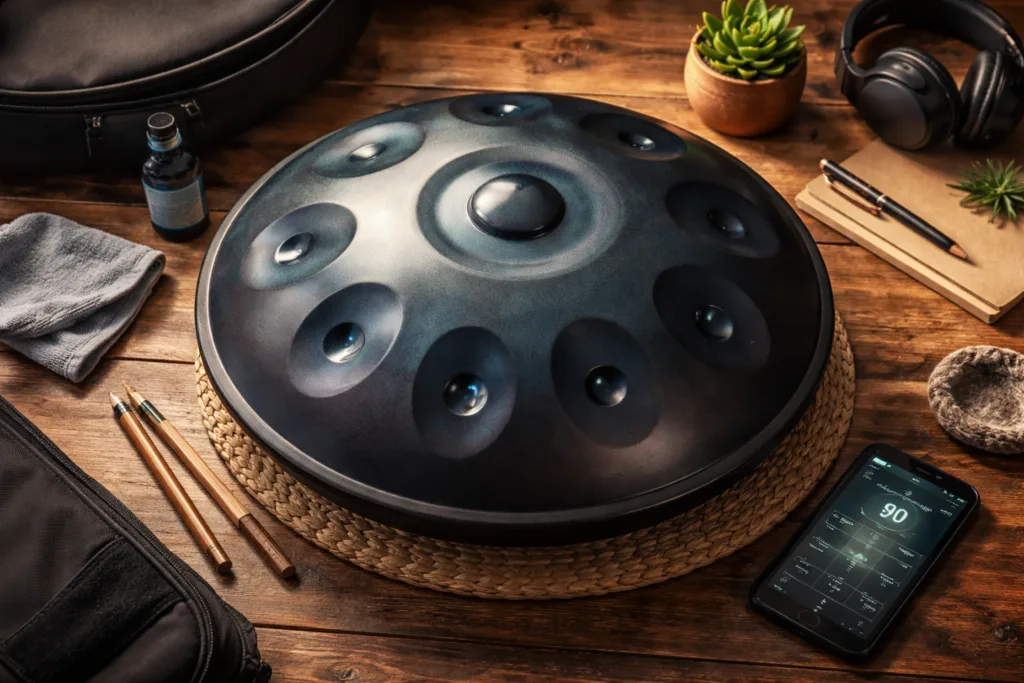
What a Handpan Is — and What It Is Not
| Term | What It Usually Means | Why It Matters |
|---|---|---|
| Handpan | The wider family name for a tuned steel instrument played by hand. | The broad family term used when discussing makers, scales, materials, and modern builds. |
| Hang | The original instrument name used by PANArt for its own design. | Useful for history and collecting; not every handpan is a Hang. |
| Hang drum | A common nickname people still use for the same general sound family. | Common in everyday speech, but technically loose because the instrument has no stretched drum skin. |
| Pantam | Another maker-used label for closely related instruments. | Usually points to the same broad family; the build details matter more than the label. |
A handpan is a tuned steel vessel instrument made from two formed metal shells joined at the rim. It has a central note on top, a circle of surrounding tone fields, and an air opening below. Players use the fingers, thumbs, and soft edge of the hand to create both melody and rhythm.
Not really a drum, even when people call it one.
The terminology can be confusing because the first widely known model was the Hang. Everyday speech later produced nicknames such as hang drum, but these labels blur an important distinction: Hang refers to one historic instrument line, while handpan names the broader family developed by later makers.
- Body Class: Idiophone — the steel itself vibrates.
- Common Layout: One center note plus 7 to 9 tone fields around it.
- Playing Surface: Hands only, or nearly always hands only.
- Bottom Opening: The gu, which shapes the air response and low bloom.
That last part matters more than most basic writeups admit. The best handpan basics are not only about note names. They are about how steel, air, touch, and damping behave together in one small shell.
How a Handpan Actually Works
- A fingertip lands fast, then lifts.
- The struck tone field flexes and releases stored tension in the steel.
- Several pitch components speak together, not just one.
- The air cavity joins the note through the lower opening.
- The hand can shorten or lengthen the sound by contact time alone.
A handpan works because each note area is shaped and tuned to move in a controlled way when struck, while the joined shell and enclosed air cavity reinforce the response. A well-made handpan is not simply a flat plate with random dents. Each field is a tuned acoustic zone, and the center ding usually anchors the ear while the outer notes carry the melody.
The sound is layered. Always layered.
On a well-built instrument, the ear catches a low center pitch first, then an upper shimmer that gives the note its timbre, then the air bloom from the shell. Acoustics studies on the early HANG showed why players hear so much color from one strike: the instrument responds differently to soft finger flesh, fingernail contact, flams, and palm damping, and the cavity joins the upper shell through a Helmholtz-type air resonance rather than a drumhead-like membrane behavior.
That is the first gap many articles miss. They explain the note names, then stop just before the sound becomes interesting.
🛠️ Pro Tip
When testing a handpan, listen at very low volume first. A healthy note should open with a clear center, bloom evenly, and fade without a sour wobble. Loud striking hides flaws. Soft playing reveals them.
The gu is not just a hole. It is part of the voice. On some instruments it adds a rounded breath under the note; on others it gives a firmer bass pulse when the shell is moved by the thighs or when the opening is lightly worked with the palm. That is why the best builders pay close attention to neck shape, opening size, and the relation between the air chamber and the central note.
And yes, contact time matters — a lot. Stay on the note too long and the sound chokes. Lift too stiffly and the attack hardens. The player shapes the note after the strike, not only at the strike.
Handpan Vs. Steel Tongue Drum
Simple Comparison
- Handpan: Hammered tone fields, broader dynamic shading, more air interaction, more note bloom.
- Steel Tongue Drum: Cut tongues, shorter and more direct attack, usually less cross-body air bloom.
- What the Ear Notices: A handpan often feels rounder and more floating; a tongue drum feels more immediate and percussive.
This distinction matters because first-time buyers often encounter steel tongue drums alongside handpans. The two instruments may look related, but their construction and response are different. They are cousins, not twins.
Materials, Heat Treatment, and Surface Feel
| Material | What the Hands Feel | What the Ear Often Hears |
|---|---|---|
| Nitrided Steel | Drier touch, firmer rebound, often a little more direct under the fingertips. | Tighter attack, clearer note edge, shorter decay, cleaner rhythm definition. |
| Stainless Steel | Smoother feel, less daily care stress, often softer in perceived response. | Longer ring, softer front edge, wider sustain cloud, more lingering shimmer. |
Material is never a side note on a handpan. It changes the note envelope, the way overtones stack, the amount of sustain, and even how the player times the next stroke. Nitrided steel usually gives a drier, more focused response. The note appears faster, stands in clearer relief, and leaves more room for rhythmic detail. Stainless steel, by contrast, tends to hold onto the note longer, which can sound open and floating but can also blur fast patterns if the touch is not clean.
This is not a better-or-worse choice. It is a voice choice.
Surface treatment also changes the playing feel in small but real ways. A slightly matte shell often gives the fingertips better grip for light ghost notes and muted landings. A slicker surface can feel faster, though some players notice more slip when the hands warm up. Under workshop light the difference looks cosmetic. Under the hands it is not cosmetic at all.
Nitrided Steel Vs. Stainless Steel
A player who wants crisp separation between handpan notes, short phrases, and clearer pulse usually feels at home on nitrided steel. A player who wants long melodic arcs and more suspended after-ring often leans toward stainless. The material choice also affects care: stainless generally asks less from the owner in humid settings, while nitrided shells often reward regular wipe-downs and a more disciplined care routine.
There is another layer that basic pages often skip: the same steel type can still sound very different from builder to builder. Forming method, shell thickness, heat treatment, tuning style, and post-tuning stabilization all shape the final voice. Material sets the grain of the sound, but the maker decides how tightly that grain is controlled.
Shell Shape, Note Geometry, and Why Two Handpans With the Same Scale Can Feel Far Apart
- Shell Depth: Changes air pressure behavior and bass bloom.
- Shoulder Shape: Affects how energy moves between ding and outer notes.
- Tone Field Size: Alters forgiveness, rebound, and pitch stability.
- Spacing Between Notes: Changes comfort, accuracy, and accidental crosstalk.
This is the second gap most top-ranking pages leave open. They talk about scales and note count, but not enough about geometry. From a maker’s bench, shell form is part of the tuning. A deeper body often yields more air weight under the note. A tighter shoulder can make the center feel more compact and punchy. Wider spacing can make the instrument friendlier for larger hands, yet too much distance may slow fluid movement across the circle.
A strong handpan should respond before the player starts chasing it. The outer notes should wake up on a light touch, the center should not dominate the whole shell, and one note should not tug the next note out of line. When crosstalk is high, melodies smear. When the balance is right, the shell feels almost conversational.
That is the difference between a note layout and a real instrument.
🏺 Collector’s Note
Early and later builds in this family can feel different even before a note is struck. Shoulder slope, gu neck work, note orientation, and shell tension tell the hands a lot. On vintage-oriented pieces, small geometric choices often reveal the era faster than the finish color does.
Another point often lost in beginner writing: more notes do not always mean more music. On a crowded shell, the hands work harder, note fields shrink, and muting becomes more exacting. Sometimes an 8- or 9-note layout gives a fuller musical result simply because the instrument breathes better.
Nine Notes Vs. Twelve Notes
| Layout | What It Gives | What It Asks Back |
|---|---|---|
| 8–9 Notes | Clean layout, easier reach, calmer visual field, strong first-instrument option. | Accepts a narrower pitch range. |
| 10–12 Notes | More melodic routes, extended voicings, extra low or high color. | Demands cleaner touch, better muting, and more care in layout choice. |
For a beginner, the smarter question is rarely “How many notes can fit?” It is “How many notes remain comfortable and usable under relaxed hands?” A small, balanced layout keeps the ears fresh and the body loose. That counts for more than sheer note inventory.
Scales, Mood, and Why the Ding Sets the Floor of the Instrument
Ask any long-time player what stays with them after the finish color and the maker name fade from memory, and the answer is usually the same: the scale. A handpan’s scale is not just a row of notes. It is the emotional grammar of the shell. The center note sets the floor, the circle notes set the path, and the spacing between intervals decides whether the instrument feels open, inward, bright, or quietly dark.
Many first instruments use minor-leaning layouts for a practical reason: they tend to be forgiving. Notes sit together more easily during unplanned improvisation, which helps new players sound musical sooner. Scales such as Kurd or Celtic-type layouts are therefore common starting points, not because other scales are unsuitable, but because these often give the hands more room to wander without clashing.
Some shells sound good in a demo and tiring in daily life. The scale is usually why.
Lower dings often feel broader in the lap and slower in the ear. They can sound grounded, weighty, and full. Higher dings tend to feel quicker, brighter, and more nimble. Neither is superior. But a buyer choosing between a low D-centered instrument and a higher F- or G-centered one is also choosing body feel, not only pitch.
Scale Choice Vs. Daily Use
A meditative stainless shell with a low center note can be lovely for solo flow, slow recording, and open sustain. A tighter nitrided shell in a familiar minor layout may serve ensemble work, rhythmic phrasing, and clean articulation better. In daily life, a handpan’s value comes less from rarity than from the habit it creates. The right scale is the one that still invites the hands back on an ordinary Tuesday.
The PANArt Hang Vs. Modern Handpan
| Period | What Stands Out | What a Listener Often Notices |
|---|---|---|
| Early Hang Era | Multiple sound models, historic scale references, eight-note circles on many early builds. | More scale-specific personality, a rawer and earthier identity from model to model. |
| Later Integral Era | Deeper center tuning, stronger integration between ding and gu, narrower design focus. | A more centered, inward, and unified response. |
| Modern Handpan Era | Many makers, more steel options, more note counts, broader layout choices. | Greater variety, from short and rhythmic voices to long and floating ones. |
This is the third gap many articles leave half-finished: they mention “the Hang inspired the handpan,” then move on too fast. The actual split matters. The original Hang was not only a first version of the same product. It followed its own design path, its own naming, and its own acoustic priorities. Early models offered a broader set of sound models; later versions moved toward deeper tuning and a more integrated relationship between the upper voice and the gu.
By the late 2000s, acoustics papers were already examining multiple HANG variants, and PANArt’s own development path had shifted toward fuller low response, lower center tuning, and more deliberate cavity behavior. Later Integral and Free Integral instruments pushed that inward unity even further. Modern handpans, built by many workshops rather than one historic maker, opened the field in another direction: more materials, more note counts, more scale families, more ergonomic variation.
Hang drum became a popular nickname for the original PANArt instrument and, in casual speech, for similar instruments. In more precise use, however, Hang refers to the original PANArt line, while handpan refers to the broader family that followed.
🔎 Collector’s Note
If the interest is historical rather than purely musical, era matters as much as condition. Early sound-model diversity, the lowered D3 approach of later Hang development, and the more integrated later forms give each period its own profile. Two instruments may share the same family name and still belong to very different listening habits.
Why Original Hang History Still Matters
The modern market makes more sense when this history is clear. It explains why the nickname hang drum remains common, why some players avoid calling the instrument a drum, and why collectors look beyond surface finish to shell era, note layout, and maker approach. History here is not decoration. It changes how the ear sorts the instrument family.
How to Judge a Handpan Before Buying
- Check the soft-touch response. Notes should speak with light contact, not only with force.
- Listen for note balance. The ding should not swallow the outer ring.
- Test sustain discipline. Long ring is good; messy overlap is not.
- Watch for pitch wobble. A healthy note settles; a weak one swims.
- Ask about steel and care. Material choice affects both voice and upkeep.
- Ask who tuned it and who will retune it. After-sale support matters.
A good buying test is to play a three-note loop quietly, then repeat it louder. The identity of each note should stay intact. On a stable handpan, the voice grows with force but does not lose pitch center. If the instrument sounds fine only in one dynamic band, the tuning window may be narrower than it should be.
Also check the shell as a physical object. Sit with it for ten minutes. Reach across the ring. Rest the wrists. Notice the angle of the forearms. An instrument can sound lovely in a short clip and still fight the body every day. That friction adds up.
Small annoyances become large ones.
What a Beginner Should Really Prioritize
A beginner should usually prioritize three things: stable tuning, a forgiving scale, and a note layout that does not crowd the hands. Fancy note counts, unusual finishes, and rare scale names can wait. Good response cannot wait.
Care, Climate, and Retuning
- After Playing: Wipe the shell with a soft, dry cloth.
- Storage: Avoid hot cars, damp corners, and sharp temperature swings.
- Case Use: A padded case helps in transit, but air circulation still matters.
- Retuning: If pitch drift appears, use a qualified handpan tuner rather than trial-and-error fixes.
Steel remembers climate. Humidity, heat, hard travel, and poor handling do not always damage a handpan at once, but they can nudge the tuning over time. Well-made instruments hold up better, yet no tuned steel shell is fully outside the laws of material fatigue. Care is not fussiness; it is part of preserving the voice.
A final point worth saying plainly: retuning is a craft job. The note field is a tension system, not a screw to tighten. Once the shell leaves expert hands, it should return to expert hands if the pitch moves.
FAQ
What is a handpan, exactly?
Open Answer
A handpan is a tuned steel instrument made from two joined shells, with a center note and surrounding tone fields on top and an air opening below. It is played by hand, and its sound comes from the vibration of the steel body and the air cavity working together.
Is it hard to learn a handpan?
Open Answer
For many players, no. A well-chosen first handpan can feel welcoming because many note layouts sound musical even with simple patterns. The harder part is not finding notes; it is developing clean touch, good timing, and control over sustain.
How do I know if a handpan is well made?
Open Answer
Listen for clear low-volume response, steady pitch, balanced note volume, and clean decay. A good handpan should sound alive under soft hands, not only under heavy strikes. The notes should belong to the same shell, not feel like separate islands.
What is the difference between a Hang and a handpan?
Open Answer
Hang refers to the original instrument line developed by PANArt. Handpan is the broader family name used for related instruments made by many builders. People often say hang drum in casual speech, but that is a loose nickname rather than a precise family label.
Which material should I choose for a first handpan?
Open Answer
If the goal is cleaner rhythm, shorter decay, and a firmer note edge, nitrided steel often fits well. If the goal is longer sustain and a softer, floating feel, stainless steel may be the better match. The right answer depends on touch, climate, and musical habit more than trend.