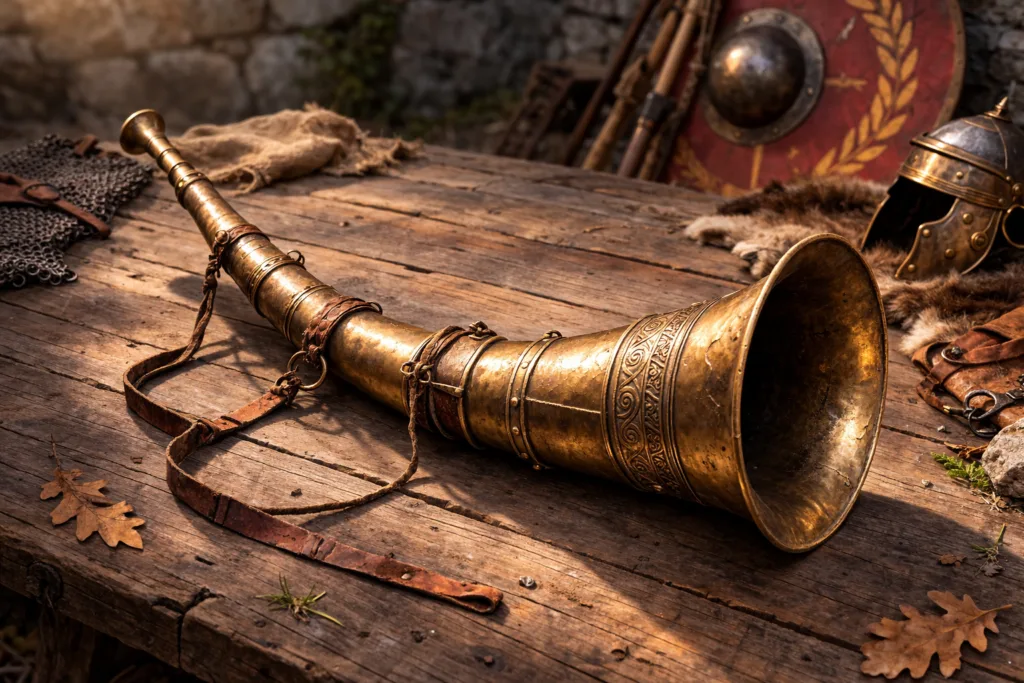

In a Roman camp, the Buccina was less about “music” and more about time made audible—a curved voice that could tell hundreds of people to move, pause, gather, or stand down without a single written word.
Not a melody-maker, not really. A signal instrument with a bite. And when you hear a well-built Buccina, you don’t just “listen”—you feel the note press against the air.
What A Buccina Really Is
- 🏺 Instrument Type: Metal lip-reed horn (player’s buzz drives the sound)
- 🛡️ Primary Role: Signaling in military and civic routines (calls, alerts, daily cues)
- 🎺 Sound System: Natural-harmonic series (notes come from overtones, not valves)
- ⚒️ Common Build Idea: Curved tube with a flared bell; often depicted with support elements for carrying
The Buccina sits in that fascinating family of ancient Roman brass—alongside the tuba and cornu—but it carries its own silhouette and attitude. The tone is often described as direct, reedy-bright, and commanding, yet the “command” comes mostly from geometry: tube length, curve, and bell flare.
Up close, it’s a tactile instrument. The metal can feel cool and slightly slick, and the sound seems to “lock” into place when your lips find the right overtone. Slotting is the word modern brass players use—on a valveless horn, those slots can feel wide in the low partials and suddenly narrow higher up.
Oddly intimate, for something meant to be heard across distance. That’s the charm.
Collector’s Note: The word buccina can appear in different historical contexts, and it sometimes gets loosely mixed with “shell trumpet” ideas in casual modern writing. When you evaluate an object or a reconstruction, look for Roman metal-horn construction cues (tube sections, seams, bell work, mouthpiece style) rather than relying on the label alone.
Materials, Build, And Why Your Ear Notices
| Build Element | What It Changes | What You’ll Hear/Feel |
|---|---|---|
| Tube Thickness | Vibration damping and “give” | Thicker can feel steadier; thinner can feel more responsive but less forgiving |
| Bell Flare | Projection and brightness | A wider flare tends to “throw” sound more; a tighter flare can sound focused |
| Seam / Join Quality | Air leaks, stability, noise | Leaks soften attacks; clean joins help notes snap into place |
| Mouthpiece Shape | Resistance and overtone access | Cup depth and rim profile change how quickly you can jump partials (and how tired you get) |
Historically, Roman metal horns are usually discussed in terms of copper alloys—most often bronze-like compositions rather than modern “brass as a default.” The practical takeaway is simple: the shape drives the acoustics first, but material and build choices affect how the horn “finishes” each note—how it starts, how it steadies, how it fades.
Run your fingertips along a well-made curve and you’ll notice it: a subtle stiffness where the tube wants to stay true. That stiffness becomes confidence in the pitch. And yes, the surface matters—polished metal can feel a touch brighter to the ear than a lightly textured surface, partly because of how high frequencies behave at the boundary. Small things add up.
Pro Tip: If you’re comparing reconstructions, play (or listen to) the same call pattern at the same dynamic. A good Buccina keeps the tone clear even when you back off the volume—cheap builds often sound fine loud and fall apart soft.
Playing Feel: Resistance, Lip Work, And That “Signal Snap”
- 🎺 Start With Air: A steady airstream matters more than “pushing” volume
- 🧠 Think In Partials: You don’t “press keys,” you climb overtones
- 👄 Rim Comfort Counts: Mouthpiece fit changes endurance fast
- 🛠️ Check Leak Points: Any hiss at joins steals clarity from the attack
The Buccina rewards a clean buzz. It can feel like the instrument is “asking” for a firm center, then giving you this blunt, confident note in return. In the low range, the resistance often feels gentle—almost too open—then higher partials can suddenly feel like stepping onto narrow stones in a stream: land wrong and you slip into the neighboring overtone.
Here’s the part people don’t expect: you can play it with finesse. Sure, it was built to carry, but a careful player can shape attacks and releases so the sound becomes less like a shout and more like a firm announcement. And when you hit it right, the “snap” at the front of the note is addictive.
Into the air it goes—clean, blunt, unmistakable. That’s the point.
Buccina Vs. Other Ancient Brass
| Instrument | Typical Shape | Everyday Use Profile | Sound Character |
|---|---|---|---|
| Buccina | Curved horn with flared bell | Signals tied to routine and organization | Commanding, clear attack, practical projection |
| Cornu | Large curved “G-like” horn (often supported) | Signals where stability and carrying power matter | Broad, rounder presence; can feel weightier |
| Tuba | Straighter trumpet form | Signals with a direct “line-of-sound” feel | Bright, straight, piercing when pushed |
| Lituus | Longer profile with a distinct bell bend | Often discussed in ceremonial/martial contexts | Edgy, lean tone depending on build |
The real “Vs.” moment isn’t only about volume. It’s about how the note sits in space. A straighter form tends to feel like it points; a more curved body can feel like it wraps the sound outward. (Not a rule carved in stone—just a pattern your ear often notices.)
If you come from modern brass: think of the Buccina as closer in behavior to a bugle or a natural trumpet than to a valved trumpet. Same physics, different priorities—less chromatic freedom, more authority per note. One note, plenty of meaning.
Workshop Fingerprints And What Collectors Actually Inspect
- 🔍 Join Lines: Look for consistent seams, neat transitions, and believable wear patterns
- 🏺 Bell Work: The flare often reveals skill—smooth expansion vs. abrupt “step” changes
- 🧪 Metal Behavior: Patina tends to settle into creases and joins in a way polishing can’t fake
- 🧰 Support Evidence: Mounting points or reinforcing elements (where present) should “make sense” mechanically
A serious look at a Buccina is a serious look at craft. Ancient metalwork leaves behind habits: how edges are finished, how the curve is managed, how the bell transitions without collapsing the tube. And the most honest clue is often the boring one—alignment. If the horn looks elegant but the geometry feels sloppy, something’s off.
Dating is tricky, and anyone who claims easy certainty is selling a story. What you can do, though, is evaluate consistency: does the wear match the handling points, does the oxidation read naturally, do repairs look historically plausible for a metal object that lived a long life? Questions beat assumptions.
Collector’s Note: For high-value pieces, conservators often rely on non-destructive methods (for example, alloy screening and imaging) rather than aggressive cleaning. A Buccina with stable patina is usually more desirable than one made shiny—because shine can erase historical surface truth.
Why The Buccina Still Works In Modern Rooms
- 🎬 Film And Game Scoring: The ancient-brass color reads instantly, even in a dense mix
- 🏛️ Museum Demonstrations: Short calls teach faster than long lectures (people remember sound)
- 🎼 Historically Informed Performance: Ensembles use reconstructions to explore Roman sound worlds
- 🧑🤝🧑 Reenactment And Living History: Signals coordinate movement with a single clear cue
Every so often, a modern audience hears a reconstruction and you can see the reaction: “Oh… that’s not a trumpet, that’s a tool.” The Buccina cuts through chatter because its strength is clarity of intent, not complexity of pitch.
And in recording, it’s surprisingly cooperative. Close-mic it and you’ll capture the grain of the buzz; back the mic up and the bell bloom becomes the story. Different distances, different personalities—same signal DNA. Flexible in a weirdly ancient way.
Care, Storage, And Display Without Regret
- 🧤 Handle With Gloves: Skin oils can spot metal over time; gentle handling protects patina
- 📦 Stable Environment: Avoid rapid swings in humidity and temperature (the swings do the damage)
- 🧽 Avoid Abrasives: No harsh polishing; cleaning should be conservative and purpose-driven
- 🪛 Support The Curve: Use mounts that cradle the horn evenly so stress doesn’t sit on one join
- 📝 Document Everything: Photos, measurements, condition notes—boring now, invaluable later
An antique Buccina is a metal object with a long memory. Treat it like one. If you display it, support the curve so the weight doesn’t “hang” from a single point; metal can creep over time, and old joins don’t appreciate drama. Quiet stability is the goal.
And yes, sometimes the best “restoration” is leaving it alone. A small flaw that stays stable is better than a risky fix that spreads. Conservation is patience.
FAQ
Is it hard to learn the Buccina if I play modern trumpet?
Open answer
If you already play trumpet, you’ll recognize the basics—buzz, breath, and embouchure control—but a Buccina asks for more comfort with natural harmonics. You won’t “find notes with valves.” You’ll find them by aiming your air and shaping your lips. It feels strange for a week or two, then it starts to click (and it’s fun, honestly).
How do I know if a “buccina” is the Roman metal horn or a shell trumpet?
Open answer
Start with construction. A Roman Buccina will show metal-horn logic: tube sections, joins, a formed bell, and a mouthpiece approach consistent with lip-reed brass. A shell trumpet is a different object entirely—its body is the shell, not assembled tubing. When in doubt, ask for detailed photos of seams, bell flare, and mouthpiece area. Labels mislead; build details don’t.
What material should a modern Buccina reconstruction use?
Open answer
Most builders aim for copper-alloy behavior because it fits the historical family of Roman metalwork. In practice, good reconstructions focus first on geometry—tube profile, bell shape, and airtight joins—then choose an alloy that balances durability with response. If you need a brighter edge and easier maintenance, modern brass can work; if you want a “drier” historic feel, copper-alloy choices often suit the concept.
Does the Buccina play scales or only signals?
Open answer
It can play multiple pitches, but it’s not designed for chromatic freedom. The Buccina naturally offers notes from the overtone series, which makes certain intervals easy and others awkward. That’s why it excels at calls and patterns: short, memorable shapes that speak clearly in real spaces.
How loud is a Buccina indoors?
Open answer
“Loud” depends on the build and the room, but the bigger story is projection. A flared bell and clear attack can make the sound feel present even when you don’t blast. If you plan to play indoors, start softer than you think you need, and let the room do the work.
How should I store an antique metal horn like a Buccina safely?
Open answer
Keep it stable: moderate, consistent climate; no rapid humidity swings; no direct heat sources. Use supports that cradle the Buccina along its curve so stress doesn’t sit on one join. Avoid polishing, avoid abrasive cloths, and document condition with photos. If corrosion looks active, consult a conservator—slow, careful intervention beats quick fixes.