
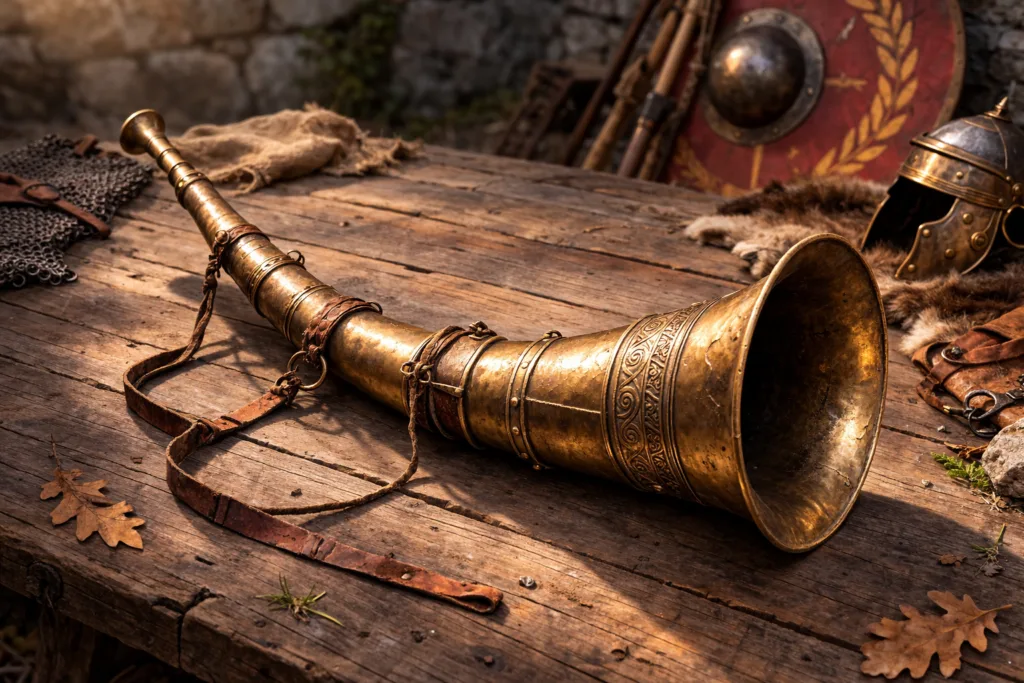
Instrument Snapshot
The carnyx is a long Iron Age natural trumpet with an animal-shaped bell, usually raised so the head projected above the player. Archaeological evidence connects it with Celtic communities across Europe, military display, ceremony, and deliberate deposition. The near-complete West Norfolk example announced in January 2026 has changed the British picture by adding a far fuller instrument than the famous Deskford bell alone.
What a Carnyx Is
A carnyx is a valve-free metal trumpet sounded by vibrating the lips against a mouthpiece. Its notes come from the natural harmonic series rather than finger holes, keys, valves, or a slide. The long tube ends in a sculpted animal head whose open mouth forms the bell.
The instrument is closely associated with Iron Age Celtic societies, although “Celtic” describes a broad group of regional cultures rather than one uniform people or musical tradition. Carnyces appear in ancient imagery, on coins, and in Roman depictions of captured arms. Excavated examples show that the instrument also entered ritual or ceremonial deposits, so its use cannot be reduced to battlefield noise alone.
Common Confusion: The surviving instruments are not a standardized model. Deskford, Tintignac, West Norfolk, and other fragments differ in bell design, preserved structure, date, and archaeological setting. A modern replica usually interprets one find rather than reproducing a universal carnyx pattern.
Anatomy and Sound Production
The carnyx works as a long resonating air column. The player starts the vibration at the mouthpiece, the tube supports a series of natural resonances, and the bell releases the sound above or ahead of the player. Tube length, internal shape, joints, wall thickness, and bell geometry all affect response and tone.
| Part | Structural Role | Effect on Sound or Handling |
|---|---|---|
| Mouthpiece | Transfers the player’s lip vibration into the tube. | Cup shape, opening, and fit affect attack, resistance, and harmonic stability. |
| Long Tube | Defines the main resonating air column. | Length and bore influence the available harmonic series and the amount of air support required. |
| Seams and Joints | Join worked metal sections into a continuous instrument. | Leaks or abrupt internal steps weaken response; clean joins support a steadier tone. |
| Bell Throat | Connects the tube to the animal-head cavity. | Its taper affects how energy moves from the narrow tube into the wider bell. |
| Animal-Head Bell | Forms the radiating end of the instrument and carries its visual identity. | The mouth opening and internal cavity can alter brightness, edge, and directional projection. |
| Moving Details | Some reconstructed bell designs include a tongue, jaw, or other mobile part. | Such elements may add rattle or buzz, but they should not be assumed for every archaeological example. |
The 2026 West Norfolk Carnyx Discovery
Historic England announced the West Norfolk find on 7 January 2026. The objects had been recovered during a routine archaeological excavation carried out by Pre-Construct Archaeology as part of the planning process for residential development. The discovery itself was made before the public announcement, while conservation and examination were already underway.
The assemblage contains a near-complete carnyx and parts belonging to at least one additional carnyx. It also includes a sheet-bronze boar’s head from a military standard, five shield bosses, and an iron object that had not yet been identified in the initial announcement. These are military objects from roughly two thousand years ago, during the period when Iron Age communities in Britain were living through Roman expansion and rule. The hoard should not be described simply as a cache of Roman army equipment: its animal-headed trumpet and boar standard belong to an Iron Age cultural setting that researchers are still studying.
Historic England described the near-complete trumpet as one of only three carnyx examples known from Britain and one of the most complete found in Europe. The second instrument’s fragments make the deposit even more informative because they may reveal whether the objects were dismantled, damaged, grouped by type, or selected for burial in a deliberate way.
What We Know: The hoard was lifted within a block of soil so the arrangement of the objects could be preserved. Imaging and micro-excavation were used before and during removal. Historic England, Pre-Construct Archaeology, Norfolk Museums Service, and National Museums Scotland are coordinating conservation and research. The metal remains fragile, and stabilization must continue before detailed study can answer questions about manufacture, assembly, dating, use, and deposition.
Why the Find Changes the British Record
British knowledge of the carnyx previously depended heavily on incomplete remains, especially the Deskford animal-head bell. West Norfolk adds a far greater portion of the instrument’s overall structure. That offers a chance to study tube construction, joint placement, proportions, bell attachment, and the relationship between the trumpet and other military objects recovered beside it.
The phrase “one of three known from Britain” refers to the British archaeological record, not to three complete playable instruments. Survival ranges from partial remains to the near-complete West Norfolk example. The number of physical fragments is also larger than the number of instruments because one deposit can contain parts from more than one carnyx.
West Norfolk and Deskford Compared
The Deskford carnyx remains one of the best-known British finds and one of the most recognizable animal-headed objects from Iron Age Scotland. It was discovered in Banffshire in 1816, but only the boar-like head and bell region survived. Modern reconstructions have used that head as the starting point for a complete playable instrument.
The West Norfolk find is different in both survival and context. Much more of the trumpet is present, parts of another instrument were found with it, and the carnyces belong to a grouped deposit that also contained a boar-headed standard and shield fittings. Deskford provides close evidence for a distinctive bell design; West Norfolk may provide stronger evidence for the construction of the instrument as a whole.
| Feature | Deskford Carnyx | West Norfolk Carnyx |
|---|---|---|
| Place | Deskford, Banffshire, Scotland | West Norfolk, England |
| Discovery Record | Found in 1816 | Excavated before its public announcement in January 2026 |
| What Survives | Mainly the animal-head bell | One near-complete carnyx plus parts of another |
| Associated Objects | Its original deposit was recorded far less fully by modern archaeological standards | Boar-headed military standard, five shield bosses, and an unidentified iron object |
| Research Value | Detailed evidence for bell form, decoration, and a specifically northern British design | Potential evidence for full proportions, tube assembly, multiple instruments, and hoard formation |
| Current Interpretation | A surviving original bell has informed modern reconstructions of the missing trumpet | Conservation and research remain in progress, so reconstruction details may change |
Deskford, Tintignac, and West Norfolk
No single discovery explains the carnyx on its own. Deskford preserves an elaborate animal-head bell. Tintignac in France produced a group of seven carnyces, including one of the fullest known examples, within a larger deposit of metal objects. West Norfolk contributes a near-complete British trumpet, pieces of another, and a closely recorded group of associated military material.
A boar-headed bell was found in Banffshire. The missing tube left later makers to reconstruct the full form from comparative evidence.
Excavation at the Gallic sanctuary in Corrèze revealed remains from seven carnyces, greatly expanding knowledge of continental forms and deliberate deposition.
The hoard was excavated and then announced publicly on 7 January 2026. Its near-complete instrument and second set of carnyx parts expanded the British corpus.
Stabilization, documentation, material study, and reconstruction work may refine the instrument’s date, assembly, and relationship to the other objects in the hoard.
Materials and Construction
Surviving carnyx remains were made from worked copper alloys rather than cast as one solid object. Sheet metal could be shaped into tubes, bell sections, ears, jaws, and decorative features, then joined by seams, solder, rivets, fitted edges, or combinations that varied between instruments.
Material labels require care. “Bronze” is often used as a broad description for ancient copper-alloy objects, while analysis may reveal different alloy recipes or the reuse of metal. Alloy composition affects hardness and working behavior, but the final sound also depends on wall thickness, internal shape, seam quality, and how the bell is attached.
Thin worked sheet keeps the instrument manageable, but uneven walls can change stiffness and vibration. A replica must balance archaeological plausibility with enough strength for repeated playing.
The animal head is part sculpture and part acoustic termination. Its throat, mouth, and internal volume affect how upper harmonics leave the instrument.
Long instruments are easier to build and transport in sections, yet every join must remain airtight and internally smooth. Archaeological evidence should guide where those divisions are placed.
How the Carnyx Sounds
The carnyx belongs to the same basic acoustic family as other natural trumpets. The player changes notes mainly through lip tension, air speed, and embouchure rather than mechanical pitch controls. Lower harmonics are widely spaced; higher harmonics sit closer together and allow more melodic movement.
Reconstructions can produce a clear trumpet tone, a rougher brassy edge, or a growling attack when the player pushes the air column and uses the bell’s directional character. These results demonstrate what a reconstruction can do, not an exact recording of Iron Age performance practice. Mouthpiece form, tube length, bore, alloy, and bell interpretation differ between modern builds.
What the Animal Head Adds
The animal head directs sound through a mouth-shaped opening rather than a plain circular flare. That geometry can filter and color the upper part of the tone. It also makes the instrument visually readable at a distance, combining sound projection with the image of a boar, serpent, or other creature.
Some reconstructions use a movable tongue or jaw to create extra vibration. Deskford has played a large role in these experiments, but a mechanical feature demonstrated on one reconstruction should not be treated as standard equipment on every carnyx.
Playing Position and Technique
Ancient images often show the bell raised above the player, allowing the animal head and sound to carry over a group. The exact angle may have varied by design. Some reconstructions work comfortably in a strongly upright position, while others are held at an angle because of their tube and mouthpiece arrangement.
Support the Length
The instrument acts as a long lever. The lower hand supports the tube while the upper hand controls balance without squeezing or twisting thin metal sections.
Start with a Centered Buzz
A relaxed lip vibration and steady air supply help the first harmonic speak cleanly. Excess pressure at the mouthpiece can restrict response.
Find Stable Harmonics
The player moves between resonances by changing air speed and lip tension. The goal is a stable center before adding volume or a rougher tonal effect.
Judge the Sound at Distance
The bell sits far from the player’s ears and points away from the body. A listener or distant recording gives a more useful picture of projection than the sound heard directly behind the bell.
Player Tip: A carnyx replica should not be forced into the technique of a modern valved trumpet. Its balance, mouthpiece, resistance, and harmonic spacing may require slower attacks and more attention to air support.
Military, Ceremonial, and Depositional Context
Classical authors and ancient images connect animal-headed trumpets with warfare, massed sound, and the visual display of Iron Age groups. Roman art also presents carnyces as trophies, turning the captured instrument into a symbol of defeated opponents.
Archaeology adds a different layer. Tintignac and West Norfolk place carnyces among grouped metal objects rather than on a battlefield where they were lost during use. This suggests deliberate burial or deposition, though the exact event and motive must be argued from each site rather than assumed. The instrument may have carried ceremonial, political, or sacred meaning alongside its practical ability to signal and intimidate.
The carnyx was only a primitive noise-maker used to frighten Roman soldiers.
It was a controlled natural trumpet with crafted metalwork, a recognizable visual identity, and roles that included military display and carefully selected archaeological deposits.
Carnyx and Roman Cornu
A long tube ending in an animal-head bell, associated with Iron Age communities beyond the Roman military system. Its raised bell combined sound projection with a strong visual emblem.
A large curved military horn supported around the player’s body. Its circular form suited organized Roman signaling and differed clearly from the tall animal-headed construction of the carnyx.
Evaluating a Modern Carnyx Replica
A replica can be historically informed, acoustically convincing, or visually dramatic without achieving all three to the same degree. The maker should identify which archaeological example guided the bell, tube, mouthpiece, alloy choice, and any moving parts.
- The reference find is named rather than described vaguely as “Celtic.”
- The tube joints are airtight, stable, and free from sharp internal steps.
- The bell weight does not make the instrument unsafe or exhausting to hold.
- Thin ears, jaws, and decorative edges are reinforced only where needed.
- Modern compromises for transport or durability are disclosed.
- Claims about exact ancient pitch or battlefield volume are presented as reconstruction choices, not proven measurements.
Collector’s Note: A faithful Deskford-based replica and a faithful Tintignac-based replica should not look identical. The West Norfolk discovery may support a new reconstruction family once conservation reveals enough of its tube, joints, bell, and mouthpiece arrangement.
Care and Storage for Playable Replicas
Playable carnyces combine long leverage with thin metalwork and sculpted bell details. Damage is most likely at joints, seams, ears, mouth edges, and any movable tongue or jaw. The instrument should be supported along its length rather than lifted by the bell.
- Drain and dry moisture after playing, especially around removable joints.
- Use padded supports that carry the tube and bell without pressing on thin sculpted features.
- Avoid aggressive polishing that removes patina, softens detail, or leaves abrasive residue in seams.
- Keep storage temperature and humidity reasonably stable.
- Inspect soldered or fitted joints before performance and transport.
- Ask the maker before applying wax, lacquer, oil, or chemical metal cleaner.
Mini FAQ
How many carnyces survive?
There is no single useful total because survival ranges from isolated animal heads and tube fragments to deposits containing parts of several instruments. Historic England described the near-complete West Norfolk carnyx as one of only three known from Britain, while the same hoard also contains parts of at least one additional carnyx. Tintignac in France produced remains from seven carnyces, which shows why fragment counts and instrument counts must be separated.
What did the West Norfolk discovery change?
It added one of Britain’s fullest carnyx remains, evidence for a second instrument, and a well-recorded military assemblage. It gives researchers more of the tube and overall structure to study than the Deskford bell alone provides.
Is the West Norfolk carnyx complete?
Historic England describes it as near-complete, not fully complete. The metal is fragile, conservation is still underway, and the final reconstruction of missing or displaced parts may change as research progresses.
How does it compare with the Deskford carnyx?
Deskford is known mainly from its elaborate animal-head bell and has guided modern reconstructions of the missing tube. West Norfolk preserves much more of a complete trumpet and was excavated with parts of another carnyx, a boar-headed standard, shield bosses, and an iron object.
Was the carnyx only used in battle?
Battlefield signaling and display are well supported by ancient imagery and written descriptions, but excavated deposits show a broader role. Carnyces could also carry ceremonial, political, or ritual meaning.
Could a carnyx play melodies?
Yes, within the limits of a natural trumpet. A skilled player can move through the harmonic series and shape short calls or melodic figures, especially in the closer-spaced upper harmonics. The exact range depends on the reconstruction.