| Aspect | What Matters | What The Ear Usually Gets |
|---|---|---|
| Instrument Family | A free aerophone; the air itself does the sounding | A low, pulsing whirr rather than a fixed flute-like note |
| Blade Form | Length, width, thickness, edge profile, and balance around the cord hole | Lower or higher pulse, smoother or rougher attack |
| Material | Wood, bone, or stone/slate, plus cord type and surface finish | Warmth, bite, weight, startup speed, and stability in spin |
| Playing Control | Whirling speed, cord length, and the amount of twist set into the line | Pitch rise, stronger pulses, and the familiar swell as the sound passes the listener |
| Common Working Size | Many catalogued pieces sit around 10 to 35 cm, but museum examples can run much longer | Shorter pieces answer quickly; longer ones build a broader, weightier roar |
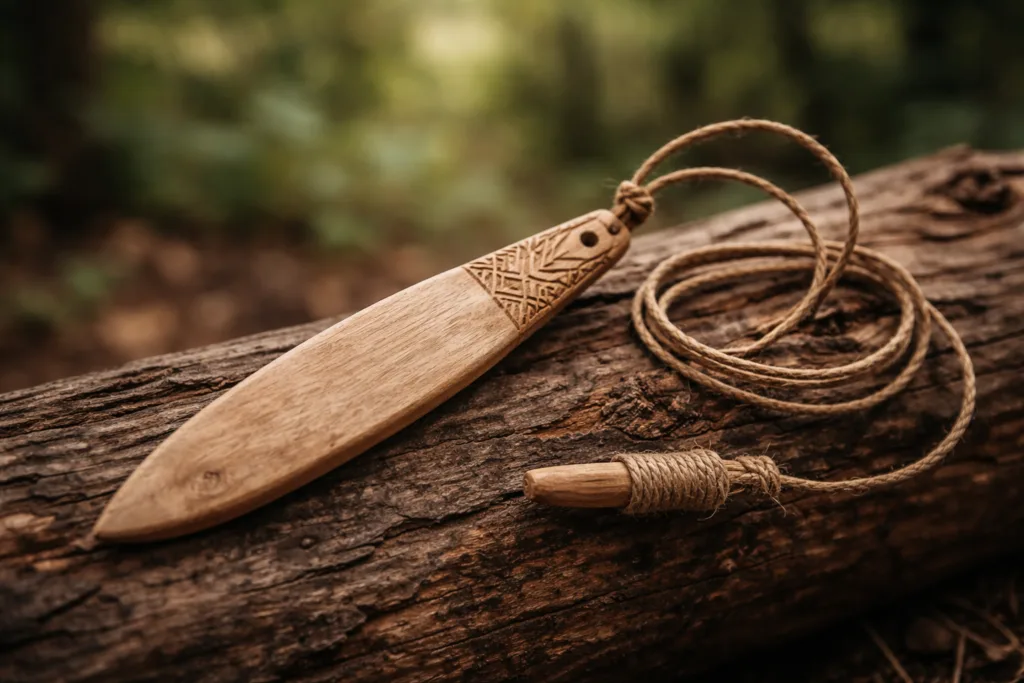
The bullroarer does not speak through a tube, a membrane, or a plucked string. It sends motion straight into open air, and that is why its voice feels so physical: the sound is shaped by moving air first, and only then by the listener’s ear.
That directness explains its strange mix of traits. A well-cut bullroarer can sound distant and near at the same time, soft in one moment and almost stern in the next. Small changes in blade mass, edge sharpness, and cord length do not stay small for long.
🎼 What The Ear Hears First
- Speed raises the apparent pitch. Faster whirling means more airspeed and a tighter, more active voice.
- More blade length usually lowers the pulse. Larger bodies tend to give a deeper, slower-moving throb.
- Balance decides whether the sound blooms or fights back. An off-center hole or uneven shoulder makes the spin feel nervous.
- The passing arc changes what the listener hears. Part of the rise-and-fall effect comes from motion itself, so the ear catches a mild Doppler swell.
A plain description often stops at “a piece of wood on a string.” That misses the real thing. The bullroarer behaves more like a hand-driven airfoil than a simple noise maker. The blade twists on its long axis, bites the air, releases it, then catches again. That repeated catch-and-release is what gives the tone its rolling pulse.
The air is the reed here. Nothing else.
When the edges are cut clean and the thickness tapers with care, the tone opens up and the attack feels less ragged. When the blade is too thick through the middle, the sound often turns blunt. When it is too thin at the shoulders, startup may feel lively for a second, then the spin starts wandering.
Pro Tip 🪶
On an old or newly made bullroarer, check three points before anything else:
- Whether the cord hole sits cleanly on the center line.
- Whether both long edges taper with the same intent.
- Whether the blade starts spinning with only a modest wrist lead instead of a hard yank.
If one of those is off, the ear will usually hear it before the eye explains it.
🪵 Materials That Change The Voice
| Material | What It Feels Like In Hand | What It Usually Does To The Sound |
|---|---|---|
| Light wood | Fast to start, forgiving, easy to swing for longer runs | A leaner whirr with a quicker lift in pitch |
| Dense hardwood | More planted in the arc, steadier once moving | A darker center, firmer pulse, and a fuller low-end push |
| Bone | Compact, hard-edged, less forgiving if balance is poor | A brighter edge and a drier, leaner voice |
| Stone or slate | More inertial weight in a small body, slower to wake up | A dense rumble when the spin settles, though not with the same ease as wood |
Wood remains the natural center of the bullroarer family for good reason. It is easy to true, easy to taper, and easy to balance against the hole and cord. More than that, wood gives the maker room to tune the feel. A thin wooden blade can be made eager and quick; a denser one can be made calm and weight-bearing without losing the living pulse that makes the instrument worth hearing.
Why Dense Hardwood Often Wins
- It keeps a clean edge longer.
- It resists fuzzy wear around the hole.
- It carries its own momentum once the spin settles.
- It often gives a more settled low register than very soft stock.
That does not mean heavier is always better. Too much mass in the wrong place makes a bullroarer feel late to answer. Dense hardwood works best when the thickness falls away with discipline and the shoulders do not stay clumsy. Good weight distribution matters more than brute weight. By far.
Bone and Stone Vs. Wood
Bone and stone tell a different story. They can be wonderfully direct, but they demand precision. A wooden blade can hide a mild error in taper; bone rarely does. Stone and slate can sound forceful for their size, yet they ask for more care in handling and a more settled spin before their voice rounds out. That is one reason wooden bullroarers remain the more practical sounding bodies across many collections.
Surface treatment matters too, though less than many buyers assume. Incised lines, light pigment, lime, or paint usually affect the eye and grip more than pitch. Thick finish build-up is another matter; once the edge gets choked, the attack loses bite and the blade can feel slower off the hand.
📏 Forms, Measurements, and What They Tell You
| Catalogued Example | Approximate Size | What The Proportions Suggest |
|---|---|---|
| Aboriginal Australian oval form | 22 × 7 cm | Broad body, easy air grab, likely a fuller pulse at modest speed |
| Aranda wooden blade with hair cord | 22.7 × 2.6 × 0.5 cm | Slender section, fast response, cleaner edge-to-air relationship |
| Irish rectangular notched piece | 16.8 × 3.4 × 1.2 cm | Shorter and chunkier, with more texture in the attack than a smooth oval |
| Māori pūrerehua | 23 × 7.3 × 1.3 cm | Wide face and solid body, built to throw a broad voice rather than a thin buzz |
| Namau ceremonial blade | 92.1 × 12.7 × 1.3 cm | An extended body that shifts the whole experience toward presence, reach, and visual command |
Measurements tell the truth that labels often blur. The bullroarer is not one fixed object but a family of related air-voices. Museum collections show compact pieces, broad paddle-like forms, pointed oval blades, and long ceremonial bodies whose scale alone changes how the air is loaded and released.
And yes, size changes posture. A short blade can be started quickly and repeated often. A long blade asks for space, timing, and a more committed arm path.
Oval Body Vs. Rectangular Body
- Oval and pointed-oval forms usually give a smoother onset and a more even rotational feel.
- Rectangular forms often sound more abrupt on entry and can feel more percussive in the hand.
- Notched or serrated edges tend to roughen the sonic outline, adding grain rather than pure smoothness.
The oval type is the one most listeners think of first because it is aerodynamically polite without being shy. It enters the air cleanly, finds its axis sooner, and usually keeps the tone coherent. The rectangular or notched type is another creature altogether—less smooth, more carved into the wind, sometimes a touch raspier, sometimes almost bark-like at the edge.
Long Ceremonial Blade Vs. Compact Working Size
A long blade does not just sound larger; it behaves larger. It needs more room, more swing discipline, and more trust in the cord. In return it gives a slower, broader pressure wave and a stronger sense of moving air around the listener. Compact pieces, especially those near the low twenties in centimeters, are easier to launch, easier to recover, and often better for studying how subtle changes in edge and thickness alter the voice.
One answers quickly. The other arrives with weight.
Bullroarer Vs. Spinning Disk
| Feature | Bullroarer | Spinning Disk |
|---|---|---|
| String Layout | Usually one hole near one end | Usually two holes through the center |
| Motion | Whirled in a broad arc | Pulled and released between the hands |
| Tone Character | Lower, roaming, pulsing whirr | Tighter buzz with a more mechanical rhythmic cycle |
| Body Feel | Whole-arm control, open space needed | More compact and centered in front of the player |
This comparison matters because the two are often mistaken for one another as if they differ only in shape. They do not. A bullroarer creates a mobile, outdoor-feeling voice with a pronounced sweep. A spinning disk creates a more cyclical buzz. Even experimental archaeology has shown that smaller bullroarer types can sit down around roughly 55 to 77 Hz, while spinning-disk replicas can range much wider in recorded output. Same family branch? Yes. Same musical behavior? Not really.
🏛️ History, Names, and Cultural Setting
- The English name describes the sound, not the whole object. “Bullroarer” is a listener’s term.
- Other names point to local meaning. Greek sources use rhombos; Māori collections preserve names such as pūrerehua and purorohu.
- The object appears across wide geographies. Wood is common, but bone and stone examples also appear in museum and archaeological records.
- Use is not one-note. In some places it served ceremony, in others signaling, weather rites, teaching, play, or a mix of roles.
That breadth matters. The bullroarer should not be squeezed into one narrow story, because the object itself refuses it. Greek ritual use, Australian ceremonial use, Māori taonga pūoro contexts, Pacific sacred forms, European folk toys, and prehistoric bone examples from northern Europe do not cancel one another out. They show how durable the design is: simple in parts, wide in meaning.
A bone specimen from Mesolithic Denmark is a sharp reminder of that depth. The form is unmistakable even when the material changes, and when such an object sounds again after millennia, the design stops feeling merely simple and starts feeling exact.
Not every bullroarer belongs to open, casual handling, though. Some living traditions place it inside ceremonial protocol, and that deserves a clean, respectful distance. For a reader, collector, or maker, context is not decoration added after the fact; context is part of the instrument’s identity.
Collector’s Note 🏺
A decorated surface can attract the eye, but decoration alone does not tell whether a piece was made to sound, to teach, to travel, or to sit in a display setting. Read the blade from the hole outward. Hole wear, edge truing, shoulder symmetry, and cord choice usually say more about working intent than painted motifs by themselves.
How To Read An Old Example Like A Maker and Curator
- Look at the hole first. A clean round hole suggests lighter use or careful maintenance. An ovalled hole often shows repeated tension and spin.
- Read the shoulders. If one shoulder is bulkier, the blade may have been reworked after wear or damage.
- Check the edges in raking light. Honest playing wear rounds edges in a flowing way; careless sanding often flattens them with no logic.
- Notice the cord material. Hair, plant fiber, hemp, and later synthetic replacements do not feel the same in motion.
- Do not ignore thickness. Two blades of the same length can sound miles apart if one keeps too much meat through the middle.
Old sounding tools often reveal themselves by restraint. They are rarely overbuilt. The better ones keep only the wood they need, and the remaining mass sits where it helps the spin rather than where it merely survives carving. That is why a lean blade can out-voice a thicker, prettier one.
Working Piece Vs. Later Display Piece
This is one of the most useful comparisons in the whole category. A working bullroarer tends to show logic in the places that air and strain care about: the taper, the hole, the shoulders, the relation between width and thickness. A later display or visitor-market piece may still be beautiful and fully worth collecting, yet its emphasis can shift toward surface image, heavier paint, or a broader silhouette that reads well before it spins well.
Neither type needs to be dismissed. They simply ask different questions. One asks, “How does it fly?” The other asks, “How was it meant to be seen?”
That distinction is missed all the time.
FAQ
Is it hard to learn a bullroarer?
See answer
A basic spin is not difficult, but a bullroarer only starts to sound right when the wrist, arm path, and cord twist work together. Most beginners can make noise quickly; making a stable, rounded voice takes more control than people expect.
How do I know if a bullroarer is well made?
See answer
Check balance, taper, and the cord hole before decoration. A good blade starts with little effort, holds a clean rotational path, and does not wobble into a confused attack. Symmetry matters, but so does sensible weight distribution.
What material gives the warmest sound?
See answer
Well-shaped wood usually gives the warmest and most usable voice. Dense hardwood often adds a darker center and a firmer pulse, while lighter wood starts faster and feels easier in the hand. Bone and stone can be striking, though they usually feel less forgiving.
Why do some bullroarers sound lower than others?
See answer
Lower sound usually comes from a mix of more blade length, more settled mass, and a slower pulse pattern in the air. Speed still matters, but a longer or broader blade usually speaks with more depth than a short, light one.
Can an antique bullroarer still be playable?
See answer
Sometimes yes, but playability depends on condition, balance, and cultural context. A blade may be physically sound yet not suitable for active use because of surface fragility, cord loss, or ceremonial sensitivity. For older examples, preservation and context should come before curiosity.