
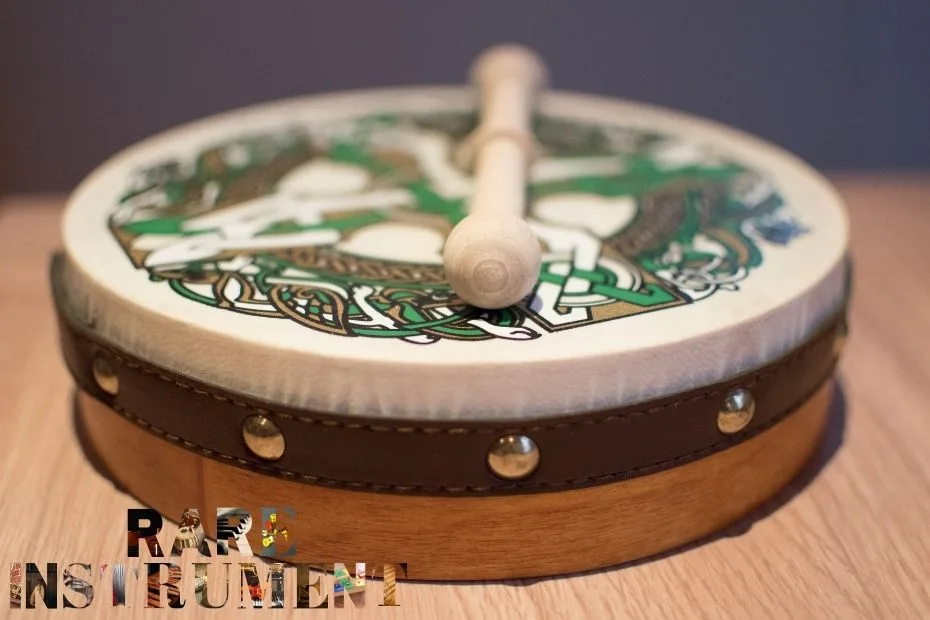
Bendir Drum: Traditional North African Rhythms
Bendir construction, snare-like internal strings, hand technique and rhythmic use are described within North African and related musical...
Daf Drum: Spiritual Rhythms of Persian and Middle Eastern Music
Daf construction, ringed frame, hand strokes and resonant roll techniques are linked to Persian, Kurdish and Middle Eastern...
Kanjira: South Indian Frame Drum in Carnatic Music
The kanjira is profiled through its compact frame, membrane, pitch bends and hand strokes within Carnatic rhythm and...
Native American Frame Drum: Ritual, Sound & Playing Traditions
Native American frame drums are discussed through regional construction, rim and head materials, striking technique and culturally specific...
Pandeiro: Brazil’s Iconic Frame Drum and Samba Sound
Pandeiro construction, jingles, thumb and finger strokes, tuning and rhythmic function are described within samba and other Brazilian...
Riq: A Timeless Frame Drum of Middle Eastern Music
The riq is examined through its jingled frame, skin, finger technique, rhythmic vocabulary and role in Middle Eastern...
Shamanic Drum: Siberian & Central Asian Ritual Frame Drums
Siberian and Central Asian shamanic drums are examined through frame construction, beaters, symbolism and documented ritual performance traditions.
Tambourine: Meaning, History, Types and How It Is Played
Tambourine history, frame and jingle construction, regional types and playing techniques are outlined across folk, orchestral and popular...
8 articles in Frame Drums
Frame Drum Family Map
| Type | Region | Head and Frame | Added Hardware | Core Sound | Traditional Feel in the Hands |
|---|---|---|---|---|---|
| Bendir | North Africa | Wood frame with skin head | Internal gut snares on many examples | Dry pulse with a soft buzz | Upright hold, thumb control, broad hand strokes |
| Daf | Iran, Kurdistan, West Asia | Large frame with skin head | Rings or chains on many regional forms | Airy wash, low resonance, rolling shimmer | Large circular motion, finger rolls, sustained rhythmic flow |
| Riq | Egypt and the Arabic-speaking world | Small wood frame with a relatively tight skin head | Paired metal cymbals | Bright attack with fast, crisp jingle response | Finger-led playing, shakes, snaps, edge control |
| Tar | North Africa and Middle Eastern traditions | Plain frame with skin head | Usually no jingles on plain-head forms | Open tone with a clear membrane response | Inside-hand muting and pressure can shape the note |
| Bodhrán | Ireland | Open-back frame, traditionally with animal skin | Crossbar on many older builds; internal tuners common on modern models | Soft attack, dark bass, adjustable pitch shading | Tipper strokes combined with inside-hand pressure and damping |
| Kanjira | South India | Small frame with a highly responsive head | A single jingle slot is typical | Sharp slap, pitch bends, short decay | Support-hand pressure continually changes membrane tension |
| Pandeiro | Brazil | Tunable head on many modern instruments | Paired metal jingles known as platinelas | Low bass tone with controlled metallic chatter | Thumb, fingertips, heel, shake, and roll combined in one pattern |
| Tambourine | Mediterranean, Europe, and global traditions | Frame with or without a membrane, depending on type | Metal jingles | Bright jingle response with varying membrane contribution | Shake-and-strike techniques, rolls, accents, and orchestral techniques |
The frame drum family shares a shallow shell and broad membrane surface, but construction varies enough to produce very different instruments. Changes in head material, diameter, frame depth, jingles, internal snares, tuning hardware, and back access can alter both sound and technique.
Player Tip: A pandeiro or riq suits playing that combines membrane strokes with controlled metal color. For a more skin-centered response, instruments such as the bodhrán, tar, and bendir place more attention on membrane articulation, damping, and resonance.
What Changes the Sound of a Frame Drum
- Diameter: Larger membranes generally support lower resonances, while smaller drums often respond more quickly to finger articulation.
- Depth: Frame depth changes internal air behavior, balance, and the way low frequencies develop.
- Head Material: Natural skin responds to climate and can provide varied tactile feedback. Synthetic films are usually more stable from room to room.
- Frame Construction: Stiffness, thickness, weight, joinery, and internal profile affect balance and vibration.
- Hardware: Jingles introduce a metallic layer and can partially mask or interrupt membrane sustain. Internal snares add a controlled grain or buzz around the head tone.
- Back Design: Open backs, crossbars, thumb holes, grip recesses, and internal supports change how easily the supporting hand can reach and damp the membrane.
The strongest distinctions within the family are acoustic and mechanical as well as regional. A bendir can combine its membrane tone with a persistent snare texture, while a plain tar leaves the head more exposed. A riq and a concert tambourine both use jingles, but differences in head tension, cymbal weight, shell size, and technique produce very different articulation.
The support hand also changes role from instrument to instrument. It may simply stabilize the frame, control membrane pressure, damp unwanted resonance, change pitch, or continuously reposition the drum for different strokes.
Frame Construction and Hand Contact
Frames may be made from bent hardwood, laminated wood, carved wood, or other regionally available materials. Historical instruments show substantial variation in shell dimensions and construction. The frame establishes the membrane boundary, carries the hardware, determines much of the instrument’s weight, and influences where the supporting hand rests.
These physical details affect technique directly. A deep or heavy shell changes leverage during long rolls. A narrow rim can feel very different from a rounded one against the palm. On instruments played with substantial inside-hand contact, access to the underside of the membrane becomes part of the playing system.
Collector’s Note: On older frame drums, inspect the tack line, shell roundness, scarf or joint area, repairs, oxidation around jingle slots, and wear where the supporting hand contacted the frame. These details can help distinguish long-term use from recent cosmetic aging.
How Frame Drums Spread Across Musical Traditions
- Ancient Near East: representations of large and small frame drums appear in early ritual, ceremonial, and courtly contexts.
- Egypt, the Levant, Greece, and Rome: hand-held frame instruments became associated with song, dance, ceremony, and public performance.
- Medieval Europe: frame drums and jingled forms circulated through cultural contact and developed local names and construction styles.
- South Asia: compact forms such as the kanjira developed techniques centered on rapid articulation and membrane-pressure control.
- North Africa and West Asia: plain, snared, ringed, and jingled frame drums remained active in folk, devotional, classical, and ensemble traditions.
- Brazil: European tambourine ancestry became part of Brazilian musical practice and developed into the modern pandeiro tradition.
Frame drums are portable, acoustically efficient, and capable of producing several contrasting articulations from one membrane. Depending on construction, one instrument can provide low pulse, edge strokes, rolls, muted notes, buzz, or metallic jingle response.
Those traits allow frame drums to work effectively with voice, strings, reeds, dance, and other percussion without requiring a large resonating body.
Historical Construction and Modern Adaptations
Natural skin changes tension as temperature and humidity shift. Dry conditions can tighten the membrane and raise pitch, while increased humidity usually softens tension and lowers the response.
Modern builders address climate sensitivity with internal tuning mechanisms, mechanical tension systems, replaceable heads, and synthetic films. These changes make setup more predictable, although membrane feel, overtone behavior, and response to pressure may differ from natural skin.
Main Types in the Frame Drum Family
Bendir
- Usual Role: pulse, groove, ceremonial music, ensemble support
- Build Markers: wooden frame, skin head, thumb hole on some forms, internal snares on many examples
- Tone Words: earthy, grainy, soft-edged, buzzy, dry
The bendir combines the main membrane tone with a soft buzzing layer created by snares running against the head on many examples. The effect is generally less abrupt than a modern snare drum and can remain audible around both isolated strokes and rolling patterns.
Frame depth, rigidity, head thickness, membrane tension, and snare setup influence how clearly the pulse remains separated from the buzz. Traditional natural-skin heads can add a softer attack and greater climate sensitivity than modern synthetic alternatives.
Bendir vs. Tar
The internal snare layer adds grain around the membrane stroke and can soften the boundary between repeated notes.
A plain-head tar exposes the membrane more clearly, making damping, rim articulation, and open tones easier to hear without an internal snare layer.
Bendir technique commonly combines broad strokes with finger articulation and controlled frame movement. Snare response changes with membrane tension, playing angle, humidity, and stroke strength. A loose setup can blur articulation, while excessive tension may reduce the depth of the buzzing response.
Daf
- Usual Role: sustained rhythmic flow, devotional performance, folk and concert music
- Build Markers: large diameter, broad frame, natural skin on many traditional examples, rings or chains on numerous regional forms
- Tone Words: expansive, breathy, shimmering, resonant
The daf uses a large membrane and broad frame that can produce a substantial low-frequency response. On ringed instruments, movement of the frame activates the internal metal hardware and adds a separate layer above the membrane.
The relationship between head tone and ring response changes with playing angle and motion. Center strokes can emphasize the membrane, while rotational movement and shakes bring more of the metal layer forward.
Traditional technique often combines finger rolls with arm and wrist movement. Efficient playing keeps these motions connected so the weight of the large frame does not create unnecessary tension.
Player Tip: On a large daf, continuous arm and wrist motion can support smoother ring response and reduce fatigue. Isolated heavy strikes usually require more effort and can interrupt the flow of longer patterns.
Riq
- Usual Role: detailed rhythmic articulation in Arabic classical, folk, and ensemble traditions
- Build Markers: compact circular frame, skin head, multiple pairs of small cymbals
- Tone Words: bright, crisp, controlled, fast
The riq is a precision frame drum whose membrane and cymbals are treated as coordinated sound sources. Head tension affects finger articulation, while cymbal weight, spacing, and grip determine how freely the metal rings.
Historical examples vary in hardware layout. Some museum instruments carry twenty-four cymbals arranged in six double rows. The exact number is less important than the balance between the head and metal: both must respond clearly enough for the player to alternate between ringing, muted, and skin-centered passages.
Riq vs. Tambourine
Finger-led technique allows detailed control over the membrane and cymbals, including rapid muting and changes between skin and metal emphasis.
Construction varies widely, but many forms favor broader shake-and-strike patterns and a more open jingle response.
Riq technique includes finger strokes, compact shakes, cymbal damping, snaps, rolls, and rapid changes of grip or angle. The technical difficulty comes from coordinating timing with the exact amount of membrane and cymbal resonance required by the phrase.
Tar
- Usual Role: accompaniment, dance, open hand-drum pulse
- Build Markers: plain circular frame, membrane head, often little or no added hardware
- Tone Words: clear, open, rounded, skin-centered
The tar places the membrane and hand technique in the foreground. Without a persistent jingle or snare layer, differences between open strokes, muted notes, edge articulation, and pressure changes remain easy to hear.
Frame stiffness, dimensions, membrane thickness, and head tension affect attack and sustain. Natural skin on traditional forms usually reacts more strongly to humidity and hand pressure than modern synthetic materials.
Some contemporary frames use openings or grip modifications that give the support hand easier access to the membrane. On plain frame drums this can expand the player’s control over damping, pressure, and decay.
Bodhrán
- Usual Role: Irish traditional music, dance support, low rhythmic color
- Build Markers: open back, animal-skin head on traditional instruments, crossbar on many older forms, internal tuning systems on numerous modern models
- Tone Words: soft attack, dark bass, dry edge, variable pitch
The bodhrán divides technique between the striking hand and the hand behind the membrane. A tipper provides attacks and subdivisions, while the inside hand can alter pitch, shorten sustain, and move the tonal focus across the head.
Natural skin remains closely associated with traditional sound and tactile response. Modern tunable instruments provide easier control when climate changes, while synthetic-headed examples offer another option where environmental stability is a priority.
Bodhrán vs. Bendir
The inside hand continuously shapes pitch and damping while the tipper articulates the rhythm.
Membrane strokes interact with an internal snare on many forms, creating a persistent grain around the beat.
Crossbars on older bodhráns can help stabilize the instrument, although they restrict access to parts of the membrane. Open-back modern designs give the support hand a larger working area for pitch bends and damping.
Kanjira
- Usual Role: Carnatic accompaniment, solo percussion exchanges, complex rhythmic dialogue
- Build Markers: compact frame, responsive membrane, single jingle slot
- Tone Words: sharp, elastic, bent, popping, short-decay
The kanjira is a small frame drum capable of large pitch changes under hand pressure. Historical instruments were associated with highly elastic reptile skin; contemporary instruments use alternative head materials, including natural and synthetic substitutes.
Membrane flexibility is central to traditional technique. The support hand changes tension while the striking hand produces sharp accents, open strokes, muted notes, and rapid rhythmic figures. This combination allows a compact instrument to move quickly between high, dry attacks and lower pressure-bent tones.
Kanjira vs. Pandeiro
Pressure-sensitive membrane technique allows pronounced pitch bends and tightly controlled rhythmic articulation.
Membrane strokes are integrated with continuous control of multiple jingles, giving the instrument a broader layered groove function.
Pandeiro
- Usual Role: samba, choro, capoeira, and other Brazilian traditions
- Build Markers: compact frame, tunable head on many instruments, paired platinelas
- Tone Words: low bass, dry jingle, articulate slap, agile roll
The pandeiro combines several sound layers in a compact frame. The membrane supplies bass tones, open tones, slaps, and muted strokes, while the platinelas provide a controllable metallic subdivision.
Jingle construction has a large effect on decay. Weight, alloy, shape, spacing, and pairing can produce anything from short dry chatter to a more sustained metallic response. Makers adjust these features according to the playing style and desired balance between membrane and metal.
Head tension changes bass response and rebound. Lower setups generally favor a deeper membrane tone, while tighter heads increase rebound and sharpen slap articulation. Players select setup according to instrument construction and musical context.
Traditional technique integrates thumb, fingertips, heel-of-hand contact, slaps, and frame movement into a continuous cycle. Effective playing depends on keeping the membrane and platinelas rhythmically distinct even when both sound at the same time.
Tambourine and Related European Forms
- Usual Role: dance, song accompaniment, folk music, orchestral percussion
- Build Markers: circular frame with jingles, with or without a membrane depending on type and tradition
- Tone Words: bright, agile, open, metallic
The tambourine appears in many regional forms and cannot be reduced to one fixed construction. Mediterranean, European, Middle Eastern, folk, and orchestral traditions use different frame sizes, membranes, jingle layouts, and techniques.
Its musical range comes from controlling the relationship between membrane strokes and jingle movement. Italian tamburello traditions demonstrate how fast finger technique, rolls, frame rotation, and short jingle decay can create dense dance rhythms from a shallow instrument.
Compared with the riq, many tambourines use a more open jingle response and less intricate damping. Compared with the pandeiro, they often emphasize the metal layer more strongly than bass membrane tones. A large daf occupies another part of the family, using greater diameter and internal rings to create broader movement and resonance.
Traditional Playing Styles by Hand Function
| Playing Logic | Examples | What the Hands Control |
|---|---|---|
| Inside-Hand Modulation | Bodhrán, tar, some modern frame drums | Pitch, damping, sustain, and membrane tension are adjusted from the back of the head |
| Finger-Led Precision | Riq, kanjira | Rapid finger groups, edge articulation, damping, and short ornamental strokes |
| Shake-and-Strike Hybrid | Pandeiro, tambourine | Membrane attacks are coordinated with deliberate jingle movement |
| Large Circular Motion | Daf, bendir | Arm, wrist, and frame movement help connect repeated strokes and hardware response |
| Tipper-Led Subdivision | Bodhrán | Rotating stick motion supplies articulation while the inside hand changes resonance and pitch |
Technique differs according to where tonal control is located. On the bodhrán, much of the sound is shaped from behind the head. The pandeiro requires constant balance between membrane strokes and jingle motion. The kanjira relies heavily on pressure changes, while the riq demands precise control over how long both skin and cymbals are allowed to ring.
Player Tip: When comparing frame drums, identify which hand controls damping, pitch, or hardware response. Instruments with similar outlines can require very different coordination once those functions are considered.
How Materials Affect Response
- Natural Skin: climate-sensitive tension, variable surface friction, and a tactile response that differs from skin to skin
- Synthetic Head: more stable tension and predictable behavior across changing environments
- Dense or Rigid Frame: can support a firm structure under membrane tension and keep the shell dimensionally stable
- Lighter Frame: reduces hand fatigue and changes the instrument’s balance during rotational techniques
- Heavier Jingles: generally provide greater inertia and longer or denser metallic response
- Lighter Jingles: can respond quickly and decay sooner, depending on shape and alloy
Head material influences attack, rebound, damping, friction, and climate response. A goatskin head on a plain frame drum can provide a flexible membrane with natural variation in thickness. A responsive kanjira head allows large pitch changes under hand pressure. Synthetic films on modern riqs, pandeiros, and other frame drums provide easier tuning stability where environmental conditions change frequently.
Wood species alone does not determine quality. Frame stiffness, thickness, grain direction, joinery, dimensions, weight, and the way the membrane is mounted all contribute to the final response.
Traditional Heads vs. Modern Heads
Natural skin reacts strongly to humidity, temperature, and pressure. This allows subtle changes in feel and pitch but also means that an instrument may need adjustment as conditions change.
Synthetic heads reduce much of that environmental variation. They are useful for touring, amplification, outdoor work, and situations where repeatable tension is valuable. Their surface friction and pressure response can differ from natural skin, so experienced players may prefer one material for a particular technique rather than treating either as universally superior.
Inspecting an Older Frame Drum
- Check Shell Roundness: Warping can affect tension, comfort, head seating, and hardware alignment.
- Inspect the Head Edge: Look for old tacks, replacement membranes, glue lines, tears, or uneven attachment.
- Listen Across the Surface: Compare center, edge, muted, and hardware-adjacent strokes for dead areas or unstable buzzes.
- Examine Hardware Wear: Different oxidation patterns, unmatched cymbals, or modern fasteners can indicate later replacements.
- Inspect the Interior: Snare anchors, thumb holes, crossbars, repairs, and grip wear reveal how the drum was built and used.
- Test Balance: Hold the instrument in playing position long enough to notice wrist strain, excessive weight, or awkward grip geometry.
Condition should be assessed acoustically as well as visually. Decorative inlay, old finish, or surface patina can add historical and collector interest, but they do not compensate for a warped shell, badly seated head, unstable cymbals, or poor balance.
Collector’s Note: A repaired instrument can remain musically useful and historically interesting. The important questions are whether the repair is stable, whether original construction has been altered, and whether the drum still responds evenly across its usable playing range.
Mini FAQ
How do I choose a frame drum for a particular style of music?
Start with the sound and playing function. Riq and pandeiro combine membrane articulation with metal response. Bodhrán and tar provide greater access to skin-centered damping and pitch control. Bendir adds internal snare texture, kanjira specializes in pressure-sensitive pitch movement, and daf supports large circular motion with a broad membrane and, on many forms, internal rings.
Is a frame drum difficult to learn?
Basic strokes can be learned quickly, but advanced control takes time. Different instruments require different combinations of damping, grip, finger independence, rebound, pressure, frame movement, or hardware control.
Why do some frame drums have jingles or snares?
Jingles add a separate metallic sound layer that can respond to both strikes and frame movement. Internal snares create a buzzing or grainy membrane response. Plain-head drums leave more of the membrane tone exposed and usually give the player clearer control over open and muted skin sounds.
Should I choose natural skin or a synthetic head?
Natural skin suits players who value traditional construction, variable tactile response, and pressure-sensitive membrane behavior. Synthetic heads are useful when stable tuning, travel, outdoor performance, or reduced climate sensitivity are priorities.
What should I inspect before buying an older frame drum?
Check shell roundness, membrane condition, repairs, hardware, jingle or snare stability, interior construction, and balance in playing position. Then test the drum at several dynamic levels and listen for an even response across the usable area of the head.