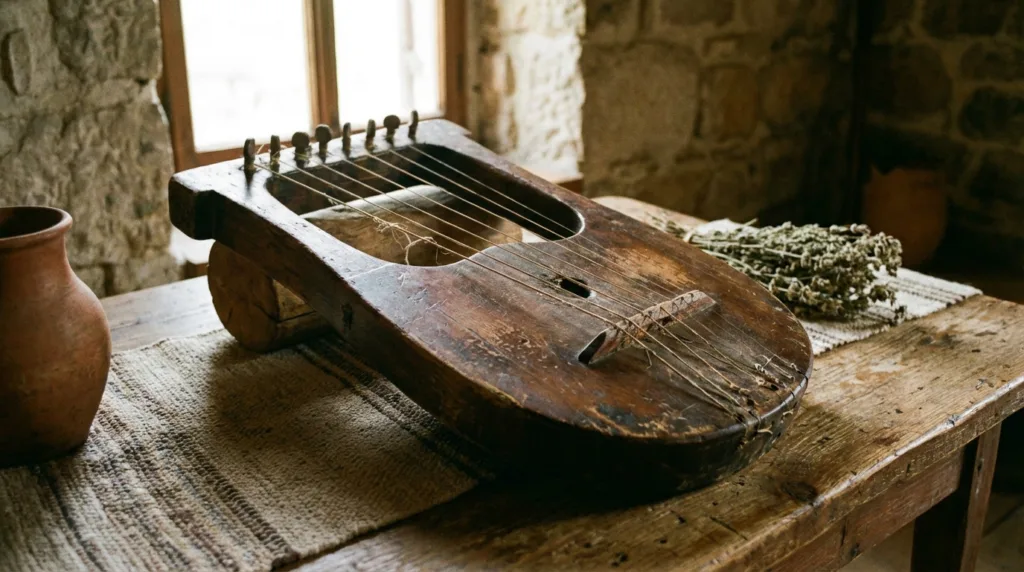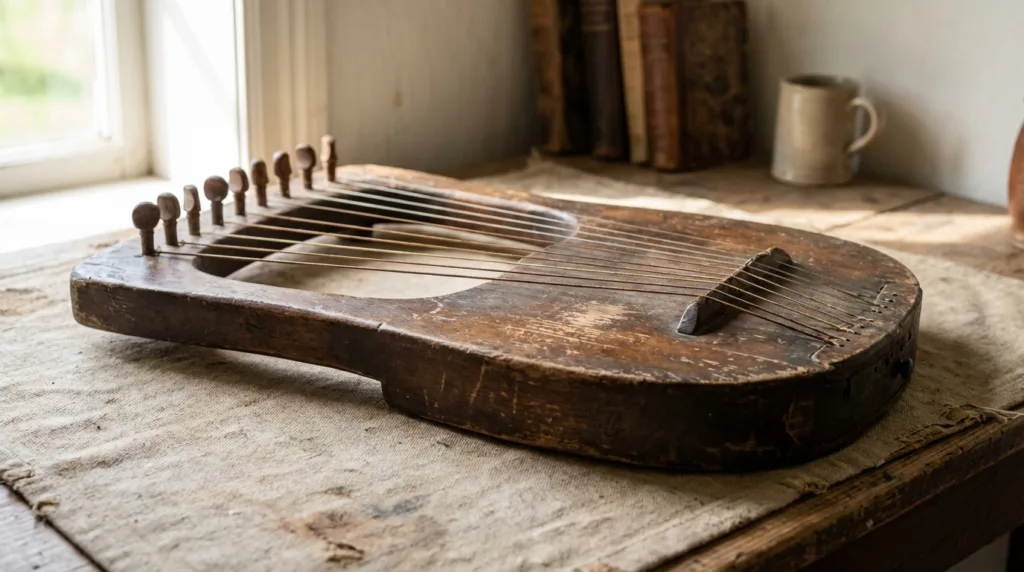
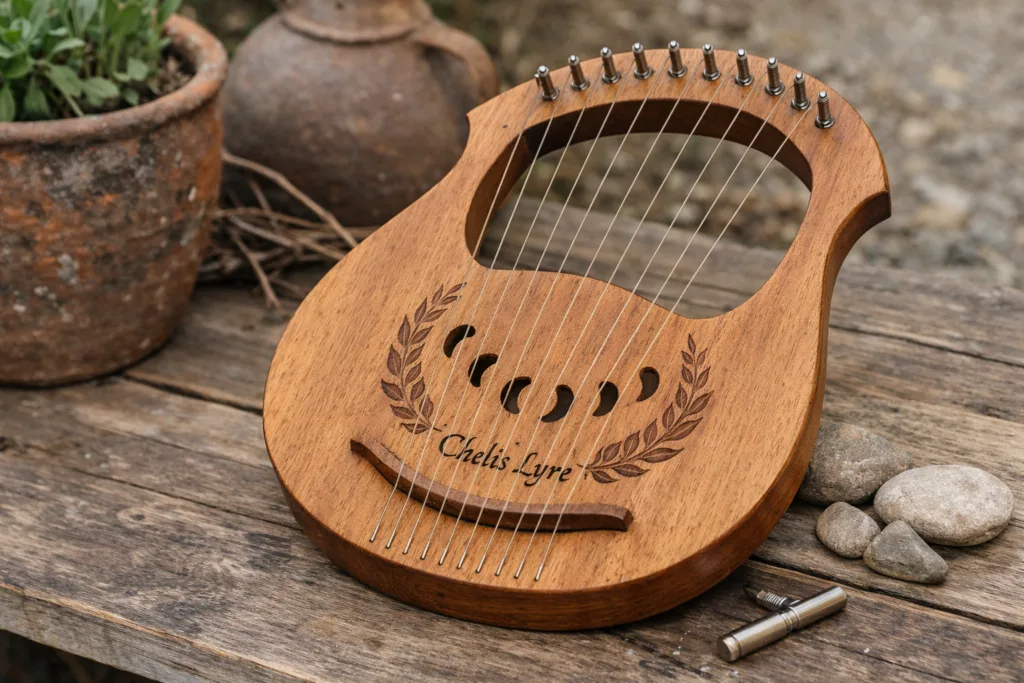
One shell. One skin. A handful of strings.
The Chelis Lyre (often written as chelys) is the kind of instrument that feels almost too simple—until you actually play it. Then you notice the resistance in the strings, the quick “bloom” from the skin soundboard, and the way the tone sits close to the voice instead of trying to overpower it.
- 🐢 Built around a shell-shaped resonator (historically tortoise shell; often wood/ceramic in replicas).
- 🪵 A light frame that invites strumming + muting rather than harp-like single-note plucks.
- 🪶 A sound that’s dry, warm, and fast—excellent for singing with, and surprisingly honest under the fingers.
Anatomy and Materials of the Chelis Lyre 🐢🪵
- Soundbox (Bowl): historically a convex tortoiseshell back, or wood shaped like one.
- Soundboard: often stretched hide (a drum-skin logic), turning plucked energy into quick projection.
- Arms + Yoke: two uprights joined by a crossbar (the yoke), acting as the string anchor and tension spine.
- Bridge: a small transfer point that “hands off” vibration into the soundboard.
- Strings: traditionally gut; modern builds may use synthetic gut/nylon.
- Plectrum: the right-hand driver (often hung by a cord when not in use).
| Part | Classic Material Logic | What You Hear | What You Feel |
|---|---|---|---|
| Shell-shaped soundbox | Rigid, curved back (shell/wood/ceramic) | Focused mids, less “boomy” bass than a deep wooden bowl | Lightweight; sits steady on the lap |
| Hide soundboard | Stretched membrane | Fast attack, quick decay, clean articulation | A slight “spring” under strong strokes |
| Arms + yoke | Wood or horn-like geometry | Defines how much energy stays in the frame vs. the top | Rigidity changes perceived string firmness |
| Gut strings | Dense, elastic fiber | Rounder, less metallic edge | More grip; plectrum “catches” pleasantly |
| Tuning pegs | Friction pegs | Stable when well-fitted, temperamental if dry/loose | Small micro-adjustments; you learn patience (good patience) |
Original Chelis Lyre examples are rare because the core materials (hide, wood, organic strings) don’t like time. Most of what we “know” comes from surviving fragments, museum pieces, and a huge trail of vase imagery—so modern builds lean on best-fit reconstruction, not perfect certainty.
Timbre, Touch, and That Oddly Human Resistance 🎶
- Attack: quick—almost like a soft drum being tapped, but with pitch.
- Decay: faster than many wooden-top instruments; notes don’t “hang around” unless you ask them to.
- Color: mid-forward, intimate, voice-friendly.
- Dynamic ceiling: it speaks clearly, then it tops out; that limit is part of the charm.
A well-made Chelis Lyre doesn’t feel like a tiny harp. It feels like a frame you can steer. In the lap it sits, and the body almost tells you where the right hand should land.
Here’s the tactile surprise: the hide soundboard gives back a little. Not a lot—just enough that strong strums have a faint rebound, and that rebound shapes the tone. You get a clean “ping” at the front of the note, then a warm body, then—gone. No smear. No endless wash. Honest.
And the strings? They tend to feel slightly stiffer than you expect at first, especially on seven-string builds that aim for a compact, singable range. Stiffness isn’t a flaw here. It’s control.
If the Chelis Lyre sounds “papery,” the right hand is often the fix: use a slightly slower plectrum stroke, then let the left hand decide what stays silent. This instrument loves intention more than force.
Playing Technique That Explains the Design 🪶
- Right hand: drives with a plectrum (single strokes or light strums).
- Left hand: mutes and selectively releases strings—this is the real “fretboard.”
- Common feel: you’re shaping a chord-cloud into a clean line, one mute at a time.
The Chelis Lyre rewards a specific kind of coordination: strike broadly, then sculpt quietly. It’s a little backward if you come from guitar or oud—so it can feel clumsy for a day or two. Then it clicks. Suddenly, it’s natural.
Try these three micro-drills (short, practical, no drama):
- Two-string clarity: strum across all strings, but let only two ring by muting the rest with the left hand. Hold it for two seconds.
- Pulse control: on one string, play four soft strokes, then one firm stroke. Keep pitch stable; don’t squeeze the frame.
- Voice space: play a simple repeated pattern, then speak a sentence over it. If the instrument fights your voice, you’re playing too loud or letting too many strings ring.
Some days you’ll feel like you’re “chasing buzzes.” Normal. Skin-top instruments can be picky. Still, once the hand learns the mute dance, the Chelis Lyre becomes oddly forgiving.
Chelis Lyre Vs. Close Relatives
Chelis Lyre Vs. Kithara
Chelis Lyre: lighter, more intimate, often associated with learning and everyday music-making. The sound tends to stay close to the player.
Kithara: generally larger and more robustly built, designed for stronger projection and formal performance contexts. It tends to feel tighter and more “architectural” under tension.
- Projection: kithara usually wins (bigger body, stronger frame).
- Touch: Chelis Lyre feels more agile; kithara feels more anchored.
- Tone: chelis-style builds often sound drier; kithara-style builds often carry more sustained presence.
Chelis Lyre Vs. Barbitos
- Barbitos typically uses longer arms, which encourages lower pitch and a slower, deeper response.
- Chelis Lyre stays compact, with a quicker “speak” and tighter control for voice accompaniment.
Chelis Lyre Vs. Modern Lyre Harp
| Feature | Chelis Lyre | Modern Lyre Harp |
|---|---|---|
| Typical string count | Most depictions favor 7 (sometimes more in later/pro settings) | Often 7–21+ |
| Soundboard | Often hide (membrane-like) | Usually wood (plate-like) |
| Decay | Faster; tidy notes | Longer sustain; more shimmer |
| Technique emphasis | Mute-shaping with left hand | More direct plucking patterns |
So, yes—these instruments overlap in silhouette. In the hands, though, they behave like different animals. The Chelis Lyre is less about “playing notes” and more about choosing silence. A strange sentence, but it’s true.
Historical Footprints, Without the Fog 🏺
- Name logic: “chelys” ties to “tortoise” in Greek usage—an instrument nicknamed by its back.
- Survival reality: few physical examples remain; imagery and fragments do much of the heavy lifting.
- Dating anchor: known museum pieces and reconstructions often point toward Classical-period contexts (roughly mid-1st millennium BCE), even if the broader lyre family is older.
A Homeric hymn famously frames the lyre’s origin as a tortoise-shell invention story. Myth, sure—but myths tend to cling to recognizable objects. The “shell-backed” identity stuck because people could see it, touch it, carry it.
Also worth saying (plainly): the Chelis Lyre was not built to win volume wars. It was built to sit beside a human voice and behave. That design goal shows up again and again in how modern researchers test reconstructions—especially with controlled recordings and spectrum analysis. Old instrument, modern ears. Nice combo.
If you’re evaluating a modern Chelis Lyre as a “collector-grade” build, look for clean joints at the arms/yoke, a well-seated bridge, and pegs that turn smoothly without slipping. Those boring details decide whether the instrument feels alive—or just looks the part.
Workshop Choices That Change the Voice 🧰
- Arms wood: denser woods often feel more stable in the hand and can keep the tone slightly more focused.
- Soundboard material: hide tends to give a crisper front edge than many thin wooden plates.
- String material: gut usually reads warmer; synthetics can feel cleaner and more consistent across weather changes.
- Plectrum stiffness: softer plectra reduce click; stiffer ones sharpen articulation (and reveal sloppy muting—ouch).
Small changes matter on the Chelis Lyre because the instrument is acoustically “direct.” There isn’t a big wooden cavity to blur everything into beauty. You hear the build. You hear the hands. You hear the day you’re having.
One more practical truth: skin behaves with humidity. It does what skin does. Some mornings it feels tight and bright, some afternoons it relaxes and goes a bit mellow. Annoying? Sometimes. Musical? Also yes.
If your Chelis Lyre suddenly loses sparkle, don’t rush to blame the strings. First, check whether the soundboard feels slightly slack to the touch. A tiny shift in membrane tension can change the whole personality.
FAQ
Is the Chelis Lyre the same thing as a modern lyre harp?
Open Answer
No. A Chelis Lyre is a specific ancient-style bowl lyre tradition, often linked to a shell-shaped soundbox and a technique centered on plectrum strokes plus left-hand muting. Many modern lyre harps use wooden soundboards, longer sustain, and a more direct plucked approach.
How many strings should a Chelis Lyre have?
Open Answer
Seven strings is the most commonly referenced and depicted setup for the Chelis Lyre, especially in the “classic” idea of the instrument. Some later or more experimental builds add strings, but seven keeps the traditional balance between strumming and controlled muting.
Is it hard to learn the muting technique?
Open Answer
It feels awkward at first, then it becomes second nature. The Chelis Lyre asks your left hand to manage silence, not just pitch. Start by letting only two strings ring after a full strum; that one habit builds the core skill fast.
What strings work best: gut or synthetic?
Open Answer
Gut strings often give a warmer, more textured tone and a satisfying “grab” under the plectrum. Synthetic gut or nylon tends to be more stable with humidity and easier for consistent tuning. On a Chelis Lyre, both can work well—choose based on the sound you prefer and the climate you live in.
How do I know if the hide soundboard is set right?
Open Answer
A well-set hide top usually feels evenly firm across the surface and produces clear notes without a papery rattle. If the tone turns dull overnight or the response feels sluggish, the membrane may be slightly slack. The Chelis Lyre is sensitive to small tension changes, so gentle adjustments matter.
Can I tune a Chelis Lyre to modern songs and play with other instruments?
Open Answer
Yes, within reason. The Chelis Lyre adapts well to simple modal or diatonic tunings, and it can sit nicely with vocals, flutes, or soft-string textures. Because the sustain is shorter, it often blends best when you keep patterns clear and avoid overly dense chord stacks.