
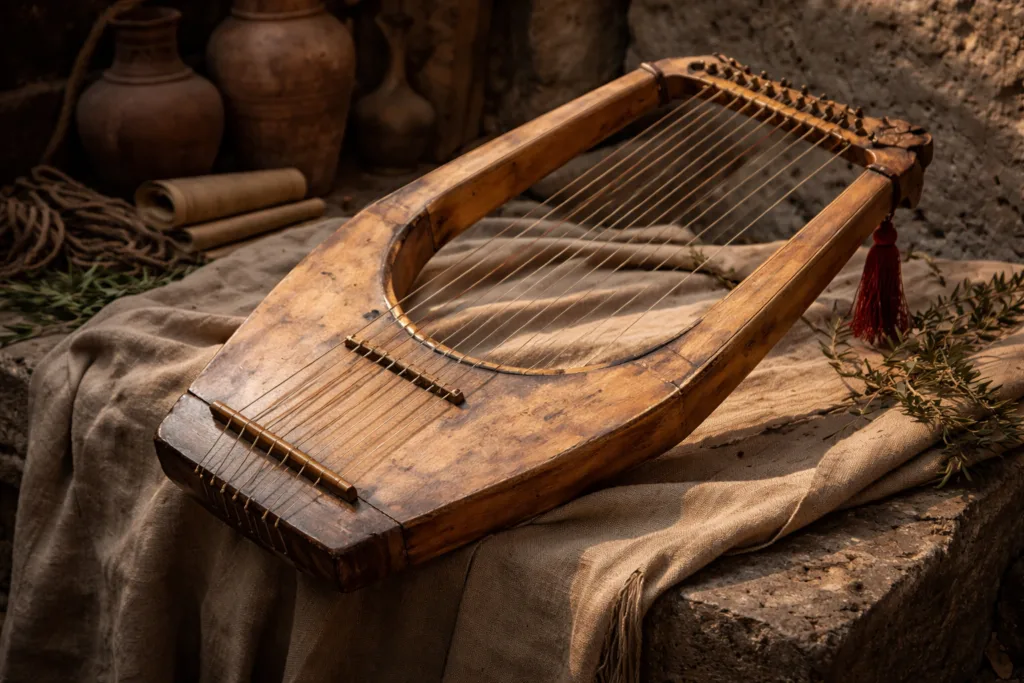
The term magadis survives more clearly than the physical object it may have described. Ancient authors connect it with string playing and octave doubling, but they do not leave one stable construction that can be treated as the standard form. Some passages describe an instrument, while later interpretation has also treated magadis as a descriptive term connected with the ability to double a melody in octaves.
The safest description therefore begins with the evidence rather than a reconstructed silhouette:
- Well supported: the word is closely connected with octave doubling and the verb magadizein.
- Reported in ancient sources: magadis appears in discussions of plucked or stringed instruments.
- Reported but inconsistent: one tradition refers to twenty strings, while another ancient passage describes five strings.
- Open question: the term may not always have referred to one fixed instrument design.
Identity, Evidence, and the Name Itself
Ancient testimony about the magadis is internally difficult. Athenaeus preserves several earlier statements about the term, including accounts that describe it as a stringed instrument, connect it with many strings, identify it with an older form of psalterion, or give a very different string count.
Andrew Barker described Athenaeus’ discussion as inconclusive and noted that even the question of whether magadis named an instrument is part of the problem. John Landels offered another reading: magadis may function as a descriptive term meaning something like able to double a melody in octaves.
Those interpretations do not erase the ancient passages that appear to use the word as an instrument name. They show why a single physical reconstruction should not be presented as settled historical fact.
- Octave terminology: magadizein is associated with performing the same melodic material at the octave.
- String-instrument references: several ancient passages place magadis terminology around plucked strings.
- Twenty-string report: a twenty-string association survives in the textual tradition, but it is not a measured specification from an archaeological instrument.
- Five-string report: Athenaeus also quotes Telestes in connection with a five-string magadis, demonstrating that the literary evidence does not produce one stable specification.
| Claim About Magadis | Evidence Level | What Can Safely Be Said |
|---|---|---|
| The term relates to octave doubling. | Strong | Magadizein is associated with performing corresponding material in octaves. |
| Magadis was used as the name of a stringed instrument. | Supported but debated | Ancient authors use the term in string-instrument contexts, although its exact meaning and form remain disputed. |
| It had twenty strings. | Reported tradition | Twenty strings appear in the literary record but should not be treated as a universal construction specification. |
| It had one fixed harp, psaltery, or lute form. | Uncertain | No surviving standard body securely establishes one physical type under the name. |
| Magadis could be descriptive rather than a fixed instrument name. | Established scholarly interpretation | The term has been interpreted as describing the ability to double a melody in octaves. |
Collector’s Note
Claims about an “authentic ancient Magadis” require extreme caution because there is no standard surviving instrument against which such an object can be matched. Provenance, archaeological context, dating, materials, and specialist examination matter more than resemblance to a modern reconstruction.
What Can Be Reconstructed and What Remains Unknown
Octave doubling provides a useful musical clue, but it does not determine a single physical design. A reconstruction could place octave-related strings where the hand can reach them easily, yet that arrangement would represent one interpretation of the evidence rather than a recovered historical specification.
The surviving record does not securely establish:
- one standard body outline;
- one standard frame or soundbox construction;
- one fixed string count;
- one historical string tension;
- one accepted string spacing;
- one documented finger technique;
- one known soundboard material or thickness.
A modern builder can test plausible arrangements, but the resulting instrument should be described as a reconstruction hypothesis, experimental interpretation, or magadis-inspired instrument when the physical design goes beyond what the texts establish.
Materials in Modern Reconstructions
Wood, gut, modern synthetic strings, bridge design, and frame dimensions will affect any reconstruction, but those effects belong to the modern build being tested. They should not be presented as known properties of the ancient magadis.
- Frame material: stiffness and mass affect tuning stability and resonance in a reconstruction.
- Soundboard choice: thickness, bracing, and material affect attack and sustain when a builder chooses a soundboard-based design.
- String material: gut, synthetic gut, or modern strings produce different tension and tactile behavior.
- Layout: paired or conveniently positioned octave strings can be tested as one response to the octave-doubling evidence.
Reconstruction Note
A replica that uses octave-paired strings can demonstrate how octave doubling might work mechanically. It cannot by itself prove that ancient performers used the same string material, spacing, body shape, or tension.
What a Modern Reconstruction Can Reveal About Sound
A reconstruction can answer practical acoustic questions once its assumptions are stated. Builders can test how octave-related strings interact, how quickly a chosen body decays, how different string materials respond, and whether a particular layout makes repeated octave playing comfortable.
Those observations describe the reconstruction itself. They do not establish the exact sound or feel of an ancient magadis.
- Attack: depends on the chosen string material, plucking method, body, and bridge.
- Sustain: depends on construction, tension, resonance, and damping.
- Finger resistance: depends on string gauge, material, scale length, and tension selected by the modern maker.
- Octave blend: can be tested when a reconstruction places corresponding pitches in a playable relationship.
Sympathetic resonance may appear in a reconstruction with many lightly damped strings, but the amount of sympathetic response depends on that instrument’s construction. It should not be treated as a documented Magadis feature without stronger evidence.
Collector’s Note
Sound demonstrations of modern Magadis reconstructions are demonstrations of individual design choices. Compare the builder’s stated evidence and assumptions before treating the recorded timbre as historical reconstruction rather than modern interpretation.
Octaves, Magadizein, and the 2:1 Relationship
An octave corresponds to a 2:1 frequency relationship. A pitch at 440 Hz, for example, has an octave counterpart at 880 Hz. Because their periodic structures align closely, the two notes often blend strongly while remaining separated by register.
Magadizein is generally discussed in relation to octave doubling:
- Musically: the same melodic material is performed at two octave-related pitch levels.
- Textually: the term helps explain why magadis terminology became associated with paired registers.
- Organologically: it does not by itself prove a particular frame, harp, psaltery, lute, or fixed string arrangement.
One scholarly interpretation treats magadis as an adjective describing octave-doubling capability rather than the proper name of one instrument. Other ancient passages use the term in ways that appear more instrument-like. The disagreement should remain visible because it is part of the evidence.
Acoustic Note
A modern octave-paired reconstruction should be tuned according to its own design and string limits. Audible beating between two intended unisons or octave-related components can reveal tuning differences, but it does not establish an ancient tuning standard.
Magadis and Nearby Ancient String-Instrument Terms
Comparison is useful only if the uncertainty around magadis remains explicit. Lyres and kitharai have clearer structural evidence. Magadis does not provide the same level of physical certainty.
Magadis and Lyre or Kithara Traditions
- Lyre and kithara: surviving images and other evidence establish a yoke structure with strings running between a body and crossbar.
- Magadis: literary evidence connects the term with strings and octaves, but does not securely establish the same yoke construction.
- String count: lyre-family counts vary historically; Magadis reports are themselves inconsistent.
Descriptions of posture, attack, and hand motion should therefore come from documented lyre or kithara evidence when discussing those instruments, not be transferred automatically to magadis.
Magadis and Psaltery or Harp Interpretations
Some scholarship has placed magadis near harp or psaltery-type instruments, partly because ancient sources associate it with plucked strings and many-stringed practice. Other interpretation questions whether magadis should be treated as a fixed instrument name at all.
A harp- or psaltery-shaped reconstruction is therefore possible as an experimental model, but its silhouette should be labelled as an interpretation.
Magadis and the Twenty-String Tradition
The frequently repeated figure of twenty strings comes from literary transmission rather than a surviving Magadis with twenty measurable strings. Athenaeus also preserves conflicting evidence, including a passage connected with five strings.
The twenty-string description is useful evidence for ancient discussion of the term, but it should not be converted into a universal construction specification.
| Feature | Magadis Evidence | Lyre / Kithara | Modern Harp-Type Reconstruction |
|---|---|---|---|
| Physical Form | Uncertain and disputed | Yoke structure documented in ancient evidence | Chosen by the modern builder |
| Octave Association | Strongly associated with magadizein and octave doubling | Not the defining feature of the family | Can be designed deliberately into the layout |
| String Count | Conflicting literary reports, including twenty and five | Varied by period and type | Depends entirely on reconstruction design |
| Finger Feel | Not securely recoverable | Depends on documented reconstruction choices | Depends on string material, gauge, length, and tension |
Evaluating a Modern Magadis Reconstruction
A modern reconstruction should be judged first by how clearly it separates evidence from interpretation. Since no standard surviving Magadis establishes the historical geometry, a maker should explain which ancient passages or scholarly interpretations informed the design.
- Ask what evidence shaped the body form. A harp, psaltery, lyre-like, or other layout should be identified as an interpretation when the form is uncertain.
- Ask why the string count was chosen. Twenty strings can follow one ancient report, but it should not be presented as the only historically valid count.
- Ask how octave doubling is implemented. The design may pair strings physically or simply make octave-related pitches easy to reach.
- Check ordinary construction quality. Stable joints, sensible string angles, reliable tuning, and clean contact points matter for any playable reconstruction.
- Separate playability from historical certainty. Comfortable spacing or modern string tension may make a useful instrument without proving ancient practice.
Collector’s Note
Useful documentation includes the maker’s chosen textual evidence, reconstruction model, string material, tuning concept, and any modern compromises made for stability or playability. Precise documentation is more valuable than unsupported claims of historical authenticity.
Care and Setup for a Modern Reconstruction
Care instructions depend on the reconstruction that was actually built. A wooden harp-type model with gut strings requires different maintenance from a synthetic-strung experimental psaltery. These are modern instrument-care questions rather than known Magadis traditions.
- Humidity: follow the needs of the wood, adhesives, and string material used by the maker.
- Tuning: remain within the tension range specified for that reconstruction.
- Strings: replace them with gauges and materials compatible with the design rather than assuming an ancient specification.
- Contact points: inspect bridges, nuts, pins, or other string supports according to the actual construction.
If a reconstruction was built for experimental historical performance, keep the maker’s notes with the instrument. Later owners should be able to distinguish documented evidence from the choices introduced during reconstruction.
FAQ
Was the Magadis a lute?
Open answer
There is not enough evidence to identify the Magadis securely as a lute. Ancient texts associate the term with strings and octave doubling, while modern scholarship has proposed harp- or psaltery-related readings and, in another interpretation, a descriptive term for octave-doubling capability rather than one fixed instrument.
Was the Magadis a harp or lyre?
Open answer
The exact body type remains disputed. Some interpretations place it near harp or psaltery families, but the evidence does not establish one standard form. It is safer to describe the term through its ancient string-instrument associations and its connection with octave doubling.
How many strings did the Magadis have?
Open answer
A twenty-string description appears in the ancient literary tradition, but Athenaeus also preserves a passage associated with five strings. Without a standard surviving instrument, neither number should be treated as a universal Magadis specification.
What does magadizein mean?
Open answer
Magadizein is associated with performing corresponding musical material in parallel octaves. This octave practice is one of the clearest musical ideas connected with Magadis terminology.
Do we know how the Magadis felt under the fingers?
Open answer
No standard historical finger feel can be recovered with confidence. Resistance and touch on a modern reconstruction depend on its string material, gauge, scale length, tension, spacing, and body design.
How should a modern Magadis reconstruction be evaluated?
Open answer
Check whether the maker clearly identifies the evidence behind the chosen body form, string count, octave layout, materials, and tuning. Construction quality can be assessed directly, but a playable modern design should not be treated automatically as proof of the ancient instrument’s exact form.
Can a Magadis reconstruction use modern concert pitch?
Open answer
It can if the modern instrument was designed for that tension and tuning. Concert pitch is a reconstruction choice, not a securely documented Magadis standard, so the maker’s intended string gauges and tension limits should determine the setup.