
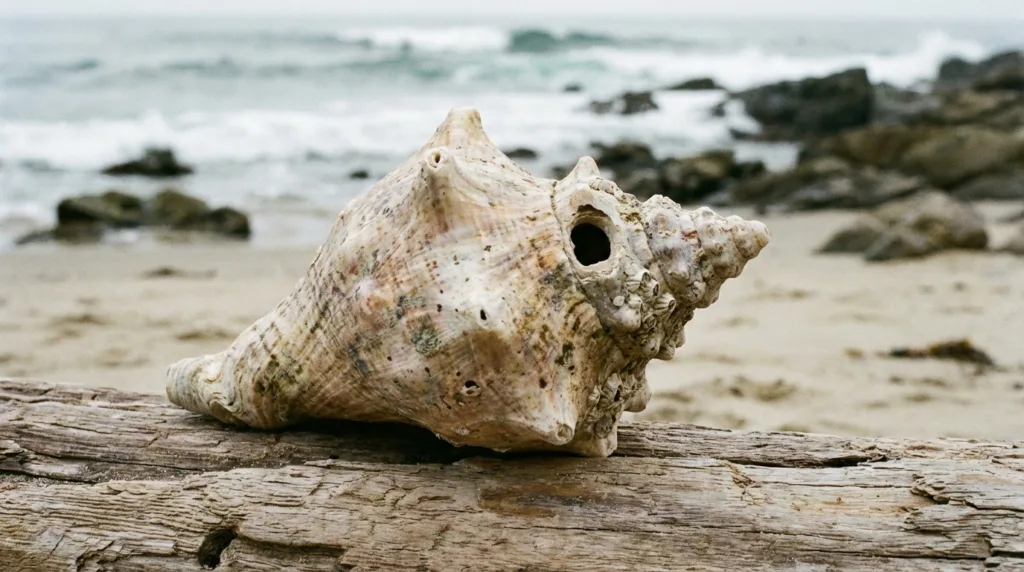
It’s a strange feeling the first time a Conch Shell Trumpet speaks back. The shell is cool in your hand, faintly salty if it has lived a life near the sea, and when your lips finally “catch,” the note blooms with a round, horn-like core that feels older than any workshop.
Not polite. Not timid. Just present.
🐚 Instrument Profile
| Instrument Type | Lip-reed natural trumpet (end-blown shell aerophone) |
| Primary Material | Marine gastropod shell (mostly calcium carbonate, often in aragonite form) |
| How Sound Starts | Your lips buzz; the shell’s spiral acts as a resonant air path (a “coiled tube” with its own sweet spots) |
| Measured Pitch Examples | Upper Paleolithic shell horn recordings have produced notes around 256–285 Hz (three stable tones). Neolithic shell trumpets tested in Catalonia have shown fundamentals clustered around 395–471 Hz, with one measured example around 595 Hz. |
| Measured Dimensions Example | A Classic-period archaeological example from the U.S. Southwest measures about 19.0 cm long and 13.5 cm wide, with an aperture (orifice) diameter about 1.8 cm. |
| Carry Distance (Real-World Tests) | Acoustic experiments with a modern replica have shown audibility up to about 1 mile (≈1.6 km) in suitable conditions. |
| Typical Note Set | Often one dominant pitch plus partials; some traditions (for example Japanese horagai) develop multiple notes through technique and a fitted mouthpiece. |
If you’ve only heard a conch horn in movies, you might expect a blunt “sea call.” The real thing is more layered: a dense fundamental with grainy overtones that shift as your embouchure tightens, relaxes, then tightens again (yeah—your lips will negotiate).
🎺 Sound Path and Physics
- Lip Buzz = Engine: Like a brass instrument, your lips supply the vibration. No reed. Just you.
- Spiral Bore = Filter: The shell’s interior favors certain frequencies and damps others, shaping a signature timbre.
- Length Matters: Measured examples show that shell length correlates with the fundamental frequency; shorter effective “tube” length can push pitch higher.
- Opening Size Matters: Instrument tests indicate smaller, cleaner openings tend to support more stable tone and make it easier to find overtones, while larger openings can feel louder but less steady.
Here’s the part people miss: the Conch Shell Trumpet is not “random noise in a spiral.” It behaves like a natural trumpet with a personality. The spiral and flare create a pressure landscape—tiny pockets where a note locks in, then slips away if you push too hard. You don’t just blow; you steer the air. Sometimes gently. Sometimes with stubborn patience.
And yes, it can feel like the shell is teaching you instead of the other way around.
🧪 Materials, Mass, and Mouthfeel
- Shell Composition: The hard structure is largely calcium carbonate (commonly aragonite) with an organic matrix—tough, stiff, and surprisingly “ringy” when excited by air vibration.
- Wall Thickness: Thicker shells often feel more anchored in the low end (less flutter), while thinner areas can add a raspier edge.
- Surface Texture: Polished interiors can reduce turbulent noise; rougher interiors can introduce a subtle breathy grain.
- Temperature: Cold shell, warm breath—this contrast changes comfort at the lips and the ease of starting the buzz (especially if a metal mouthpiece is fitted).
As a maker, I think of the shell as a naturally cast acoustic object—part sculpture, part instrument. Run a finger over the ridges and you feel the growth history. Inside, the spiral isn’t just pretty geometry; it’s an acoustic corridor. That corridor can make the tone feel dense, like the sound has weight, not just volume.
Then there’s the tactile truth: a conch trumpet has back-pressure. Not huge, but real. The resistance is the instrument telling you, “That’s enough air—now shape it.”
🧰 Craft Choices That Change the Voice
- Apex Cut vs. Natural Blow: Grinding/cutting the spire apex to form a blowing edge can improve consistency and comfort.
- Fitted Mouthpiece: Some traditions attach bronze, wood, bamboo, or built-up metal mouthpieces; this can sharpen attack and expand note control.
- Opening Diameter: Tested Neolithic examples show that opening diameter can influence tonal stability and the ability to access overtones.
- Aperture Edge Finish: Smoother edges protect lips and can reduce airy turbulence at the start of the tone.
Two shells can look similar on a shelf and feel utterly different in the mouth. A cleanly finished blowing edge often gives you a clearer onset, while a rough edge can add breath noise—sometimes charming, sometimes messy. It’s a bit like the difference between a well-cut nut on a stringed instrument and one that pinches: the note is there either way, but the response changes.
One more detail collectors love: fitted mouthpieces can “standardize” the lip interface, but they also imprint a certain character—more direct, slightly more brass-like, sometimes a little less wild. Choose your wildness. Seriously.
🏛️ Deep Time, Living Traditions, and a Modern Moment
- Upper Paleolithic Sound Revival: A conch shell horn from Marsoulas Cave (France) has been studied and recorded in the modern era, producing stable tones after millennia of silence.
- Neolithic Europe in the Spotlight: In 2025, researchers publicly discussed Neolithic shell trumpets from Catalonia (Spain), including measured pitch ranges and playing tests—bringing global attention back to the shell trumpet as a serious instrument, not just a curiosity.
- Ritual and Signaling: Across cultures, shell trumpets appear in ceremonies, processions, and long-distance communication where a strong, carrying tone matters.
The Conch Shell Trumpet has the rare gift of being both ancient and current. It shows up in museum cases, yes—but also in living practice: temple calls, mountain signals, stage cues, and contemporary sound design where that ocean-metallic brightness slices through a mix without sounding like any modern synth.
And when you learn that measured Neolithic shells can sit up around 395–471 Hz (with an outlier near 595 Hz), it reframes the instrument: this isn’t always a “low moan.” Sometimes it speaks in a higher, more piercing register—almost alert-like. Unexpected, but totally plausible once you hear it.
🔍 What to Listen For When You Hear One
- Attack: Does the note “click” into place or smear in with airy noise?
- Core Tone: Is the center round (horn-like) or edgy (buzzy)?
- Bloom: Many shells start narrow, then open into a fuller sound after a fraction of a second.
- Overtone Glow: A good shell lets partials shimmer without the tone collapsing.
- Stability: Can you hold a steady pitch, or does it wobble as soon as you increase intensity?
A conch trumpet that “blooms” well feels alive. You start the note, it narrows—then the shell catches it and adds that resonant halo. It’s a little like striking a bell and realizing the bell has an entire second voice inside it. That’s the spiral resonance doing its thing.
Dark Body |■■■■□□□□□□| Bright Edge
Stable Pitch|■■■□□□□□□□| Expressive Wobble
Vs. Comparisons That Actually Help
Vs. Brass Trumpet
- Control: Brass trumpet offers precise pitch and wide range; the shell offers fewer stable notes but a uniquely textured voice.
- Feel: Brass is engineered resistance; conch is “found” resistance—quirkier, sometimes stubborn.
- Timbre: Brass can be brilliant and focused; conch often sits between horn and foghorn, with a raw edge that reads as ancient to the ear.
If you love brass for its accuracy, the shell will feel like jazz. If you love the shell, brass can feel almost too clean. Different pleasures.
Vs. Shofar
- Material: Shofar is keratin (ram’s horn); conch is mineralized shell. That difference alone shifts the “grain.”
- Sound: Shofar often emphasizes a brassy, tearing buzz; conch tends to add a hollow resonance from its spiral cavity.
- Response: Many players find shofar attacks quickly; conch may demand more patience before the note locks.
Both are lip-driven, both are ritual-capable, and both can make a room go quiet—fast.
Vs. Didgeridoo
- Breath Strategy: Didgeridoo commonly uses circular breathing; conch playing can be powerful in shorter phrases, though advanced players can extend technique.
- Texture: Didgeridoo excels at rhythmic overtones and vocalizations; conch excels at single-note authority and signal clarity.
- Pitch Behavior: Didgeridoo often sits in a drone center; conch can shift between a few stable notes depending on design and approach.
Think of the conch as a “call.” Think of the didgeridoo as a “world.”
🧿 Regional Names and Cultural Forms
- Horagai (Japan): A conch trumpet tradition that uses a fitted mouthpiece and develops multiple playable notes.
- Shankha / Sankha (South Asia and Himalayan regions): A sacred conch context, often associated with ceremonial use and iconography.
- Pū (Hawaiʻi) and Related Oceanic Forms: Shell trumpets used for calling, signaling, and ceremony, often emphasizing projection.
- Archaeological Shell Trumpets (Americas and Europe): Museum objects show deliberate modifications (apex grinding, lip smoothing) that treat the shell as a crafted instrument.
These names matter because they hint at how the instrument is expected to behave. A tradition that adds a mouthpiece often pursues note control. A tradition that blows the shell more directly often pursues signal power and ritual impact. Same idea, different priorities.
Also—small aside—some shells feel like they want to be “played,” others feel like they want to be “sounded.” That’s a real distinction once you’ve held a few.
🧼 Care, Storage, and Long-Term Stability
- Skip Acids: Shell is calcium carbonate; acidic cleaners can etch and dull the surface and weaken edges.
- Gentle Cleaning: Use mild soap and water, then dry fully—especially around a cut apex or any fitted mouthpiece.
- Mind the Rim: A chipped blowing edge changes response; store so nothing presses on the mouth area.
- Humidity and Heat: Avoid prolonged high heat; sudden changes can stress joins if a mouthpiece is attached.
Collectors sometimes chase shine, but a conch shell trumpet doesn’t need to look brand-new to sound wonderful. In fact, a slightly aged surface can feel more honest in the hand—less slippery, more grippy. The real goal is preserving structural integrity: the blowing edge, any drilled/cut areas, and any mouthpiece seat.
🧭 Evaluating One Before You Commit
- Edge Geometry: Look for a smooth, even blowing rim (no sharp micro-chips).
- Air Leaks: If there’s a fitted mouthpiece, check for wobble or gaps at the seat.
- Crack Lines: Hairline cracks near the apex or along stress points can spread over time.
- Playability Test: A shell that consistently speaks at moderate effort is a keeper; one that only speaks when you “fight it” can become a shelf piece fast.
Here’s the practical truth: the best Conch Shell Trumpet is the one you actually use. A flawless-looking shell that refuses to speak will quietly drain your enthusiasm. Meanwhile a cosmetically imperfect shell that starts easily—whoa—can become your go-to voice for years. That’s not romance; it’s instrument logic.
And yes, sometimes you’ll meet a shell that plays beautifully and looks a little odd. That happens. Nature didn’t read a catalog.
FAQ
Is it hard to learn the Conch Shell Trumpet?
Answer
It can feel tricky at first because the lip buzz has to “lock” into the shell’s resonance. Once you find that spot, the basics come quickly. Consistency is the real skill—getting a clean start every time.
How do I know if a conch shell trumpet is playable or just decorative?
Answer
A playable shell usually has a smooth, comfortable blowing edge (often a worked apex or a clean mouthpiece seat) and produces a stable tone without extreme effort. Decorative shells often look great but have awkward edges or leaks that make the tone unstable.
What makes one conch shell trumpet sound higher or lower?
Answer
Shell size and effective tube length strongly influence pitch. Measured examples show fundamentals can sit around 256–285 Hz for one recorded prehistoric shell horn, while tested Neolithic shells have shown fundamentals around 395–471 Hz (with a higher outlier near 595 Hz). Design choices like opening diameter also affect stability and usable overtones.
Do I need a mouthpiece, or can I play the shell as-is?
Answer
You can do both. A fitted mouthpiece can improve comfort and note control, while direct blowing often keeps the sound more raw and traditional. The “better” choice depends on whether you prioritize control or character.
How loud can a conch shell trumpet get in real life?
Answer
Very loud. In practical tests with modern replicas, the sound has been reported as audible up to about 1 mile (≈1.6 km) under suitable conditions. Indoors, the projection can feel even more intense because reflections reinforce the core tone.
How should I clean and store an antique conch shell trumpet?
Answer
Use mild soap and water, dry it fully, and avoid acidic cleaners that can etch calcium carbonate shell. Store it so the blowing edge and any mouthpiece seat are protected from knocks. Gentle care preserves both sound and value.