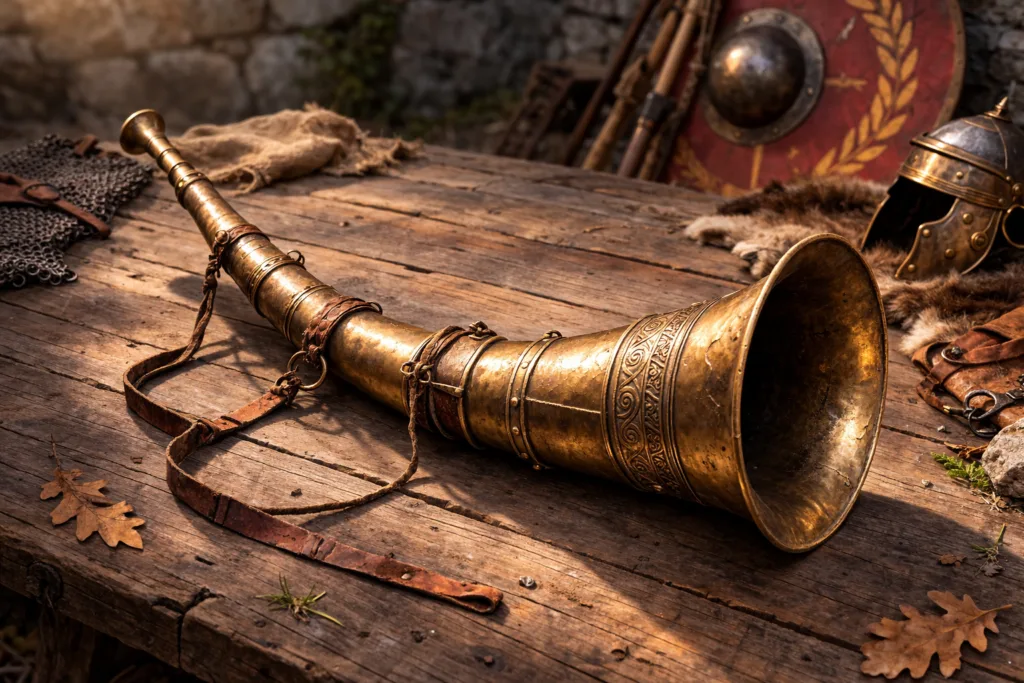
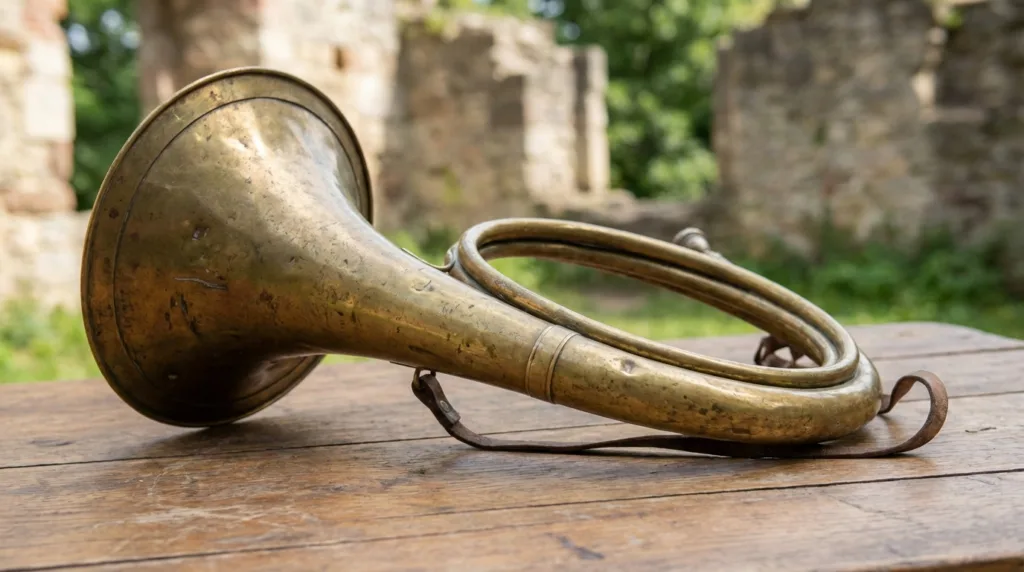
A three-meter loop of metal can speak louder than a crowd. That’s the Roman cornu—a shoulder-borne brass horn that feels less like “playing music” and more like steering airflow through a living, vibrating tube.
Not delicate. Not shy. Just direct.
The Cornu as an Object You Can Hold 🏺
| Form | Large “G”-shaped curve with a crossbar brace |
| Overall Length | Roughly 3 m (about 11 ft) of tubing when uncoiled |
| Material Family | Metal (commonly described as bronze / copper-alloy in surviving and reconstructed examples) |
| How It’s Carried | Balanced on the shoulder, stabilized by the crossbar |
| Why It Existed | To project—signals in military life, plus use in public spectacle and ceremony |
| Archaeological Reality | Rare survivals include examples from Pompeii; individual components like mouthpieces have also been found in Roman sites |
- What you notice first: the geometry. That “G” isn’t decoration—it’s logistics.
- What you notice second: the brace. The crossbar isn’t optional; it’s the instrument saying, “I’m heavy enough to need a spine.”
- What you notice third: the feel of the metal—cool, slightly “dry” under the hand, and surprisingly resonant when you tap the tube with a fingernail.
In a workshop mindset, the Roman cornu is a study in controlled compromise: you want maximum acoustic reach without making a player wrestle a straight three-meter lance. So you bend it, brace it, and let the shoulder do some of the work.
And yes—when you see one up close, it looks a bit like a big question mark with confidence. What did you expect?
Material, Wall, and Why the Metal Changes the Voice 🔧
- Alloy character: small changes in copper-tin (bronze-like) mixes can shift stiffness and damping, nudging the timbre toward brighter bite or softer bloom.
- Wall thickness: thicker walls tend to feel more stable under pressure, often yielding a slightly “anchored” core; thinner walls can feel more lively but less forgiving.
- Seams and joins: construction details (sections, soldering/brazing choices) affect how energy travels through the tube—tiny, but not imaginary.
- Bell flare: the end profile shapes how the instrument throws sound into space (projection) versus how it feels under the ear (feedback).
- Mouthpiece fit: the receiver and mouthpiece geometry can alter resistance more than most people expect.
Here’s the tactile truth: metal isn’t just “metal.” A Roman cornu made with a slightly stiffer tube tends to give you a cleaner edge at the start of notes—attacks feel like they click into place. A more compliant tube can feel warmer, but it may blur the very first millisecond (that tiny “pop” that helps signals cut through). It’s subtle, then suddenly it’s not.
Also, old surfaces matter in a human way. Patina doesn’t magically “improve tone,” but it does change how your hands grip the instrument, how it reflects heat, and how you treat it—carefully, reverently, a little slower. That changes sound indirectly. Yep.
Playing Feel: Breath, Backpressure, and Shoulder Balance 🎺
- Posture: shoulder takes the load; hands guide alignment.
- Breath plan: think long column of air, not “short blasts,” even for signals.
- Embouchure: works like other natural brass—lip tension selects partials.
- Resistance: expects steady support; it punishes hesitant airflow.
- Stability: crossbar becomes your anchor point (and your friend, honestly).
A Roman cornu doesn’t sit “in front of you” the way a modern trumpet does. It sits on you. That changes everything: your chest becomes part of the feedback loop, and the instrument feels like it pushes back with a slow, springy resistance—not stiff, not loose, more like leaning into a firm door that eventually swings.
Players often describe a weird moment (in a good way): you find the note, then the tube seems to lock into resonance and your face relaxes. The sound gets louder without effort. It’s the kind of “oh!” that makes you grin even if you pretend you’re serious.
One more thing—short, honest sentence: it’s physical.
Timbre and Projection: What the Cornu Sounds Like Up Close 🛡️
| Core Tone | Focused, bright-leaning natural brass sound with a firm center |
| Attack | Fast, clear onset when supported—ideal for signals |
| Carry | Designed to travel in open air and over noise |
| Color Shift | Changes noticeably with mouthpiece fit and how hard you drive the air |
- Soft playing: can feel slightly grainy (in an earthy way) because the instrument wants energy.
- Medium playing: the sweet spot—notes snap into place, and the horn “speaks.”
- Hard playing: you get that commanding edge; overdo it and the tone can turn sharp and tiring.
Technically, a Roman cornu behaves like other natural brass: it gives you the harmonic series. That means you don’t “choose notes” with keys or valves—you choose them with embouchure, breath speed, and a touch of courage. Melodic playing is possible, but the instrument’s personality leans toward clear intervals and strong partials rather than quick chromatic runs.
A Simple Harmonic Map You Can Feel 🧪
- Lower partials: big, stable, and physically satisfying (you feel them in the sternum).
- Middle partials: the “signal zone” where clarity meets reach—useful, reliable.
- Upper partials: brilliant but demanding; intonation becomes a conversation between lips and tube.
If you’ve only heard modern horn sections, the cornu may surprise you. The sound is less “velvet” and more “bronze light.” Not harsh—just unapologetically present. And in a reflective space, it can bloom into a halo that feels almost ceremonial.
Where the Cornu Lived: Signals, Spectacle, and Daily Order 🏺
- Military signaling: used to help communicate commands and organize movement.
- Public games and arenas: appears in Roman art among instruments tied to large public events.
- Ceremonial settings: processions, formal moments, and the kind of civic theater Rome loved.
The performer mattered as much as the instrument. The cornicen (cornu player) wasn’t just “a musician”—they were a functional part of coordination, timing, and public rhythm. In that sense, the Roman cornu sits at a crossroads: music, messaging, and ritual all wrapped into one curved tube.
There’s also a modern echo, in a friendly way: today, historical performance groups and music-archaeology teams build playable replicas, test acoustics, and bring these sounds back into museums and live demos. It’s not nostalgia—it’s hands-on research. (And it’s fun, let’s be honest.)
Cornu Vs. Other Roman Brass Voices ⚔️
| Instrument | Typical Shape | Typical Role | Sound Impression |
|---|---|---|---|
| Cornu | Curved “G” with crossbar | Signals, ceremony, public spectacle | Commanding, carrying, stable core |
| Tuba | Mostly straight trumpet-like form | Signals and formal functions | Direct, clear, “forward” |
| Lituus | Long with an upturned bell | Often linked to ritual and signaling | Focused, bright, cutting |
| Buccina | Curved horn form (descriptions vary) | Associated with calls and timing duties | Functional, practical |
Think of it like a toolkit. The Roman cornu specializes in reach and recognizability; its shape helps a player hold a long tube without chaos. Meanwhile, other Roman horns occupy nearby lanes—similar goals, different ergonomics. And yes, the historical record can be messy; Rome was big, and terminology doesn’t always behave.
Cornu Vs. Modern French Horn 🎼
- Cornu: natural harmonic series, built for projection and signals; shoulder-borne balance.
- French horn: valves for chromatic range; right-hand bell shaping; orchestral blend.
- Feel difference: cornu often gives a more raw feedback loop—what you put in is what you get back.
A French horn can whisper and shade color with astonishing finesse. A Roman cornu can do nuance too, but it prefers to be understood from far away. Different jobs. Different DNA.
Cornu Vs. Sousaphone 🎺
- Similarity: both wrap around the body for carry and comfort.
- Difference: sousaphone is a modern, valve-driven bass powerhouse; cornu is a natural horn optimized for clear signals.
People love comparing the two because the silhouette rhyme is real. But the experience is different: sousaphone is a moving foundation; Roman cornu is a moving announcement.
Owning, Building, or Evaluating a Cornu Today 🧷
- Most “cornu” you’ll encounter: modern replicas, museum reproductions, or educational builds.
- What to verify first: tubing length target (around 3 m), crossbar placement, mouthpiece interface, and overall balance.
- What to ask the maker: how they determined geometry (archaeological models, museum examples, or published organology).
- What to avoid: vague claims of “ancient authenticity” with no documentation—keep it simple, keep it checkable.
If you’re commissioning a Roman cornu replica, start with the question that decides everything: do you want playability, or do you want a display-faithful form that happens to be playable? Ideally you get both, but trade-offs happen. Makers may tweak wall thickness, mouthpiece fit, or brace comfort so a modern shoulder and jaw can sustain the instrument without strain. That’s not “cheating.” That’s making a living instrument.
And for collectors: keep your standards high but your tone friendly. Ask for measurements. Ask for build notes. Ask for how they tuned and tested. Then listen. The ear catches what the spec sheet misses—every time.
A Practical Setup Checklist ✅
- Mouthpiece fit: secure, aligned, no wobble. Small leaks steal focus.
- Brace comfort: crossbar contact should feel stable, not sharp, not slippery.
- Balance point: you should be able to hold position without clenching the wrists.
- Response test: medium airflow should “catch” a partial without forcing.
- Fatigue check: if your neck hurts quickly, adjust carry—don’t tough it out.
Care, Handling, and Long-Term Stability 🧼
- Handling: hold at the brace and stable tube points; avoid gripping thin spans where dents happen easily.
- Cleaning: use gentle, non-abrasive methods; avoid aggressive polishing that removes surface integrity.
- Storage: stable temperature and humidity help keep joints and finishes calm.
- Transport: support the curve and the bell; the G-shape needs a case or cradle that respects its geometry.
With a Roman cornu, a little care goes a long way. The instrument is basically a long resonant system; anything that changes alignment—tiny bends, loosened joins, stressed braces—shows up as response changes. So keep it stable, keep it supported, and treat it like a precision object that happens to roar.
FAQ ❓
Is it hard to learn the cornu if I already play brass?
Open answer
If you already play brass, you’ll recognize the core skills: embouchure, breath support, and partial control. The bigger challenge is ergonomics—how the shoulder-borne shape changes posture and endurance. Most players adapt faster than they expect, especially if they treat balance as the “first lesson,” not an afterthought.
How do I know if a cornu replica is historically sensible?
Open answer
Look for clear, checkable choices: a roughly 3 m tube length, a true “G” curve, a crossbar brace, and a mouthpiece interface that makes acoustic sense for natural brass. A good maker can explain what they copied (museum examples, published organology) and what they adjusted for modern playability.
What does a cornu actually sound like in a room?
Open answer
Expect a focused, carrying brass voice with a bright edge and a stable center. At moderate volume, the sound can feel almost ceremonial; push harder and it becomes unmistakably “signal-like.” The room matters a lot—stone and hard surfaces make it bloom, soft rooms make it feel drier.
Can I play melodies on a cornu, or only signals?
Open answer
You can play melodies, but the instrument naturally favors the harmonic series. Simple tunes that sit well on natural partials feel great. Fast chromatic lines are harder because you don’t have valves—your lips and air do the note selection, and that takes practice (and a bit of stubborn joy).
Why does the cornu have that G-shape and crossbar?
Open answer
The long tube needs a way to be carried and stabilized. The “G” curve compacts length, and the crossbar stiffens the structure while giving the player a practical support point on the shoulder. It’s a design built for real-world use, not display.
What mouthpiece works best on a cornu replica?
Open answer
There isn’t one universal answer because replicas vary. In general, you want a mouthpiece that seals well and gives predictable resistance without making the upper partials painfully sharp. A good maker will recommend a compatible option and confirm the receiver dimensions so you don’t fight leaks or poor fit.