Most short entries reduce the crotalum to “an ancient castanet.” Useful, yes. Enough, no. The older evidence points to a small hand-held clapper family rather than one frozen museum shape: sometimes closer to wooden clappers, sometimes closer to small metal finger cymbals, always tied to rhythm, gesture, and dance. That distinction matters, because with the crotalum the material is the sound.
| Aspect | What Fits the Evidence Best | Why It Matters |
|---|---|---|
| Instrument Family | Hand percussion idiophone; clapper / castanet branch | The body itself vibrates. No skin, no string, no reed. |
| Main Function | Rhythmic punctuation for dance, procession, and bodily timing | The crotalum marks pulse more than pitch. |
| Likely Materials | Wood, shell, and metal forms are all plausible in the ancient record | Each material changes attack, ring, weight, and feel in the hand. |
| Playing Method | Not fully fixed; one-hand manipulation and pair-in-each-hand use both appear in later descriptions and modern summaries of visual evidence | This is not a neatly standardized concert instrument. |
| Best Modern Analogy | Between castanets and finger cymbals | That “between” space is where most modern summaries stop too early. |
🏺 Collector’s Note
When a catalog, blog, or museum label says crotalum, it may be naming a family resemblance more than a single locked form. That is why one source sounds castanet-like, another sounds cymbal-like, and both can still be pointing toward the same ancient rhythmic idea.
What the Crotalum Really Was
The Greek krotalon and the Latin crotalum refer to a rattle- or castanet-like clapper. In practical terms, that means a compact concussion idiophone: two sounding parts meet, the strike happens fast, and the ear catches a dry click, a sharp snap, or a brighter metallic ping depending on the build. Small instrument. Clear authority.
Ancient descriptions connect it closely with dance, and surviving visual evidence from Attic pottery places krotala in the hands of dancing figures, especially maenads. That iconography matters because it keeps the crotalum inside the moving body. It is not just a noise-maker. It is a timing tool, a kinetic cue, and a piece of choreography all at once.
That is where many modern summaries thin out. They define the instrument, compare it to castanets, then move on. The more useful reading keeps three facts in view:
- There was likely no single standard build.
- Material changed the voice of the instrument in a very direct way.
- The crotalum sits in a border zone between clapper, castanet, and finger cymbal.
Without those three points, the instrument gets flattened. And it should not be.
The Name Does Not Lock the Shape
That is the first thing to keep straight. A modern orchestral instrument usually arrives with fixed dimensions, a stable tuning idea, and a known playing setup. The crotalum does not. The name points more safely to function and sound behavior than to one factory-clean silhouette. So varied, in fact, may the forms have been that the most honest reconstruction starts with gesture and acoustic result, not with a single drawing copied too literally.
Wood, Shell, and Bronze
| Material | Likely Timbre | Feel in the Hand | Best Use |
|---|---|---|---|
| 🪵 Dense wood | Dry, short click; fast decay; strong pulse definition | Warm, light to medium weight, less slip than metal | Dance rhythm, repeated patterns, quick articulation |
| 🐚 Shell | Crisp but lighter snap; a touch brittle; less body than hardwood | Light, quick, slightly sharper edge | Bright rhythmic accents without long ring |
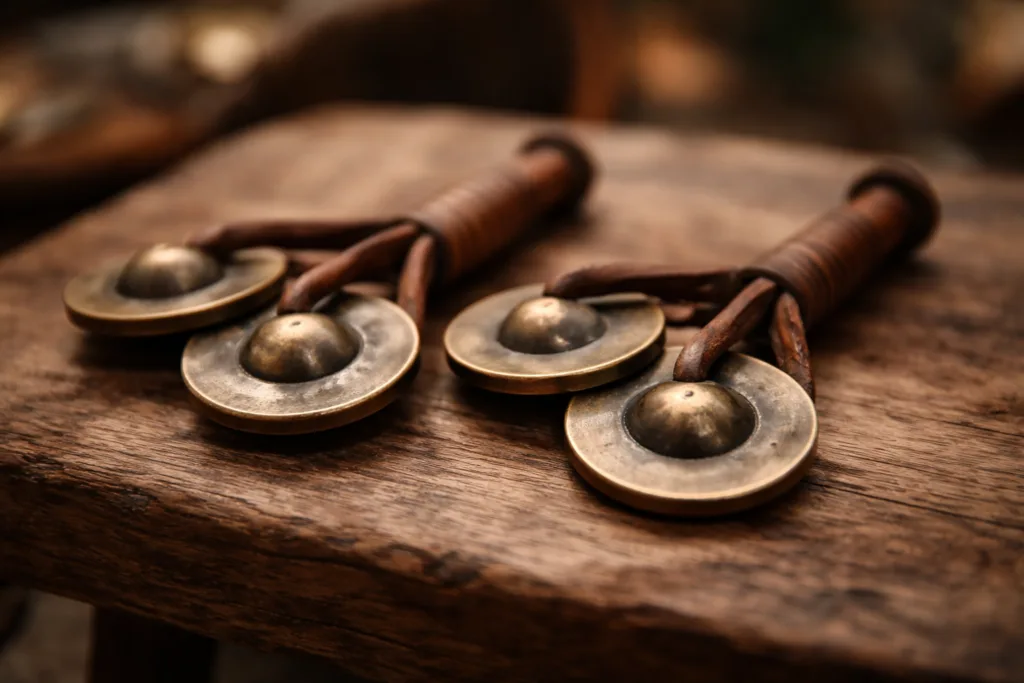
| 🥉 Bronze or copper alloy | Brighter attack, more upper sparkle, longer after-ring | Cooler, denser, more exacting under the fingers | Sharper projection, ritual or processional edge, open-air cut |
A luthier’s eye lands here first: material choice is not cosmetic. It decides whether the crotalum speaks as a dry click or a bright metallic flash. Dense wood gives a fast attack and then gets out of the way. That makes it easy to layer stroke after stroke without the previous sound clouding the next one. For dance, that is gold. Or better—plain, reliable timing.
Shell sits in a narrower lane. It can be quick and crisp, but it does not usually carry the same grounded body as dense hardwood. There is a slightly more fragile edge to it, a sound that feels thinner and tighter. Not weak. Just leaner.
Bronze and related copper alloys change everything. The strike grows brighter, the upper partials step forward, and the note hangs on longer. Even a very small metal clapper starts to push beyond simple beat-marking into sonic color. That extra ring can help in a procession or outdoor setting, where a wooden click may vanish too fast. Indoors, though, too much ring can blur fast patterns. Trade-off after trade-off—this instrument is full of them.
🔧 Pro Tip
For a historically minded wooden crotalum reconstruction, a dense hardwood is usually the better starting point than a soft, open-grain wood. Harder stock gives a cleaner front edge to the sound and a shorter tail, which suits repeated rhythmic figures far better.
Why Dense Wood Often Beats Soft Wood
Soft wood tends to soften the very thing the crotalum needs most: the attack. The note arrives with less bite, the edges feel fuzzy, and repeated strokes can turn papery. Dense wood, by contrast, keeps the transient firm. The click stays readable. In a hand percussion instrument this small, readability is half the battle.
Simple reason, big result.
Why Metal Can Be Better—and Worse
Metal projects. That is its gift. It also lingers. That is its risk. If the player wants a glinting, audible edge that cuts through voice, pipe, or open movement, bronze-like material makes sense. If the job is to mark a steady bodily pulse with no smear between beats, wood often behaves better. The right choice depends on whether the ear needs clarity of pulse or brightness of color.
How the Crotalum Was Likely Played
Here the evidence needs careful handling. One common description says the crotalum was held in one hand and worked somewhat like castanets. Another modern scholarly glossary, summarizing the visual record, describes crotala as pairs held in each hand and clicked rhythmically. Those accounts do not cancel each other out. They point to a more useful conclusion: the playing setup was probably not single and fixed.
That matters more than it may seem. A one-hand setup changes leverage, rebound, and rhythmic density. A pair-in-each-hand setup shifts the instrument closer to dance-linked bilateral marking, where the body itself becomes the metronome. Once again, the crotalum resists neat modern standardization.
And that is part of its character.
The Body Is Part of the Instrument
Many antique hand percussion instruments can be studied as isolated objects. The crotalum really cannot. On vase paintings, it appears with dancing bodies, turned torsos, lifted arms, and patterned movement. The sound is short, but the gesture around it is not. The instrument belongs to the wrist, fingers, elbow, shoulder, and step pattern as much as it belongs to the hand itself.
That is why a good reconstruction should not only sound right. It should move right.
What the Visual Record Adds
Attic vase painting is one of the clearest places where the krotala keep showing up. Late 6th- and early 5th-century BCE pieces depict maenads and related dancing figures with these clappers in hand. Those images do two useful things at once. First, they confirm the instrument’s link with movement. Second, they remind us that the crotalum belonged to a broader performance setting rather than to a lone, detached instrument cabinet.
Another detail often left out: visual evidence does not simply “illustrate” texts. It corrects them. Text can compress. Images preserve posture, spacing, hand position, and ensemble context. For the crotalum, that extra layer is not a bonus. It is basic evidence.
🧭 Collector’s Note
The safest curatorial reading is this: the crotalum is best understood through text plus image plus material logic. Any article that uses only one of those three will feel thinner than the instrument deserves.
Why So Few Hard Measurements Exist
Because the evidence is uneven. The ancient world did not leave a tidy product sheet for the crotalum, and surviving objects that can be tied to the name without doubt are not abundant. That is why many pages recycle the same short definition. It is easier. Still, later Roman-period finds of small metal hand cymbals from Egypt show that related hand percussion could be very compact—about 4.7 to 7.3 cm across in documented examples. Those numbers should not be forced onto every crotalum, but they do help calibrate scale. Small enough for finger work. Large enough to speak.
Vs. Castanets, Finger Cymbals, and Sistrum
| Instrument | Closest Match Point | Main Difference |
|---|---|---|
| Castanets | Handheld clapper logic and rhythmic role | Modern castanets are more standardized in shape, grip, and performance method |
| Finger Cymbals | Small scale, dance link, bright metallic option | Finger cymbals are fully metal and more openly cymbal-like in ring behavior |
| Sistrum | Ritual context and percussive shimmer | A sistrum is a shaken frame rattle, not a struck pair of clappers |
| Modern Crotales | Shared name history | Modern orchestral crotales are tuned discs with long shimmer; antique crotalum was a rhythmic hand clapper |
Vs. Castanets
Calling the crotalum an “ancient castanet” helps a reader get in the door. It does not finish the job. Castanets, as most players know them today, come with clearer expectations of shell shape, tying method, and finger technique. The crotalum, by contrast, sits earlier and looser in the record. The kinship is real. The one-to-one equation is a bit too tidy.
Vs. Finger Cymbals
This comparison gets closer when the material turns metallic. A bronze or copper-alloy crotalum can lean toward the high, cutting brightness of finger cymbals. Still, the old term seems to cover more than strictly metal pieces, which means the antique category remains broader. Put plainly, not every crotalum should be heard as a tiny cymbal, even if some very likely behaved that way.
Vs. Sistrum
This is one of the most common mix-ups. A sistrum is a shaken rattle-frame with its own ritual history and its own mechanical logic. The crotalum works by two sounding parts meeting directly. One shakes. The other strikes. That difference changes not only the sound but the whole playing gesture.
Vs. Modern Crotales
The name tempts the ear in the wrong direction. Modern crotales are tuned bronze discs, usually struck with mallets, prized for pitch shimmer and long sustain. The ancient crotalum is a different animal—smaller in concept, more physical in touch, and aimed first at pulse, not tune. Same linguistic branch. Very different musical job.
Period Feel and Build Logic
When antique instruments pass through long stretches of time, one trap appears fast: readers assume every period used the same object. The crotalum is a good warning against that habit. Archaic and Classical Greek imagery shows one performance world. Roman-period small metal cymbals point to another, or at least to a shifted edge of the same family. Better, then, to think in build logics rather than one frozen type:
- Clapper logic: short, dry, body-led rhythm.
- Shell logic: light, brittle, quick accents.
- Metal logic: brighter edge, more carry, more ring.
That reading also helps modern makers. A reconstruction does not need to pretend there was one perfect ancient template. It needs to decide which acoustic behavior it is trying to restore.
What a Plausible Reconstruction Should Get Right
- Scale: compact enough for agile finger or hand work
- Weight: light enough for dance-linked use, heavy enough to speak clearly
- Attack: immediate and readable
- Decay: short for wood, longer but controlled for metal
- Grip: secure under motion, not only at rest
If those five things are wrong, the result may look antique and still feel false.
🛠️ Pro Tip
When testing a reconstruction, listen for the second beat, not the first. Many clappers can make one attractive click. The better instrument keeps the next click just as clean, with no mush left hanging in the gap.
Why the Crotalum Still Feels Modern
Because it solves a timeless musical problem with almost no hardware: how to lock rhythm to the moving body in the most direct way possible. No tuning system to maintain. No membrane to stretch. No string length to manage. Just touch, strike, timing, and the small but exact voice of the material itself.
There is something very old about that, and very fresh too.
FAQ
Was the Crotalum Closer to Castanets or Finger Cymbals?
Show Answer
It sits between the two. Wooden forms lean closer to castanets because of their dry click and short decay. Metal forms lean closer to finger cymbals because they add brightness and a longer ring. The old term likely covered more than one build tradition.
Why Do Some Sources Say Wood While Others Mention Metal or Shell?
Show Answer
Because the crotalum was probably not one rigidly standardized object. Ancient and later descriptions point to a family of clapper-like instruments. Wood, shell, and metal all make sense within that family, and each one changes the timbre in a different way.
Did Players Use One Hand or Both Hands?
Show Answer
The record does not force a single answer. Some descriptions compare the instrument to castanets used in one hand, while other summaries of the visual evidence describe pairs in each hand. The safest view is that playing method may have varied by form, material, and performance setting.
Is the Crotalum the Same Thing as a Sistrum?
Show Answer
No. A sistrum is a shaken frame rattle, while a crotalum works through direct impact between two sounding parts. They can share ritual space and bright percussive character, but their mechanics and feel are different.
How Can a Modern Reconstruction Feel More Historically Plausible?
Show Answer
Start with behavior, not only appearance. The instrument should be small, easy to control in motion, quick in attack, and clear on repeated strokes. Dense hardwood suits a drier clapper voice, while bronze or copper alloy suits a brighter, more projecting one.