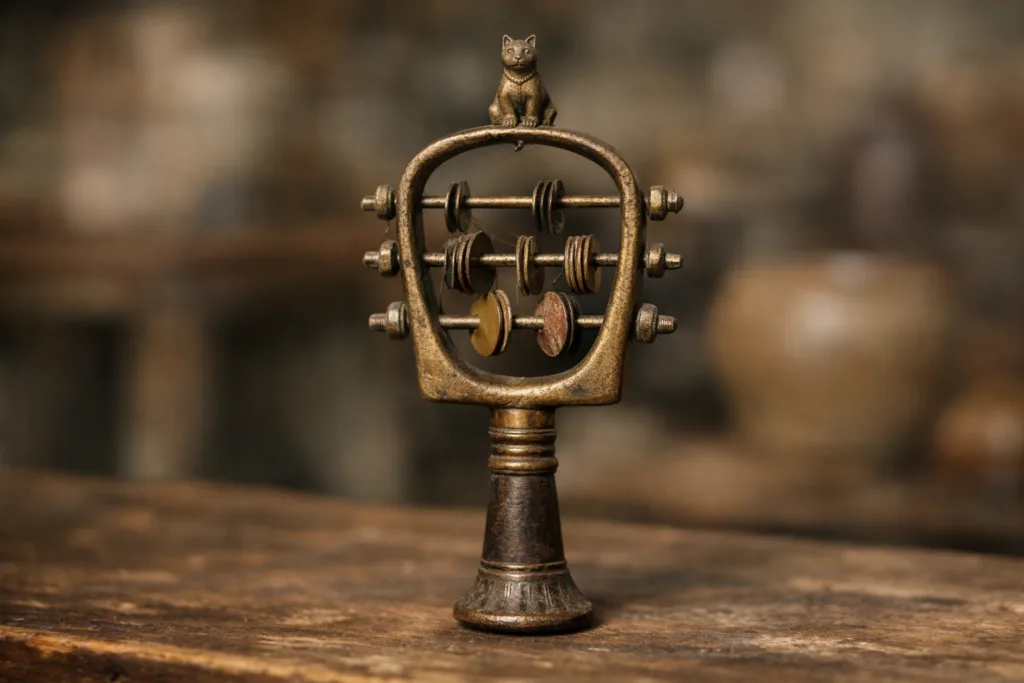
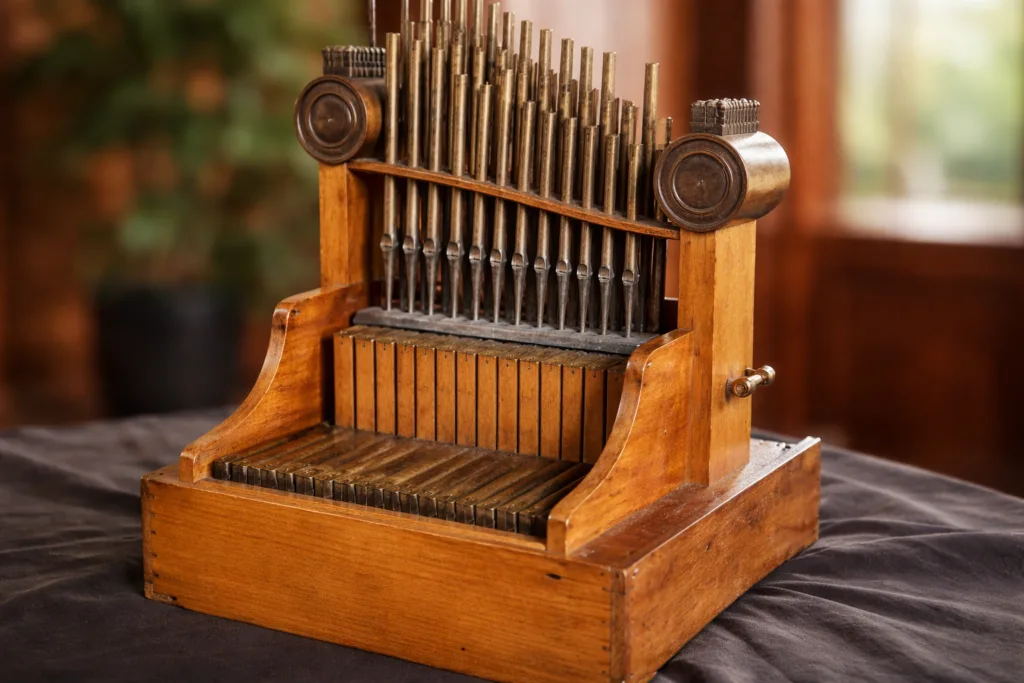
Before the organ became a church voice, it was already a pressure-managed machine of metal, water, and touch. The Hydraulis did not send water through its pipes to make sound. It used water to steady the wind, so the pipework could speak with a firmer, cleaner, more even voice than a loose cluster of blown tubes.
- Origin: Usually linked to Ctesibius of Alexandria in the 3rd century BC
- Type: The earliest known mechanical pipe organ
- Wind System: Hand-pumped air, levelled by water pressure
- Playing Method: Keys and sliders, not a self-playing fountain device
- Lineage: A direct early branch in the history of the later organ family
🔧 Main Parts and Their Job
| Part | What It Does | What It Changes In The Sound |
|---|---|---|
| Pumps | Push air into the system | Set the available wind supply and note length |
| Water Chamber | Levels out pressure swings | Helps notes start more evenly and hold pitch more steadily |
| Wind Chest | Stores ready wind below the pipes | Gives the instrument a more settled speech |
| Keys and Sliders | Open the path for chosen notes and ranks | Shape touch, response, and note selection |
| Pipes | Turn wind into pitch | Decide register, color, brightness, and carrying power |
The basic layout matters because the Hydraulis sits at the point where simple pipe logic meets controlled mechanical wind. That meeting is the whole story. Without it, there is no true organ behavior, only a set of pipes waiting for breath.
🏛️ What The Pressure System Really Does
- It keeps the wind steadier than raw hand pumping alone.
- It helps the pipes speak with a more settled attack.
- It allows louder public use without the tone breaking apart too easily.
- It turns engineering into musical control.
Many short articles stop at the phrase water organ and leave the wrong picture in the reader’s mind. The water is not the singing medium. Air still makes the tone. Water works as the regulator that holds the pressure line steady while the pumps rise and fall. That single point changes how the whole instrument should be heard, and how any reconstruction should be judged.
And that distinction is not small.
Water Regulator vs. Water-Powered Myth
The Hydraulis is often folded into the later idea of the water-driven garden organ, the kind tied to flowing water and self-moving display. That is a different branch. The antique Hydraulis still needs a player, still needs mechanical control, and still depends on air inside the wind system. In other words, this is a keyboard instrument with hydraulic pressure support, not a decorative automaton pretending to be one.
The pipes sing on air. The water keeps that air honest.
That point also helps explain why newer work on the pressure chamber matters. Some recent studies argue that the real Hydraulis may have run at higher pressure than many reconstructions assume. If that reading is right, the tone would not be merely smooth; it would have more bite at the front of each note, more edge in outdoor use, and more authority in a crowd.
When a museum label says water organ, check whether it explains how the air was stabilized. If it does not, the most useful part of the instrument has been left out.
🎼 What Sort of Voice It Had
- Pipe Family: The surviving ancient finds point to flue pipes, not reed pipes.
- Material Bias: Metal pipes tend to sound more radiant and carrying than wood-heavy ranks.
- Open vs. Closed Logic: Closed pipes speak softer and with fewer upper partials than open ones of the same length.
- Scaling: Length and diameter still govern pitch depth and tonal weight.
That makes the Hydraulis less mysterious than it first appears. Its sound world belongs to the organ family, but at an early, lean, public-facing stage. A compact rank of metal flue pipes under steady pressure does not whisper. It projects. The likely result is a tone with a direct center, a clear front edge, and enough upper-color energy to travel in open air.
Not plush. Not misty. Focused.
Bronze Pipes vs. Wooden Pipe Traditions
Here the material story gets interesting. Surviving examples and reconstructions place bronze or other copper-alloy pipework at the center of the Hydraulis image. In organ building more broadly, metal pipes are usually heard as brighter, more harmonic, and more carrying, while wooden pipes lean darker, softer, and more fundamental in tone. That does not mean every metal pipe is bright or every wooden pipe is dull—mouth cut, wind entry, pipe scale, and voicing still matter—but it does mean the antique metal-built Hydraulis likely spoke with more shine and more forward throw than a later wood-heavy chamber organ of similar size.
There is also a tactile side to that choice. Metal keeps a precise edge at the mouth and holds a stable pipe profile, which matters because tiny shifts around the speaking area change the turbulence that starts the note. On an instrument where pressure control is such a big part of the design, that precision is not decoration. It is part of the voice.
Published descriptions of the Dion Hydraulis mention silver rings and colored glass ornament on the body. Those details matter, but mostly as marks of finish, status, and visual craft. They do not outweigh pipe scale, mouth geometry, and wind behavior in shaping the actual tone.
Hydraulis vs. Later Bellows Organs
Compared with many later bellows organs, the Hydraulis likely felt tighter in speech and less cushioned at note onset. A later church organ can bloom inside architecture; the Hydraulis had to state itself more quickly. That difference matters. One instrument blends into a room over time. The other has to seize air at once.
Modern pipe organs also spread their color across far larger compass ranges, more ranks, and more room-dependent blend. The antique Hydraulis sits earlier in that family line—narrower in range, sharper in profile, and more exposed in every design choice.
Dion vs. Aquincum
| Find | What Survives | What It Suggests |
|---|---|---|
| Dion | Early bronze pipework and decorated upper structure | A visually refined instrument in which sound and prestige were closely linked |
| Aquincum | A later copper-alloy organ with 52 pipes in four rows, bronze key sliders, and a documented civic setting | A more clearly layered register system and a mature Roman organ layout |
Placed side by side, these two finds do more than prove that the Hydraulis existed. They show that it was not one frozen design. Dion preserves the image of a refined, metal-faced instrument whose finish mattered almost as much as its mechanics. Aquincum, later and better documented in its control layout, shows rows, registers, and civic practicality more plainly.
That difference is worth holding onto. Too many summaries describe the Hydraulis as though one blueprint served every age and place. The evidence points instead to a family of related instruments—same principle, different build choices, different musical jobs, different levels of complexity.
Seen that way, Dion feels closer to a prestige object with a striking sonic profile. Aquincum feels more like a worked civic instrument with a clearer stop logic. Neither cancels the other. Together, they make the instrument easier to hear in the mind.
Why Material Choice Matters More Than Most Summaries Admit
- Bronze or Copper-Alloy Pipes: Help give the rank shape stability, brightness, and projection.
- Wood and Leather Elements: Likely shaped touch, sealing, and response even where they have not survived well.
- Pipe Mouth Geometry: Has a direct effect on how each note starts.
- Open or Closed Construction: Changes pitch relation and the balance of upper partials.
- Wind Pressure: Can turn the same pipe from mild to assertive.
It is tempting to reduce old instruments to a single magic material. Better not. The Hydraulis is a good reminder that material and construction work together. A bronze tube with poor mouth cut will not rescue itself. A well-shaped pipe under bad wind will still sound wrong. And a handsome case tells almost nothing about the speech of the rank until the pressure behavior is understood.
Metal alone does not make the voice.
This is where a maker’s eye helps. The old organ family has always lived in the thin borderland between craft and acoustics: alloy, wall stiffness, mouth width, toe opening, wind steadiness, and pipe scale all push against one another. The Hydraulis may be ancient, yet the listening problem is still the same one organ builders know today—small physical decisions leave audible fingerprints.
Where The Hydraulis Sat In Musical Life
- Festivals and Public Shows: Its carrying tone suited open or semi-open settings.
- Civic Feasts and Association Halls: The Aquincum evidence ties the organ to group life, ceremony, and social display.
- Elite Craft Culture: Fine metalwork and ornament show that the instrument could also act as a luxury object.
The Hydraulis was not born as a church staple. It belonged to public life first—festive, civic, performative, mechanical. That social place helps explain its tone. Instruments built for crowd-facing use tend to favor clarity, attack, and projection. They do not rely on hush or long room bloom to be persuasive.
Even its image carries that energy. This is not a shy antique. It is an engineered sound object built to be seen, heard, and remembered.
FAQ
How Did The Hydraulis Use Water Without Blowing Water Into The Pipes?
See Answer
The water sat in the pressure system, not in the speaking pipes. Its job was to steady the air supply coming from the pumps, so the wind reaching the pipes stayed more even. The sound still came from moving air at the pipe mouth.
Did The Hydraulis Sound More Like A Church Organ Or More Like Pipes And Flutes?
See Answer
It belonged to the organ family, but it likely sounded leaner, sharper, and more direct than many later church organs. Metal flue pipes under firm pressure would have given it a clear and carrying tone rather than a soft indoor bloom.
How Do I Know Whether a Reconstruction Is Convincing?
See Answer
Look at three things: how the pressure is stabilized, what kind of pipework is used, and whether the builder explains mouth geometry and scaling. A convincing reconstruction treats the Hydraulis as an acoustic machine, not just an archaeological shape.
Was The Hydraulis Really The First Keyboard Instrument?
See Answer
It is widely treated as the earliest known keyboard instrument because it joined pipes, controlled wind, and hand-played keys into one playable system. That is why it stands at the start of organ history rather than beside simple blown pipe clusters.
Why Do Dion and Aquincum Matter So Much?
See Answer
Dion gives an early and visually refined example of the instrument, while Aquincum offers later evidence with clearer register structure and a documented civic setting. Together they show that the Hydraulis changed over time instead of staying fixed in one pattern.