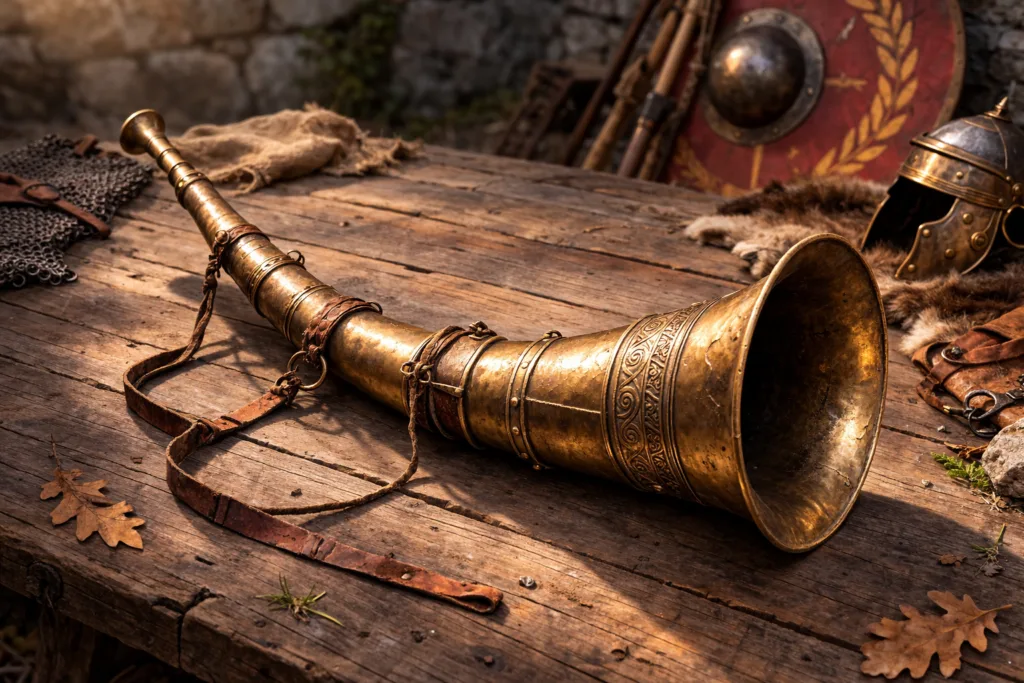
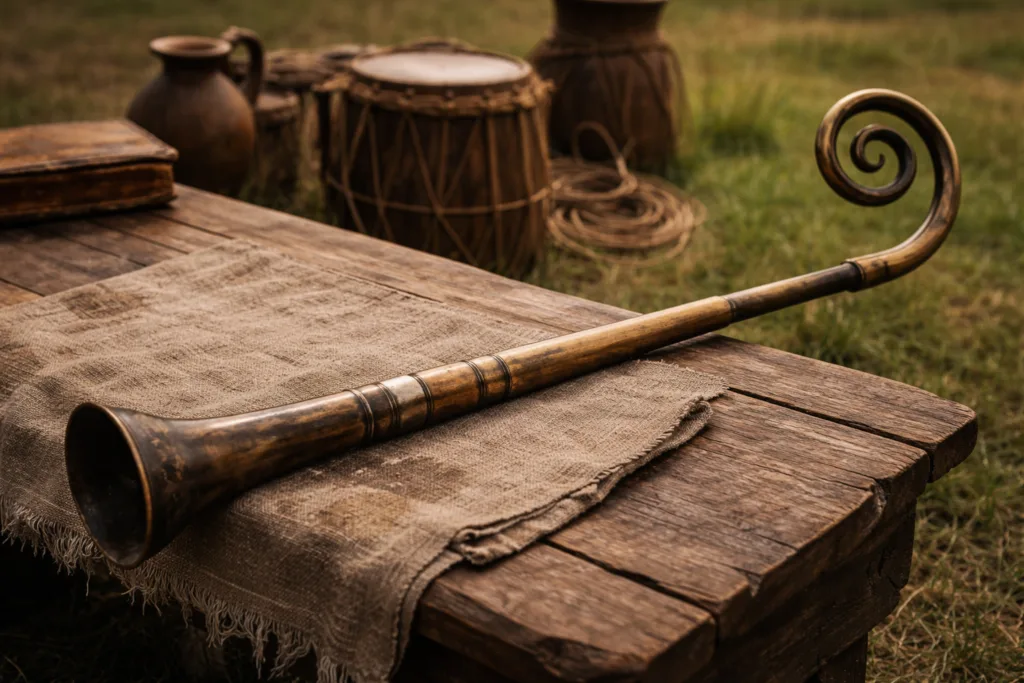
A single bent bell can change how a whole room hears a note. With the lituus, that bend is the point—practical, symbolic, and oddly elegant in the hand.
- Instrument Type: Natural brass trumpet (no valves, no keys), built to speak through the harmonic series
- Shape: Long, mostly straight tube with an upturned bell (often described as a J-like end)
- Material Family: Usually discussed as bronze work (a copper–tin alloy), sometimes in cast or hammered construction
- Where It Shows Up: Roman and Etruscan contexts—processions, public ceremonies, and organized signaling (kept factual, no drama)
| Feature | What You Can Actually Hear | What You Feel While Playing |
|---|---|---|
| Long Tube | A focused tone that favors clear partials | More back-pressure than you expect if the bore stays narrow |
| Upturned Bell | More “throw” and presence in the high partials | Notes can feel like they lock in with a firmer center |
| Metal Thickness | Thicker metal often shifts the sound toward stability over shimmer | Less “flutter,” more steady resistance |
| Mouthpiece Geometry | Changes attack, brightness, and how the upper partials speak | Controls lip grip and endurance in a big way |
Short version? It behaves like a natural trumpet, but the bell bend nudges how it projects and how it “slots.”
What The Name Really Means
- Latin “lituus” can mean a crooked staff associated with Roman religious practice, and it can also mean a curved trumpet.
- That overlap is not a cute coincidence—it mirrors the way the Romans reused shapes and names across ritual objects and sound tools.
- When ancient authors describe the instrument, they often lean on shape: a trumpet that resembles a hooked staff.
Language does this sometimes: it keeps one word for two things that share a silhouette. The lituus is exactly that kind of word.
Form In The Hand, Sound In The Air
- Tube Profile: Usually discussed as straight and narrow, sometimes slightly conical
- Bell Orientation: Turned upward at the end (the signature move)
- How It Speaks: Through the natural harmonic series—you don’t “choose” every chromatic note; you aim for partials
If you’ve only played modern valved brass, the first surprise is psychological: you stop thinking in notes and start thinking in partials. Not romantic. Just real.
Now, the physical side. The long tube gives you a steady column of air to manage, and the bell bend changes where the sound seems to “stand” in space. It can feel like the instrument wants to project upward even when you keep the body level. A small thing, but you notice it.
And yes—sometimes it feels stubborn. That’s part of the charm, part of the work.
What The Upturned Bell Actually Does
- Projection: A bell is an acoustic transformer; it helps couple the vibrating air column to the room
- Perceived Brightness: Bell geometry can shift emphasis toward higher overtones (that “edge” you hear at distance)
- Slotting Feel: The bell and taper influence impedance peaks, which is why certain partials feel easier to “catch”
A bell isn’t just decoration. It sets the instrument’s handshake with the air outside the tube. With an upturned bell, the sound field you create can feel less “straight-line” and more like it blooms upward. (In a crowded space, that matters.)
Here’s the non-mystical part: the instrument’s “where do notes want to land?” is linked to acoustical impedance. You don’t need to do calculus to feel it. You blow, you adjust, the horn answers back.
Sometimes, it answers back quickly. Sometimes… it makes you earn it.
Metal, Wall Thickness, And Timbre
- Bronze Family: Copper–tin alloys tend to support a dense, steady core in the tone
- Thickness: Thicker walls often reduce “zing” and increase stability; thinner walls can feel more lively but less forgiving
- Finish: Smooth interiors reduce turbulence; rough interiors can add noise and unpredictability (sometimes interesting, often annoying)
As a maker, you listen to metal before you shape it. Bronze doesn’t ring like modern yellow brass; it can sound less glittery, more anchored—like the note has weight. Not always “dark,” not always “bright.” Just weighted.
Wall thickness is the silent governor. A slightly thicker tube can make attacks cleaner and keep partials from wobbling. The tradeoff? The instrument may feel a touch less “springy” under the lips. You gain control, you lose a bit of easy sparkle. Fair deal, most days.
| Build Choice | Likely Sound Result | Likely Playing Result |
|---|---|---|
| Hammered Sheet (thin) | More immediate response, more texture | Less tolerance for sloppy air; partials can “split” easier |
| Cast Bronze (thicker) | Stable core, cleaner ring | More resistance; endurance becomes a skill |
| Gentle Taper | Smoother upper partials, less harshness | Easier slotting, especially above mid range |
Playing Resistance, Attack, And The “Lock”
- Embouchure: You shape pitch by lip tension and air speed, aiming for partial centers
- Articulation: Clean attacks rely on steady air; the tongue only starts the note, it doesn’t carry it
- Endurance: Natural instruments can punish overblowing—balance is the whole game
The lituus asks for a controlled, narrow stream of air. If you blow like you’re trying to win an argument, the tone gets brittle fast. If you blow like you’re placing a glass on a table—firm, measured—you get a cleaner edge.
Here’s the sensation players talk around: the “lock.” On a good build, certain partials click into place with a centered resistance. It’s not effortless, but it’s predictable. That predictability is gold.
Some days the horn feels friendly. Some days it feels like it woke up grumpy. Happens.
- Hold one comfortable partial for 6–10 seconds with steady air.
- Move to the next partial above using air speed, not brute force.
- Come back down softly. Keep the sound intact.
- Only then add sharp articulations.
Reconstruction Choices That Change Everything
- Mouthpiece Style: A detachable mouthpiece can make the build more playable for modern lips, but it changes the historical “feel.”
- Bore Direction: A nearly cylindrical bore behaves differently than a subtly conical one—especially in upper partial ease.
- Bell Flare: More flare often means friendlier projection; less flare can sound rawer and more direct.
Rebuilding the lituus is not like copying a modern trumpet blueprint. You’re working from depictions, fragments, and organological reasoning. And yes, the choices you make—tiny choices—stack up.
A maker’s dilemma: do you build a strict interpretation of a likely ancient geometry, or do you build something that helps modern players reach a stable harmonic ladder without fighting the instrument all day? Different goals. Both can be honest, if you say what you did.
Vs. Other Ancient Roman Brass
| Instrument | Shape Cue | Typical Job | Sound And Feel |
|---|---|---|---|
| Lituus | Straight tube with upturned bell | Processional and signaling roles | Focused, bright-leaning edge; firm slotting when well-built |
| Tuba | Long, straight trumpet (often shown without a hooked end) | Straightforward calls and ceremonial presence | Direct, “line-of-sight” projection; can feel less quirky in response |
| Cornu | Large G-shaped horn with crossbar support | Broad signaling and ensemble support | Bigger, rounder presence; more physical handling demands |
| Bucina | Varied depictions; sometimes curved horn types | Calls and signals in organized contexts | Often discussed with ambiguity; “name vs. shape” is the puzzle |
Notice what the lituus does: it stays relatively slender and then uses that upturned bell to redirect presence. That’s a different design philosophy than the big, body-wrapping cornu.
If you want clarity, the lituus makes sense.
If you want mass, the cornu makes sense.
If you want straightforward, the tuba makes sense.
Vs. Modern Trumpet And Bugle
- Modern Trumpet: Valves let you choose chromatic notes. The lituus makes you negotiate with the harmonic series.
- Bugle: A closer cousin in concept (also natural notes), but modern bugles usually aim for stable modern tuning norms and standardized mouthpieces.
- Feel Under The Lips: Many lituus reconstructions feel more resistant than a modern trumpet because bore and bell choices prioritize projection and partial definition over comfort.
Here’s a practical truth: a modern trumpet forgives. A natural instrument teaches. Not politely, either.
If you try to “play it like trumpet,” you may overwork. Instead, play it like a voice exercise—steady air, small adjustments, and an ear that listens for when the partial centers. When it centers, it’s satisfying in a very clean way.
Display, Handling, And Responsible Care
- Support: Long tubes dislike point pressure; use broad supports that avoid stressing the bell bend
- Environment: Stable humidity helps prevent corrosion on bronze and keeps joints from loosening on multi-part builds
- Cleaning: Avoid aggressive abrasives; patina is not “dirt,” it’s surface history
Whether you own a replica or you study museum pieces, treat the instrument as a long lever. A small bend takes the load. If you store it wrong, you teach the metal new habits—and metal learns, slowly, but it learns.
Also, don’t chase shine. A soft, honest surface reads better than a mirror finish on an antique-style build. That’s my bias, sure, but it’s a useful one.
FAQ
Is it hard to learn the lituus?
Answer
It can feel hard at first because you rely on the harmonic series instead of valves. Most players improve fastest by practicing stable partials, clean attacks, and controlled air speed. The instrument rewards calm, repeatable technique more than raw power.
How do I know if a lituus replica is historically plausible?
Answer
Ask for clear build facts: tube length, bore profile (cylindrical or gently conical), bell flare and angle, and mouthpiece approach. A plausible replica also matches the basic silhouette described in ancient contexts: a long tube with an upturned bell.
Does the upturned bell make it louder?
Answer
It can increase perceived presence and help the sound project in a way that carries, especially in higher overtones. Loudness still depends heavily on bore shape, bell flare, and the player’s air control, not only the bell direction.
Can I use a modern trumpet mouthpiece on a lituus?
Answer
Sometimes, yes—many replicas accept modern-style mouthpieces for practicality. That choice can change response and tone color, often making attacks easier and altering how upper partials speak. If you care about period feel, discuss mouthpiece geometry with the maker.
What metal should a lituus be made from?
Answer
Bronze (a copper–tin alloy) fits the common ancient-metal context and often produces a stable, weighty tone. Brass can work well for playability and consistency in modern manufacturing. The most important factor is consistent wall thickness and a well-shaped bell flare.
What does “lituus” mean in Latin?
Answer
It can mean a curved staff associated with Roman religious practice, and it can also mean a curved trumpet. The shared name reflects a shared hooked shape and the way ancient writers used the term across objects with similar form.