
- 🎺 Instrument Type: A natural brass horn (no valves, no finger holes), played with a brass-style embouchure.
- 🏺 Most Famous Form: The Bronze Age Lur from Scandinavia, often found in matched pairs in bog deposits.
- 📏 Typical Length (Bronze Age Lur): About 1.5–2.5 m (roughly 5–8 ft), depending on the find and model.
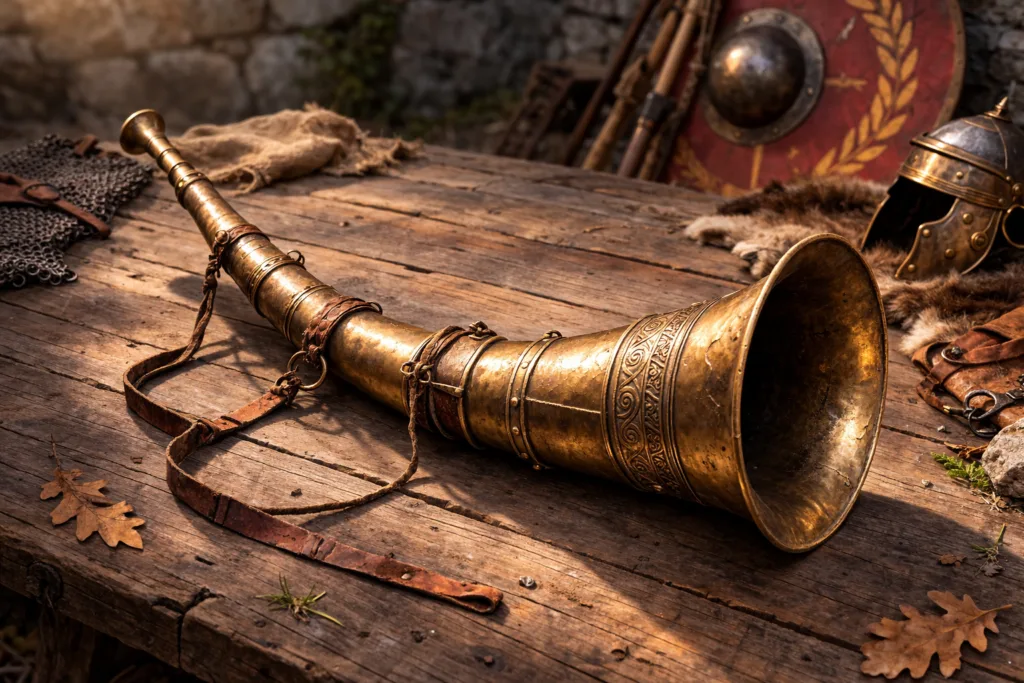
- 🔔 Key Visual Tell: A long, curved tube (often S-shaped) ending in a flared bell with an embossed disk/plate.
- 🧪 Material Voice: Bronze gives a bright, forward timbre and a “tight” clarity that wood rarely copies.
| Feature | Bronze Age Lur (Classic) | Wood/Birch-Bark Lur (Later Folk Forms) |
|---|---|---|
| Build | Cast in multiple sections, joined; fixed mouthpiece; often S-curved | Wooden halves joined, often wrapped in birch bark; typically straighter |
| Length (Common Range) | ~1.5–2.5 m | Often around ~1–1.5 m for many museum/replica examples (varies widely) |
| Sound | Brassy, direct, carrying; strong projection | More woody, slightly softer edge; still loud, but less metallic “bite” |
| Playing System | Natural harmonic series; pitch shaped by lips and air | Also harmonic-based; often used for calls, signals, simple melodies |
| Collector Reality | Originals are usually in national museums; collectors meet them via replicas | Replicas and folk-instrument builds are more attainable |
The word Lur can point to more than one historical branch, and that’s part of the charm. Still, when most people say “Lur” in an antique-instrument context, they mean the Scandinavian Bronze Age horns—long, curved, bronze, and built like serious objects meant to be heard from far away.
What A Lur Is In Your Hands
- 🔎 No Keys, No Valves: A natural horn. Notes come from the harmonic series, not mechanics.
- 🫁 Embouchure-Driven: Lip tension and airflow do the steering; your face becomes the “valve block.”
- 📣 Designed To Carry: The bore profile and bell flare favor projection over softness.
- 🧭 Often Found As Pairs: Many archaeological finds show paired instruments, sometimes mirrored left-right.
A Lur feels like a long conversation between breath and tube. The instrument gives you very little “help” compared to a modern trumpet—no valves to rescue you, no fingerings to hide behind—yet it offers something modern instruments rarely do: a raw, honest relationship with air pressure and bore shape.
And yes, it can be a little rude at first. That’s normal.
Materials And Build: Why Bronze Sounds Like Bronze
- 🧪 Bronze Core: Bronze (typically copper + tin alloying) tends to yield a clear, brilliant timbre with strong upper harmonics.
- 🧩 Sectioned Construction: Many bronze lurs were cast in parts and joined—those seams matter for vibration control and stability.
- 🔔 Bell Plate: The bell often ends with a decorative disk/plate; it adds mass and can subtly affect how the bell “releases” sound.
- 🎺 Fixed Mouthpiece: On classic Bronze Age lurs, the mouthpiece is commonly permanently affixed, which locks in a specific feel and response.
If you’ve ever compared two horns with the same length but different metal thickness, you already know the trick: mass changes the way an instrument “pushes back.” A bronze Lur often feels anchored—the tube does not flutter under your hands the way thin brass can. Instead, it gives a steadier platform for the lip buzz, and that steadiness shows up as focus.
Wood and birch bark tell a different story. They can be loud—very loud—yet the edge softens. The transient (that crisp start of the note) feels a touch rounder, like the instrument is exhaling with you rather than cutting through you.
Sound And Resistance: The Part You Feel In Your Teeth
- 🎚️ Natural Harmonics: Expect stable “slots” on harmonic partials, with expressive pitch shaping between them.
- 🫧 Backpressure Feel: Long conical tubing tends to create a firm, controlled resistance—not suffocating, but present.
- 📌 Directional Output: A Lur can feel like a beam of sound rather than a cloud.
Here’s the odd thing: a Lur can feel easy and hard at the same time. Easy because the tube “wants” to vibrate on certain partials; hard because you must meet the instrument exactly where it lives. Miss the center by a little, and the note does not politely wobble—it just refuses, or snaps to a neighboring partial when you least expect it.
The timbre is typically described as bright, brassy, and carrying. Up close, you hear more than brilliance—you hear texture: the little rasp of the lip buzz riding on a long tube, the faint grain of air, the way the bell launches the note rather than absorbing it.
Dating And Provenance: Numbers That Ground The Story
- ⏳ Bronze Age Context: The best-known bronze lurs belong to the Nordic Bronze Age, with many dated broadly around the late 2nd to early 1st millennium BCE (specific finds vary).
- 📍 Denmark Concentration: A documented total of 39 Bronze Age lurs have been found in Denmark, with additional examples known from nearby regions.
- 🪵 Later Folk Continuations: The term “lur” also persists in Scandinavian folk instruments (wood and birch-bark forms), used historically for calls and signaling.
Those numbers matter because they keep the Lur from drifting into fantasy. We are not talking about a one-off curiosity. We are talking about a recognizable instrument family—rare, yes, but coherent—built to a standard that repeats across finds. The fact that so many are found as paired deposits suggests intention, not accident.
If you’re drawn to the antique side of the Lur world, this is where your mindset changes: you stop asking “Is it old?” and start asking “Is the lineage clear?” A well-documented replica, built from measured profiles, can be more meaningful for a player than an undocumented “antique” with a charming story and no paper trail.
How A Lur Was Used: Ceremony, Signals, And Social Sound
- 📣 Long-Distance Communication: A loud, focused horn is practical; it slices through wind and open space.
- 👥 Paired Performance: Depictions and finds often suggest two players working as a matched set.
- 🕯️ Ceremonial Presence: Many scholars interpret bog deposits and iconography as evidence of ritual or ceremonial roles.
Think of a Lur as a public voice. It can announce a gathering, mark a moment, or punctuate a procession. The sound is not private. Even when one player stands alone, the instrument implies an audience—someone is meant to hear it, somewhere. That’s why the best replicas focus on projection and stability, not “pretty” tone in a small room.
And the pair idea? It’s more than romance. Two matched lurs, especially if they share a fundamental pitch, can create a strong unison that feels almost architectural—thick, straight, and unmistakable.
Vs. Comparisons That Actually Help You Choose
Vs. Modern Valved Trumpet
- Control: Trumpet gives mechanical pitch choices; Lur demands embouchure control.
- Sound Shape: Lur tends toward a straight, ceremonial blast; trumpet can whisper, smear, and pivot quickly.
- Learning Curve: Trumpet players adapt faster, but they must unlearn valve-thinking and embrace harmonic “slotting.”
If you play trumpet, you’ll recognize the lip mechanics immediately. What you won’t recognize is the patience required. A Lur rewards a steady air column and a calm face—get tense and it gets jumpy. Fast.
Vs. Alphorn (Alpine Natural Horn)
- Length: Alphorns often run longer than many lurs; lurs commonly sit in a shorter (yet still substantial) range.
- Material: Alphorn is typically wood; Bronze Age Lur is bronze—different overtone emphasis.
- Timbre: Alphorn often blooms warm; Lur tends to cut.
Both live in the harmonic world. The difference is emotional: the alphorn can feel pastoral, even gentle. A bronze Lur feels formal—like a gate opening.
Vs. Scandinavian Birch-Bark Lur (Näverlur / Neverlur)
- Build: Birch-bark lur uses wood halves and bark wrapping; Bronze Age lur uses cast bronze sections.
- Response: Birch-bark lur can feel lighter under the lips; bronze lur often feels more anchored.
- Use Case: Birch-bark lurs are strongly tied to herding calls and folk signaling traditions; bronze lurs skew ceremonial.
If you want something you can actually take outdoors without museum-level anxiety, a birch-bark Lur style replica is often the smarter first step. It still teaches the core skill: harmonic control without mechanical shortcuts.
Playing Technique: Getting Past The First Brutal Week
- Start With Long Tones: Hold a stable partial and let your lips find the center. Do not chase volume first.
- Use Calm Air: Think “steady hose,” not “burst.” A Lur punishes panic air.
- Explore Adjacent Partials: Move up and down the harmonic series slowly; listen for clean slotting.
- Practice Soft Attacks: If the note only speaks when you slam it, the embouchure is too tense.
- Work With Space: This instrument was built for distance. A larger room (or outdoors) can make the feedback clearer.
The “resistance” you feel is not your enemy. It’s the instrument telling you where the air wants to go. When you line it up, the tone locks in and the tube feels like it’s helping—finally. Then you smile, then you overblow it (everyone does), then you reset. That’s the loop.
One more thing: your body posture matters more than you expect. A long horn asks for a long spine. Slouch and the air path kinks. Tiny kink, big consequence.
Restoration And Care: When “Cleaning” Ruins Value
- 🧤 Handle Like An Artifact: Skin oils can stain patina; gloves are not overkill for a serious piece.
- 🧽 Avoid Aggressive Polishing: Polishing can remove historic surface, blur tool marks, and flatten character.
- 🌡️ Stable Environment: Rapid humidity and temperature swings stress joints and seams—especially on composite builds.
- 🎺 Playability vs. Preservation: “Still playable” is a tempting phrase, but preservation comes first for true antiques.
With antique wind instruments, the biggest danger is good intentions. People try to make an object look “new,” and accidentally erase what makes it legible as history. A Lur—especially a bronze one—often carries subtle surface cues: casting lines, join work, tiny asymmetries that show human hands. Strip those away and you have a shiny tube with a weaker story.
If you want to play regularly, the honest path is a high-quality replica Lur. It lets you blow hard, take it outside, and live with the instrument the way it was meant to live—used, not worshipped.
Choosing A Replica Lur: What Matters More Than Looks
- Bore Profile: Consistent taper and clean internal joins.
- Mouthpiece Geometry: Cup depth and rim shape that match your embouchure (and your endurance).
- Wall Thickness: Enough mass for stability, not so much that it turns dead and stubborn.
- Balance And Hold: A long Lur should not force wrist strain; mounting and grip points matter.
- Pitch Centering: The best replicas slot clearly without feeling “locked.” There’s a sweet spot.
A replica Lur can be museum-accurate and still feel lifeless if the bore is wrong. Conversely, a visually modest build can sing if the internal geometry is honest. The internal shape is the instrument’s spine. Everything else is clothing.
And here’s a modern twist that fits the moment: makers now use high-resolution scanning and precise measurement tools to model historical bore shapes more faithfully. That means today’s best replicas can be closer to the original acoustic intent than some older “inspired” builds. Quietly, the craft has leveled up.
FAQ
Is It Hard To Learn Lur If I Already Play Trumpet?
Answer
If you play trumpet, you already have the core embouchure skills. The hard part is switching mindset: a Lur lives on the harmonic series, so you must learn clean slotting, controlled lip bends, and steady air without relying on valves to “fix” pitch.
How Do I Know If A Lur Is An Antique Or A Replica?
Answer
Treat provenance as the deciding factor. Documented museum or academic records, find history, and consistent expert assessment matter more than surface age. Most Bronze Age bronze lurs are museum-held, so the market you’ll commonly encounter is replicas and historically inspired builds.
Why Are Lurs Often Found In Pairs?
Answer
Many finds and depictions suggest paired use, likely for matched unison playing and strong ceremonial impact. Practical symmetry also matters: mirrored curves let two players project outward rather than into each other.
What Does A Lur Sound Like In Real Life?
Answer
Expect a bright, brassy, carrying tone with a direct “beam.” Up close it can feel sharp and textured; at distance it often becomes fuller and more balanced. A skilled player can shape pitch and color using lip control and air support.
Can You Tune A Lur?
Answer
You cannot tune it like a valved instrument, but you can manage pitch centers through embouchure, air speed, and mouthpiece fit (on replicas). Many lurs are played across harmonics, so “tuning” often means choosing stable partials and refining intonation by technique.
What Makes A Good Birch-Bark Lur (Näverlur / Neverlur) Replica?
Answer
Look for clean internal join work, stable wrapping, and a bore that feels consistent under breath. The best builds speak easily across a useful set of harmonics, stay comfortable to hold, and keep a clear, strong core tone without forcing the player to overblow.