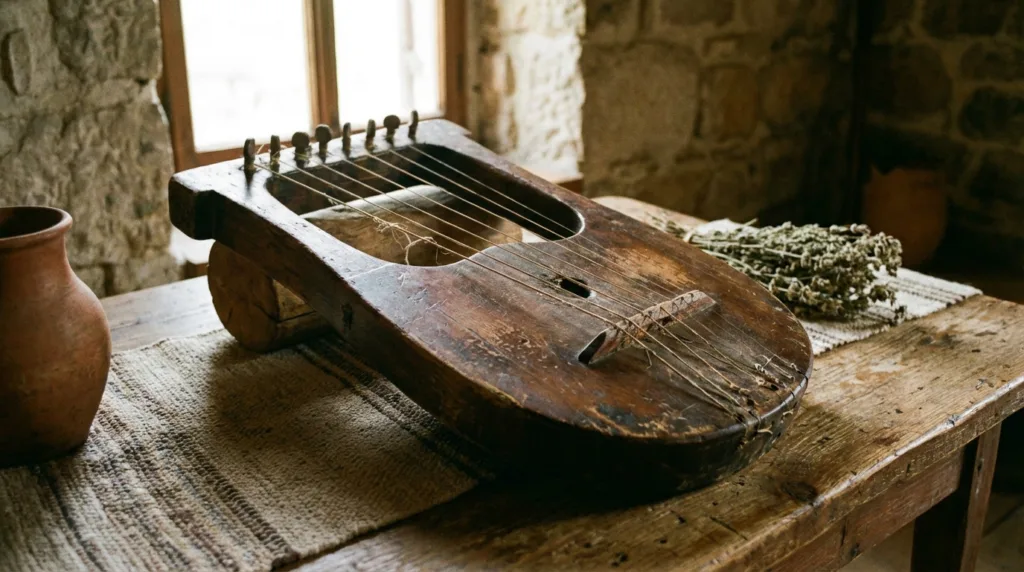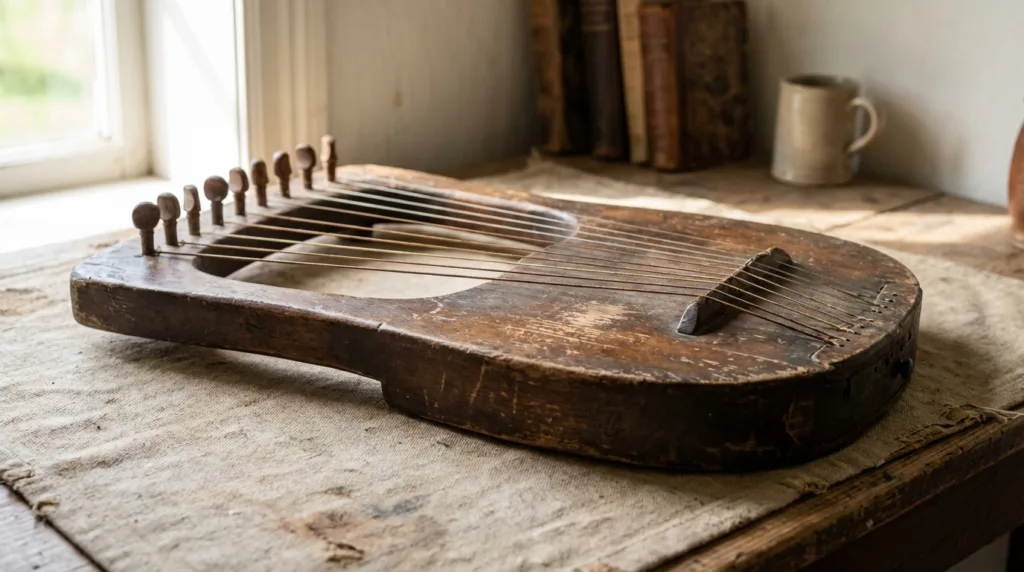
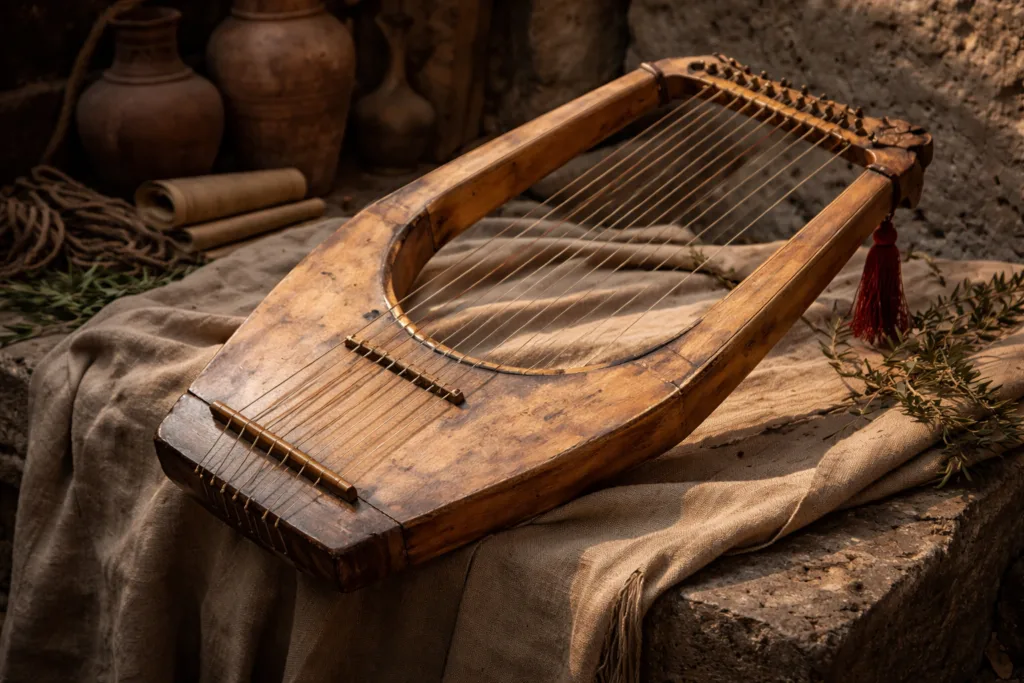
The Magadis Instrument sits in that fascinating zone where sound survives better than hardware. We can trace the name, the idea, and a few technical habits around it—yet the exact body shape stays slippery. That ambiguity is not a flaw. It is the story.
Here’s what you can safely hold onto (and what you should hold loosely):
- Solid: The term is tied to octave-doubling (playing or singing the same line in octaves).
- Often repeated: A tradition links it with twenty strings and a plucked technique.
- Open question: Was “Magadis Instrument” always a single, fixed design—or sometimes a label for a playing method?
Identity, Evidence, and the Name Itself
In ancient music writing, Magadis Instrument shows up as a word people argued about—exactly the kind of term that can mean “an instrument,” “a style,” or “a capability,” depending on who’s talking. You see the same pattern in modern workshop slang, too: we name a build by what it does, not just what it is.
Bench-friendly evidence snapshot 🏛️:
- Text tradition: The word is connected to octaves (magadizein / “magadizing”).
- Instrument family: Many discussions place it among plucked string instruments, close to harp/psaltery territory.
- String count claim: “Twenty strings” appears in the tradition, but treat the exact number as reported, not measured.
| Claim About the Magadis Instrument | How Safe It Is to Say | Why It Matters for Sound |
|---|---|---|
| It relates to octave-doubling (“magadizein”). | High | Predicts a shimmering, “two-voice” clarity even without harmony. |
| It was a plucked string instrument. | Medium–High | Plucking favors fast attack, quick decay, and articulate speech-like phrasing. |
| It had “twenty strings.” | Medium | Many strings allow octave pairs and easy “echo” voicings across registers. |
| “Magadis” could be a descriptor (“able to double in octaves”) rather than one fixed model. | High | Explains why the name travels across contexts without a single clean silhouette. |
Collector’s Note 🔍
If you ever see a seller claim “an authentic Magadis Instrument from antiquity,” slow down. Surviving originals are not the norm here. What you can assess is craft logic: materials, joinery, wear patterns, and whether the build plausibly supports octave pairing.
Form, Frame, and How a Builder Thinks About It
Even with debate around the exact shape, you can still reason like a luthier: if a tradition stresses octave-doubling, you expect either (a) paired strings tuned an octave apart, or (b) a layout that makes octave reach easy and repeatable.
Practical design cues 🧰:
- String layout: A tight, readable plane so the hand can “sweep” across pairs without getting lost.
- Body response: Enough resonance to let the octave partner answer the first note (sympathetic ring helps).
- Stability: A frame stiff enough that paired strings stay aligned—otherwise the octave effect gets messy fast.
Wood choice changes the whole personality. Not subtly, either.
Material Choices and the Specific Way They Color Timbre
When modern makers build a Magadis Instrument-style replica, the wood is not just “tonewood.” It is a filter. And you feel that filter under the fingers as much as you hear it.
- Dense hardwood frame (think maple-like behavior): more focus, a firmer “edge” at the start of the note, and slightly more perceived loudness.
- Lighter, softer soundboard (spruce-like behavior): quicker bloom, more air in the sustain, and that faint “paper” texture that makes plucked lines feel alive.
- Gut-style strings: a warm core and a soft bite; the fingertip gets a tiny bit of “grab,” so the note starts with a human, almost spoken consonant.
Pro Tip 🪕
If your goal is the classic octave shimmer, avoid overly bright modern strings. A slightly warmer string (or a warmer soundboard) makes the two pitches “lock” together instead of fighting for attention.
Sound, Touch, and the “Resistance” Under Your Hand
Plucked instruments tell the truth instantly. You touch, they answer. With a Magadis Instrument-style setup, that answer is typically less about long sustain and more about definition—a clean start, a controlled bloom, and a decay that leaves space for the next thought.
What players tend to notice first 🎼:
- Attack feel: Gut or gut-like strings offer a gentle resistance; the finger sinks in a hair, then releases. It feels grippy, in a good way.
- Octave halo: When you strike a pitch and its octave partner, you get a “single voice with a bright outline.” Simple. Compelling.
- Hand travel: An octave-friendly layout invites a small rocking motion—down and back, down and back—almost like pacing while you talk.
Sometimes the most important sound is the one you didn’t intend: sympathetic resonance. A paired-string system can make notes “answer” each other, especially in a quiet room. Goosebump stuff. (And yes, it makes you play slower without noticing.)
Collector’s Note 🏺
A thoughtful replica will not chase modern “piano-like” sustain. If everything rings forever, the instrument may feel impressive for ten seconds… then tiring. The Magadis Instrument idea shines when the line stays readable.
Octaves, Magadizein, and the Physics That Makes It Work
The octave is not a vague “higher version” of a note. It is math you can hear: a 2:1 frequency ratio. That’s why octaves fuse so easily—two pitches, one identity. Same note, different height.
So what is magadizein in plain terms?
- Musically: Perform the same melody in parallel octaves (voice+voice, instrument+instrument, or mixed).
- Mechanically: Make octave access easy—often by building or stringing the instrument so octaves are “pre-paired.”
- Aesthetically: Keep the line simple, then let the octave doubling supply richness without harmony.
Here’s the twist: some scholarship argues that “Magadis Instrument” might not point to one fixed object, but to this octave-doubling capability itself. In other words, the name can behave like a label you’d put on a technique: “this one can do that trick.” Reasonable, honestly.
Pro Tip 🎯
If you try octave doubling on a replica, tune slowly. When the octave is slightly off, you hear “beating” (a pulsing wobble). When it locks, the pulse disappears and the sound turns still.
And a modern-world echo (nothing heavy, just real life): today’s museum labs and instrument makers share builds, measurements, and sound demos online all the time—short clips, close-mic plucks, slow-motion handwork. That “let’s reconstruct the past with our hands” energy fits the Magadis Instrument conversation perfectly. Same curiosity, different tools.
Magadis Instrument Vs. Nearby Strings
Comparisons are where the instrument becomes tangible. You stop chasing a name and start chasing a feel.
Magadis Instrument Vs. Lyre and Kithara
- String count mindset: Lyre/kithara traditions often center on a small, stable set of strings; the Magadis Instrument tradition leans “many-stringed,” or at least octave-capable.
- Attack character: Lyre-family playing can be very percussive and speech-like; Magadis-style octave pairing tends to sound more “woven,” less “struck.”
- Hand behavior: Lyre phrasing often pivots around a tight grip and quick articulation; Magadis-style playing invites small sweeps and repeated patterns.
Different posture, different psychology. On a lyre, you feel like you’re declaring. On an octave-friendly harp/psaltery layout, you feel like you’re shaping.
Magadis Instrument Vs. Psaltery-Style Harps
- Overlap: Many writers group names like magadis with harp/psaltery families.
- Special sauce: The octave pairing idea is the standout—whether that pairing is literal doubled strings or a playing habit.
- Timbre: A psaltery/harp approach often yields a cleaner, rounder onset than a hard-plectrum attack.
Magadis Instrument Vs. a Modern Lever Harp
- Hardware: Modern lever harps offer fast key changes; the Magadis Instrument idea is more about texture and octave color than mechanical modulation.
- Tension feel: Modern setups can feel higher-tension and more uniform; gut-style or historically inspired strings often feel softer and more “fingertip intimate.”
- Sound goal: Modern harps can chase sustain and projection; Magadis-style octave playing chases blend and clarity.
| Feature | Magadis Instrument (Best-Fit Reconstruction) | Lyre / Kithara | Modern Lever Harp |
|---|---|---|---|
| Core Idea | Octave-capable, often described via magadizein | Stable string set; crisp articulation | Versatile keys via levers; wide range |
| Typical Attack | Clean pluck, “woven” if octaves are paired | More percussive, speech-like | Round, sustained, often bigger bloom |
| Finger Feel | Often gut-style softness; light resistance | Firm control; quick release | More uniform tension; smooth travel |
| Best Use | Melody with octave color | Rhythmic support, declamatory lines | Broad repertoire and key flexibility |
How to Judge a Modern Replica Like a Curator
When you can’t rely on a surviving “gold standard,” you judge a Magadis Instrument replica by internal consistency: does the design support the sound claims?
Checklist (fast, honest, useful) ✅:
- Octave logic: If the maker claims octave pairing, can you see how the layout helps the hand find octaves quickly?
- Frame stiffness: Gently test for twist. A frame that flexes too much will fight tuning stability—especially with paired strings.
- String spacing: Too tight feels nervous; too wide kills speed. There’s a “comfortable corridor” where the hand relaxes.
- Noise floor: Listen for buzzing at normal touch. A little wood talk is charming; persistent buzz is a build problem.
- Repair philosophy: Look for reversible decisions (clean joins, sensible glues, minimal invasive hardware).
Collector’s Note 🧾
Ask for the maker’s notes: string material, target tension range (even approximate), and the tuning concept. A careful builder will gladly explain the choices in plain language. If everything is vague, that’s your clue.
Care, Setup, and the Small Habits That Keep It Singing
- Humidity: Gut-style strings react. Keep conditions steady; avoid sudden swings.
- Tuning routine: Tune in small passes. Octave pairs settle better with patience (annoying, yes; effective, also yes).
- String life: Replace one of a pair only if the partner still matches in feel and color. Otherwise the octave blend can turn uneven.
- Contact points: Check nut/bridge contact for wear. Tiny grooves can create little “ticks” that steal clarity.
And one more workshop truth: if the instrument gives you kefi (that Greek kind of bright, buoyant spirit), you’ll practice more. If it feels stiff and punishing, you won’t. Build and setup should serve the habit, not just the headline.
FAQ
Is the Magadis Instrument a harp or a lyre?
Open answer
Most discussions place the Magadis Instrument with plucked string instruments, often near harp/psaltery families. Still, some ancient debate and later interpretations muddle the picture, so it’s safer to say: it is strongly linked to plucked strings and octave practice, even if the exact body type varies by source.
How many strings did the Magadis Instrument have?
Open answer
A common tradition mentions twenty strings, and some interpretations connect that count to octave pairing. But no one is counting surviving originals here. Treat “twenty” as a reported feature rather than a guaranteed specification.
What does magadizein mean in plain terms?
Open answer
Magadizein is a term for performing the same line in parallel octaves. It can be done by voices, instruments, or a mix. The octave’s 2:1 frequency relationship is why it fuses so cleanly.
Would it feel hard on the fingers to play?
Open answer
On gut-style strings, the feel is usually firm but forgiving. You get a small, pleasant resistance and a quick release. If a replica feels harsh, it often comes from overly high tension, sharp string angles, or a bright setup that prioritizes volume over comfort.
How do I know if a modern replica is thoughtfully made?
Open answer
Look for internal consistency: the design should make octave playing easy, stay stable in tuning, and keep the melody clear. A good maker can explain wood choice, string material, and the intended tuning concept without hand-waving.
Can I tune a Magadis-style replica to modern concert pitch?
Open answer
Often yes, but it depends on the build. Some replicas are designed for lower tension to suit gut-style response and historical feel. If you raise pitch too far, you can lose the sweetness and risk stress on the frame.