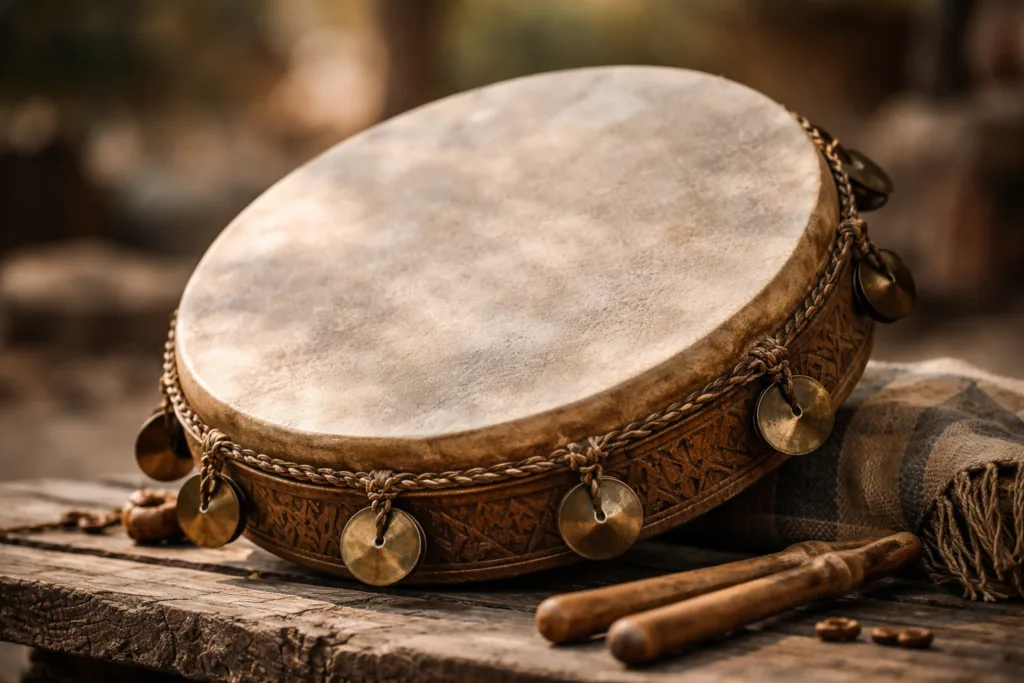
The oldest part of a Mesopotamian frame drum is not the rhythm. It is the surface—skin drawn over a shallow body, light enough to answer the hand fast, firm enough to hold a clear pulse.
The modern label frame drum helps, but it also smooths over a messy truth: Mesopotamian evidence points to more than one drum type, more than one size, and more than one social setting. That matters. A lot.
| Evidence Layer | What It Supports | What Still Needs Care |
|---|---|---|
| Cuneiform Terms | More than one drum family, including round and rectangular frame drums, plus large and small types. | A one-to-one match between every ancient name and one modern instrument shape is not always secure. |
| Plaques And Reliefs | Playing posture, scale, ensemble use, and the fact that smaller hand drums appear often in women’s hands in later Sumerian imagery. | A picture does not tell exact shell depth, skin thickness, or final pitch. |
| Temple And Administrative Texts | Wood, hides, cords, oil treatment, named performers, and festival use. | Not every material note belongs to the same drum subtype. |
| Missing Originals | Modern reconstructions must lean on text, art, and instrument logic together. | No surviving Mesopotamian frame drum lets anyone claim a perfect rebuild. |
What This Instrument Really Is 🥁
- Frame drum is an organological label for a drum whose head is wider than its depth.
- In Mesopotamian material, the family is not limited to one neat round tambourine shape.
- Texts point to round and rectangular frame drums, while visual sources show both monumental ritual drums and small hand-held drums.
- Some drums may have carried rings or ring-jangles; others were likely plain skin-and-frame instruments.
That last point gets skipped far too often. Many articles flatten the whole topic into “the earliest tambourine.” That is too narrow. A Mesopotamian frame drum can sit closer to a plain hand drum, a temple instrument, or a jangled relative depending on the source in view.
Even the ancient names do not line up like modern catalog labels. Terms such as uppu, balag, balag-di, ala, and related drum words belong to a living musical culture, not a tidy museum shelf. Some are still debated. So the careful move is simple: treat Mesopotamian frame drums as a family seen through texts and images, not as one frozen product spec.
Collector’s Note
If a modern seller calls any Middle Eastern hand drum “Mesopotamian,” the useful question is not “Does it look old?” It is this: Which details come from texts, which come from iconography, and which come from later regional practice?
Why Round Forms Are Only Half The Story
Round hand drums are the image most readers expect, and for good reason—they appear clearly in later Mesopotamian and wider Near Eastern art. But the written record also points to rectangular frame drums. That changes the conversation. It means the Mesopotamian drum field was already more varied than the usual “ancient tambourine” story suggests.
And that variety affects sound. A circular frame tends to distribute tension evenly and gives a smoother, more centered response. A rectangular build changes corner stiffness, edge response, and hand feel. Subtle shifts, yes. Still audible.
Materials, Skin, and The Shape Of The Sound 🪵
- Ancient texts mention wooden bodies, animal hides, wool cords, and treatment materials such as oil.
- One temple-drum text links an instrument body to a wood called halub, often tentatively connected with an eastern oak.
- Large-drum evidence includes ox hide; for smaller reconstructions, modern makers often choose goat or calf skin because those hides mount well on shallow frames.
- Fastening could involve hoops, lacing, wedges, nails, or pegs. The exact choice depends on subtype, and certainty runs out fast.
For voice, the membrane rules. More than the frame does, usually. A thin skin speaks quickly, gives a cleaner upper click near the rim, and lets finger detail show through. A thicker hide slows the response a touch, darkens the attack, and fills the low-mid band with more body. On a big ritual drum, that weight can feel almost architectural. On a small hand drum, it can make the instrument seem stubborn if the shell is too light.
The wood still matters, just less dramatically than players often think. A denser rim feels firmer under the hand and can keep the pitch center more settled. A lighter rim lets the skin dominate even more. Put plainly: with frame drums, the hand meets the head first, not the shell. So the membrane decides the character, and the wood shapes the edges of that decision.
Natural skin also has a texture modern plastic heads do not copy very well. Under the fingers it feels slightly granular, a bit alive, a bit fussy. In dry air it rises; in damp air it softens. That shift is not a flaw. It is part of the instrument’s behavior.
Pro Tip
If the aim is a believable historical-style voice, choose natural skin first and perfect tuning stability second. Synthetic heads are practical, no doubt, but they often give a cleaner and flatter response than the old material itself would have allowed.
Why The Head Matters More Than The Frame
A shallow drum does not hide much. Strike the center and the ear catches the fundamental body note. Strike closer to the rim and the sound dries out, brightens, and starts to talk more than sing. Muted contact shortens the decay and sharpens the consonants of the rhythm. That is why old hand drums can sound almost speech-like in close playing.
Dry, quick, plainspoken—that is one path. A heavier skin and a larger diameter pull the sound the other way: lower, slower, fuller, more air around the note. Same family. Different accent.
How The Evidence Works, and Where It Stops 🏺
No original Mesopotamian frame drum survives in a way that settles every construction question. That absence shapes the entire topic. What remains are texts, figurines, plaques, reliefs, and the hard logic of drum building.
So the best reading method is layered:
- Start with texts: they preserve names, materials, ritual settings, and administrative detail.
- Move to images: they show size, posture, and ensemble context.
- Then test both against instrument logic: hide size, frame strength, fastening method, and what a human hand can actually play.
That third step is where weak articles usually stumble. They repeat myth, skip build logic, and end up describing a drum that looks ancient but behaves like a modern stage tambourine. A believable Mesopotamian reconstruction has to obey both the archive and the hand.
There is another limit worth stating plainly. Some ancient drum names remain debated, and some objects in art are not easy to classify. Fair enough. The honest approach is to mark that uncertainty instead of polishing it away.
Period Vs. Period: Temple Scale and Handheld Scale 🏛️
| Period Focus | What Stands Out | Likely Sonic Character |
|---|---|---|
| Third Millennium BCE Temple Contexts | Large ritual drums, official performance, stronger connection to temple service and formal ceremony. | Broader low-end weight, slower bloom, more public and processional presence. |
| Around 2000 BCE and After | Smaller frame drums become more visible in women’s hands; hand-held playing comes forward in iconography. | Faster response, lighter articulation, closer tie to gesture, song, and portable ensemble use. |
| Old Babylonian Plaque Culture | Small hand drums appear beside lutes and lyres in more intimate or folk-like scenes. | Tighter rhythmic support, less mass, more conversation with melody. |
Scale changes sound before anyone even strikes the head. A waist-high or monumental frame-based drum carries authority through size alone; the air load is different, the hide is different, the attack spreads differently. A small hand drum, by contrast, can answer fingers, palms, and quick rim work with much finer detail.
That shift also changes the social feel of the instrument. Earlier large drums lean toward official weight—temple time, public rite, declared rhythm. Later small hand drums feel closer to the body. Closer to song. Closer to gesture. Not smaller in meaning, just different in use.
There is a gendered visual story here too, though it should be handled carefully. Large ritual drums are linked more often with male temple performance in some sources, while smaller frame drums in Sumerian imagery around the early second millennium BCE appear in women’s hands more often. So a Mesopotamian frame drum is not one social symbol only; it shifts with scale, setting, and period.
Mesopotamian Frame Drum Vs. Modern Riq, Daf, and Bendir 🎼
| Instrument | Main Build Cue | What The Ear Hears |
|---|---|---|
| Mesopotamian Hand Frame Drum (as cautiously reconstructed) | Shallow frame, natural skin, often plain or only lightly furnished with metal elements. | Skin-first tone, dry edge detail, a clear body note without constant metal chatter. |
| Riq | Small frame with multiple pairs of jingles and a highly responsive head. | Bright, agile, sparkling, built for crisp ornaments and quick articulation. |
| Daf | Larger round frame, often with rings or chain elements inside. | Longer shimmer, wider air movement, more wash around the stroke. |
| Bendir | Large frame drum, often with a snare or buzzing string system. | Low buzz, deeper drone-like character, more sustained roughness in the tail. |
| Modern Tambourine | Light shell, strong jingle priority, stage-friendly projection. | Metal-forward attack, short membrane role, instant cut. |
This is the comparison many readers actually need. A reconstructed Mesopotamian frame drum is usually less metallic than a riq, less shimmering than a daf, and less buzzing than a bendir. In other words, its charm often sits in the naked skin tone itself.
That may disappoint ears trained by modern ensemble percussion. Or it may feel exactly right. A plain frame and skin head can produce a wonderfully honest note—short, warm, and direct, like dry clay rather than polished brass.
Collector’s Note
A convincing historical-style hand drum often sounds plainer than expected. Less glitter. Less extra hardware. More membrane, more rim, more touch.
Why Some Reconstructions Feel Right and Others Do Not 🔍
- They admit the gaps. A good maker says where the evidence ends.
- The skin suits the diameter. Too thick, and the drum goes dull. Too thin, and it turns papery.
- The rim depth stays believable. A shell that is too deep drifts toward a later drum concept.
- The fastening method makes structural sense. Decorative tacks are not the same thing as a sound build.
- Metal elements are used with restraint. A few plausible rings are one thing; a full modern tambourine setup is another.
- The instrument sounds right in the hand, not just on a wall. This point gets missed often.
Display pieces can borrow the silhouette and still miss the instrument. The rim may be too heavy, the skin too neat and glossy, the jingle layout too modern, the tension too stiff for finger-led playing. Then the drum looks old and speaks new.
Sometimes the opposite happens—a maker leaves the shell slightly uneven, allows the skin to keep its small natural marks, and avoids too much polished hardware. The result can feel more truthful at once. Not rough for the sake of roughness. Just believable.
The Sound Under The Hand
- Center Contact: fuller body note, rounder attack, more air in the sound.
- Near-Rim Contact: drier response, brighter overtones, clearer rhythmic edges.
- Muted Contact: shorter decay, more speech-like articulation.
- Shaken Or Jangled Elements: only relevant for versions that plausibly include rings or related fittings.
Ancient texts did not hear “drum” as one flat category. Large drums could be described with thunder-like force, while smaller drums were heard in gentler, more brushing terms. That contrast matters because it shows a listening culture already alert to timbre, not only pulse.
On a small Mesopotamian frame drum, the most interesting color may sit right at the border between tone and noise. Hit too squarely and the note can turn blunt. Brush the edge or catch the head with a lighter finger and the voice sharpens, almost like the consonants of a spoken line. Very human. Very close.
And then there is the rim itself. A firm wooden edge gives the hand a second language: taps, clicks, supported slaps, controlled rebounds. That is one reason these drums stay compelling even when stripped of metal, snare, and overt showmanship. The instrument does not need much hardware. It needs a good head, a trustworthy rim, and space for the hand to work.
Old, yes. Simple, no.
FAQ
Is a Mesopotamian frame drum the same as a tambourine?
Open Answer
No. Some Mesopotamian hand drums can sit near the tambourine family, especially where ring or jangle elements are possible, but the broader Mesopotamian frame-drum field also includes plainer skin-and-frame instruments and larger ritual drums. Treat “tambourine” as only one later branch of a wider family.
How do I know if a modern reproduction is believable?
Open Answer
Look for honest evidence use, natural-skin logic, sensible rim depth, and restrained hardware. A believable reconstruction should explain which details come from texts, which come from iconography, and which are modern solutions added for playability or durability.
What skin gives the most convincing old-style sound?
Open Answer
For a hand-played historical-style result, natural skin usually gets closer than plastic. Thin to medium goat skin often gives fast response and clear edge detail, while thicker hides produce a darker and weightier tone. The right choice depends on the drum’s diameter and the sound goal.
Why do some reconstructions sound dry while others ring more?
Open Answer
Dryness or ring comes from a mix of skin thickness, diameter, frame depth, tension, and any added metal or buzzing elements. A plain shallow frame with natural skin will usually sound drier and more direct than a daf-like or bendir-like build with extra fittings.
Were these drums mainly played by women?
Open Answer
Not in every case. The visual and textual record points to different roles for different drums. Large ritual drums can be tied to male temple performance in some sources, while smaller frame drums appear often in women’s hands in later Sumerian imagery. The answer changes with period, scale, and setting.