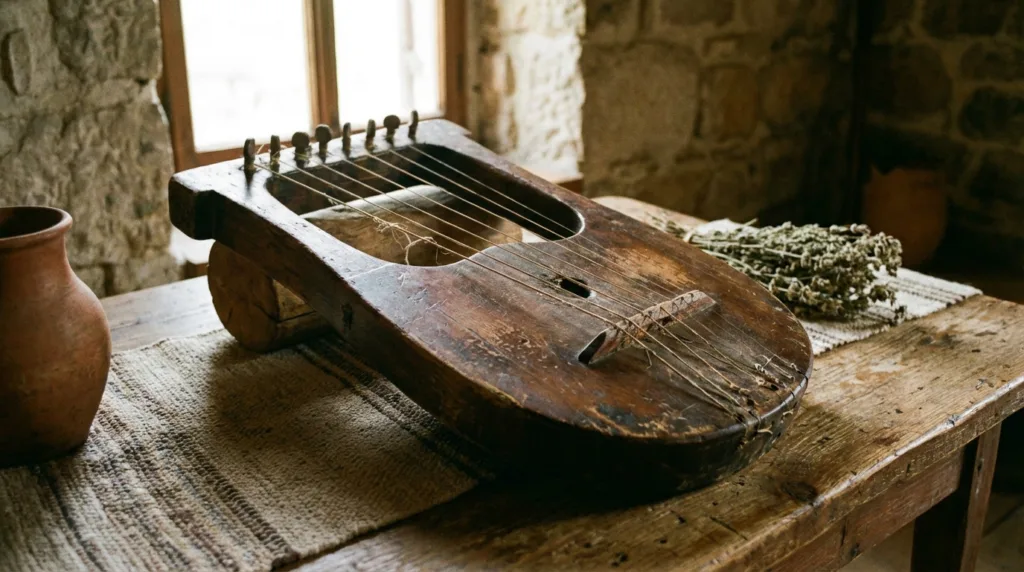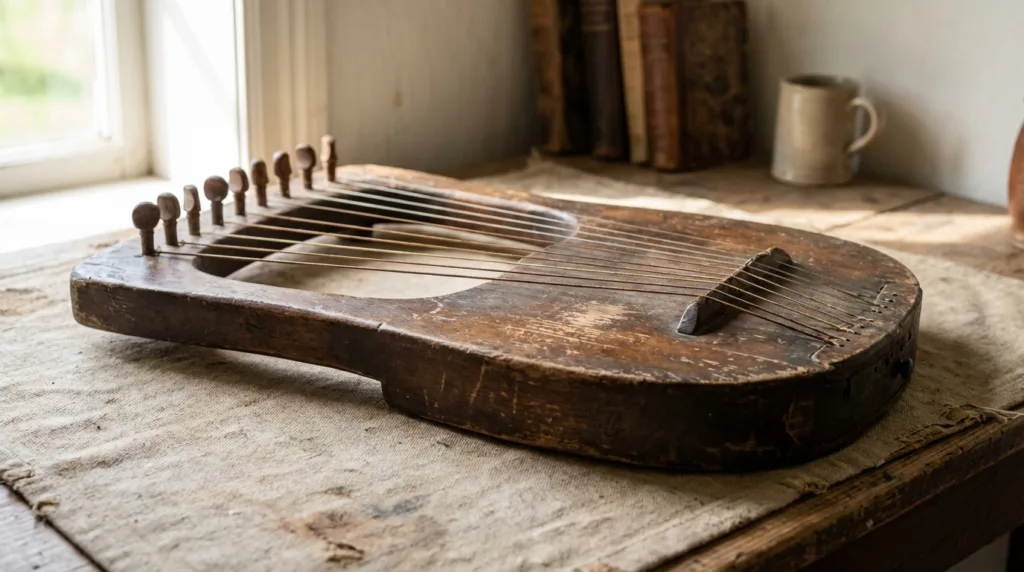
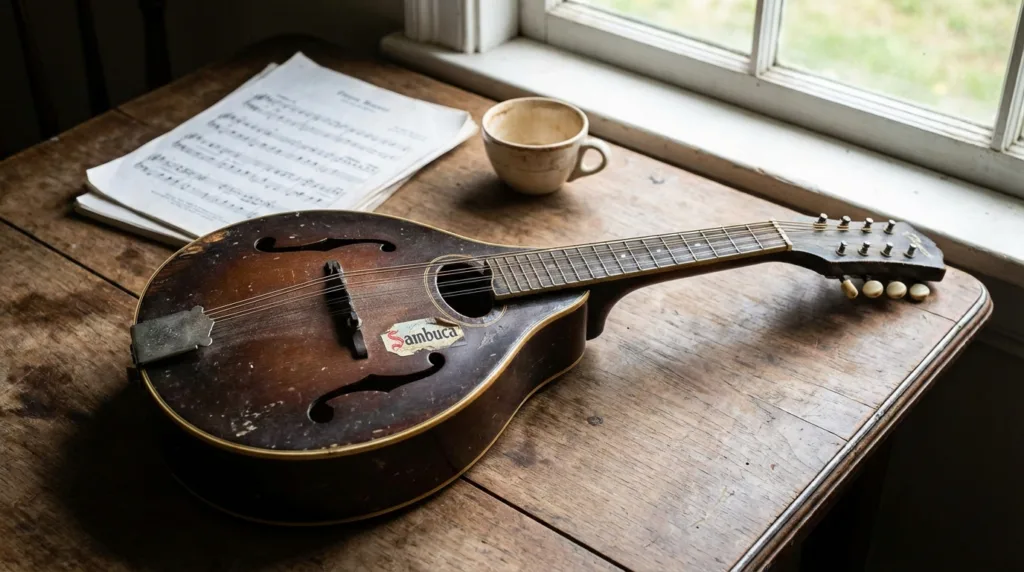
Not every ancient instrument keeps a clear silhouette—Sambuca is one of the rare cases where the name outlived the blueprint.
| What It Is | What We Can Say With Confidence | What Stays Uncertain |
|---|---|---|
| Instrument Family | A stringed instrument (a chordophone), described as small and triangular in many traditions. | Exact construction details vary across eras and authors; later sources reuse the word for other tools and instruments. |
| Sound Reputation | Often characterized as bright and even shrill in historical descriptions. | We do not have a single “standard” tuning or a single verified scale layout. |
| Where The Name Appears | Greek and later Latin writing mentions it from classical antiquity onward; medieval glossaries also keep the word alive. | Some medieval uses likely point to a different instrument altogether (and sometimes even to a wind instrument). |
| Common Confusions | The same word can refer to a sieve-engine (a ladder-like assault device) and to other instruments in later periods. | When a text says “sambuca,” you must read the context—music, war, or botany can all be on the table. |
- 🏺 The term is strongly tied to an ancient harp-like form, but later writers reused it broadly.
- 🧵 Some accounts describe very few strings (as low as four in certain descriptions), while modern reconstructions vary.
- 🪵 Medieval references can shift “sambuca” toward an elder-wood association (because elder was used for pipes and simple winds).
🏺 What Sambuca Really Refers To
- In antiquity: a stringed, often triangular instrument—commonly compared to a small harp.
- In later centuries: “sambuca” can label a different string instrument, a wheel-driven instrument (hurdy-gurdy), or even a wind made from elder wood.
- Outside music: the word also names a ladder-like siege device, reportedly called that because it resembled an instrument’s outline when raised.
So, when you see Sambuca, don’t picture a single museum object locked behind glass. Picture a word traveling through time, picking up meanings as it goes—sometimes precise, sometimes sloppy, sometimes (honestly) a little chaotic. That messiness matters, because your expectations of timbre and feel depend on which “sambuca” a source really meant.
And yes, it can feel unfair. A name that survived… but a design that didn’t.
When a catalog, manuscript, or conversation drops the word “sambuca”, scan for nearby clues: words like strings, harp, wheel, pipe, elder, or even ladder. Context is your authentication tool here—before you ever think about “what it sounded like.”
🪵 How It May Have Been Built
- 🪵 Frame Concept: a compact, angled structure that supports short-to-medium string lengths.
- 🧵 String Logic: fewer strings can push you toward clean, piercing intervals; more strings open up richer patterns, but that is a modern choice.
- 🔧 Anchoring: any harp-like design needs stable end points—pins, knots, or a simple bar system—yet exact hardware is rarely explicit in texts.
A luthier’s brain can’t help but translate old descriptions into forces: where tension gathers, where wood wants to bend, where a joint wants to creep over time. A small, triangular harp-like Sambuca implies higher perceived tension than you might expect, because the hand reads “short string” as “stiff string” even when the absolute tension stays moderate.
Under your fingers, that can feel like a polite resistance—then a snap of sound.
If historical writers call the tone shrill, you can often get there in two honest ways: shorter speaking length and brighter resonance. No myth required.
If you ever commission a Sambuca-style build, ask the maker to aim for stable, moderate tension first, then “brighten” the voice with setup: slightly firmer stringing choices, a clean witness point, and a responsive top (if a soundboard is used). You can always chase more edge later; fixing an over-stressed frame is a headache.
🎶 Timbre, Attack, and Playing Feel
- Attack: typically described as immediate—the note “speaks” quickly.
- Brightness: the historic “shrill” label points to a forward, high-frequency presence.
- Sustain: harp-like instruments can sustain well, but smaller frames often give a leaner tail to the note.
- Hand Feel: fewer strings can feel oddly intimate—each string matters, each mistake shows. Kind of thrilling, kind of unforgiving.
Here’s a practical listening trick—even without an “official” recording tradition. If you imagine a small harp but strip away the velvet softness, you land closer to what many descriptions imply: a tone with glassier edges and less bloom. Bright, yes. But not necessarily loud.
And that playing feel? It’s not only sound; it’s the way the instrument answers you. A compact chordophone can respond fast enough that your rhythm feels “locked in” the moment you touch the string—no lag, no fog. Clean in, clean out.
⚖️ Sambuca Vs. Close Relatives
| Instrument | Core Mechanic | Typical Sonic Impression | What Makes It Different |
|---|---|---|---|
| Sambuca | Plucked harp-like chordophone (ancient term; design varies). | Bright, fast attack; often described as shrill. | A name with multiple historical meanings; fewer fixed “rules.” |
| Lyre | Plucked strings over a yoke; strong cultural iconography. | Clear, rounded, focused tone. | More standardized imagery; easier to “recognize” in art and replicas. |
| Small Harp | Triangular frame, wider design tradition. | Often warmer and more sustaining, depending on size. | A broader, better-documented family; Sambuca sits as a specific historical label inside that idea-space. |
| Psaltery | Strings across a box; plucked or struck. | Brilliant, shimmering sparkle. | Different geometry; often more “zither-like” than harp-like. |
| Hurdy-Gurdy | Wheel bows strings; drone + melody system. | Reedy, continuous, buzzing resonance. | Sometimes called “sambuca” in medieval usage, but the sound world is totally different. |
Vs. Lyre
- Recognition: a lyre is easier to “place” historically; Sambuca is easier to mislabel.
- Feel: lyres often invite chordal patterns; Sambuca-style concepts feel more like line-based playing when string counts are low.
The lyre is a symbol; Sambuca is a question. That’s not a weakness—it’s an invitation. If you like instruments that make you read, compare, and listen like a curator, this one keeps you alert.
Vs. Small Harp
- Size Assumption: Sambuca is frequently described as small; small harps can be small, medium, or large.
- Voice: the “shrill” reputation leans Sambuca toward a sharper top end than many folk harps.
A small harp can melt into a room. A Sambuca-style voice, as described, tends to cut through—especially in lively spaces. Think banquet chatter, clinking cups, that Greek kefi mood… and then a bright string line threading right through it.
Vs. Psaltery
- Geometry: psalteries are box-based; Sambuca descriptions point more often to angular harp thinking.
- Hands: a psaltery can be feather-light under the fingers; harp-like frames can feel more “springy.”
If you chase shimmer, psaltery is an obvious pick. If you want that harp-like snap with a slightly stricter physical response, Sambuca-style ideas sit in a different lane.
“Authentic Sambuca” is a risky phrase unless the maker states which period and which textual or iconographic thread they follow. The most honest builds label themselves as Sambuca-inspired or Sambuca-style, then document their design choices plainly.
🪵 Choosing Materials For a Modern Replica
- 🪵 Soundboard Woods (If Used): spruce for quick response; cedar for a slightly softer edge (often perceived as “rounder”).
- 🪵 Frame Woods: maple for firmness and reflected brightness; walnut for a calmer, darker overtone profile; beech for practical stability.
- 🧲 Metal Choices (For Hardware): brass can feel smoother under the hand; steel parts can increase “snap,” but require careful corrosion control.
- 🧵 Strings: gut-style strings tend to give a grainier complexity; modern synthetics offer stable pitch and easier maintenance.
Material talk gets mystical fast, so let’s keep it grounded. Wood choice doesn’t “add magic”; it changes loss and reflection—how quickly vibration becomes sound, and how much the structure “holds” it before letting it go. For an instrument already described as bright, a very hard, reflective frame can push it toward edge. Sometimes that’s perfect. Sometimes it’s too much.
So you balance it. A slightly more damping wood, or a gentler top, can keep the voice sharp but not prickly. Subtle. Effective.
🔧 Setup, Care, and Safe Storage
- Stabilize First: bring strings up to pitch gradually; let the frame “learn” the load. That’s stress management, not superstition.
- Check Anchor Points: knots, pins, or tie bars should not bite the string at sharp angles—tiny kinks turn into breakage.
- Humidity Matters: wood moves; keep it away from radiators and sunlit windows. Your timbre changes when the wood changes.
- String Hygiene: wipe hands before playing; oils dull the attack and shorten string life.
- Transport: support the frame, not just the body; triangular forms can twist if you carry them carelessly.
Here’s the odd little truth: you can “care” for tone. A stable setup keeps the sound consistent, and consistency is what lets your ear learn the instrument’s personality—its timbre, its moods, its habits.
🧭 Where Sambuca Shows Up Today
- Historically-Informed Performance: builders and performers keep exploring ancient chordophones, often presenting “best-fit” reconstructions rather than absolute claims.
- Museum Workshops: replicas increasingly come from measured geometry and careful material testing—less guesswork, more transparent craft.
- Modern Sound Design: bright, quick-plucked textures sit well in contemporary scoring, especially when you want “ancient” color without a heavy, cinematic thud.
It’s a quiet revival, not a headline-grabber. But it’s real. And every time a maker labels choices clearly—string count, frame geometry, materials—the word Sambuca becomes a little less foggy for the rest of us.
FAQ
Is it hard to learn the Sambuca?
Answer
It depends on the build. A Sambuca-style instrument with fewer strings can feel straightforward at first, but it demands clean timing and touch because every note sits “exposed.” More strings add options, yet also add navigation and tuning work.
How do I know if a “sambuca” reference means the harp, the hurdy-gurdy, or the flute?
Answer
Read the surrounding words. If the text mentions strings, harp, plucking, or shrill string tone, it likely points to the ancient chordophone. If it mentions a wheel, cranking, drones, or buzzing, it likely points to the hurdy-gurdy usage. If it mentions elder wood, pipes, or “flute,” it likely points to a wind instrument meaning.
What did the Sambuca probably sound like?
Answer
Historical descriptions often paint it as bright and even shrill. In practical terms, expect quick attack, strong high-frequency presence, and a clearer, more cutting tone than many softer folk harps—especially if the frame is compact.
How many strings did the Sambuca have?
Answer
Ancient descriptions are not uniform. Some accounts describe very low string counts (as few as four), while modern reconstructions may choose more strings for musical flexibility. Treat string count as a documented design choice, not a fixed rule.
What materials work best if I commission a modern Sambuca-style replica?
Answer
For a responsive voice, many makers favor a light, lively soundboard wood (often spruce) paired with a stable frame wood (like maple, walnut, or beech). Hardware choices and string types then fine-tune brightness, sustain, and feel.
Can I tune it like a lyre or small harp?
Answer
You can adopt a practical tuning approach similar to related plucked chordophones, especially on modern builds. Since no single standardized tuning survives for all historical “sambuca” references, a builder typically chooses a stable system that fits the string count and musical goal.