
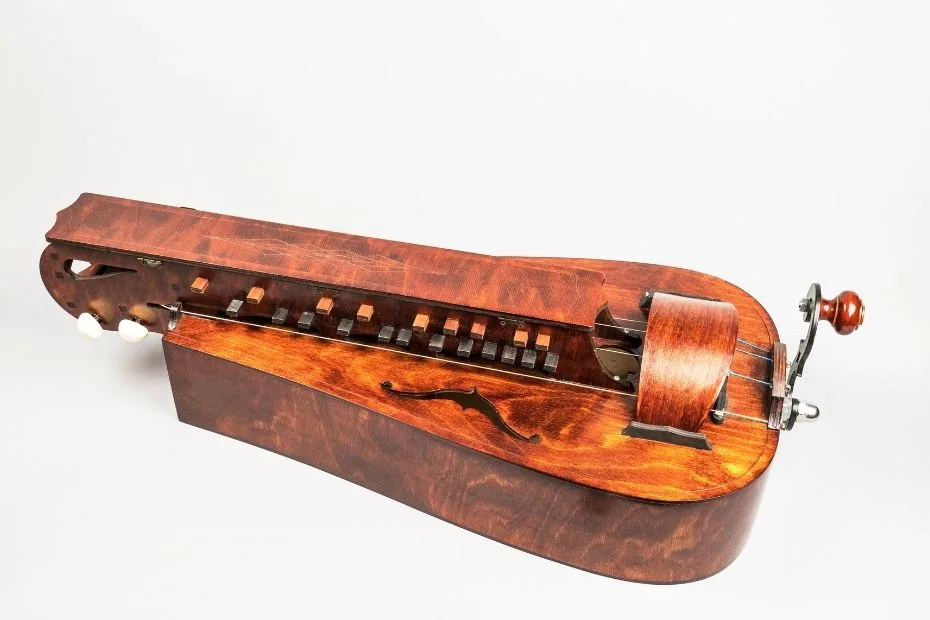
Turning the Wheel: Groove Engineering on the Hurdy-Gurdy
The hurdy-gurdy is a mechanically bowed chordophone in which a rosined wheel replaces the conventional bow. A crank keeps the wheel moving beneath the strings, a keybox changes the pitch of the melody strings, and fixed drones can sustain a continuous tonal foundation. On many French-style instruments, a separate drone string and movable buzzing bridge add a second function: rhythm generated directly by the crank hand.
| Feature | Description |
|---|---|
| Instrument family | Mechanically bowed chordophone with a friction wheel, keyboard-operated tangents, melody strings, and drones |
| Common names | Hurdy-gurdy; French vielle à roue; Hungarian tekerő; Galician zanfona; Ukrainian lira |
| Sound source | Strings rubbed continuously by a rosined wooden wheel |
| Melody mechanism | Keys move small wooden tangents against one or more melody strings, shortening their vibrating length |
| Drone system | One or more strings remain at fixed pitches while the melody changes above them |
| Rhythmic mechanism | On instruments fitted with a trompette, controlled crank impulses make the chien bridge produce a percussive buzz |
| Body forms | Historical examples include lute-shaped, guitar-shaped, and regionally distinct bodies; dimensions and string layouts are not standardized |
Construction: Wheel, Strings, Keybox, and Body
The wheel is the mechanical center of the instrument. Its rim must be smooth, round, and accurately aligned because every sounding string depends on consistent contact with that surface. Rosin gives the wheel enough friction to set the strings into vibration, while a thin layer of cotton wrapped around each bowed string helps regulate contact and soften irregularities in the attack.
The melody strings, often called chanterelles in French terminology, pass through the keybox. Pressing a key moves a wooden tangent sideways until it touches a string. That contact defines a new vibrating length in much the same way that a fret or finger changes the active length of a string on another chordophone. Releasing the key allows the tangent to move away again.
Drone strings bypass the melodic action and continue sounding at fixed pitches. Their tuning determines much of the harmonic character of the instrument, so a hurdy-gurdy configured for one modal center may require retuning or changes to the active drones before moving into another.
Body construction varies markedly. Eighteenth-century French makers produced ornate lute-shaped and guitar-shaped instruments from combinations of maple, pearwood, ebony, cedar, walnut, and decorative materials. Folk instruments from other regions can have simpler bodies and different string counts. The body is therefore better understood as a regional and maker-dependent part of the design rather than a single standardized form.
How the Wheel Produces a Continuous Bowed Sound
A conventional bowed string instrument must reverse bow direction repeatedly. The hurdy-gurdy avoids that interruption by using the circumference of a rotating wheel as an effectively continuous bow. As long as the crank turns and wheel contact remains stable, melody and drone strings can sustain without a normal bow change.
Crank rotation affects more than duration. Smooth rotation supports an even tone, while abrupt variations can change the attack and excite the buzzing mechanism. Wheel condition, rosin level, cotton thickness, string tension, and string pressure against the wheel all influence whether the result is focused or rough.
Common Confusion: The trompette and chien are not two names for the same part. The trompette is the buzzing drone string, while the chien is the small movable bridge that allows that string to create the characteristic rhythmic buzz.
The Buzzing Bridge
The chien does not behave like the stable main bridge carrying the melody strings. Its geometry allows part of the bridge to move against the soundboard. When the player introduces a controlled acceleration into the crank rotation, the vibrating trompette can make the bridge respond with a dry, percussive chatter.
This turns the right hand into both bowing mechanism and rhythm controller. A player can maintain a nearly uninterrupted drone, articulate repeated rhythmic patterns, or suppress the buzz for a smoother texture without changing instruments.
From the Medieval Organistrum to the Vielle à Roue
The hurdy-gurdy belongs to a long sequence of wheel-bowed instruments rather than to a single unchanged medieval design. One of the clearest early visual witnesses is the organistrum represented on the Pórtico da Gloria at the Cathedral of Santiago de Compostela. The monument belongs to Master Mateo’s late twelfth-century project, and its lintel records the date 1188. The carved organistrum is operated by two musicians.
That large two-person arrangement differs from the later portable instrument. Medieval representations and descriptions show smaller forms developing that allowed one performer to control both crank and pitch mechanism. Names such as symphonia and related medieval spellings appear in the history of these wheel-bowed instruments, although terminology was not consistent across places and centuries.
The Pórtico da Gloria in Santiago de Compostela depicts a large organistrum requiring two performers, preserving unusually detailed visual evidence of the wheel-bowed principle.
Smaller wheel-bowed instruments capable of one-person operation appear, bringing crank and pitch control into a more portable format.
The vielle à roue became associated not only with folk performance but also with fashionable courtly and aristocratic music. Elaborately decorated lute- and guitar-shaped instruments survive from this period.
Regional traditions remained active in parts of France, Hungary, Galicia, Ukraine, and elsewhere, while workshops developed local body forms, tunings, string counts, and playing practices.
Contemporary builders combine historical principles with more adjustable setups, modern strings, amplification options, and instruments designed for older repertories as well as new music.
Documented Historical Instruments
Museum collections show how much the instrument could vary even within a relatively narrow period. String counts, body shapes, decorative treatment, keyboard dimensions, sympathetic strings, and drone layouts all differ among surviving examples.
| Date | Maker or Attribution | Documented Features | Collection |
|---|---|---|---|
| 1740 | Pierre Louvet, Paris | Lute-shaped body, six main strings, three sympathetic strings, 23-key keyboard | Musée de la musique record available through MIMO |
| 1760–1780 | François le Jeune, Paris | Guitar-shaped body, melody and drone system, trompette, and four resonance strings | The Metropolitan Museum of Art |
| Second half of the 18th century | French, maker unspecified | Wood, ivory, and metal construction; wheel diameter 16.4 cm; documented melody-string vibrating length about 32.2 cm | The Metropolitan Museum of Art |
| Early 19th century | Bassot, France | Six strings comprising two melody strings and four drones, with 23 keys | Smithsonian National Museum of American History |
| Circa 1879 | Gilbert Nigout, Jenzat | French wooden instrument with bone, ivory, and mother-of-pearl details | The Metropolitan Museum of Art |
These objects also show why a single fixed measurement for the hurdy-gurdy is misleading. Historic French instruments in major collections can differ in total length, wheel size, keyboard span, vibrating string length, and internal layout.
Regional Forms and Playing Traditions
French instruments provide many of the best-documented historical examples of the developed buzzing-bridge system. Traditions in central France, including areas associated with bourrée repertory, helped maintain the instrument after its eighteenth-century courtly fashion had faded.
The Galician zanfona belongs to the same wheel-bowed tradition but developed its own construction and terminology. Historical practice included accompaniment for songs performed by blind itinerant musicians. Faustino Santalices played an important role in the instrument’s twentieth-century recovery in Galicia, followed by workshops, performers, and makers who continued the revival.
The Hungarian tekerő survived particularly strongly in the southern Great Plain around Szentes. Ethnographic descriptions document smooth playing as well as dance styles in which rhythmic crank motion activates a rasping or buzzing string. Four-string instruments are widely represented in the documented tradition, though other configurations exist.
The Ukrainian lira was associated with itinerant musicians known as lirnyky. A common historical arrangement used one melody string and two fixed drone strings. Its social history and repertory differ from French vielle practice even though the basic wheel-bowed mechanism belongs to the same broad instrument lineage.
Playing Technique: Melody, Drone, and Crank Rhythm
The left hand operates the keys while the right hand turns the crank. Clean melody playing depends on letting the keys travel freely enough for their tangents to contact and release the string without unnecessary drag. Excessive force does not improve intonation and can make mechanical noise more obvious.
The crank hand controls the continuity of the bowing action. For sustained passages, rotation should remain even enough that the wheel does not alternately grab and release the strings. Rhythmic playing adds short accelerations at selected points of the rotation. On a well-adjusted buzzing system, these impulses trigger the chien while the melody and other drones continue sounding.
Advanced players divide the crank cycle into repeatable rhythmic positions and combine them into dance patterns. The result can sound like a bowed melody, a drone instrument, and a small percussion layer operating at the same time, but those functions remain mechanically connected through one wheel.
Player Tip: A weak or unreliable buzz is not always a right-hand problem. Trompette tension, chien adjustment, cotton, rosin, wheel condition, and the small pressure adjustments used in the buzzing system can all change how easily an accent speaks.
Modern Builds and Historical Reconstructions
Modern hurdy-gurdies range from historically informed copies to instruments designed for amplified folk, experimental, and contemporary music. Builders may add adjustable drone capos, sympathetic strings, extended keyboard ranges, contact pickups, or other setup controls while retaining the same basic wheel-and-tangent acoustic principle.
Reconstructing a medieval organistrum is a different task from copying an eighteenth-century museum instrument. Later vielles can be measured directly from surviving objects, sometimes down to wheel diameter, keyboard span, string layout, and individual materials. Medieval builders often have to interpret sculpture, manuscript imagery, written descriptions, and knowledge gained from later mechanisms. A reconstruction should therefore be understood as a reasoned working interpretation rather than an untouched medieval specification.
The Pórtico da Gloria is especially useful because its sculpted musicians show the large instrument being operated by two people. Modern reconstructions based on the ensemble have also been used to investigate how its depicted instruments may have functioned together.
Setup, Cotton, Rosin, and Wheel Condition
Cotton should form a thin, even layer around the part of each string contacted by the wheel. Dirty, compacted, or uneven cotton can produce rough attacks, squealing, weak response, or unstable volume. Adding more is not automatically better.
The wheel needs enough rosin to grip the strings consistently. Heavy buildup can make the sound harsh and uneven, while too little can produce a weak tone or intermittent contact. Changes should be gradual.
Tangent position affects intonation. Small adjustments may be needed after string changes or when individual notes drift, but unnecessary movement can turn a stable keyboard into a lengthy tuning problem.
An out-of-round, warped, dirty, or poorly aligned wheel can produce repeating changes in volume and texture once per rotation. Wheel work requires precision because every bowed string shares the same surface.
Terminology That Changes How the Instrument Is Understood
Chanterelle: French term commonly used for a melody string whose pitch is altered by the key-operated tangents.
Bourdon: A drone string that sustains a fixed pitch rather than following the melody keyboard.
Trompette: The drone string used with the buzzing bridge to create rhythmic articulations. It is a physical string, not the name of the rhythmic pattern itself.
Chien: Literally “dog” in French; the small movable buzzing bridge associated with the trompette string.
Keybox: The enclosed structure containing the keys and tangents used to shorten the vibrating length of the melody string or strings.
Tangent: A small projecting piece moved by a key until it contacts the melody string and establishes the sounding pitch.
Organistrum: A large medieval wheel-bowed instrument represented in twelfth-century sources and generally treated as an ancestor within the hurdy-gurdy’s mechanical lineage.
Related Instruments and Common Mix-Ups
An earlier large wheel-bowed form, often represented as a two-person instrument. It shares the rotating friction-wheel principle but differs substantially from the later portable hurdy-gurdy.
A keyed bowed chordophone. Keys and tangents alter the strings, but the player uses a conventional handheld bow instead of a crank-driven wheel.
A bowed string instrument associated with a buzzing bridge effect. Its acoustic buzz offers an interesting mechanical comparison with the chien, but it has no hurdy-gurdy wheel or melody keybox.
A mechanically operated wind instrument using pipes or reeds. It is acoustically unrelated to the hurdy-gurdy despite historical English usage that has sometimes caused the names of crank-operated street instruments to be confused.
The zanfona, tekerő, and Ukrainian lira are better treated as regional wheel-bowed traditions rather than merely as unrelated instruments that happen to resemble the French vielle à roue.
High-Quality Sources
- The Metropolitan Museum of Art — François le Jeune, Vielle à Roue, 1760–80
- MIMO / Musée de la musique — Pierre Louvet Vielle à roue, Paris, 1740
- Smithsonian National Museum of American History — Bassot Hurdy-Gurdy
- Cathedral of Santiago de Compostela — Pórtico da Gloria and the Organistrum
- Consello da Cultura Galega — Galician Zanfona
- Hungarian Electronic Library — Hungarian Hurdy-Gurdy and Folk Instrument Tradition
- Encyclopedia of Ukraine — Lira