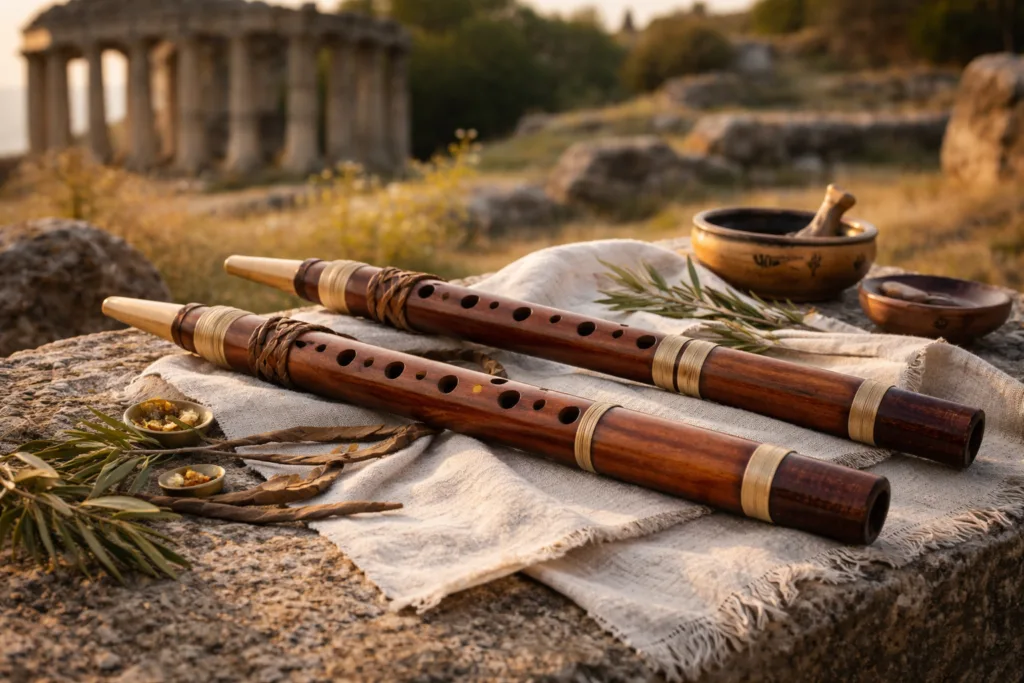
Two pipes. One breath. And a sound that can feel closer to the human voice than you’d expect from a carved tube.
The Tibia Musical Instrument: The Ancient Roman Reed Pipe sits right on that edge where craft meets physiology—where reed resistance, wood density, and finger stretch decide whether the tone blooms… or bites back.
What This Instrument Really Is 🏛️
- Family: Reed woodwind (often discussed alongside the Greek aulos).
- Common Setup: Two separate pipes played at the same time—one in each hand.
- Reed Type: Frequently double reed behavior (two blades beating together), with a very direct, “alive” response.
- Why The Name “Tibia”: The Latin word also means shinbone; hollow bone and other natural tubes inspired the term and early materials.
- Player Name: A Roman piper is often called a tibicen (you’ll see it in texts and museum labels).
| Material Choice | What Your Ears Notice | What Your Hands Notice |
|---|---|---|
| 🦴 Bone | Fast, bright “edge”; crisp attacks; a slightly dry shimmer. | Cool touch; low weight; can feel “snappy” under strong air. |
| 🌳 Dense wood (boxwood-like behavior) | Rounder core; warmer midrange; steadier pitch once warmed up. | Softer tactile warmth; subtle grip; stable if humidity is managed. |
| 🪙 Metal sleeves/collars | More projection; a focused “ring”; cleaner note transitions. | Extra weight; smoother mechanics; firmer feel under fingers. |
| 🦷 Ivory-like density (historical context) | Clear, glossy highs; tight articulation; strong carrying power. | Very smooth surface; “slippery” control if you sweat—oddly real. |
The headline is simple: a Roman tibia is not just “a pipe.” It’s a reeds-first instrument, where your breath doesn’t merely blow—your breath negotiates with the reed.
And yes, sometimes the word “tibia” got used broadly for different pipe-like instruments in Roman culture, which can muddy labels. Still, when people say “Roman reed pipe,” this is usually the sound-world they mean.
Collector’s Note: If you’re looking at an alleged “ancient tibia,” treat it like an archaeological object first, an instrument second. Documentation and lawful provenance matter more than polish.
Sound, Feel, and Response 🎶
- Timbre: A reedy buzz sitting on a focused core—think “nasal” only if the reed is pinched. With a balanced reed, it becomes vocal, not harsh.
- Attack: Instant. The reed speaks fast, so sloppy air shows up immediately (no mercy, honestly).
- Resistance: Medium-to-high backpressure is common; the instrument likes supported air more than raw force.
- Two-Pipe Effect: You don’t just play notes—you play relationships: unisons, drones, rough beating, and tight consonances.
Here’s the thing many modern players don’t expect: the tibia’s resistance can feel like pushing air through a narrow gate, then suddenly—when the reed aligns—everything opens and the tone snaps into place.
Some days it feels like the reed has a mood. (It does.) A tiny change in moisture, a fraction of a millimeter in scrape, and the instrument shifts from stubborn to singing.
When you play two pipes together, your body learns a new kind of balance. One hand can hold a stable pitch while the other shades notes—micro-adjustments, quick half-holes, and those little “just to the side” finger touches that look messy but sound right.
It’s physical music.
Pro Tip: Don’t chase volume first. Chase clean reed closure. When both blades meet evenly, the tibia gets louder on its own—without you overblowing and flattening the pitch.
Workshop Anatomy: What Makers Control 🛠️
- Bore shape: Even “small” bore changes can shift stability and brightness. A slightly wider lower bore often adds body; too wide can blur focus.
- Hole layout: The spacing decides comfort and intonation. Too tight feels athletic; too wide feels like a stretch you regret mid-phrase.
- Reed seat: How the reed fits (depth, taper, seal) controls response more than most people admit.
- Surface finish: Not cosmetic—finish affects moisture behavior and how the instrument “settles” during a session.
One well-studied doublepipe pair (often discussed in specialist literature) shows why makers obsess over small numbers. Measurements on that pair describe bores around 7.5–7.7 mm, flaring toward about 8.5–8.8 mm near the end. Up near the reed insert, the bore opens more dramatically into a larger seat (over 10 mm in that example) to support a reed that can fan out to roughly 1.5 cm in blade breadth.
That’s not trivia. That’s the difference between a reed that locks and one that wobbles.
Even the effective reed length matters. In the same kind of documented reconstruction work, reed lengths in the neighborhood of 4.0–4.2 cm appear in playable setups. Not as a rule for every tibia—more like a reminder that you’re working with precise air engines, not vague “ancient pipes.”
Pro Tip: If you build or buy a replica, ask how the maker treats the reed seat. A clean taper and a dependable seal often matter more than fancy exterior details.
Fingerwork, Holes, and Why Rome Loved Hardware 🔧
| Feature | What It Does Musically | What It Feels Like |
|---|---|---|
| Thumb hole (often present) | Adds a control point for pitch and articulation; supports quick venting. | A “pivot” under the hand; demands clean rolling motion. |
| Multiple finger holes per pipe | Expands scale options; enables tighter chromatic steps. | More choices, more risk—mis-fingering shows immediately. |
| Sleeves/collars that rotate | Open/close holes mechanically; supports fast mode changes. | A satisfying “click” logic—like ancient keywork, but simpler. |
| Half-holing techniques | Fine pitch shading; expressive slides; microtonal color. | Feels imperfect, looks imperfect—sounds honest when done right. |
On a paired, two-handed reedpipe, you can’t physically cover an endless number of holes at once. That limitation pushed innovation: extra holes, partial holes, and mechanical aids like rotating sleeves on some later instruments.
So the Roman world didn’t just “inherit a pipe.” It kept refining the control system around it—because performers demanded flexibility, especially in public settings.
And the body had to keep up. Players sometimes used a cheek strap—known in Greek as phorbeia and in Latin contexts as capistrum—to stabilize the embouchure and support the cheeks under sustained pressure.
Not glamorous. Very practical.
Where The Tibia Lived: Street, Stage, and Ceremony 🎭
- Stage accompaniment: Rhythmic drive, dramatic color, and sustained energy—ideal for performance contexts.
- Public life: The tibia could cut through crowd noise with focused projection.
- Ritual settings: Reedpipes naturally support repetitive, trance-like patterns without needing huge ensembles.
- Archaeological “anchor date”: Instruments and parts associated with Pompeii are often discussed with the eruption of 79 CE as a preservation point.
A reed instrument like this works because it’s direct. You don’t need a concert hall. You need air, a reed, and a musician who can keep their nerve when the reed pushes back.
That’s why the tibia shows up in performance art contexts so easily: it can be rhythmic, insistent, and strangely intimate at the same time.
One more detail that matters for builders: when an instrument is meant to be heard outdoors or in lively rooms, the design often favors a strong midrange and quick response, even if that sacrifices some “sweetness.” The tibia tends to make that trade willingly.
Tibia Vs. Greek Aulos: Same Roots, Different Habits ⚖️
Short version: Many descriptions treat the Roman tibia as the practical counterpart to the Greek aulos. They share the doublepipe idea and reed-driven voice, but Roman usage and terminology can be broader—and later Roman examples show a strong taste for mechanical refinement.
- Language difference: “Tibia” can be a wider umbrella term in Roman culture, while “aulos” stays more specific in many Greek discussions.
- Instrument culture: Both are often paired-pipe instruments, but Roman contexts frequently emphasize professional performance roles.
- Hardware: Later examples associated with the Roman world can show complex collars and sleeves—almost like a bridge toward keywork thinking.
If you’ve ever restored old instruments, you know the feeling: people don’t just copy. They tweak. They optimize. The tibia story has that same fingerprint—an inherited idea, shaped by different venues and different demands.
So yes, it’s related. But it’s not a carbon copy. And those small differences show up in response and playability.
Tibia Vs. Modern Oboe and Clarinet: Familiar, Then Suddenly Not 🎼
| Comparison Point | Roman Tibia | Modern Oboe / Clarinet |
|---|---|---|
| Number of pipes | Two at once is common | One pipe |
| Primary control feel | Two-handed coordination between pipes; interval thinking | Linear melody control; key system assists |
| Reed relationship | Reed is brutally direct; small changes reshape the tone | Still sensitive, but standardized dimensions help consistency |
| Tone character | Focused, reedy, sometimes raw in a beautiful way | More blended, designed for ensemble balance |
If you play oboe, you’ll recognize the double reed logic—that tight window where the reed opens just enough to sing without collapsing. That part feels familiar.
Then the tibia reminds you it’s a different animal: you’re coordinating two voices, and the instrument expects you to treat harmony as a physical act, not a theory concept.
If you come from clarinet, you’ll love the finger independence but you might miss the forgiving stability of a single-reed mouthpiece. The tibia’s reed can feel more “on the edge.” And that’s the point.
It rewards calm air.
Pro Tip: Oboe players transitioning to tibia replicas often improve fastest by practicing steady pressure at medium volume, not by hunting extreme dynamics.
Wood and Bone Vs. Metal-Sleeved Tibiae: A Maker’s Choice 🧩
- Wood/Bone builds: More tactile warmth; timbre can feel grainy-in-a-good-way; small humidity shifts show up in pitch and response.
- Metal sleeves/collars: More “locked” tuning; faster hole changes; stronger projection; slightly heavier feel under the hands.
- Repair reality: Wood cracks and bone splits require conservation-minded work; metal parts introduce corrosion and joint-fit issues.
If you want the sound to feel organic, wood and bone get you there. They also give you that subtle “give” under the fingers—the instrument feels like it’s breathing with you.
If you want reliability and fast transitions, metal sleeves can feel like a quiet revolution. Not loud, not flashy—just more control.
And yes, you can mix approaches in modern replicas. Makers do it all the time. A wood body with carefully fitted rings can keep the tone warm while improving stability.
Good work is good work.
Playing and Caring: What Keeps The Voice Alive 🌿
- Reed storage: Keep reeds dry but not brittle; sudden heat can warp the blades.
- Humidity control: Wood bodies like consistency; big swings can move tuning and stress joints.
- Condensation: Warm air meets cooler bore—water happens. Gentle swabbing beats aggressive cleaning.
- Handling: Support the joint areas; don’t lift the pipe by collars or sleeves.
A tibia-style reedpipe asks for routine. Not drama. A quick check of the reed opening, a gentle swab, and you avoid most problems.
When people over-maintain, they often damage things. When they under-maintain, the reed punishes them. The sweet spot is steady and light-handed.
Collector’s Note: If you encounter authentic archaeological fragments, avoid “making them playable.” Conservation ethics usually treat original artifacts as non-performing objects. High-quality replicas exist for sound research and performance.
Modern Revival: Why The Tibia Keeps Coming Back Today 🧪
- Experimental archaeology: Makers and researchers build playable replicas to test tuning, ergonomics, and reed behavior.
- Museum education: Replicas let visitors hear a plausible sound without risking originals.
- Digital tools: 3D scanning and printing can support accurate geometry, then skilled hand-finishing brings the instrument to life.
In the last few years, it’s become normal to see digital documentation paired with traditional craft—scan an object, model it, print a working blank, then finish it by hand like you would any serious instrument. That blend keeps the process honest: data gives shape, but the reed and bore finishing decide the voice.
And in a world where short-form performances travel fast, the tibia’s sound is easy to recognize. It’s sharp, it’s human, it cuts through. It doesn’t beg for attention. It takes it.
Still, the heart of the revival is not tech. It’s the reed. Always the reed—that small, stubborn piece that turns air into story.
FAQ
Is The Tibia The Same As An Aulos?
Show answer
The Roman tibia is often treated as the counterpart to the Greek aulos, especially when discussing paired reedpipes. However, “tibia” can be used more broadly in Roman sources, so context matters. In practice, many reconstructions treat them as closely related instruments with a shared doublepipe tradition.
Does A Roman Tibia Use A Double Reed?
Show answer
Many descriptions and reconstructions use a double reed setup, and the playing feel strongly matches double-reed behavior: quick response, higher resistance, and tone that changes dramatically with reed adjustment. Some Roman terminology can be broader, but for the reedpipe tradition, double reeds are a common and historically grounded approach.
Is It Hard To Learn If I Already Play Oboe Or Clarinet?
Show answer
If you play oboe, the air support and reed sensitivity will feel familiar, but coordinating two pipes is a new skill. If you play clarinet, your finger independence helps, but the reed behavior will feel less forgiving. Either way, steady medium-volume practice usually works better than pushing extremes early.
How Do I Know If A Replica Is Historically Informed?
Show answer
Ask for the model basis (which artifact or measurement set inspired it), the bore and hole logic, and how the reed seat is built. A strong replica explains its geometry and reed approach clearly, and it prioritizes playability that matches known constraints of paired reedpipes.
What Materials Change The Sound The Most On A Tibia?
Show answer
The reed and bore dominate, but material still matters. Bone often feels brighter and quicker, dense woods tend to sound rounder, and metal sleeves can increase projection and stability. The biggest audible differences usually appear in attack clarity and midrange focus.
Can I Play Ancient-Style Tibia Music Without Circular Breathing?
Show answer
Yes. Circular breathing can help with long phrases, but you can play convincing lines with normal breath planning and clean articulation. Many players build endurance gradually and use musical phrasing rather than constant sound as the main goal.