
- Best documented ritual strings: the lyre and the long-necked lute
- Most likely time-keeping force: drums, cymbals, rattles, and other struck instruments
- Most debated area: exact identification of some instrument names in the tablets
- What survives best: ritual texts, relief vases, and later stone reliefs—not many complete instruments
- What matters most: these were not stage instruments first; they were ritual tools with sound, gesture, and timing built into ceremony
| Instrument | Main Evidence | Likely Material Clues | Sound Role in Ritual | What Makes It Distinct |
|---|---|---|---|---|
| Large Lyre | Texts, relief vases, ritual scenes | Large wooden body; organic strings are assumed in reconstructions, but full build details remain open | Ceremonial support, sung accompaniment, strong visual presence | Monumental scale; often treated as the main prestige string voice |
| Small Lyre | Texts and iconography | Compact wooden resonator; about seven to ten strings in common reconstructions from depictions | Solo support in drinking or offering settings | More intimate, quicker response than the standing lyre |
| Long-Necked Lute | Texts, İnandık and Alaca Höyük imagery, Neo-Hittite reliefs | Small wooden soundbox, long neck, likely two or three strings | Rhythmic melodic line, dance support, mobile performance | Sharper attack and more direct articulation than a lyre |
| Drum | Texts and later reliefs | Membrane over a frame or shell; exact construction varies | Marks entrances, pulse, dance, and bodily movement | Carries the rite physically, not only musically |
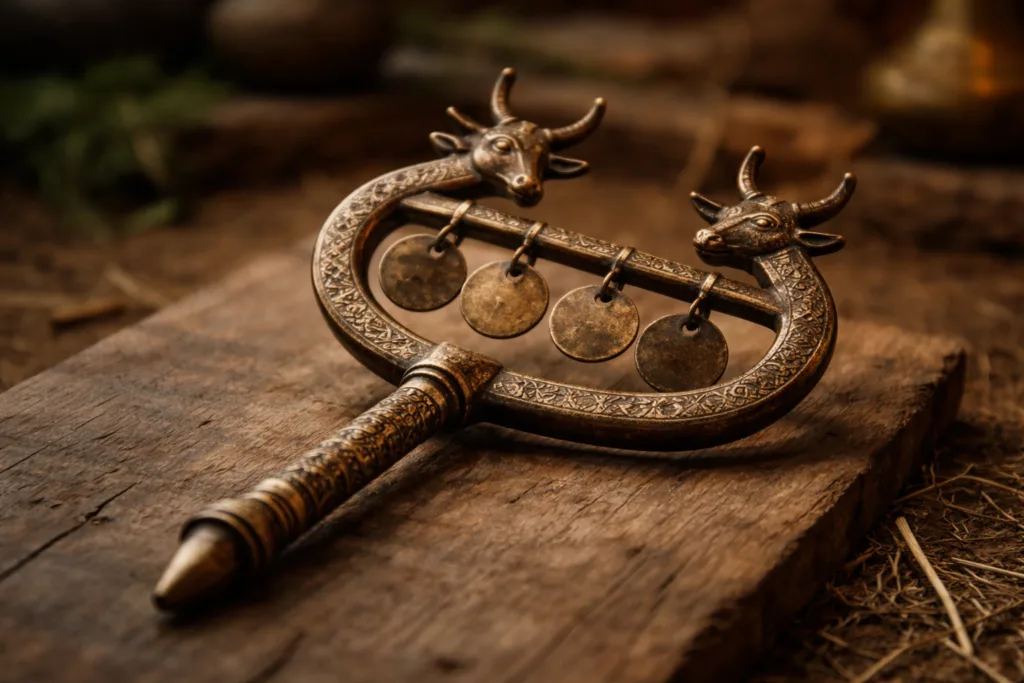
| Cymbals / Struck Pairs | Archaeology, vessel scenes, ritual references | Bronze is certain in some offerings; metal, wood, and clay appear in the textual record for related struck pairs | Accent, punctuation, shimmer, ritual emphasis | Fast, bright edge that cuts through ensemble texture |
| Horn / Double Pipe | Texts and Neo-Hittite reliefs | Bull-horn form for the horn; reed or pipe family for the long tube remains debated | Signal, procession cue, piercing melodic layer | Breath-led projection, often more about function than tonal luxury |
A Hittite ritual ensemble was organized from function to sound. The tablets record the sequence of singing, recitation, dance, and instrumental entries; relief vases and stone carvings show the positions and movements of performers beside libations, processions, and offerings. Sound in Hittite ceremony was organized action, not decoration.
Not every Hittite instrument name is securely identified. Some terms survive through Hittite, Luwian, Hattian, or Sumerograms, and the written label does not always correspond neatly to the object shown in the art. The identification of several instruments therefore remains provisional.
🏺 Evidence and Its Limits
- Ritual tablets show sequence: when instruments enter, when singing joins, and even when silence is required.
- Relief vases such as İnandık and Hüseyindede show ensemble layout: lyres, lutes, cymbals, dancers, acrobats, and cult movement.
- Later Neo-Hittite reliefs show continuity and change: long-necked lutes, double pipes, large drums, and rattles in clearer profile.
- What is missing is just as important: there is no surviving Hittite music theory text that explains tuning, scale system, or notation in the way a modern musician would want.
Exact modern names on museum labels and replicas often represent a best-fit identification rather than a final verdict. In Hittite studies, silhouette, textual terminology, and ritual role do not always point to a single secure classification.
The distance between a written name and a depicted object is part of the surviving evidence. The Hittite sound world survives mainly through fragments of use, not through a collection of fully preserved, playable instruments.
🎼 Strings That Lead the Rite
Large Lyre and Small Lyre
Among Hittite ritual instruments, the lyre stands on the firmest ground. Textual and visual evidence distinguish between a large standing lyre and a smaller, more portable lyre. The monumental version is often reconstructed at around two metres in height and can require two players in surviving imagery. Its scale gave it both acoustic weight and a commanding visual presence within the ceremony.
The smaller lyre seems to belong to tighter spaces in the rite—drinking scenes, focused accompaniment, and more direct support for the sung line. It likely answered faster, with less air in the body of the tone than the standing instrument. Closer sound. Shorter bloom.
The difference in size changes the role of the instrument. A larger resonator usually provides stronger low-frequency support and a broader after-ring, while a smaller body responds more quickly and leaves more space for voice or recitation. Even without a securely reconstructed tuning system, body size still provides acoustic evidence.
A large ritual lyre differs from a smaller lyre in more than volume. Its larger body produces greater weight of resonance, a longer decay, and a broader sonic field around the accompanying voice.
Lyre Vs. Harp in the Near Eastern Setting
Mesopotamian visual and ritual culture gives the harp a prominent place. Hittite material, by contrast, provides much firmer evidence for the lyre, while the harp remains less securely attested. Hittite ritual sound therefore reflects a stronger lyre-based tradition than a harp-based one.
The Long-Necked Lute
The long-necked lute is where Hittite instrument study gets especially rewarding. In art, it often appears with a relatively small soundbox and a long fingerboard. Some depictions suggest two or three strings. On the İnandık material, the body appears oval with several sound holes; at Alaca Höyük, the soundbox is rendered in a more angular form with more numerous small openings. That is not trivial decoration. Shape alters attack, sustain, and the way the box throws sound.
A small soundbox with a long neck tends to favour clarity of line over a broad wash of resonance. The instrument was therefore well suited to rhythmic melodic work, dance support, and mobile performance. Unlike a standing lyre, a long-necked lute could move with the performer through the ritual space.
Lyre Vs. Long-Necked Lute
The Hittite lute is more accurately placed within the broader long-necked lute family than described as an “early guitar.” Comparable structural features later appear in instruments such as the pandura and, much later, in the wider bağlama sphere. The resemblance is significant, but the evidence does not establish a simple, uninterrupted line of descent.
Reconstructions that impose later lute proportions on the Hittite instrument can obscure its distinctive body shape, neck length, and soundbox profile. The surviving images support a recognisable long-necked lute form with its own regional identity.
🥁 Percussion That Marks the Body of the Ritual
Drum, Cymbal, Rattle, and Sistrum
If string instruments give contour, percussion gives ritual body. Hittite texts and images repeatedly document drums, cymbal-like pairs, rattles, and related noisemakers. Their presence points to a sound field structured by pulse, entrances, movement, and sharply defined accents rather than melody alone.
The drum seems to work at beginnings, dance passages, and transitional moments. In later Carchemish imagery, even a very large drum—about a metre across in one relief—is carried and played in a way that makes the instrument feel communal and public. That kind of drum does not whisper. It announces.
The cymbal family is even more telling. Bronze examples are known archaeologically in Anatolia from very early periods, and small paired cymbals are attested in the wider Late Bronze Age world as well. On ritual scenes, the effect would not have been “melodic support” in any modern sense. It would have been flash, punctuation, edge, and a bright metallic crown over the darker fabric of drum and voice.
Then there are the harder cases: instruments such as ḫuḫupal, galgalturi, and mukar, which sit in a zone where text, material, and performance method do not always align neatly. Some of these could be struck instruments, some may overlap with vessel use, and some may have existed in more than one material. That overlap is not odd in a ritual setting. In Hittite ceremony, an object could carry sound and offering together.
Bronze Cymbals Vs. Frame Drums
A bronze cymbal pair produces a bright transient and a short metallic tail, while a frame drum adds body, membrane resonance, and moving air. Together they create both boundary and depth: the cymbals define the edge of a ritual moment, while the drum fills its interior pulse.
The distinction between metal, wood, and clay in ritual inventories carries acoustic information. Bronze produces a cutting attack and metallic decay. Wood creates a drier, shorter response. Clay gives the strike a more matte and less radiant character. Material descriptions therefore provide direct clues to timbre.
Percussion reconstructions reveal material differences immediately. Bronze, wood, and clay produce distinct attacks, decays, and tonal colours, often creating a greater acoustic change than surface ornament.
📯 Wind Instruments, Signal Tone, and Breath
Horn Vs. Double Pipe
Wind instruments in the Hittite sphere are not one simple category. The horn, shaped like a bull’s horn in later evidence, is best understood as a signal instrument with limited pitch reach. That makes it useful for entry, proclamation, and ritual cueing. It can cut across open space. It can also carry symbolic weight, especially where animal form and cult meaning meet.
The long tube or pipe family remains less securely identified. Some scholars connect it to a reed or double-pipe type, and Neo-Hittite reliefs show figures holding paired wind instruments. The likely acoustic contrast is clear even while the exact organology remains open: the horn projects a short call, while a double pipe sustains a more continuous and penetrating melodic stream.
Processions, mountain cults, and outdoor sequences often required a projecting signal voice rather than a sustained melodic texture. Hittite ritual instruments were selected according to function. Utility shaped tone.
🪵 Material, Surface, and Timbre
Why Material Matters More Than Ornament
- Bronze points toward brightness, cut, and longer metallic after-ring.
- Boxwood, when named for ritual objects and instruments, suggests density, clean edges, and a dry, focused attack.
- Ivory adds hardness and smoothness, often favouring crisp contact rather than absorbent warmth.
- Clay tends to mute brilliance and redirect the ear toward knock and body rather than shimmer.
- Wood species for many lyres and lutes remain less securely identified than their shapes.
Material determines how an instrument begins, sustains, and releases sound. A bronze pair and a wooden pair differ not only in appearance but also in attack, resonance, and decay. Boxwood and ivory can signal status, yet their density and surface hardness also affect the sharpness of contact and the duration of the resulting sound.
For the string instruments, the surviving evidence is stronger on form than on timber species. Body size, neck length, and soundbox profile can therefore be discussed with greater confidence than exact wood selection. A larger box broadens low-frequency support, a tighter body responds more quickly, and a long neck allows finer pitch control and clearer melodic articulation. Shape leaves identifiable traces in the expected sound.
Name, function, and material must be considered together. This combination provides the strongest basis for interpreting Hittite ritual instruments and their place within ceremonial sound.
🏛️ Old Hittite Vs. Neo-Hittite Visual Evidence
Vessel Friezes Vs. Stone Reliefs
Old Hittite relief vases and later Neo-Hittite stone reliefs preserve different kinds of evidence. The earlier vase scenes—especially İnandık and Hüseyindede—show dense ceremonial action with lyres, long-necked lutes, cymbals, dancers, and acrobatic performance within a cult narrative. Later stone reliefs from places such as Carchemish, Zincirli, and Karatepe often provide clearer profiles of individual instruments and players.
The earlier evidence is especially valuable for ensemble logic, while the later reliefs often preserve clearer instrument silhouettes. One records the rite in motion; the other isolates the form and playing position more clearly. Together they indicate continuity in practice alongside changes in representation, local taste, and cultural mixture across centuries.
Old Hittite Vs. Neo-Hittite Sound Image
Anatolian string instruments cannot be placed within a single, uninterrupted line leading directly to later folk lutes. Resemblance is not proof of direct descent, and visual continuity does not erase changes in ritual use, patronage, construction, or local workshop practice.
🎭 Ritual Function Changes the Sound
- Strings support voice, prestige, and ceremonial depth.
- Percussion marks movement, emphasis, and bodily coordination.
- Winds cue, project, and cut through open ritual space.
- Silence also belongs to the structure of the rite when texts specify periods without music.
A Hittite instrument was rarely an isolated musical object. It marked sequence, gathered attention, supported sacred speech, accompanied movement, and sometimes formed part of offering practice. The modern separation between “music” and “ritual object” does not fully apply. In Hittite ceremony, sound was an action.
So, when the lyre enters, the question is not only what note it played. It is what moment it opened. When the cymbal strikes, the question is not only how bright it was. It is what boundary it marked. And when the horn sounds, it is probably telling the body of the rite to move, gather, or turn.
Hittite ritual instruments reveal a musical culture in which timbre, material, gesture, and sacred timing formed an integrated ceremonial system.
FAQ
Is it hard to tell what a Hittite instrument really sounded like?
Show answer
Yes. The hardest part is that very few complete instruments survive, and no Hittite music theory text explains tuning or notation in a full technical way. What can be studied with more confidence is body shape, material clues, ritual function, and the likely difference between broad resonant instruments such as lyres and sharper, more direct ones such as long-necked lutes or metal percussion.
How do I know whether a scene shows a lyre or a long-necked lute?
Show answer
The clearest visual distinction is the neck and upper frame. A lyre has a yoke-like structure with strings stretched across an open upper section, while a long-necked lute has a compact soundbox attached to an extended fingerboard or neck. In Hittite art, the lute appears more linear and portable, while the lyre has a broader, more architectural form.
Were Hittite cymbals small or large?
Show answer
They were likely not all one size. Archaeology from the wider Bronze Age region shows that hand cymbals could be quite small, and the Hittite visual record suggests paired struck instruments used for accent rather than for a massive orchestral crash. In ritual terms, brightness and punctuation seem more important than sheer weight.
Is the Hittite lute the direct ancestor of the bağlama?
Show answer
It is safer to say that the Hittite long-necked lute resembles later long-necked lute families than to claim a simple direct line. The structural similarity is real, but the surviving evidence does not support a clean uninterrupted family tree from one named Hittite instrument to the modern bağlama.
Why do museum reconstructions of the same Hittite instrument look different?
Show answer
Because reconstructions combine different kinds of evidence that do not always match perfectly. A tablet may give the ritual name, a vase may show the silhouette, and a later relief may suggest playing position, but none of those sources is a full workshop blueprint. Small differences in string count, wood choice, bridge shape, or body depth are often the result of scholarly interpretation rather than error.