
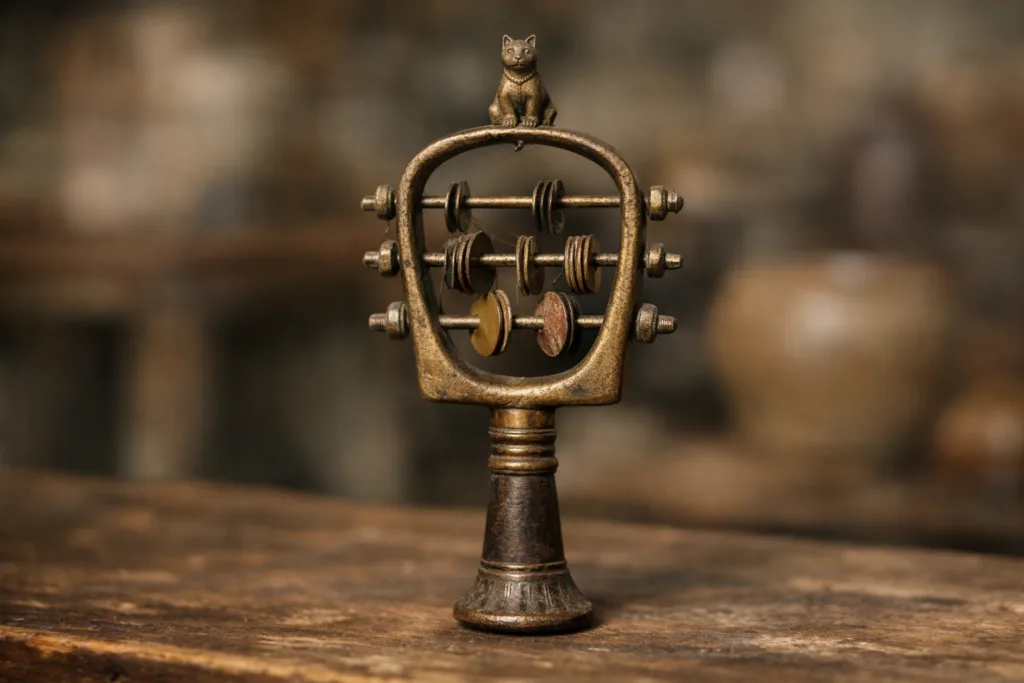
| Aspect | What Matters |
|---|---|
| Instrument Family | A shaken idiophone; the sound comes from moving parts striking each other or the frame. |
| Main Forms | Arched sistrum and naos-shaped sistrum. |
| Usual Materials | Bronze most often in surviving functional pieces; also faience, clay, and wood in the wider tradition. |
| How It Sounds | A dry rattle, bright jingle, or short metallic chatter depending on rods, plates, mass, and motion. |
| Best Historical Match | Temple ritual, procession, and cult practice linked above all with Hathor, later also Isis. |
| Later Route | The arched form traveled through the Mediterranean with Isis worship; related liturgical use lived on in Coptic and Ethiopian church practice. |
🏺 What Makes a Sistrum a Sistrum
- A handle that controls balance and wrist motion.
- A frame, either arched or shrine-like, that carries the sound hardware.
- Crossbars, wires, rods, or slots that hold the moving elements.
- Loose plates, disks, or jingling pieces that create the actual voice of the instrument.
Long before the tambourine settled into its modern form, the sistrum had already solved a very old musical problem: how to turn a simple wrist motion into a measured burst of bright, percussive sound. In hand, it is not just a ritual object and not just a noise-maker. It is a controlled shaker whose response depends on weight, metal contact, and the spacing of its moving parts.
The name most readers know comes through the Greek seistron, “that which is shaken.” In Egyptian use, the instrument appears under names tied to its forms and to the sound it makes. That matters, because the sistrum was never one fixed silhouette. It changed shape, material, and emphasis as it moved from temple rite to wider sacred life, then into Roman-period Isis worship.
Small instrument, yes. Simple instrument, not quite.
🔔 Shape Before Symbol
| Type | Visual Character | Sound Behavior | What Usually Gets Missed |
|---|---|---|---|
| Arched Sistrum | Hoop or horseshoe profile, often with Hathor or Bat imagery at the junction. | Usually the clearer rattle-jingle form, especially when rods and plates survive. | Its sound hardware is often missing in museum pieces, so many examples look quieter than they once were. |
| Naos Sistrum | Temple or shrine form, more architectural and more overtly emblematic. | Often treated as less acoustic, yet modern testing has reopened that question. | Too many summaries reduce it to symbolism and skip the sound debate. |
Arched Sistrum Vs. Naos Sistrum
The arched sistrum is the one most players and makers instinctively understand. It presents the sounding parts openly. The wrist sets the mass in motion, the rods answer, and the loose pieces strike with a clean metallic edge. This design reads almost like a stripped-back acoustic machine. Less wall, more movement.
The naos-shaped sistrum works differently in the eye and in the hand. Its shrine-like body adds visual weight and sacred reference before a single shake happens. For that reason, many general articles treat it as mainly symbolic. That is too neat. Recent sound research has revisited whether the naos form could also function acoustically rather than serving only as an image of sacred architecture. That single point changes how the instrument should be read.
A silent museum sistrum is not always a silent original. On many surviving pieces, the disks, plates, or loose sounding elements are gone. What remains is the frame, not the full voice.
There is also a historical split here. The naos type stayed closely tied to Egyptian religious imagery, while the arched type traveled more easily. In Roman-period examples linked with Isis worship, the arc keeps working even when older Hathoric meaning is softened or partially dropped. The form survives because the design still makes sense in the hand.
Why the Handle Deserves More Attention
Most short descriptions rush past the handle. They should not. On the better bronze pieces, the handle is where iconography, grip, and balance meet. Hathor faces, Bat emblems, columnar shafts, palm-like capitals, uraei, cats, birds—these are not random additions. They add mass, shift the center of gravity, and alter the way the sistrum starts and stops.
A handle that carries more metal near the top tends to feel more deliberate, a little slower off the mark, but steadier through repeated pulses. A slimmer lower handle lets the shake snap faster. Tiny difference on paper. Big difference in the wrist.
🧰 Where the Sound Really Comes From
- The frame supports the motion, but the moving metal elements make the main sound.
- Rod length, rod thickness, and the looseness of plates shape the attack and decay.
- The shake itself matters: short vertical pulses produce a tighter chatter; broader arcs open the sound.
A good sistrum does not just jingle. It speaks in layers. First comes the attack—that first crisp contact. Then the body of the rattle blooms for a brief moment, often as a clustered shimmer rather than a single pitch. After that comes the decay, short or slightly lingering depending on how freely the sounding plates can travel.
This is where many articles stop too soon. They say “rattle” and move on. But the timbre of a sistrum can lean in several directions:
- A dry chatter when the moving pieces are few, tight, or light.
- A bright jingle when plates have enough room to strike and rebound.
- A denser metallic wash when multiple elements answer at nearly the same time.
Some surviving bronze examples show rods of decreasing length and thickness. That is not just decoration. A graded set of rods can spread the mechanical response so the upper part feels quicker and the lower part answers with a firmer click. The ear reads that as texture, not as melody. It is a percussive cluster, compact and alive.
Not every quiet sistrum was born quiet.
When examining a reconstruction or an antique example, look first at the travel distance of the sounding parts. Too little movement and the instrument goes dull. Too much looseness and the response turns messy, with less rhythmic definition.
The playing motion matters just as much. A short, wrist-led pulse gives a compact, temple-ready articulation. A wider arm-led shake creates more bloom and less precision. The instrument can do both, but its design clearly favors pulse over flourish. That is one reason the sistrum feels closer to ceremonial time-keeping than to showy hand percussion.
Sistrum Vs. Tambourine
The comparison is useful, but only up to a point. A tambourine spreads its voice around a circular frame and, in many forms, may also involve a skin head or broader hand technique. A sistrum is more vertical, more focused, more skeletal in design. It does not cushion the jingle behind a membrane. The metal contact is out in the open.
So the tambourine often feels broader and more social in sound. The sistrum feels tighter, drier, and a touch more formal. Less wash. More edge.
🏛️ Material Choices and Their Sonic Consequences
| Material | Why It Was Used | Effect on Use and Voice |
|---|---|---|
| Bronze | Durable, castable, suitable for rods, fittings, and repeated shock. | Usually the clearest path to a functional, repeatable rattle. |
| Faience | Strong visual presence, sacred color, formal display value. | Often shifts attention toward appearance and symbol, though sound should not be dismissed outright. |
| Wood or Clay | Lighter and easier to shape in some traditions. | The final voice depends heavily on the metal fittings attached to them. |
Bronze Vs. Faience and Wood
Bronze dominates the surviving functional sistrum story for good reasons. It tolerates repeated impact, holds narrow rods reliably, and lets the maker cast or finish a form with both structure and ornament in one body. Some museum examples were made as highly integrated objects, not as loose assemblies. That alone says a lot about how fully the form had matured.
Acoustically, bronze gives the player a more direct mechanical answer. The hand feels the instrument reset after each shake. The metal hardware also wears in a revealing way: holes oval slightly, rods polish at contact points, edges smooth where movement repeats. A careful eye can almost read the old rhythm back from the surface.
Faience changes the emphasis. Its glazed body catches light beautifully and carries sacred visual charge, especially in Egyptian contexts where surface brilliance was never trivial. But a faience piece is not judged by the same practical rules as a working bronze arc with free-moving metal plates. Too many readers lump them together and call it a day. They should not.
Wood sits in the wider family history as a practical frame material, but in a sistrum the wood does not speak alone. The actual voice still comes from what is attached to it—rods, disks, jingles, or plates. So when judging a wooden or clay-bodied version, the question is never only “What is the frame made of?” The better question is “What strikes what, how far does it travel, and how cleanly does it return?”
Why Bronze Usually Wins for Sound
For a maker’s eye, the answer is plain enough. Bronze allows fine pierced work, crisp edges, stable rod support, and enough mass to keep the shake from feeling flimsy. It also holds decoration without giving up utility. That balance—ornament and function together—is exactly where the best sistra live.
No fuss, really. The material simply suits the job.
📜 Period Differences Worth Noticing
| Period | What Stands Out | How It Affects Reading |
|---|---|---|
| Old Kingdom and Early Egyptian Use | Naos-shaped examples appear early; temple context is already close to the form. | The instrument starts as both sound tool and sacred marker. |
| Late Period and Ptolemaic Egypt | Bronze forms with strong Hathoric imagery, carefully worked rods, and firm ritual identity. | This is where many museum pieces set the visual standard people now imagine. |
| Roman Period | The arc form travels with Isis worship; older Egyptian symbols may be simplified or reworked. | The design becomes more portable across cultures without losing its shaken identity. |
Late Period Vs. Roman Period
A Late Period or early Ptolemaic sistrum often looks tightly rooted in Egyptian sacred language: Hathor faces, cobra imagery, carefully structured rods, and a handle that still carries temple-born meaning. These pieces tend to feel internally coherent. Symbol, grip, sound, and visual program all pull in the same direction.
In the Roman period, the arc form can look more adaptable. The instrument still rattles, still signals ritual presence, but the older Hathor/Bat logic may no longer control every feature. Some Roman examples preserve the function while letting the imagery bend toward a broader Isis-centered setting around the Mediterranean.
That shift matters for collectors and readers because it shows what survived best: not only a religious emblem, but a convincing piece of hand percussion design.
Sistrum Vs. Menat
The menat and the sistrum often appear in related sacred settings, and the two are too often blurred together by casual summaries. The menat leans toward necklace and counterpoise form with ritual meaning carried by movement and adornment. The sistrum is more explicit as an instrument. Its sound-producing logic is visible. One can see the mechanism.
That visibility is part of its charm. The ear hears metal, and the eye understands why.
🪙 How to Read Wear, Repairs, and Missing Parts
- Check whether the rods are original, replaced, or fixed too tightly.
- Look for missing plates, disks, or loose jingles.
- Inspect the holes and slots for smoothing, widening, or later drilling.
- Study the handle-to-frame junction. That is where balance problems often show first.
For antique pieces, the loudest clue is often what is no longer there. A museum sistrum may survive with the frame intact but the sounding plates gone, leaving only the architecture of the instrument. That can fool the eye into thinking the piece was always restrained in voice. Not so fast.
Rod wear tells its own story. If the movement was real and repeated, contact points usually grow smoother. If the rods sit too neatly, or if the movement looks oddly frozen, a later repair may have changed the feel. That does not kill the object’s value, but it changes how honestly the current sound reflects the old one.
On many antique examples, rarity sits in the integrity of the sound system, not just in the frame decoration. A sistrum with original moving hardware, even if modest in ornament, can tell more about historic sound than a more ornate but stripped piece.
Reproductions deserve the same scrutiny. A handsome replica can still fail as a musical object if the maker treats the rods as fixed decoration rather than as active acoustic parts. The best reconstructions get the travel, weight, and rebound right. The rest merely look the part.
⛪ Beyond Egypt, Without Losing Its Identity
The sistrum did not stay enclosed within one time and one temple network. The arched form moved outward with the cult of Isis around the Mediterranean, and related liturgical use continued in Christian practice in the Coptic and Ethiopian traditions. That later life matters because it proves the instrument was more than a local image. It remained useful where rhythm, procession, and sacred gesture still needed a bright shaken voice.
And yet it never turns into just another jingle frame. Even in later settings, the sistrum keeps its upright profile, its clear handle-to-frame logic, and its clipped metallic speech. The silhouette stays recognizable. So does the feel.
FAQ
Is a sistrum hard to identify when parts are missing?
See Answer
Not always. Even when the loose sounding parts are gone, the handle, the frame shape, and the holes or slots for rods usually still reveal that the object is a sistrum. The harder task is judging how it once sounded, because many surviving examples lost the very pieces that made the brightest noise.
How do I know if an arched sistrum was built for sound or mostly for display?
See Answer
Look at the sound hardware first. A genuinely functional arched sistrum should show clear provision for moving rods, plates, or disks and enough travel for those parts to strike cleanly. If the frame is ornate but the motion path is cramped, fixed, or incomplete, the object may lean more toward display, later repair, or partial survival than live acoustic use.
What makes the sound of a sistrum different from a tambourine?
See Answer
A sistrum usually gives a tighter, drier, more vertical pulse. A tambourine often spreads its jingle more broadly and may involve a skin head or wider playing gestures. The sistrum keeps the metal contact more exposed, so the attack feels sharper and the rhythmic outline stays firmer.
Why do so many old sistra show Hathor on the handle?
See Answer
Because the instrument was closely linked with Hathor, especially in temple ritual and ceremonial music. Her face, ears, and related symbols on the handle mark both sacred identity and visual lineage. On later pieces, especially outside Egypt, those older meanings may soften, but the connection remains one of the clearest signs in Egyptian examples.
Can a naos-shaped sistrum still be a real instrument, not just a ritual symbol?
See Answer
Yes, that remains a live and useful question. Many readers assume the naos-shaped sistrum served only a symbolic role, yet recent acoustic study has pushed back on that simple view. The right answer depends on the individual piece: its material, surviving fittings, and how much room its sound elements had to move.