
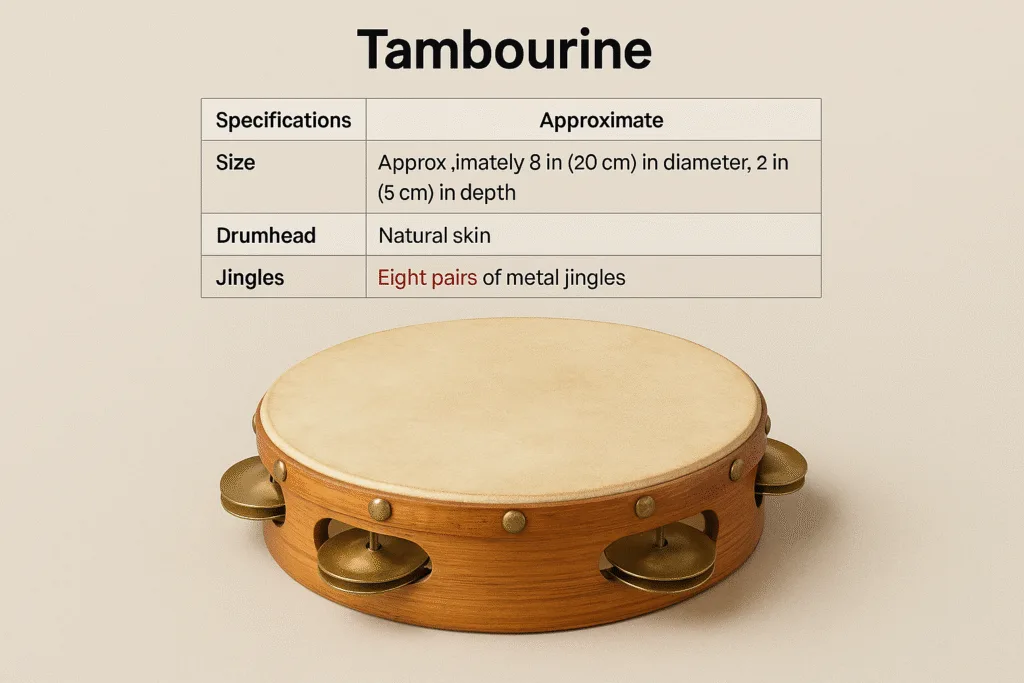
A tambourine is a handheld percussion instrument made from a shallow frame fitted with pairs of metal jingles. Many versions also have a drumhead. It is played by shaking, striking, tapping, rolling, or mounting it on a stand, producing sharp accents, continuous shimmer, and short drum tones in folk, classical, gospel, rock, and pop music.
Tambourine Meaning and Pronunciation
Tambourine meaning: a percussion instrument formed by a narrow frame containing loose pairs of metal discs. A headed tambourine combines the sound of a small frame drum with the metallic response of its jingles. A headless model produces only the jingle sound.
Pronunciation: tam-buh-REEN, commonly written in phonetic form as /ˌtæm.bəˈriːn/.
| Feature | Details |
|---|---|
| Instrument family | Hand percussion; headed models combine an idiophone and a membranophone |
| Main components | Shallow frame, metal jingles, and an optional natural or synthetic drumhead |
| Common shapes | Circular, half-moon, crescent, and other ergonomic headless forms |
| Typical handheld size | Often about 20–30 cm in diameter, though dimensions vary by design and regional tradition |
| Common materials | Wood or plastic frame, animal skin or synthetic head, and steel, brass, bronze, or alloy jingles |
| How it is played | Shaking, hand strikes, finger taps, rolls, leg strikes, stick strokes, or stand-mounted playing |
| Common musical settings | Folk dance, orchestral music, gospel, worship music, rock, pop, country, film music, and studio recording |
What Makes a Tambourine Different?
The defining feature of a tambourine is its set of loose metal discs mounted in slots around the frame. These discs are normally called jingles. The term zills is also used in some descriptions, although it more strictly refers to small finger cymbals used in Middle Eastern dance and music.
A plain frame drum produces most of its sound through a stretched membrane. A tambourine adds a metallic layer that responds to nearly every movement. Even a light change in direction can set the jingles in motion, so timing depends not only on when the instrument is struck but also on how the jingles continue moving afterward.
Headless tambourines are common in drum kits, pop bands, gospel settings, and live performances. Headed tambourines allow the player to combine dry taps, open drum tones, rim accents, shakes, and sustained rolls.
Historical Background
The tambourine belongs to the much older family of handheld frame drums. Images and written records from the ancient Near East, Egypt, Greece, and Rome show shallow drums used in ceremonies, dances, public celebrations, and ensemble music. Some were plain frame drums, while others carried rings, discs, or attachments that added a rattling sound.
It is difficult to assign the modern tambourine to one inventor, country, or date. Ancient objects and artworks do not always reveal the exact materials, attachment systems, or sound of an instrument. The present form developed through many regional frame-drum traditions rather than through a single line of invention.
In Greek and Roman visual culture, the tympanum was a handheld frame drum associated with dance and religious ceremony. It is often shown in scenes connected with deities such as Cybele and Dionysus. The instrument did not always include the paired metal jingles found on a present-day orchestral tambourine, but it belonged to the same broad frame-drum family.
During later centuries, frame drums with jingles became established across the Mediterranean, the Middle East, Europe, Central Asia, and parts of South Asia. Regional instruments developed their own dimensions, tuning systems, playing methods, and ensemble roles. European orchestras adopted the tambourine for rhythmic accents, dance references, dramatic rolls, and bright changes in tone color.
In the United States, the tambourine appeared in stage entertainment, religious music, gospel performance, vaudeville, folk music, and popular recording. Museum collections preserve wooden, skin-headed instruments from the nineteenth and early twentieth centuries as well as metal and headless designs used in worship and community music.
Main Types of Tambourine
Headed Tambourine
A headed tambourine has a membrane stretched across one side of its frame. Traditional heads may be made from calfskin, goatskin, or another prepared animal skin. Synthetic heads offer more stable tension when temperature and humidity change.
The head gives the player access to drum strokes as well as jingle sounds. It is the usual choice for orchestral technique, thumb rolls, many Mediterranean folk styles, and playing that requires several distinct tones from one instrument.
Headless Tambourine
A headless tambourine consists of a frame and jingles without a membrane. It is lighter, less affected by humidity, and well suited to repeated shaking patterns. Many modern models use a crescent or half-moon frame shaped to reduce hand strain.
This design is common beside a drum kit, in pop and rock performances, and among singers who need a simple instrument for backbeat accents. It cannot produce a drumhead tone or a traditional head-based thumb roll.
Single-Row and Double-Row Tambourines
A single-row tambourine carries one row of jingle pairs. It generally has a lighter feel, quicker response, and less metallic sustain than a comparable double-row model.
A double-row tambourine places two rows of jingles around the frame. It usually produces a denser and louder shimmer, though the exact response depends on jingle thickness, shape, spacing, and alloy. More jingles do not automatically mean a better instrument; they change its weight and sound.
Orchestral Tambourine
An orchestral tambourine is normally circular and headed, with a responsive frame and carefully matched jingles. Professional models may use two different jingle alloys to create a wider blend of bright and dark metallic tones.
Orchestral playing demands clean attacks, controlled rolls, immediate stops, and changes from very soft to forceful dynamics. The instrument may look simple, but exposed passages reveal uneven timing and unwanted jingle noise easily.
Mounted Tambourine
A mounted tambourine is fixed to a stand or drum-kit attachment and played with sticks, rods, hands, or pedals. Mounting allows a drummer to use it without putting down another instrument. The resulting attack is usually harder and more direct than a hand-held shake.
Construction and Sound
Frame
Traditional frames are made from bent or layered wood. Wooden shells can feel firm and balanced while supporting natural skin heads. Plastic frames resist moisture and are frequently molded into shapes that provide a secure grip.
Frame depth affects comfort, balance, and the way the player controls the instrument. A deeper or heavier shell may feel stable during strikes but tiring during long shaking patterns. A very light frame is easier to move but may offer less control during sudden stops.
Drumhead
Natural skin responds strongly to changes in the surrounding air. It may loosen in damp conditions and tighten in dry heat. Players often value its responsive touch and variation in tone, but it requires more careful storage.
Synthetic heads are less sensitive to weather and are useful for outdoor performance, touring, schools, and rehearsal spaces with changing temperatures. Some tambourines use fixed heads, while others have tuning hardware that allows tension adjustment.
Jingles
Jingles are installed as loose pairs so that the discs strike one another when the frame moves. Their alloy, thickness, shape, and spacing affect the attack and sustain.
- Steel jingles often produce a bright, direct attack.
- Brass jingles may sound warmer and slightly darker.
- Bronze or mixed-alloy jingles can provide a broader range of overtones.
- Hammered jingles may respond differently from smooth, flat discs because their surface and stiffness are altered.
The number of jingle pairs varies widely. Small models may have only a few slots, while orchestral and older stage tambourines may carry many pairs. The balance between jingle weight and frame weight is more useful than a fixed number when comparing instruments.
How a Tambourine Is Played
Basic Grip
The frame is commonly held in the non-dominant hand while the other hand strikes the head or rim. The grip should remain secure without squeezing the shell so tightly that wrist movement becomes stiff. On headless models, the handle or un-jingled section is held with the wrist in a relaxed position.
The instrument is often tilted slightly rather than held completely flat. This lets gravity pull the jingles toward one side of their slots and gives the player more control over when the discs meet.
Shake Stroke
A shake is produced by moving the frame back and forth so the jingles strike in alternating directions. Small wrist motions give a tighter sound, while larger arm movements create a wider and often less precise response.
For repeated eighth notes or sixteenth notes, the forward and backward movements should be treated as separate rhythmic events. The player must account for the brief delay between changing direction and hearing the jingles collide.
Hand Strike
The head can be struck with the fingertips, palm, thumb, or heel of the hand. A strike near the rim usually sounds sharper and controls the head more tightly. A stroke nearer the center gives more membrane tone but may produce less definition.
On a headless tambourine, the player can strike the frame against the palm for a strong jingle accent. This is common in pop, rock, country, gospel, and worship music.
Finger Taps
Light finger taps allow softer patterns and clearer subdivisions. Different fingers can alternate to produce short rhythmic figures while the supporting hand controls the angle of the frame. Finger technique is especially useful on headed tambourines because the membrane adds articulation beneath the jingles.
Thumb or Finger Roll
A thumb roll is created by moving the thumb or a finger around the drumhead near the rim with enough friction to make it bounce rapidly. The repeated contact sets the jingles into a sustained roll. Players may use a small amount of rosin, beeswax, or another suitable grip aid when the head is too smooth.
The pressure must remain even. Too little friction causes gaps, while too much pressure stops the finger. A roll is commonly ended with a clear hand or finger accent so that the final beat is defined.
Shake Roll
A shake roll uses rapid wrist rotation rather than friction on the head. It can be performed on headed or headless tambourines. The motion should remain compact so the sound stays even and the player can stop without an uncontrolled final rattle.
Knee, Leg, or Hip Strike
The frame may be struck against the thigh, knee, or hip to produce a loud accent while keeping one hand free. This method appears in stage performance, dance accompaniment, folk playing, and popular music. Repeated leg strikes should be controlled to avoid damaging the frame or bruising the player.
Stick Playing
A mounted tambourine can be struck with a drumstick or rod. A stick produces a harder attack than the hand and can cut through a drum kit or amplified ensemble. Heavy strokes should be avoided on thin frames and skin heads not designed for stick use.
Tambourine, Riq, Pandeiro, and Frame Drum
Several instruments resemble the tambourine, but their technique and musical roles are not interchangeable.
| Instrument | Usual Design | Playing Character |
|---|---|---|
| Tambourine | Headed or headless frame with paired metal jingles | Shakes, accents, rolls, drum strokes, and backbeat support across many styles |
| Riq | Small headed frame drum with several pairs of jingles | Detailed finger strokes, muted tones, rhythmic cycles, and controlled jingle patterns in Arabic music |
| Pandeiro | Tunable Brazilian frame drum with cupped metal jingles | Combines bass tones, slaps, taps, rolls, and controlled jingle response |
| Plain frame drum | Shallow frame with a drumhead and no external jingle pairs | Membrane-led sound with open tones, muted strokes, taps, and rolls |
Terminology note: Words such as tambourine, tamburello, pandereta, riq, daf, and dayereh may describe related jingled frame drums, but each name can carry a specific regional design and playing tradition. They should not be treated as identical labels.
Musical Uses
Folk and Regional Music
Jingled frame drums support dancing, singing, procession music, weddings, religious events, and community celebrations in many regions. Italian tamburello playing, Spanish pandereta traditions, Arabic riq technique, and Brazilian pandeiro playing each use different strokes and rhythmic systems.
In some traditions, the tambourine maintains a repeated pulse. In others, it follows dancers, marks changes in a song, answers a singer, or carries detailed patterns that function as the main percussion part.
Classical and Orchestral Music
Orchestral composers use the tambourine for dance rhythms, forceful accents, soft rolls, and bright rhythmic color. Familiar examples occur in works such as Bizet’s Carmen, Tchaikovsky’s The Nutcracker, and Holst’s The Planets.
The player may wait through much of a work before performing a short exposed passage. Accurate entry, suitable instrument choice, and a clean stop are therefore as important as speed or volume.
Gospel, Rock, Pop, and Country
In gospel and worship music, the tambourine may reinforce clapping patterns, choir rhythms, and accented beats. In rock and pop, it often strengthens beats two and four or adds repeated eighth-note and sixteenth-note motion above the drum kit.
Headless tambourines are common in live bands because they are durable and easy to hold while singing. In recording sessions, a tambourine part can make a chorus feel more active without adding another large drum sound. Poorly timed shakes can also clutter a mix, so simple and steady patterns are often more useful than constant playing.
Learning and Practice
A beginner can produce a recognizable tambourine sound immediately, but even timing and controlled stops require practice. Early exercises should separate jingle movement from hand strikes.
- Practice quarter-note shakes at a slow tempo, treating each direction change as one beat.
- Move to eighth notes while keeping the motion small and relaxed.
- Alternate a shake with a palm or finger accent.
- Practice stopping the jingles exactly on a chosen beat.
- Play backbeat accents on beats two and four with recorded music or a metronome.
- Work on soft dynamics before attempting loud, fast rolls.
- Record short exercises to detect late attacks and unwanted rattles.
Long sessions with a heavy tambourine can strain the wrist and forearm. A neutral wrist position, relaxed shoulders, and regular pauses are preferable to forcing a larger motion for volume.
Choosing a Tambourine
- Choose the design for the intended style. A headed circular model suits drum tones and traditional rolls, while a headless model suits repeated shakes and drum-kit use.
- Check the weight. The instrument should remain comfortable during several minutes of continuous playing.
- Listen to the jingle decay. Some models stop quickly, while others continue ringing after the stroke.
- Compare single and double rows. A double row usually sounds denser but also adds weight.
- Inspect the frame. Look for warping, cracks, rough edges, loose hardware, or damaged jingle slots.
- Test the head. A natural head should not show splits, severe sagging, or separation from the frame.
- Consider the room and ensemble. A bright steel-jingle model may cut through amplified music, while a darker mixed-alloy instrument may blend more easily in an orchestra.
- Check replacement and tuning options. Tunable or replaceable-head models can be easier to maintain over many years.
Care and Maintenance
Natural skin heads should be kept away from direct sunlight, heaters, damp storage areas, and sudden changes in temperature. A padded case helps protect the frame and prevents pressure from being placed on the head.
Do not attempt to restore a loose natural head by placing the instrument close to strong heat. Rapid drying can split the membrane, loosen adhesive, or distort the frame. Allow the instrument to adjust gradually to the room.
Synthetic heads can be wiped with a slightly damp, soft cloth and dried afterward. Wooden frames should not be soaked, and cleaning liquid should not be allowed to run into the jingle slots.
Metal jingles can be wiped with a dry microfiber cloth after playing. Tarnish does not always harm the sound, but moisture, sweat, and unsuitable polishing chemicals may damage plated surfaces. Loose jingles, cracked frames, and torn heads should be assessed before the instrument is played forcefully.
Common Questions
Is a tambourine a drum?
A headed tambourine is both a frame drum and a jingle instrument. Its membrane produces drum tones, while its metal discs produce an idiophone sound. A headless tambourine is classified through its jingles rather than as a drum.
What are the metal parts on a tambourine called?
They are usually called jingles. Each slot commonly holds two loose discs that strike one another. They may also be described as discs, plates, or zills, though zills more often refers to finger cymbals.
Can a tambourine be played without shaking it?
Yes. It can be tapped with the fingers, struck with the palm, rubbed to create a roll, hit against the leg, mounted on a stand, or played with a stick when the instrument is built for that purpose.
Is a tambourine easy to learn?
Basic shakes and accents are accessible to beginners. Clean subdivisions, quiet rolls, controlled dynamics, and exact stops are harder because the jingles continue moving after the player changes direction.
What is the difference between a tambourine and a timbrel?
Timbrel is an older English term used for a small frame drum, often in historical or biblical writing. It may refer to an instrument resembling a tambourine, but historical timbrels did not all have the same construction as present-day models.