
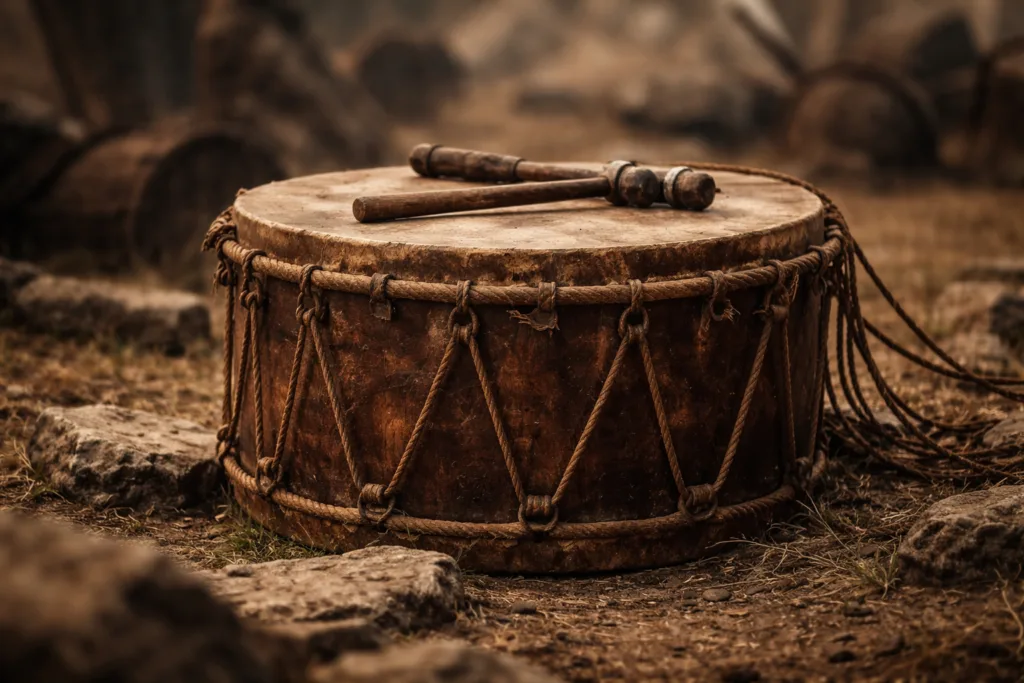
Not every Ancient Anatolian war drum was a battlefield instrument, and that is the first point worth getting right. The label fits a family of loud outdoor drums: early ritual membranes in Bronze Age Anatolia, later davul/tabl types with two heads, and the copper-bowled nakkare and kös that came to define courtly and military sound in the Seljuk and Ottoman sphere. Same broad instinct, different bodies, different jobs, different voices.
Start With The Instrument Map
| Layer | Typical Body | Head Material | Usual Sound | Usual Setting |
|---|---|---|---|---|
| Bronze Age Anatolian drums | Clay, baked earth, or light wooden forms | Animal hide | Dry attack, shorter release, earthy midrange | Ritual, procession, public ceremony |
| Davul / Tabl line | Wooden cylindrical shell, two heads | Goat, sheep, calf, or other hide | One deep pulse, one sharper answer | Marching, announcements, open-air ensemble |
| Nakkare | Paired copper bowls | Hide stretched over each bowl | Tight, bright, fast rhythmic speech | Cadence, march detail, outdoor ensemble |
| Kös | Very large copper bowl | Heavy hide | Low bloom, slower swell, long carry | State display, campaign, ruler’s presence |
🥁 What The Name Covers
- Ancient Anatolian war drums is better read as an umbrella term, not as one museum object with one fixed shape.
- For Bronze Age Anatolia, the evidence is stronger for ritual, ceremony, and public performance than for a neat catalog of battlefield drum models.
- For the later military sphere, the picture becomes clearer: davul, nakkare, and above all kös belong to named, visible, mobile outdoor traditions.
That distinction matters because many short web write-ups flatten everything into one line: Hittite drum, Seljuk drum, Ottoman drum, modern revival drum. Clean story, but too clean. The older the material gets, the more careful the ear and the wording should become.
A Bronze Age drum image on a vase, a Neo-Hittite relief with musicians, a rope-tension davul, and a copper kös do not belong to one identical build tradition. They belong to one louder habit of culture: using membrane sound to mark space, movement, rank, and occasion.
🏺 How Materials Shape The Sound
| Material Choice | What It Does To The Voice | Where It Fits Best |
|---|---|---|
| Clay or baked earth | Shorter ring, drier edge, less low-air bloom | Early pot-like or vessel-based drums |
| Wood shell | Warmer center, softer rim, easier split between low and high sides | Davul / tabl family |
| Copper bowl | Clearer pitch center, wider low swell, stronger outdoor throw | Nakkare and kös |
| Natural hide | Quick living attack, overtone nuance, weather-sensitive tension | All historical forms |
| Rope or thong tension | Organic feel, tiny uneven pulls, less machine-like response | Older field and folk builds |
Copper does not merely make a kettledrum louder. It organizes the loudness. A bowl-shaped metal body reflects and gathers the moving air under the head, so the note feels more centered and more commanding than a flatter or more porous shell. A large kös does not just hit; it arrives.
A wooden davul speaks differently. The shell gives back a warmer, grainier response, and because there are two heads the instrument can carry a low body note on one side and a leaner, tighter answer on the other. Played with a heavy tokmak and a thin stick, it almost acts like a conversation between chest and rim.
Hide matters just as much. Thicker skin darkens the stroke and slows the start a touch; thinner skin answers faster and shows more upper detail. Natural heads also move with the weather — one reason old outdoor drums feel wonderfully alive on a good day and a little stubborn on another. Historical davul practice even included oiling the skin to help stop drying and cracking.
When listening to a reconstruction, hear the release as much as the strike. A short, dusty cutoff often points toward clay or a smaller shell. A low note that seems to open half a beat later usually points toward a large copper bowl.
Wood Choices in Modern Reproductions Vs. Metal-Bowl Builds
Exact ancient shell species are not always recoverable, so the better question for a modern build is this: what happens when the maker chooses one body material over another?
| Build Choice | Likely Tonal Lean | Why A Maker Might Choose It |
|---|---|---|
| Oak shell | Firm attack, solid projection, denser punch | Outdoor use, stronger rebound, harder feel under the stick |
| Walnut shell | Rounder mids, smoother body, balanced weight | A fuller, less sharp voice |
| Lime or fir shell | Lighter response, softer edge, easier bloom | Lower carry weight, gentler feel, quicker shell reaction |
| Copper bowl | Focused low center, broader swell, more command per stroke | Distance, rank, and outdoor authority |
So, why choose wood over copper — or copper over wood? Because they are not substitutes. A wood-shell davul keeps rhythm moving with body and bite. A copper-bowl kös turns rhythm into presence.
🧭 Bronze Age Drums Vs. Ottoman War Kettledrums
Bronze Age Anatolia gives images, objects, and texts that place drums inside ritual life, feast settings, and ceremonial action. Later Anatolian and Ottoman material gives named military instruments, court use, outdoor ensembles, mobile kettledrums, and far clearer descriptions of build and function.
One straight line cannot be proved.
What can be followed, though, is a durable acoustic habit: loud membrane instruments were used to mark time, gather attention, frame processions, and signal authority in the open air. That is a more honest continuity than pretending a Hittite ritual drum and an Ottoman kös are simply the same object with different dates.
🪘 The Main Voices Inside The Family
Davul Or Tabl
- Usually a wooden cylindrical shell with two hide heads
- Traditional diameter bands often run around 60 cm, 70 cm, and 80–90 cm
- Heads are tightened by cords or side attachments
- Played with a heavy tokmak and a lighter çubuk
The davul is the outdoor grammar of pulse. One hand gives the belly of the beat; the other writes its edges. Because both skins are alive and the shell is wooden, the instrument carries not just volume but texture — the sort of texture that lets a rhythm travel across a square without turning into a blur.
In older practice, the skins were put on wet, tied with zig-zag cords, then left to dry under tension. That small making detail changes everything. A head mounted this way has a living memory in it, and the drum answers with slight irregularities that feel human rather than machine-flat.
Davul Vs. Modern Marching Bass Drum
Davul: warmer shell tone, split-stick language, more rawhide character, more outdoor folk and martial DNA.
Modern marching bass drum: cleaner shell uniformity, more controlled hardware tension, often a straighter and less grainy response.
Heavy it may look, but nimble it can be. Especially when the left-hand stick starts flicking the rim and upper head in quick reply.
Nakkare
- Two small copper bowls with skin stretched over each
- Played in pairs
- Built for articulation, not sheer mass
- Historically tied to seated use, marching use, and later chest-held revival use
Nakkare is the quick tongue of the family. The copper bowl keeps the pitch center clearer than on many small frame or shell drums, and the paired layout lets patterns jump left-right with sharp definition. In a large outdoor ensemble, nakkare fills the spaces that a giant kös would leave untouched.
Nakkare Vs. Modern Small Kettledrums
Nakkare: more rhythm-first, more bite at the front of the note, less built around smooth pitch change.
Modern small kettledrums: often asked to behave more like tuned orchestra voices, with cleaner mechanical control.
Small body. Fast authority.
Kös
- Leather over a large copper bowl
- Played with two knobbed wooden beaters
- Made in multiple sizes, including horse, camel, and elephant versions in historical naming
- Used as a ruler’s drum and as one of the loudest voices of the mehter field
The kös is where sound stops being just rhythm and becomes architecture. Strike one well-made bowl with a heavy head, and the attack does not snap like a snare; it spreads, gathers, and then rolls outward. The note feels bigger than the stick that made it. Outdoors, that matters a great deal.
A famous historical figure helps scale the instrument in the mind: one Ottoman source tradition notes that the army set out for the Çaldıran campaign with 500 köses. Even when read as a period figure rather than a studio spec sheet, it tells the same story — the kös belonged to massed outdoor sound, not to intimate room music.
Kös Vs. Modern Timpani
| Point | Kös | Modern Timpani |
|---|---|---|
| Main aim | Authority, projection, public signal | Precise tuned pitch inside ensemble writing |
| Body | Large copper bowl, historical field use | Copper or fiberglass bowl with developed tuning hardware |
| Head | Hide, often heavier and less standardized | Hide or synthetic, more uniform tension control |
| Feel of the note | Broader low swell, less surgical pitch behavior | Cleaner note center, easier retuning, more orchestral clarity |
| Historical role | Camp, procession, rank, state display | Concert hall and scored repertoire |
They are relatives, not twins. Modern timpani asks, “What pitch?” The kös asks, “How far will this carry?”
🔊 Why These Drums Worked So Well Outdoors
- Size lowers pitch. Larger bowls and wider heads move more air and push the voice downward.
- Metal bowls focus the wave. Copper gives kettledrums a firmer low center and longer throw.
- Hide keeps the attack lively. Natural skin speaks fast and carries tiny tonal shifts that synthetic heads often smooth out.
- Split-stick playing helps pattern clarity. On a davul, the heavy mallet and thin switch keep pulse and ornament apart.
- Open-air use rewards simple, bold rhythm. Long phrases get lost outdoors; strong strokes survive.
That is why a good field drum does not try to be delicate all the time. It aims to stay legible at distance. Even its beauty is built around that job.
🔍 How To Read An Antique Example Or A Museum-Style Reproduction
- Check the shell first. On wood, look for seam logic, warp, old cord wear, and whether the shell still holds a true circle. On copper, look for hammer marks, later solder, and over-polishing.
- Read the head as a replacement part. Many old drums no longer carry their first skin. A newer head may make the drum playable, but it also changes the age story and the sound story.
- Look at the tension system. Rope, thong, hoops, bolts, and side fittings tell a lot about period, repair history, and whether the object was kept for use or display.
- Do not mistake shine for honesty. A bright copper bowl can be less informative than one that still shows old patina, working dents, and wear near hand points.
- Ask for provenance before romance. A plain drum with a real chain of ownership is more convincing than a flashy one with a vague story.
- Decide whether the goal is conservation or performance. Those are not the same path. A playable rebuild may be musically useful and still move the object farther away from period condition.
If an antique davul or kös has a shell with believable age but a head that looks very fresh, hear it as two timelines joined together: the object may be old, while the present voice may be much younger.
And there is the curator’s test, simple but sharp: if the instrument lost its old skin, old rope, old hoops, and old bowl finish, what exactly is still old about it? Sometimes the answer is still “a lot.” Sometimes, frankly, not much.
FAQ
Was this one instrument or a whole family of drums?
See Answer
It is better understood as a whole family. Bronze Age Anatolia shows early ceremonial and ritual drums, while later Anatolian, Seljuk, and Ottoman practice gives clearer military and court instruments such as davul, nakkare, and kös.
How can I tell a davul from a kös by ear?
See Answer
A davul usually gives a split sound: a low thump and a sharper answering stroke. A kös tends to sound broader and lower, with more swell after the hit and more air moving under the note.
Why does copper matter so much on these drums?
See Answer
Copper helps shape the air under the head into a more focused, carrying note. On kettledrums such as nakkare and kös, that often means a clearer pitch center, a wider low bloom, and stronger outdoor projection.
Are modern timpani basically the same as a kös?
See Answer
No. They are related bowl drums, but their aims differ. Modern timpani is built for controlled tuning and ensemble pitch, while the kös was built first for authority, distance, and open-air presence.
What should I inspect before buying or restoring one?
See Answer
Start with the shell, then the head, then the tension system, then the surface history. After that, look for provenance and decide whether the object should stay close to period condition or return to playing condition.