
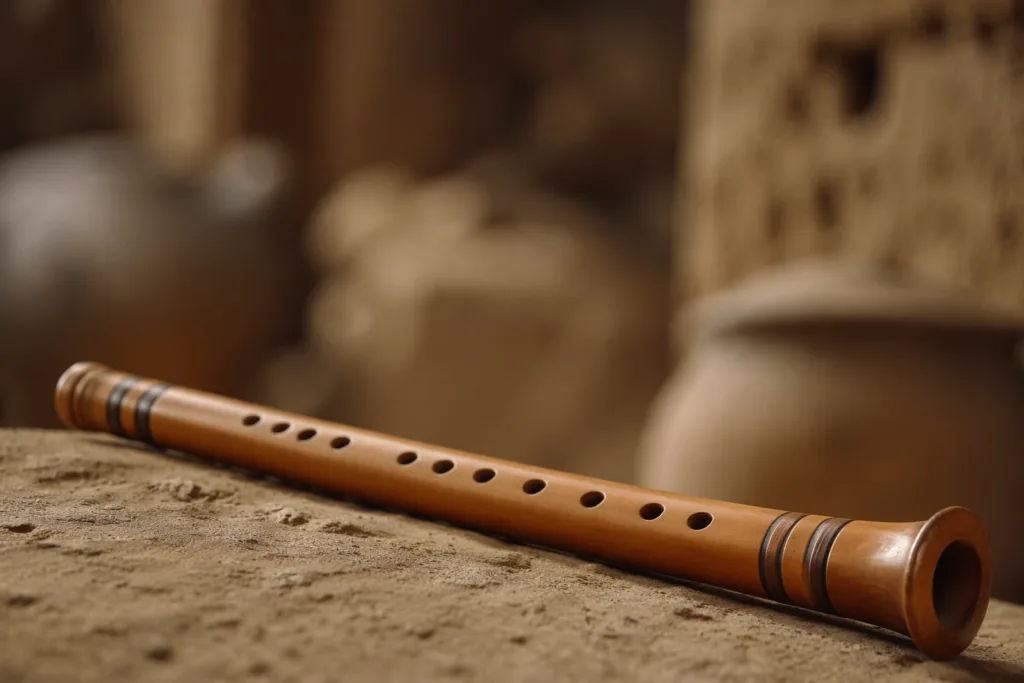
A hollow reed can look almost unfinished. In Ancient Egyptian wind instruments, that plain form is exactly the point: light walls, natural nodes, and a cut rim shape the air before the sound has any chance to spread. The result is not a lush modern flute tone. It is leaner, drier, more direct—often with a fine edge that helps the instrument sit beside harps, voices, and ritual movement rather than wash over them.
| Instrument Type | Typical Build | Tone Character | Likely Setting |
|---|---|---|---|
| 🪈 End-Blown Reed Flutes | Reed or cane tube, cut rim, finger holes | Breathy, focused, flexible in color | Ensembles, solo playing, funerary and festive scenes |
| 🎼 Reed-Pipe Relatives | Single or paired pipes with reed-driven attack | More incisive, nasal, firmer onset | Dance, outdoor use, stronger projection |
| 📯 Ceremonial Trumpet-Type Horns | Hammered metal tube, flared bell, no valves | Bright, narrow, signal-like | Procession, military display, ceremony |
The surviving pieces matter more than the romantic image. A reed flute with rough cuts, visible nodes, traces of paint, or resin tells more about real workshop practice than a polished modern reproduction ever can.
What The Surviving Objects Actually Show
- Reed flutes were not crude toys. Even simple tubes show controlled hole spacing, surface treatment, and practical repair or finishing traces.
- Material choice shaped the voice. Reed, cane, wood, and metal do not merely change durability; they change attack, brightness, and carrying power.
- Not every “horn” in modern summaries is a horn in the pastoral sense. For ancient Egypt, the clearest ceremonial survivors are straight trumpet-type aerophones, not the curled animal-horn tradition people often imagine first.
That last point matters. Many short articles flatten all ancient wind instruments into one basket, as if a reed flute, a reed-pipe, and a ceremonial trumpet answer the same musical need. They do not. A reed flute shapes melody through the fingers and the breath edge. A trumpet-type ceremonial instrument works more like a sonic emblem—short calls, public presence, sharp outline.
And that difference is audible even before it is historical.
🪈 Reed, Cane, and the Sound of the Nile Edge
- Reed and cane keep the tube light.
- Natural nodes interrupt the air column in ways a perfectly machined bore does not.
- A sharpened rim gives the player a clean edge to blow across.
- Finger-hole count changes the melodic map, but wall thickness changes the response just as much.
Ancient Egyptian reed flutes are best understood through their material honesty. Reed is not inert. Its fibers hold just enough irregularity to keep the tone lively, and the internal nodes can narrow or interrupt airflow in subtle ways. That helps explain why these instruments often produce a sound people describe as focused, grainy, and alive at the edge rather than round and evenly polished.
A museum example from ancient Egypt, for instance, preserves a large end-blown flute of reed with four holes, traces of resin, and a cylindrical bore that varies along the tube. Those details are not decorative footnotes. Resin can hint at sealing, reinforcement, or repair. A varying bore changes resistance. Rough cutting at the ends means the maker cared first about function and airflow, not showroom symmetry.
That is the real craft logic. Useful, direct, and sonically specific.
When studying an old reed flute, do not look only at the finger holes. Look at the rim cut, node placement, bore consistency, and any resin or binding marks. Those features often explain the playing feel faster than the hole pattern alone.
Why Reed Was Worth Choosing
Reed gives quick speech to the note. The sound starts fast. It also supports tiny shifts in embouchure, so the same tube can move from airy to piercing without changing the instrument itself. That flexibility is one reason a plain-looking flute could serve in both intimate and formal settings. Wood can offer a denser, steadier body of tone, yes, but reed answers the breath with less delay and a more tactile edge.
In practical terms, the material teaches the player how to blow it. Too much air, and the tone splays. Too little, and the note dries out. Find the middle, and the instrument speaks.
Ancient Egyptian Reed Flute vs Modern Concert Flute
| Point of Comparison | Ancient Egyptian Reed Flute | Modern Concert Flute |
|---|---|---|
| Body Material | Reed, cane, sometimes wood or metal examples | Mostly metal alloys |
| Tone Start | Rawer, quicker edge | Cleaner, more even onset |
| Pitch System | Breath-led, hole-led, less standardized | Mechanically stabilized |
| Musical Role | Color, melody, ritual and ensemble use | Broad orchestral and solo use |
Calling both “flutes” is fair. Hearing them as the same sort of instrument is not. The modern concert flute values evenness, projection, and mechanical control. The ancient Egyptian reed flute values direct breath contact, tonal grain, and a more exposed relationship between player and tube.
The End-Blown Line: More Than a Museum Label
- The end-blown flute appears in Egyptian imagery very early.
- Its holding position is one of the clearest clues in visual evidence.
- Later Egyptian and wider Middle Eastern flute traditions likely preserve part of this playing logic.
One of the more useful details—often skipped—is how the instrument is held. In Egyptian art, the end-blown flute does not just sit in the hand like a generic pipe. Its angle, mouth placement, and relation to the body help separate it from other aerophones. That makes iconography more than decoration; it becomes a technical witness.
There is also a living thread here. The later ney tradition is not a museum copy of ancient practice, yet the continuity in end-blown design, breath edge, and playing stance is too close to ignore. This is where careful comparison helps. Not “same instrument, unchanged forever.” Not that. Rather: the old Egyptian flute belongs to a line of playing knowledge that did not vanish all at once.
Ancient Egyptian End-Blown Flute vs Modern Ney
The comparison works best when it stays concrete.
- Shared trait: both depend on the player finding the edge with the breath, not on a fixed fipple or valve system.
- Shared trait: both allow color changes from pressure and angle, not only finger changes.
- Difference: the modern ney lives inside later musical systems and established performance habits.
- Difference: ancient Egyptian examples vary more as objects; they come to us through archaeology, not a single unbroken workshop standard.
So the ancient flute should not be treated as a “primitive ney,” and the ney should not be treated as a frozen Egyptian relic. Better to say this: they speak related design language.
Age alone does not make a flute more revealing. A well-preserved piece with clear rim wear, hole shape, and bore condition can teach more than a rarer object whose working details are too damaged to read.
🎼 Reed Pipes, Double Voices, and Why “Flute” Can Mislead
- Some Egyptian wind instruments were true edge-blown flutes.
- Others belonged to reed-pipe families with a firmer, more penetrating attack.
- Ancient art can compress these differences unless the player’s pose or the pipe layout is studied carefully.
This is another place where short summaries go soft. They call nearly every slim tube a flute. Yet reed-driven pipes answer the air in a different way. Their tone starts with more bite. The sound can carry harder outdoors. And paired-pipe traditions, whether ancient or later, invite a different musical logic—melody plus drone, or melody reinforced by a second tube, rather than a single line floating alone.
That matters because it changes the listening picture of ancient Egypt. Not every wind texture was soft, breathy, and inward. Some were sharper. Straighter to the point. A procession, a dance, or an open-air setting often needs exactly that.
How To Tell Them Apart in Practice
- Check the mouth end. An edge-blown flute needs a playable rim; a reed-pipe depends on a reed mechanism or reed seat.
- Check the tone idea. Flutes bloom from the air edge; reed-pipes speak with more immediate core.
- Check the visual posture. The player’s angle at the mouth often tells more than the carved outline of the tube.
- Check whether there are paired tubes. Dual pipes usually point toward a different musical job than a single open flute.
Small difference on the bench. Big difference in the ear.
📯 Ceremonial Horns and Straight Trumpet-Type Instruments
| Feature | Ceremonial Trumpet-Type Instrument |
|---|---|
| Body | Straight metal tube with flared bell |
| Control | No valves; pitch set by embouchure and natural partials |
| Best Use | Calls, signals, public ceremony, processional emphasis |
| Tone Goal | Clarity and command, not lyrical flexibility |
When modern readers hear “ceremonial horns,” they often picture curved animal horn instruments. In the Egyptian case, the clearest surviving ceremonial evidence points instead to straight metal trumpet-type instruments. The famous pair associated with Tutankhamun—one copper-alloy, one silver—shows what this family was built to do: cut through space, announce, and signal.
That does not make them crude. Far from it. Thin hammered metal, flared bell profile, support rings, decorative work, and careful joining methods all affect the way the air locks into the tube. But their musical job is different from the reed flute’s job. A flute invites contour. A ceremonial trumpet invites attention.
Why Metal Changed the Message
- Metal tightens the attack. Notes start with more brilliance and less air haze.
- A flared bell helps projection. The sound leaves the instrument with more public force.
- Thin hammered sheet keeps weight down. That matters in processions and formal movement.
- The instrument favors calls over extended melody. That is a feature, not a flaw.
The likely note palette was limited by design. That is exactly why the instrument works for signals. A narrow set of usable pitches makes calls easier to recognize at a distance. In other words, restraint is built into the object.
Ceremonial Trumpet vs Modern Valved Trumpet
A modern trumpet is built for agility, harmonic travel, and repeatable intonation across repertory. The Egyptian ceremonial trumpet is not trying to do that. It sits closer to a signal instrument than to a modern orchestral brass voice.
- Modern trumpet: flexible, chromatic, engineered for repertoire.
- Egyptian ceremonial trumpet: selective, declarative, engineered for presence.
That difference should guide reconstructions. When a replica tries to imitate modern brass phrasing too closely, the object’s original logic gets blurred.
If a ceremonial trumpet seems “limited” by modern standards, that is usually a sign you are judging the right object by the wrong musical job. Signal instruments are meant to be unmistakable first and versatile second.
Workshop Clues Hidden in Plain Sight
- Rough-cut ends can still be intentional if the blowing edge works.
- Resin traces may point to sealing, repair, or structural control.
- Paint and surface pattern are not only visual; they can mark care, ownership, or ritual finish.
- A bore that varies along the tube changes both resistance and tone color.
This is where a luthier’s eye—or, more exactly here, a maker’s bench eye—changes the reading. A museum label may say “reed flute.” Fine. But a maker immediately asks different questions: Was the wall scraped evenly? Did the maker preserve or cut through the node? Are the holes burned, drilled, or pared? Is the rim beveled or left plain? Does the instrument favor stable response or quick speech?
Those questions turn a relic into an instrument again.
And once that happens, the old Egyptian wind family stops looking flat. The reed flute becomes a breath-shaped melodic tool. The reed-pipe becomes a sharper outdoor or dance voice. The ceremonial metal trumpet becomes a sonic marker of order, movement, and display.
Where These Instruments Sat in Egyptian Musical Life
- Funerary settings: flutes and related winds appear beside singers and harps in tomb imagery.
- Festive and public settings: wind instruments support movement, procession, and audible structure.
- Solo use: some images suggest the flute could stand alone, not only as ensemble color.
- Formal display: trumpet-type instruments likely marked rank, motion, and command.
That range matters because it keeps the topic from becoming overly ceremonial in one direction or overly domestic in the other. Ancient Egyptian wind instruments were not locked into a single setting. They move between the intimate and the public. Between soft ensemble color and overt signal work. Between breath-led nuance and metallic declaration.
Very few instrument families make that contrast this clearly. Which is why they repay close study.
FAQ
Is it hard to tell a reed flute from a reed-pipe in Egyptian art?
See Answer
Yes, it can be. The safest clues are the playing angle, the mouth end, and whether the instrument appears as one tube or a paired set. A simple slim outline on its own is not enough.
How do I know if an ancient Egyptian flute was meant for melody or ritual use?
See Answer
Often it was both. Context helps: ensemble scenes, funerary imagery, and solo depictions all matter. The build also helps. Finger holes and an end-blown rim point toward melodic use, while metal signal instruments point more strongly toward ceremonial calls and public display.
Were the ceremonial horns basically the same as a modern trumpet?
See Answer
No. They share the basic brass principle of lip-driven sound into a tube, but the Egyptian ceremonial instruments had no valves and worked with a much narrower note set. Their main strength was clarity and projection, not broad melodic range.
What should I look at first on a surviving reed flute?
See Answer
Start with the mouth edge, the internal nodes, the finger-hole cutting, and any traces of resin, binding, or repair. Those details reveal how the instrument responded to breath and how carefully the maker managed the air column.