
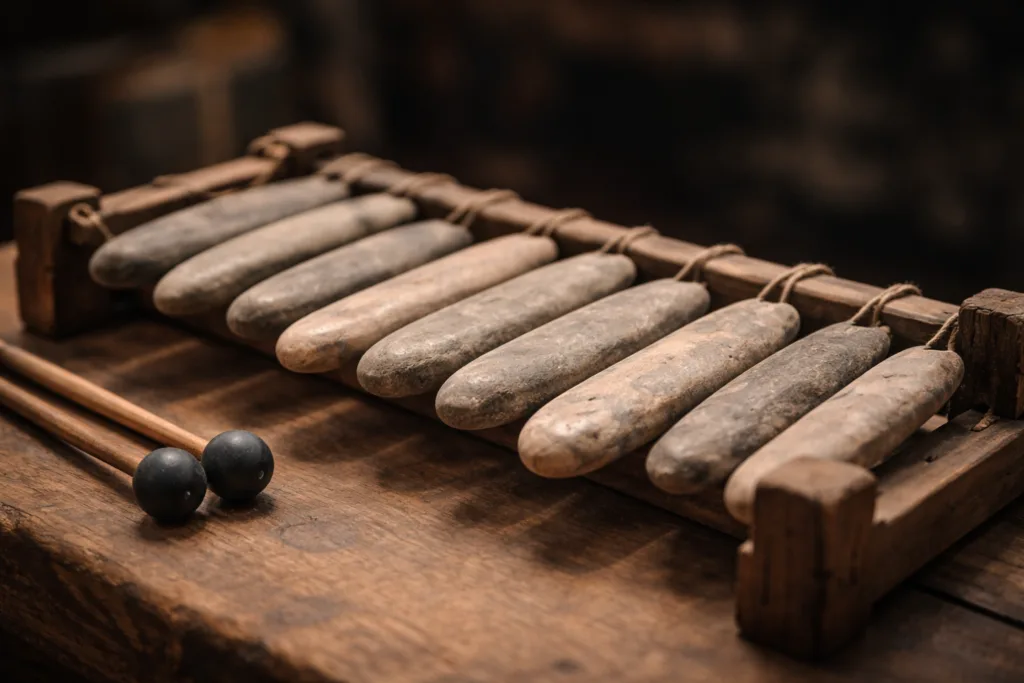
| What Shapes The Voice | What To Look For | What It Does To The Sound |
|---|---|---|
| Stone Body | Dense, fine-grained, low in cracks and open pores | Gives a cleaner pitch center, better ring, and less noisy after-sound |
| Length and Thickness | Longer and thinner bars vs. shorter and thicker bars | Longer and thinner tends to lower pitch; shorter and thicker tends to raise it |
| Support Points | Rope, straw, cord, or suspension placed near nodal points | Lets the stone breathe and keeps the decay from being choked |
| Beater Choice | Hard wood or stone, leather, or softer rubber | Changes the front edge of the note, overtone bite, and felt warmth |
A lithophone can fail before it makes a single note. Rest a good stone on the wrong point, or strike a cracked slab with the wrong beater, and the sound collapses into a dead tap. Set the same stone free, though, and it can answer with a tone that feels part bell, part wood, part bare earth.
That is why this instrument deserves more than the usual “stone xylophone” label. A real reading of the lithophone starts with material, not shape alone: the grain of the rock, the way the bar is suspended, the thickness under the striking zone, the edge profile, even the small flaws that decide whether the note will bloom or break apart. Tiny things. Big effect.
🪨 What The Name Covers and What It Misses
- Natural ringing stones struck where they lie in the landscape
- Portable tuned bars laid out and played like a keyboard
- Suspended plaques used in formal court or ritual settings
- Modern concert builds cut for exact pitch and wider range
The term lithophone is useful, but also a bit blunt. It puts very different stone instruments under one roof. A Chinese chime stone, a Vietnamese đàn đá, and a Cumbrian museum set made from hornfels may all belong to the same family, yet they do not speak with the same accent, and they were not built for the same room, the same hand, or the same idea of pitch.
That difference gets skipped far too often. It should not.
🔔 Stone Before Music
Why Some Rocks Ring and Others Do Not
Hardness helps, but hardness alone does not make a usable lithophone. What matters more is a dense and fairly even internal structure. When the stone is compact and fine-grained, vibration can travel with less interruption. When the body is full of pores, hidden cracks, weak seams, or messy internal breaks, the note loses focus. The ear hears that right away: not ring, but scatter.
This is where the instrument starts to feel almost like a curator’s object and a maker’s object at the same time. A bar may look solid on the outside and still carry a cloudy, unfocused response. Another may be plain as day, even rough-edged, yet give a stable note with a long, calm decay. The stone tells on itself when struck.
A good lithophone bar is judged in two stages: first by free resonance, then by supported resonance. A stone that sounds fine in the hand can die on the frame if its support lands in the wrong place.
Why Material Choice Is Never Just Aesthetic
- Hornfels is prized in older Cumbrian instruments because it is very hard, stable, and capable of a clear, carrying ring.
- Limestone can be ordinary or surprisingly musical, depending on density and internal uniformity. Fine examples can sound clean and poised rather than chalky.
- Slate works well in bar form and often gives a plain, direct response that suits clear melodic layout.
- Jade or nephrite in antique Chinese plaques shows that stone choice could carry both sonic and ceremonial weight.
In antique stone instruments, material is never just a matter of “what was nearby.” It shapes the envelope of the note. Dense stone with a tidy internal body tends to speak faster and hold shape longer. A weaker stone may still give pitch, but the timbre frays at the edges — the attack gets dusty, the sustain shortens, and the ear starts following noise instead of tone.
🧰 How Pitch Is Cut Into The Stone
- Shortening a bar usually raises the pitch.
- Reducing thickness in the middle usually lowers the pitch.
- Changing the wrong area can damage both strength and tone, not just pitch.
- Support placement decides whether the finished note rings freely or gets muted on contact.
This is one of the least discussed parts of the lithophone, and it should be near the top. The instrument is not tuned only by finding the right stone. It is tuned by careful loss. A little length removed here, a little mass reduced there, and the pitch moves. Too much, and the bar has nowhere to go but wrong.
Stone is less forgiving than wood. It does not bend into the plan. It either agrees or it punishes the cut.
On older bars, fresh-looking grinding around the center can point to later retuning. That is not always a flaw, but it does change how the set should be read. In antique instruments, pitch history is part of object history.
🎼 Timbre Under The Mallet
The timbre of a lithophone is shaped as much by contact as by stone. A hard wooden or stone beater sharpens the front of the note and lets upper partials flash out. The result can feel bright, dry, and bell-edged. A softer head — leather, wrapped wood, firmer rubber — rounds the attack and makes the tone sit lower in the ear. Less bite. More body.
That does not mean soft is better. It depends on the bar. Dense hornfels often likes a controlled but firm strike because its ring can take it. A weaker or thinner slab may answer more gracefully to a gentler head. Old stones, especially, do not all want the same treatment.
And then there is the striking spot. Move from the center toward the side and the note can tighten, brighten, or lose body. On an irregular antique bar, even a small change of striking point can shift the color enough to matter in performance.
Lithophone Vs. Xylophone and Metallophone
| Family | Material Voice | Attack and Decay | What The Ear Notices |
|---|---|---|---|
| Lithophone | Stone | Firm attack, ring depends heavily on structure and support | Earthy body with bell-like edge when the stone is right |
| Xylophone | Wood | Quick attack, dry and articulate decay | Woody core, clear rhythmic bite |
| Metallophone | Metal | Bright attack, longer shimmer, stronger overtone bloom | More sparkle, more overtone glare, less grain from the body itself |
A lithophone sits in a very telling middle ground. It does not have the fibrous warmth of wood, and it does not hang in the air like metal. When well made, it gives a tone with a hard front edge and a mineral center. That center matters. It is what keeps the sound from becoming just another bright struck bar.
🏛️ Old Court Stones, Highland Bars, and Fell-Born Keys
Chinese Chime Stones
In China, stone chimes took highly shaped and formal forms. Single stones appear early, and sets later became part of court and ritual music. These are not casual field finds arranged in order of pitch. They belong to a system. Their plaques were suspended, measured, and treated as both sounding bodies and cultural objects. Many surviving examples are limestone, while ceremonial pieces also appear in valued stones such as jade or nephrite.
That form changes the listening. Suspended plaques do not speak like bars laid across a simple frame. The strike is tidier, the visual language more formal, and the instrument carries a sense of order before a note is even heard.
2026 Research: Where Chu Stone Chimes Came From
A study published in Frontiers in Earth Science on 15 May 2026 examined seven representative Eastern Zhou stone chime samples from the Shuangdun, Jiunvdun, Jiuliandun, and Leigudun tombs in the Chu cultural region. The researchers used petrographic examination under polarizing microscopy and X-ray fluorescence (XRF), then applied principal component analysis (PCA) to compare the archaeological chimes with possible geological source materials from Anhui, Hubei, and Jiangsu.
The Shuangdun chimes showed a strong compositional affinity with lithophone stone from Qingyunshan Mountain in northern Anhui. The two Leigudun No. 2 samples followed different compositional trends: one was closer to the Lingbi/Qingyunshan group, while the other was more similar to limestone from the Xiangyang region. The sources of the Jiuliandun and Jiunvdun samples could not be pinned down from the reference material available to the study.
The pattern shows that raw material selection was not limited to a single local source. The authors connect this with the deliberate selection of better stone from different regions and the movement of raw material over longer distances for organized chime production. The present dataset cannot establish one exact transport route or workshop network, but the results are consistent with selected stone being moved to production centers where matched chime sets could be shaped and tuned.
The material choice had an acoustic purpose as well. By the Zhou period, limestone had become the dominant material for functional stone chimes. Dense, homogeneous limestone offered stable acoustic behavior and could be carved, shaped, and tuned with greater control. Fine-grained, relatively pure limestone was therefore useful for more than appearance or ritual value: its structure supported cleaner sound production, pitch control, precise shaping, and more consistent manufacture across a set.
Vietnamese Đàn Đá
The Vietnamese đàn đá keeps the stone bar idea in a more direct, tactile way. Here the identity of the lithophone is easier to see: selected stones, tuned by size and shaping, laid out for melody. The sound tends to feel less ceremonial in posture and more immediate in contact. Not rough, exactly. Just closer to the hand.
This matters because many short articles treat all lithophones as if they were one design repeated across the globe. They are not. Chinese chime stones and Vietnamese bar lithophones share a family line, but their construction logic and social setting pull in different directions.
Cumbrian Museum Lithophones
The Lake District gives one of the clearest antique and early modern case studies in stone selection. Cumbrian builders worked with hornfels, slate, and limestone, and they learned very quickly that not every local stone deserved a place on a frame. The old museum sets show this with almost stubborn clarity: some used rope supports, some kept a plain wooden stand, some reached only a few notes, and some expanded toward a fuller keyboard idea.
The famous Cumbrian examples also show a trait that modern write-ups often miss: layout does not erase geology. Even when arranged like a xylophone, the bars do not stop being pieces of a fell-born material with their own grain, fracture habits, and limits. Keyboard logic meets stone logic there — and stone logic usually gets the last word.
| Tradition | Typical Form | Material Focus | What Sets It Apart |
|---|---|---|---|
| Chinese Chime Stones | Suspended plaques or sets | Often limestone; sometimes valued ceremonial stone | Measured, formal, tied to court and ritual practice |
| Vietnamese Đàn Đá | Portable tuned bars | Selected resonant stone bars | Melodic bar logic with a direct hand-to-stone feel |
| Cumbrian Lithophones | Bars on rope or frame | Hornfels, slate, limestone | Museum-made keyboard thinking shaped by local geology |
Lithophone Vs. Natural Rock Gong
This is another line that gets blurred too often. A natural rock gong is usually a ringing stone used where it stands, or a very large natural slab whose sound is activated by strike marks, wear zones, and repeated use. A tuned lithophone, by contrast, is normally portable or at least deliberately arranged. One grows from site acoustics. The other grows from note control.
- Rock Gong: place-bound, often natural in shape, tied to landscape resonance
- Lithophone: selected or shaped for pitch relation, arranged for melodic use
- Shared Ground: both rely on resonant stone, controlled impact, and an ear for ringing rather than thud
Not every ringing stone wants to be a keyboard. And not every keyboard of stone starts in the landscape. That distinction is small on paper, but large in practice.
🧱 Older Sets Vs. Modern Concert Builds
Modern lithophone makers often aim for exact concert pitch, wider chromatic range, and cleaner consistency from bar to bar. Antique and museum examples are often less rigid in that sense. They may favor local materials, practical layouts, or a narrower pitch map that still works musically without chasing laboratory neatness.
Neither approach is automatically better. Modern work gives control. Older work gives character. One tends to level the family resemblance across the set; the other lets each bar keep more of its own geological accent. That old unevenness can be the point.
What Collectors, Curators, and Builders Notice First
- Cracks and Repairs
Hairline fractures shorten sustain fast. Old fills or glued breaks may keep a bar presentable, but rarely invisible to the ear. - Support Wear
Rope burn, drilled holes, edge rubbing, and flattened resting points tell how the instrument was actually mounted and played. - Bar Matching
A set that mixes stones with very different grain, density, or finish may have been expanded, repaired, or reassembled later. - Tool Marks
Grinding, pecking, polishing, and later retuning marks can show whether pitch was found by selection, shaping, or both. - Tonal Consistency
Antique sets do not need perfect modern sameness, but they should still feel like a family when struck in sequence.
Seen this way, a lithophone is never only an instrument. It is also evidence: of stone knowledge, of touch, of tuning choices, of what a maker valued enough to preserve in matter rather than leave to chance.
And that is why the best examples stay in the ear. Not because they are unusual, but because every note carries the material truth of how they were made.
FAQ
Is a lithophone just a stone xylophone?
Open Answer
Not always. Lithophone is a wider label. Some are laid out like xylophones, but others are suspended plaques, single ceremonial stones, or natural ringing rocks used in place. The shared trait is resonant stone, not one fixed shape.
How do I know if a stone lithophone is well made?
Open Answer
Listen for a clear pitch, even decay, and a note that does not collapse into noise after the strike. Then check the support. A well-made lithophone should still ring freely when mounted correctly. Visible cracks, mixed replacement bars, and awkward dead spots are warning signs.
Why do some lithophones ring while others sound dull?
Open Answer
The difference usually comes from the stone’s internal structure and the way it is supported. Dense, fine-grained, fairly even stone carries vibration better. Cracks, pores, weak seams, or poor support placement interrupt the wave path and turn a promising note into a short thud.
Can a lithophone be tuned accurately?
Open Answer
Yes, but it takes patience and a stone that is worth tuning in the first place. Shortening the bar tends to raise pitch, while thinning the center tends to lower it. The catch is simple: stone gives little room for error, so careful shaping matters more than speed.
What kind of mallet should I use on a lithophone?
Open Answer
Use the mallet that suits the bar, not just the one that feels easiest. Harder beaters give more attack and brighter upper color. Softer beaters round the strike and can sound fuller on delicate bars. On antique stones, a controlled medium-hard beater is often the safest starting point.