
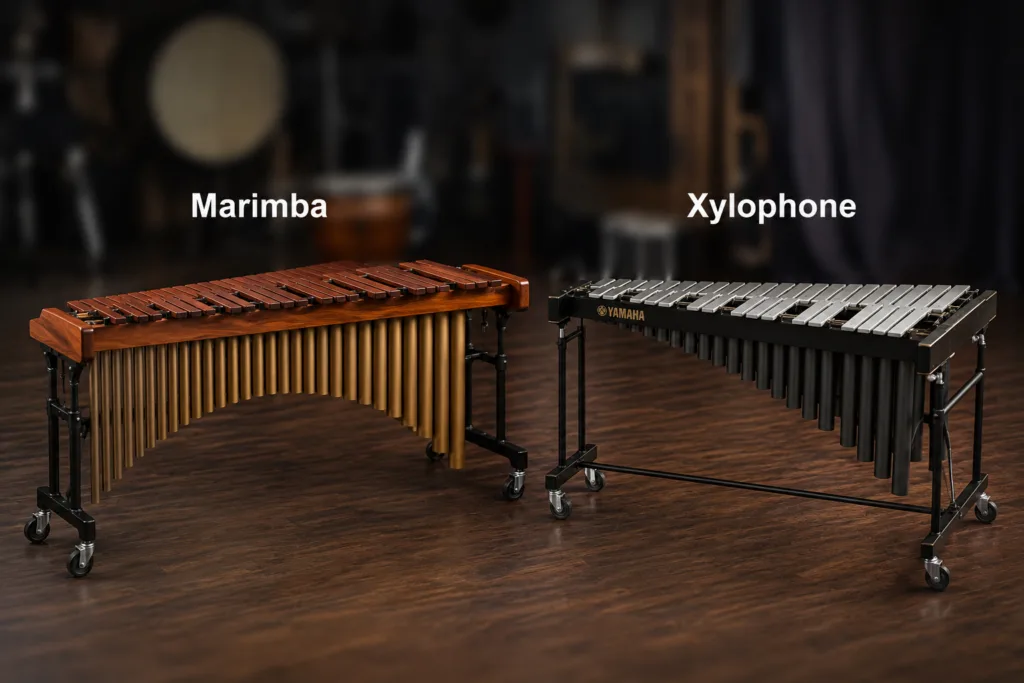
Comparison Snapshot
Marimba and xylophone are tuned percussion instruments built around struck bars and resonators, but they are designed for noticeably different registers and tone colors. The marimba generally produces a lower, fuller sound with more lingering resonance, while the xylophone favors a higher register, fast attack, bright projection, and short decay.
Marimba and xylophone belong to the tuned percussion family and share the same basic playing principle: a mallet strikes a pitched bar, the bar vibrates, and a resonator beneath it reinforces part of that vibration. Their visual similarity can make them seem like different sizes of the same instrument, yet the acoustic design is not interchangeable.
The most useful distinction is heard in the beginning and ending of each note. A xylophone note normally speaks almost immediately, with a focused attack and rapid decay. A marimba note has a rounder beginning and a broader resonant body, especially in the middle and lower registers. Bar geometry, register, resonator dimensions, tuning, and mallet choice all contribute to that contrast.
Marimba vs Xylophone: The Main Differences
| Feature | Marimba | Xylophone |
|---|---|---|
| General register | Lower and broader | Higher and more concentrated |
| Tone | Warm, woody, rounded, resonant | Bright, dry, focused, penetrating |
| Attack | Usually softer and less abrupt | Fast and clearly defined |
| Decay | Longer, especially in lower registers | Short |
| Physical size | Usually larger, with wide bass bars and long bass resonators | More compact |
| Common mallet type | Yarn or cord-wrapped heads | Hard rubber, plastic, resin, or wood depending on context |
| Four-mallet playing | Common in solo and chamber repertoire | Possible, but two-mallet playing is more typical |
| Concert notation | Normally non-transposing | Sounds one octave above written pitch |
These are characteristics of modern chromatic concert instruments rather than universal rules for every regional marimba or historical xylophone. Instrument makers offer different ranges, bar materials, tuning systems, and frame designs.
Why the Two Instruments Sound So Different
The sound difference starts before the mallet touches the instrument. A marimba and xylophone may arrange their bars like a piano keyboard, but each bar is shaped for a different acoustic goal.
Bar Geometry Sets the Basic Vibration
Length, width, thickness, density, and the amount of material removed from the underside influence the pitch and vibration modes of a bar.
The Resonator Reinforces the Bar
A tube beneath the bar is tuned to reinforce the vibration around its intended pitch. Lower notes need much longer air columns than high notes.
The Mallet Shapes the Attack
Soft wrapping filters much of the sharp contact noise. A harder head emphasizes the beginning of the note and makes upper-frequency content easier to hear.
Register Changes Perceived Tone
The marimba reaches much farther into the low register, while the xylophone concentrates on pitches where short, clear articulation is especially effective.
The Bars: Where Construction Starts to Diverge
Marimba Bars Become Much Larger in the Bass
The lowest marimba bars are long, wide, and deeply shaped underneath. Their size is not simply a visual design choice. A lower pitch requires a bar that can vibrate more slowly, so makers change its dimensions and remove material from selected areas of the underside to bring the bar to pitch while controlling its upper vibration modes.
This creates the familiar graduated shape of a concert marimba. The bass end is visibly wider, while the bars become progressively shorter toward the treble end.
Xylophone Bars Serve a Higher Register
A concert xylophone does not need a bass section comparable to that of a large marimba. Its bars therefore remain much more compact. The higher pitch range contributes to the instrument’s quick response and sharply defined attack.
The underside of a xylophone bar can also be shaped for tuning. The main distinction is not that one instrument uses shaped bars and the other does not; it is the different register, dimensions, tuning targets, and tone expected from those bars.
Common Confusion: Bar color does not reliably identify the instrument. Modern marimbas and xylophones can use natural wood or synthetic bar materials, and two instruments with similarly colored bars can have very different acoustic designs.
Wood, Synthetic Bars, and Their Effect on Tone
Rosewood has long been associated with professional mallet percussion because a well-selected bar can combine clear pitch, lively vibration, and a pleasing response across a wide dynamic range. Other woods are also used, and modern makers offer synthetic alternatives designed for stability, durability, or changing environmental conditions.
Material alone does not determine whether an instrument sounds like a marimba or xylophone. Bar dimensions, tuning, resonator design, mallet hardness, and register remain part of the result.
| Construction Element | What It Can Change | What the Player Hears |
|---|---|---|
| Dense natural wood | Vibration response and overtone character | Often a lively, woody tone with clear pitch definition |
| Synthetic bar material | Environmental stability and response characteristics | Varies by formulation and maker; often selected for consistency and durability |
| Deeper underside arch | Pitch and selected vibration modes | Allows a larger bar to reach a lower pitch without simply reducing its external size |
| Longer resonator | Reinforcement of lower frequencies | Greater support for low-register notes |
| Harder mallet | Contact transient and upper-frequency emphasis | Brighter, more immediate articulation |
Resonators Explain Much of the Size Difference
The vertical tubes below the bars are acoustic resonators, not supports for the keyboard. Each is sized to reinforce a pitch or a small group of related pitches. Because low frequencies require longer resonating air columns, the bass section of a marimba needs much longer tubes than the upper register of a xylophone.
Resonator Design
Long bass resonators follow the instrument’s low register. The tubes gradually shorten toward the treble end, creating the pronounced stepped or curved resonator profile seen beneath many concert marimbas.
The higher register allows a shorter and more compact resonator system. The resulting instrument is easier to keep physically narrow and does not need the deep bass architecture of a five-octave marimba.
Some professional marimbas allow parts of the resonator system to be adjusted because air temperature affects the resonant frequency of an air column. This matters most where players expect a refined match between the bars and the resonators.
Marimba and Xylophone Range
Range varies by model, so a single octave count should not be treated as a definition. Modern concert marimbas are commonly available in several sizes, including instruments that extend to five octaves. Large models can reach deep into the bass while retaining a substantial upper register.
Concert xylophones usually cover a narrower and much higher pitch span. A common professional layout is around three and a half octaves, although larger and smaller versions exist.
A broad register allows bass lines, inner voices, chords, melody, and high-register articulation to coexist on one instrument. The extended bass is one reason a full-size marimba occupies so much floor space.
The range is concentrated where notes speak quickly and project clearly. This suits exposed melodic fragments, rhythmic figures, rapid passages, and orchestral lines that need strong definition.
One Easily Missed Difference: Xylophone Transposition
Modern concert xylophone is normally treated as a transposing instrument. The note that sounds is one octave higher than the written note. This keeps its music on a more convenient part of the staff instead of forcing much of the part into very high ledger lines.
Concert marimba is normally written at sounding pitch. If middle C is written, middle C is expected to sound. This difference matters to composers, arrangers, percussion students, and anyone transferring a passage from one instrument to the other.
Notation Note: Moving a written marimba line directly onto xylophone does not automatically preserve the sounding octave. The available range and the xylophone’s octave transposition both need to be considered.
Attack, Sustain, and Projection
The easiest way to recognize the instruments by ear is to listen to how the note begins and how quickly it disappears. The profiles below describe common listening tendencies rather than laboratory measurements.
Marimba Listening Profile
Xylophone Listening Profile
The xylophone reverses much of that balance. Its recognizable character comes from a brighter attack, shorter decay, and concentrated projection. Even in a busy ensemble, the start of a xylophone note can remain easy to distinguish because the transient carries strong high-frequency energy.
A marimba can also produce a hard, bright attack when struck with firm mallets, and a xylophone can be softened with appropriate mallets. Mallet choice changes the result, but it does not erase the acoustic character created by each instrument’s bars, register, and resonators.
Why Mallets Matter More Than They Appear To
A percussion mallet is part of the sound-producing system. Its core, wrapping, diameter, hardness, weight, and contact area influence which parts of the bar’s vibration become prominent at the moment of impact.
Marimba Mallets
Marimba players commonly use yarn or cord-wrapped mallets. The wrapping spreads the impact over a slightly longer contact period than a very hard bare head, reducing some of the sharp contact noise and encouraging the rounded tone associated with the instrument.
Harder marimba mallets are useful when clearer articulation is required in the upper register. Very soft mallets can produce a full bass response but may lack definition on small treble bars. Players therefore change mallet hardness according to register, dynamics, repertoire, and the specific instrument.
Xylophone Mallets
Xylophone mallets are commonly much harder. Rubber, plastic, resin-like materials, and wood can produce the immediate attack needed for clear articulation. Different hardness levels still matter: a very hard head emphasizes brightness, while a slightly softer head reduces the edge of the attack.
Player Tip: Harder does not simply mean louder. Changing mallet hardness alters attack, brightness, note definition, and the balance between contact sound and bar resonance.
Bar Tuning Is More Than Cutting Each Bar to Length
A tuned percussion bar is a carefully shaped vibrating object. Makers bring it to pitch by controlling its overall dimensions and by removing material from selected parts of the underside. The familiar arch under a wooden marimba bar is part of this tuning process.
Removing material from different areas does not affect every vibration mode in the same way. Skilled bar tuning therefore involves listening to and measuring more than the fundamental pitch. The objective is to create a bar whose fundamental and upper modes produce the intended tonal character for that register.
The effect is especially visible on low marimba bars, where a large amount of shaping may be needed. Their deep underside arches allow long, wide bars to produce low pitches while maintaining a playable thickness and desired response.
Why the Same Note Feels Different on Both Instruments
Pitch alone does not define instrumental identity. If a marimba and xylophone play the same sounding note within an overlapping register, the listener can still distinguish them because the note develops differently over time.
The xylophone usually produces a stronger, harder-edged transient. The marimba tends to begin with a softer contact profile when played with a typical yarn mallet.
The marimba usually gives the ear more sustained bar and resonator energy after the initial strike. This helps individual notes feel broader.
Xylophone energy falls away rapidly, creating naturally detached articulation even when the player does not attempt a short stroke.
The xylophone’s bright attack can remain noticeable inside dense orchestral textures. Marimba projection depends more strongly on register, mallet choice, dynamics, and surrounding instrumentation.
Two Mallets, Four Mallets, and Playing Technique
It is inaccurate to define marimba as a four-mallet instrument and xylophone as a two-mallet instrument. Both can be played with two mallets, and both can technically be approached with four.
The difference is how central those techniques are to their modern repertoire. Four-mallet marimba playing is widely used for chords, independent lines, wide intervals, rolls, and textures that combine melody with accompaniment. The instrument’s broad keyboard and resonant lower register make that approach musically useful.
Xylophone parts more often emphasize two-mallet articulation, fast melodic lines, repeated notes, scales, and rhythmic figures. Four-mallet xylophone playing exists, but it is less closely tied to the instrument’s standard orchestral identity.
Musical Roles: Resonance vs Articulation
Where Marimba Works Especially Well
Marimba can support sustained melodic writing through rolls, broad interval patterns, chordal textures, bass movement, and multi-voice solo writing. Its range has also encouraged an extensive solo and chamber repertoire in addition to its place in percussion ensembles, concert bands, orchestras, and regional musical traditions.
Where Xylophone Is Especially Effective
Xylophone is suited to passages where note definition matters more than lingering resonance. Fast scales, articulated melodies, repeated notes, rhythmic doubling, and short orchestral gestures benefit from its direct response.
The xylophone’s short decay also leaves acoustic space between notes. A rapid passage can remain intelligible because one note does not continue ringing strongly into the next.
Can the Same Music Be Played on Marimba and Xylophone?
Some music transfers easily, especially single-line melodies that fit both ranges. Other passages need adaptation because the two instruments respond differently.
- Check whether every written pitch falls inside the destination instrument’s range.
- Account for the concert xylophone sounding one octave above its written notation.
- Expect sustained marimba passages to become much drier on xylophone.
- Reconsider wide four-mallet chords if the xylophone part was not designed for that spacing.
- Review mallet choice rather than using the same mallets automatically.
- Listen for whether the original passage depends on resonance or on articulation.
A melody may remain recognizable on either instrument while its musical character changes sharply. A warm rolled marimba line and the same pitches played as short xylophone attacks can serve very different purposes even though the notes are identical.
How to Identify a Marimba and Xylophone by Sight
A large concert marimba is usually easy to recognize from its bass end. The low bars become broad and long, and the matching resonators extend far beneath the keyboard. The entire frame must accommodate this graduated low register.
A xylophone is normally narrower and more compact. Its bars remain relatively small because the instrument operates in a higher register, while the resonators beneath them are correspondingly shorter.
- Very wide low-register bars
- Long bass resonators
- Large overall footprint
- Broad keyboard range
- Frequent use of yarn-wrapped mallets
- Compact keyboard
- Smaller bars across the instrument
- Shorter resonator system
- Upper-register layout
- Frequent use of harder mallets
Do not rely on bar color, frame color, or the presence of resonator tubes alone. Both instruments can use dark wooden bars, synthetic bars, and similar chromatic keyboard layouts.
Which Instrument Fits Which Musical Need?
Choose by Sound and Repertoire
You need a broad register, low notes, chordal playing, four-mallet repertoire, rounded attack, or more resonance after each stroke. It is especially useful for solo literature and music that treats the keyboard as a multi-voice instrument.
You need bright articulation, a compact upper-register instrument, short decay, rapid melodic clarity, or a tone that remains sharply defined in orchestral and band writing.
Neither instrument is a higher-quality version of the other. Their construction reflects different musical jobs. Choosing between them is mainly a question of range, note length, attack character, repertoire, and ensemble role.
Mini FAQ
Is a marimba just a large xylophone?
No. The marimba is generally larger, but size is only one result of deeper differences in register, bar dimensions, resonator length, tuning, mallet choice, decay, and intended sound.
Which is lower, marimba or xylophone?
Marimba. Modern concert marimbas extend much farther into the bass register, while xylophones are concentrated in a higher pitch range.
Why does a xylophone sound sharper than a marimba?
Its higher register, compact bars, short decay, and commonly used hard mallets create a fast, bright attack. Marimba is usually played with softer wrapped mallets and has a more resonant lower register.
Are marimba bars always wood?
No. Natural wood remains important, but modern marimbas can also use synthetic bars. Xylophones likewise appear with both wooden and synthetic bar materials.
Does a xylophone sound at the written pitch?
Concert xylophone normally sounds one octave higher than written. Marimba is normally treated as a non-transposing instrument and sounds at the written pitch.
Can you use marimba mallets on a xylophone?
They can physically strike the bars, but the result may be too soft or unfocused for the intended xylophone sound. Mallet hardness and material should match the instrument, register, dynamics, and musical context.