
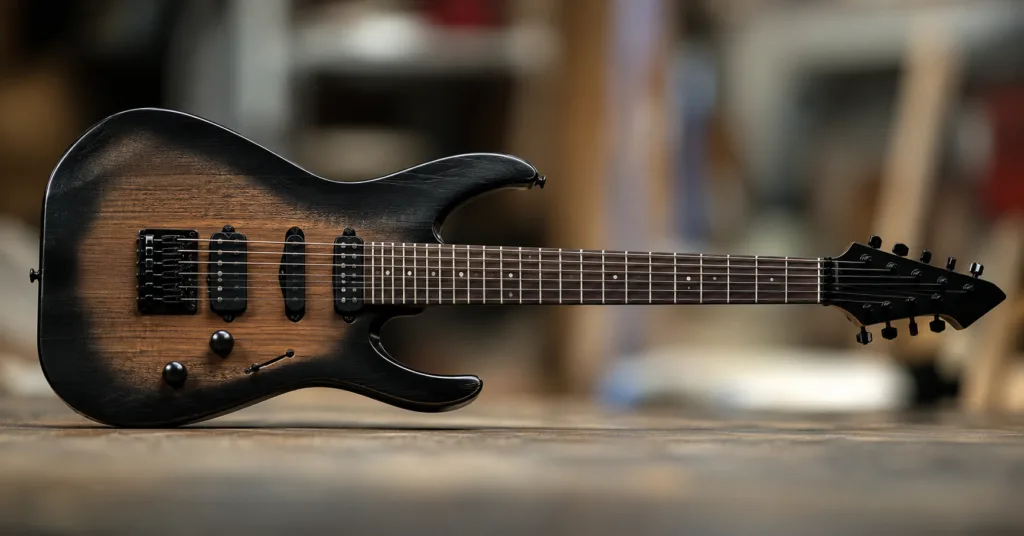
Interactive Instrument Profile
An AI musical instrument is a playable system in which physical action, sensor data, mapping logic, and a generative or adaptive music engine operate as one performance interface. Its identity does not come from the model alone. It comes from the learned relationship between gesture and sound, the amount of musical control retained by the performer, and the way the system behaves under live conditions.
An AI music generator can produce a finished track after receiving a prompt. An AI musical instrument must do something more demanding: it must remain responsive while a performer listens, acts, corrects, and shapes the result over time. The player needs a usable relationship between action and consequence, even when the exact sound is not fully predetermined.
The performance chain usually begins with a hand, breath, body movement, acoustic note, or physiological signal. Sensors capture that action. Software cleans and interprets the data. A mapping layer decides what the action means musically. A model or synthesis engine then produces notes, controls, transformed audio, or a continuous stream of sound. The performer hears the result and changes the next action, creating a closed feedback loop.
What Makes an AI System a Musical Instrument?
The word instrument implies more than output. It implies practice, timing, physical memory, expressive range, and the possibility of improvement. A performer should be able to discover repeatable regions of behavior, develop technique, and recover when a result moves in an unwanted direction.
Predictability does not require identical output. A violinist cannot reproduce every overtone in exactly the same way, yet bow pressure, contact point, and speed create a learnable field of possibilities. An AI instrument can work in a similar manner. The generated details may vary, but the player should understand how to move toward a denser texture, a quieter response, a sharper attack, a wider pitch field, or a more independent machine part.
Common Confusion: A prompt-controlled music model is not automatically a playable instrument. Instrumental use begins when control remains continuous enough for timing, correction, phrasing, and rehearsal.
Receives a request and returns music. The user may edit the result, but the interaction can stop while generation takes place.
Uses machine learning to recognize gestures, stabilize control, predict intention, or expand a limited movement into a larger sound space.
Produces new musical material while the performer steers rhythm, timbre, density, harmony, or form during the performance.
Listens, remembers recent events, and contributes phrases or structural decisions with a degree of independence.
The Complete Gesture-to-Sound Chain
Physical Action
A player presses, bends, strikes, turns, breathes, moves through space, or plays an acoustic phrase.
Sensing
Pressure pads, inertial sensors, cameras, microphones, muscle sensors, or other devices convert the action into changing values.
Signal Preparation
Calibration, smoothing, scaling, drift correction, onset detection, and noise rejection make the data usable.
Gesture Interpretation
The system estimates whether the performer made a strike, sweep, hold, rotation, pose, phrase, or compound gesture.
Musical Mapping
Gesture features are connected to note events, synthesis parameters, model conditions, autonomy settings, or structural cues.
Generation and Sound
A synthesizer, sampler, symbolic model, audio model, or hybrid setup produces the audible response.
Performer Feedback
The player hears, sees, or feels the response and adjusts the next movement. This feedback loop is where technique develops.
Sensors Define the Physical Character
The same generative model can feel like several different instruments when paired with different sensing methods. A pressure surface encourages contact, resistance, and fine control. A camera encourages larger gestures but introduces lighting and occlusion problems. An inertial sensor follows rotation and acceleration yet does not know the performer’s exact position in the room without additional tracking.
| Sensor Family | What It Captures | Useful Musical Role | Live Risk |
|---|---|---|---|
| Touch and Pressure | Contact, force, area, and movement across a surface | Articulation, dynamics, timbre, triggering, and continuous expression | Uneven calibration, sensor wear, and accidental contact |
| IMU | Acceleration, angular velocity, and orientation | Strikes, sweeps, rotations, posture, and wearable control | Drift, wireless loss, and ambiguous motion |
| Camera and Depth Tracking | Hand position, pose, distance, and whole-body movement | Dance interaction, conducting gestures, and large spatial control | Occlusion, lighting change, and restricted viewing area |
| Microphone or Pickup | Pitch, rhythm, timbre, onset, loudness, and phrasing | AI accompaniment, transformation, imitation, and call-and-response | Feedback, bleed from other instruments, and analysis delay |
| EMG | Electrical activity produced by muscle contraction | Effort, tension, pre-motion control, and accessible interfaces | Electrode placement, sweat, and performer-specific calibration |
| Breath or Pulse Sensing | Respiration cycles or cardiovascular timing | Slow modulation, pacing, biofeedback, and long-form change | Delayed response and involuntary variation |
Touch, Pressure, and Force
A touch surface becomes more expressive when it distinguishes a tap from a hold, a light contact from a hard press, and a stationary finger from a slide. Pressure can control volume, but that is only the simplest mapping. It may also change harmonic brightness, shorten a generated phrase, increase rhythmic subdivision, or reduce the model’s freedom.
The physical resistance of the controller matters. A soft surface invites gradual pressure. A rigid capacitive panel offers less tactile information and may require visual feedback. A controller that senses contact precisely but gives no physical response can feel detached unless sound or haptic feedback confirms the gesture.
Motion and Orientation
Wearable instruments often use an accelerometer and gyroscope together. Acceleration is useful for attacks and sudden direction changes. Angular velocity captures rotation. Orientation can describe posture or the angle of a hand-held controller. These values need different treatment; combining them without a clear musical purpose often creates unstable control.
Sensor placement changes the meaning of the data. A unit on the wrist emphasizes hand rotation. The same unit on the forearm captures a broader gesture. Mounted on an acoustic instrument, it can detect bowing direction, shaking, tilt, or body movement rather than the performer’s anatomy alone.
Vision-Based Control
Camera systems can track hands, facial landmarks, or a full body without attaching hardware to the player. This is useful for dance, conducting, installations, and performances where visible movement is part of the composition. The tradeoff is environmental dependence. A gesture that works in rehearsal may fail when stage lighting changes, another performer crosses the image, or a costume hides a joint.
Muscle and Physiological Signals
EMG can reveal muscular effort before a large visible movement occurs. Breath and pulse sensors usually change more slowly, making them better suited to texture, pacing, or long-term density than to precise note attacks. These signals do not provide a direct reading of emotion. They measure bodily activity, which receives musical meaning only through mapping and interpretation.
Raw Sensor Values Are Not Musical Gestures
A sensor may deliver hundreds of changing numbers each second. Those numbers become playable only after the system decides what range is useful, what counts as noise, when an action starts, and which features carry musical meaning.
Calibration and Normalization
Calibration sets the neutral position and usable movement range. A shoulder-height gesture may represent the top of one performer’s comfortable range but the middle of another’s. Pressure values also vary between devices and playing styles. Normalization converts these differences into a stable control range without pretending that every performer moves in the same way.
Smoothing Without Losing Timing
Smoothing reduces jitter but adds delay. Heavy filtering can make slow timbral movement feel polished while ruining a rapid rhythmic gesture. Many instruments need more than one treatment: quick attack detection for strikes, gentler smoothing for continuous motion, and separate thresholds for entering and leaving a gesture state.
Segmentation and Feature Extraction
The system may need to identify gesture onset, peak force, direction, duration, curvature, repetition rate, or the distance between two hands. A single movement can yield several features. The design problem is deciding which of them should affect music and which should be ignored.
Sensor Mapping Gives the Instrument Its Personality
Mapping connects performer data to musical behavior. It may be written as fixed rules, shaped with curves and thresholds, or learned from examples. Two instruments can use identical sensors and identical models yet feel unrelated because their mappings reward different movements.
One-to-One Mapping
One feature controls one musical parameter. Hand height may control filter cutoff. Pressure may control loudness. Wrist rotation may change stereo position. This design is easy to learn and useful when precise control matters, but a large patch with many separate mappings can make the performer feel like an operator adjusting isolated controls.
One-to-Many Mapping
One action changes several related properties. Opening the arms may brighten the timbre, widen the stereo field, increase note density, and reduce reverberation. This can feel closer to an acoustic instrument, where a change in bowing or breath affects several parts of the sound together.
Many-to-One Mapping
Several inputs combine to shape one behavior. Pressure, movement speed, and muscle tension might determine articulation. The distance between the hands and the direction of the torso might control harmonic tension. This approach allows nuance, though it can be harder to rehearse because the performer must learn a relationship among variables rather than a single control.
Conditional and Stateful Mapping
A conditional mapping changes meaning according to the current state. Wrist rotation might control a filter during one passage and model variation during another. A stateful mapping also considers recent gestures, accumulated energy, the previous phrase, or the present section of the piece. The same movement can therefore produce a different result after a musical transition.
Learned Mapping
Interactive machine learning allows the performer to demonstrate examples instead of writing every rule. A musician might record several movements labelled as restrained, unstable, sharp, or expansive. The system learns the sensor patterns and places later gestures within that trained space.
Learned mapping can adapt to unusual controllers and individual bodies. It also creates uncertainty. Similar gestures may be confused, and a classifier trained in a quiet studio may behave differently under stage conditions. Confidence thresholds, retraining, and a safe default response become part of the instrument design.
Mapping Sound Parameters and Mapping Generative Behavior
A conventional digital controller often changes known parameters such as pitch, amplitude, filter cutoff, sample position, or effect depth. A generative model adds controls that are less direct. The performer may steer density, continuity, harmonic stability, imitation, variation, or the length of musical memory.
Direct Parameter Control and Behavioral Control
The gesture changes a defined value. The result is easier to predict and measure. It suits attack, loudness, pitch movement, filtering, panning, and effect control.
The gesture changes how the model behaves. It may make the output more repetitive, sparse, consonant, restless, imitative, or independent without exposing every internal parameter.
Latent-Space Control
Some models represent musical material in a learned multidimensional space. A controller can move through that space instead of addressing named synthesis parameters. One direction may appear to move from acoustic to synthetic textures, while another shifts from sparse to dense activity.
The danger is uneven behavior. Nearby points do not always sound similar, and a smooth physical gesture can cross a region that changes abruptly. Performers often need to test and mark playable regions before a concert rather than assuming the entire latent area will behave like a conventional control surface.
Symbolic, Audio, and Hybrid Generative Instruments
AI instruments differ according to what the model produces. Some generate note events and control messages. Others generate finished audio. Hybrid designs split musical planning and sound production across several layers.
The model creates MIDI notes, durations, velocities, chords, or other event data. The performer can route the result to hardware, software instruments, or a custom synthesis patch.
Strength: Clear note-level editing and flexible timbre choice.
Limit: The model may not control the fine acoustic detail that makes a phrase feel performed.
The model produces the audible waveform, including timbre, texture, timing, and production detail. This allows unfamiliar sound fields and continuous transformations.
Strength: Timbre and musical material can emerge together.
Limit: Note-level correction, low latency, and exact repetition are harder.
The model may generate high-level structure or MIDI while a local synthesizer produces sound. Another hybrid path combines an acoustic performer, audio analysis, generative accompaniment, and deterministic effects.
Strength: Flexible control with a reliable local audio path.
Limit: More routing and synchronization points can fail.
Triggered and Continuous Generation
Triggered systems create a phrase, sample, or variation after a defined action. They are easier to cue but can feel segmented. Continuous systems keep producing audio while the performer steers the stream. Current live models can blend text conditions and musical controls while audio continues, moving interaction away from a prompt-and-wait pattern.
Continuous generation needs dependable stop, mute, reset, and boundary controls. A stream that sounds impressive but cannot return to silence or change direction quickly is difficult to use as an instrument.
Three Musical Timescales of Control
Gesture mapping becomes easier to design when each control is assigned to a musical timescale. A movement that should affect a note attack needs a different response from a movement intended to redirect an eight-bar texture.
Acts within the current note or moment: onset, volume, pitch bend, articulation, filtering, effect depth, mute, and model activation.
Shapes a short musical idea: continuation, variation, rhythmic response, melodic imitation, density, and call-and-response timing.
Changes the direction of a longer passage: section transition, energy curve, texture layers, thematic return, or machine autonomy.
A performer may play individual notes, steer the probability of what comes next, or manage the conditions of a longer process. These roles require different interface designs. A single controller should not be expected to provide millisecond articulation and large-scale structural direction with the same gesture unless the separation is very clear.
Human Control, Machine Influence, and Shared Decisions
Human–AI performance is not a simple choice between control and autonomy. The relationship can change during a piece. A deterministic controller may become an improvising partner for one passage and return to a restrained accompaniment role later.
Machine learning may clean signals or identify gestures, but the musical response remains defined in advance.
The system predicts intention, stabilizes movement, fills missing notes, or expands a small gesture into a more detailed response.
The model offers alternatives. The performer accepts, rejects, interrupts, or transforms them.
The model listens to recent music and answers with imitation, contrast, continuation, or accompaniment.
The machine maintains a longer musical direction, recalls prior material, and contributes its own phrase-level or form-level decisions.
Control means the performer selects the outcome. Influence means the performer changes the range of likely outcomes. Negotiation means the human and machine alter their behavior in response to one another. A clear composition decides which of these relationships is active and how the performer can change it.
Latency Becomes Part of the Playing Technique
Total delay comes from several places: sensor sampling, wireless transmission, data smoothing, gesture recognition, model processing, generation buffering, software routing, audio buffers, and the acoustic response of the room. A system can feel late even when no single component appears slow.
Reaction and Prediction
A reactive instrument waits for an event and answers afterward. This works for echoing, call-and-response, and phrase continuation. A predictive instrument estimates what may happen next so that its output arrives closer to the performer’s timing. Prediction can reduce the feeling of delay, but an incorrect prediction creates a musical error rather than a simple late response.
Look-Ahead and Musical Coherence
Some generative systems use recent context to predict future accompaniment. More look-ahead can help the model organize a phrase, yet it may make sudden changes harder to follow. Research published in 2026 continues to show a tradeoff among processing time, future context, alignment, and audio quality. Other systems avoid future information and generate causally, placing more pressure on efficient streaming and synchronization.
Live Latency Budget
List the delay added by each part of the setup before deciding where to optimize.
- Sensor sampling and local preprocessing
- Bluetooth, Wi-Fi, USB, or wired transmission
- Gesture analysis and confidence calculation
- Model processing and generation buffer
- DAW, plug-in, or patch routing
- Audio interface input and output buffers
- Network round trip when remote processing is used
Interpret the total by musical role: note attacks need the tightest response; continuous textures tolerate more delay; phrase-level accompaniment can use an intentional response gap; form-level control may remain usable with much slower change.
MIDI, MPE, MIDI 2.0, OSC, and Audio Routing
The communication method should match the kind of control being transmitted. A few note events need a different path from high-rate body tracking, per-note expression, or a continuous audio stream.
| Method | Best Use | Expressive Benefit | Design Caution |
|---|---|---|---|
| MIDI 1.0 | Notes, transport, tempo, hardware control, and common synthesizer routing | Wide compatibility and predictable event handling | Limited resolution and awkward handling of dense multidimensional sensor data |
| MPE | Independent pitch and timbre expression for polyphonic notes | Per-note bends, pressure, and timbral movement | Requires compatible controllers, instruments, and careful channel handling |
| MIDI 2.0 | Higher-resolution controls, per-note expression, and device capability exchange | More detailed gesture data and smoother continuous control | Support varies across current hardware and software |
| OSC | Named sensor streams, networked patches, custom applications, and research systems | Flexible message structure for many simultaneous controls | Timing, packet order, naming, and network behavior must be managed by the designer |
| Audio Routing | Live listening, transformation, accompaniment, and direct audio generation | Carries the full performed sound rather than a symbolic description | Feedback, bleed, gain staging, buffering, and model self-listening can cause problems |
Keep Dry and Generated Audio Separate
An acoustic or electronic performer often needs an unaffected path alongside the AI path. Separate routing allows independent monitoring, emergency muting, gain control, and recording. It also prevents a model from repeatedly analysing its own output unless that feedback is intentionally composed.
Generative Sound Must Remain Playable
High audio quality does not guarantee instrumental value. A live model also needs fast redirection, controlled silence, stable levels, clear boundaries, and a way to abandon unwanted output without stopping the performance.
Repeatability Without Exact Repetition
A useful AI instrument can return to a familiar behavior even when every detail changes. The performer might reliably reach a sparse metallic texture, a compact rhythmic response, or a harmonically stable accompaniment without receiving the same notes each time.
Productive Uncertainty
Uncertainty can support improvisation when the player understands its boundaries. Too little variation makes the model feel like a preset. Too much variation breaks physical trust. The playable area sits between those extremes, where the performer can invite surprise and still redirect the music.
Silence, Stop, Reset, and Memory
Every continuous model needs explicit control over silence and memory. The performer should know whether a mute only lowers the output, whether a stop ends generation, and whether a reset clears the recent musical context. These are different actions and should not share an ambiguous control.
Stage Failures Hidden by Studio Demonstrations
Live use exposes problems that may not appear during a short test. Heat, wireless traffic, lighting changes, room acoustics, long model sessions, and accidental movement all alter the behavior of an interactive instrument.
A value freezes, jumps, or disappears. The system should return to a neutral state rather than hold an extreme value forever.
A body part leaves the camera view or another object blocks it. Confidence should fall visibly, and a false gesture should not be triggered.
The model misses a response window or pauses during loading. A local loop, deterministic instrument, or prepared layer can keep the piece moving.
Generated material moves away from the shared beat or bar position. Resynchronization is often safer at a musical boundary than in the middle of a phrase.
A laptop or small computer reduces performance after sustained load. Rehearsals should run for concert length, not only for a short demonstration.
A generated layer becomes too loud or dense. A limiter, fixed gain ceiling, and physical emergency mute protect the performer and sound system.
Performance Warning: A fallback should preserve the musical piece, not merely keep the computer running. The substitute path needs a rehearsed musical role.
Training the Instrument and Training the Performer
AI instruments involve two learning processes. The model may learn the performer’s gestures or musical language. The performer also learns the model’s habits, delays, unstable regions, memory, and recovery behavior.
Artist-Centred Data
A small personal dataset can teach gesture recognition, phrase continuation, timbral transformation, or an individual improvisational vocabulary. This can make the instrument feel closely tied to one performer. It can also narrow the useful range if the training examples do not include the variation found in actual performance.
Remapping and Retraining
Remapping changes what a gesture controls while leaving the model’s musical behavior largely intact. Retraining changes what the model has learned. A new controller may require only a different mapping layer. A new musical language, performer vocabulary, or generation style may require new training or adaptation.
Practice as Behavioral Exploration
Practice includes more than rehearsing notes. The performer tests which gestures the system confuses, how long context remains active, when repetition appears, how quickly density can be reduced, and how the model recovers after interruption. This exploration becomes the technique of the instrument.
Accessibility and Personal Movement Design
Learned mapping can adapt musical control to the movement a performer can make rather than forcing the performer to match a fixed interface. Small gestures may control broad timbral changes. Tremor can be filtered selectively. Breath, muscle activity, head movement, or a single pressure sensor can replace a keyboard-like layout.
Personalization should not erase control. An interface that corrects every irregular motion may also remove intentional detail. Useful adaptation distinguishes unwanted noise from expressive variation and lets the performer decide how much assistance is active.
Adjustable movement range, personalized gesture examples, several input options, visible recognition confidence, and user-controlled smoothing.
A fixed definition of correct movement, hidden automatic correction, no manual override, and mappings that change without clear feedback.
What Changed in Live AI Music in 2025 and 2026
Recent systems have moved beyond generating a completed clip after a prompt. Lyria RealTime demonstrated continuous generation that can be steered while the audio is playing. Magenta RealTime introduced an open-weights live music model in 2025, followed by Magenta RealTime 2 in 2026 as an open and local platform for building interactive instruments on a laptop.
On September 4, 2026, Google made Lyria 3.5 available in the Gemini app and Gemini API. The release added more expressive vocals, richer arrangements, and options for shorter or longer generated tracks. This puts a current music-generation model directly in front of general Gemini users while also giving developers API access for music applications.
Research prototypes have also connected generative software to single-board computers, MIDI hardware, Max patches, Python inference servers, and consumer laptops. Current work explores causal accompaniment without future look-ahead, faster diffusion sampling, streaming synchronization, and generative effects that transform a performer’s improvisation while it continues.
On September 3, 2026, Frontiers in Education published a study of HarmonicThreads, a fabric-based digital musical instrument developed around accessible and inclusive music-making. The work extends the article’s accessibility discussion by showing how a soft, fabric-based interface can support alternative forms of musical interaction and personal movement design.
These developments reduce the distance between research models and playable systems, but they do not remove the old instrument-design problems. Timing, stable mapping, physical feedback, musical limits, rehearsal, and failure recovery still decide whether a system works on stage.
September 2026 Update
AIMC 2026: The Generative Turn
The Conference on AI Music Creativity 2026 took place in Berlin from September 16 to 18. Its theme, The Generative Turn: Mediated Musicianship in a Hyper-reproductive Age, placed generative systems inside a wider discussion of how musicians perform, compose, listen, and share creative decisions with computational systems.
The 2026 proceedings were published alongside the conference. Topics include performance systems, computational creativity, machine listening, robotics, and sonification, closely matching the problems faced by playable AI instruments: sensing musical action, interpreting context, generating a response, and keeping enough control in the performer’s hands for live use.
The conference also reinforces the distinction between an AI music generator and an AI musical instrument. In live work, generation is only one layer. The system must listen, respond at a usable timescale, expose musical control, and remain stable enough for the performer to rehearse its behavior.
jam_bot and the Next Live Human–AI Improvisation
A separate near-term example is MIT’s jam_bot. On October 3, 2026, Jordan Rudess is scheduled to perform with the system in a real-time human–AI improvisation setting. The event places the model inside the same kind of feedback loop described throughout this article: human playing becomes machine input, the system generates a musical response, and the performer reacts to that response while the performance continues.
For instrument design, this matters because the test is not whether the model can generate convincing music in isolation. The test is whether listening, generation, timing, and performer control remain coordinated closely enough for spontaneous musical exchange.
Designing an AI Instrument for Live Use
Define the Musical Relationship
Decide whether the machine should transform sound, continue phrases, accompany, recognize gestures, create texture, or contribute independent ideas. This decision determines what the performer must control directly and what the model may decide.
Choose the Physical Action Before the Sensor
Begin with touch, pressure, movement, breath, muscle activity, or acoustic playing. Select the sensor that represents that action well rather than designing the performance around available hardware.
Build a Deterministic Version First
Test sensing, scaling, filtering, and direct sound control before adding a generative model. This separates interface faults from model behavior and reveals whether the physical design is already playable.
Add One Generative Role
Start with continuation, accompaniment, variation, timbral transformation, or density control rather than assigning every musical decision to the model. The performer can learn one changing relationship before several layers are combined.
Set Musical Boundaries
Define pitch range, maximum density, level ceiling, allowed timbres, memory duration, tempo behavior, and the path back to silence. Boundaries turn model capability into a specific instrument.
Rehearse Failure States
Disconnect a sensor, block the camera, stop the network, overload the processor, and force a wrong gesture. Practice the musical recovery rather than treating failure as a technical event outside the composition.
Freeze the Concert Version
Keep the model, mapping, firmware, plug-ins, audio settings, and calibration procedure unchanged after the final rehearsal. Archive the working configuration before any later experiment.
Live-Performance Readiness Checklist
- The performer can explain the relationship between each main gesture and its musical effect.
- The system exposes recognition confidence or another clear indication of uncertain input.
- Continuous generation has separate mute, stop, reset, and context-clear controls.
- Sensor loss returns the instrument to a musically safe state.
- Generated output has a fixed level ceiling and physical emergency mute.
- The piece can continue through a local non-AI path when the model or network fails.
- The setup has been tested for the full concert duration under stage lighting and monitoring conditions.
- Tempo, bar position, and clock recovery have been rehearsed when synchronization is required.
- The performer knows which behaviors are repeatable and which remain probabilistic.
- The final model and mapping versions are archived with the performance patch.
Mini FAQ
Does an AI musical instrument need to generate audio directly?
No. It may generate MIDI, control synthesis parameters, transform live audio, produce accompaniment, classify gestures, or combine several of these tasks.
Can a generative instrument be rehearsed if its output changes?
Yes. Rehearsal focuses on repeatable behavior regions, timing, boundaries, recovery, and the performer’s ability to steer variation rather than reproduce every note exactly.
Which sensor is best for an AI instrument?
No single sensor is best. Touch and pressure suit direct articulation, IMUs suit wearable motion, cameras suit large spatial gestures, microphones suit listening and accompaniment, and biosignals suit slower adaptive control.
Why is mapping more important than the model?
The model determines what kinds of output are possible. Mapping determines how a performer reaches, changes, and learns those possibilities through physical action.
Can a cloud-based music model work on stage?
It can, but network delay and connection loss become part of the instrument. A local fallback, prepared audio path, and rehearsed recovery are needed when the remote service is unavailable.
Does more AI autonomy make an instrument more expressive?
Not automatically. Autonomy is useful when it supports the musical role. An independent model that cannot be redirected, muted, or understood may reduce the performer’s expressive control.