
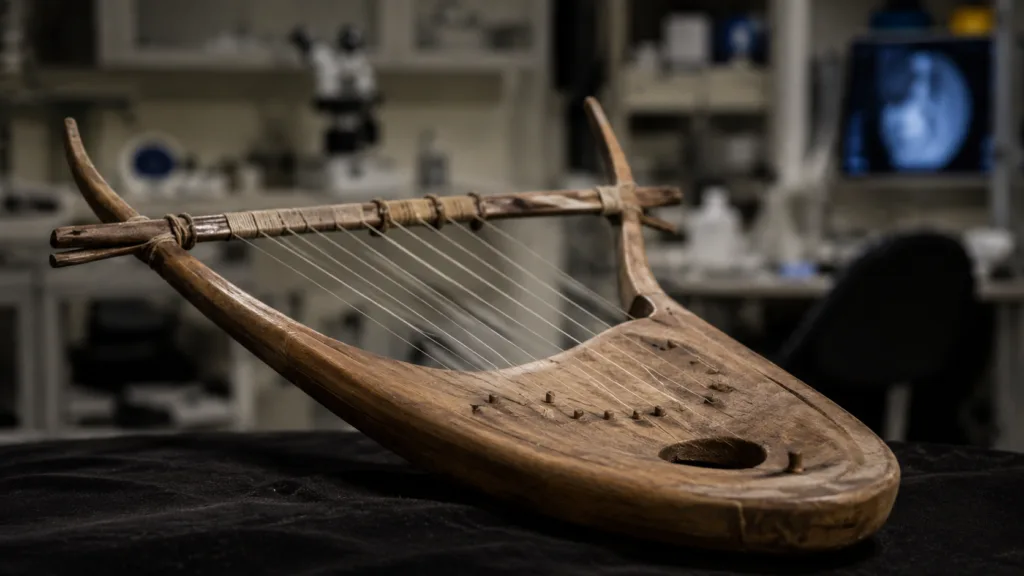
Reconstruction Method
CT scanning and 3D printing allow researchers to examine the hidden geometry of fragile historical instruments, build testable digital models, and produce playable replicas without sounding the original object. The result is not a recovered voice from the past. It is a measured reconstruction whose accuracy depends on scan quality, digital interpretation, missing parts, printing tolerances, material choice, and acoustic testing.
Ancient and historical instruments often survive in a condition that prevents direct playing. Bone may be split, wood may have shrunk, metal may be weakened by corrosion, and clay may carry hairline fractures that are hard to see. Reeds, strings, membranes, plugs, bindings, and mouthpieces are commonly missing. A museum object can also appear stable while remaining unsafe to handle, blow into, tune, or place under string tension.
CT scanning addresses a problem that photography and ordinary surface scanning cannot solve: many of the dimensions that control sound are inside the instrument. A flute may preserve its full outer shape while hiding an irregular bore, an offset windway, a repaired crack, or a narrowed section filled with soil. A whistle may contain a complex airway that cannot be measured from either opening. A sealed rattle may still hold pellets whose number, shape, and position affect its response.
The scan produces a three-dimensional density record rather than a finished replica. Researchers must separate the instrument from sediment, corrosion, adhesives, old restoration material, and imaging noise. Missing areas then have to be treated openly. Some can be restored from surviving symmetry or matching fragments. Others depend on related instruments, tool marks, iconography, craft knowledge, and acoustic trials. A printed object becomes useful only when these decisions are documented and tested.
Why the Original Instrument Is Often Left Silent
Playing an archaeological or museum instrument can alter the very evidence under study. Moist breath enters porous wood and bone. Finger pressure stresses weakened joints. Tuning a stringed instrument can load a soundboard that has not carried tension for centuries. Striking a corroded bell or rattle can release loose material or extend an existing fracture.
Cracks, thin walls, detached repairs, warped joints, and mineral loss may make ordinary playing pressure unsafe.
Breath introduces warmth and humidity into wind instruments. Hygroscopic materials can swell, shift, or develop new stress.
Some museum objects were treated with pesticides, consolidants, coatings, or adhesives that make mouth contact unsuitable.
Ownership by a museum does not automatically grant permission to sound, copy, publish, or circulate every instrument.
A replica separates acoustic investigation from direct risk to the artifact. It can be handled repeatedly, played by several musicians, altered between trials, cut open after testing, or scanned again to check whether manufacturing changed its dimensions.
What CT Reveals That Surface Methods Cannot
Computed tomography records many X-ray projections while the object rotates between an emitter and detector. Software reconstructs these projections as a stack of cross-sections. Each tiny volume element, called a voxel, carries information related to how strongly the material attenuated the X-rays.
The resulting volume can expose a complete internal path through an object. This is especially useful for woodwinds, whistles, horns, vessel flutes, rattles, and instruments assembled around hidden joints. It can also show whether an apparent opening is an intentional bore, a crack, a root channel in bone, or later damage.
| Method | What It Records Well | Main Blind Spot | Typical Role |
|---|---|---|---|
| Manual Measurement | Accessible lengths, diameters, hole positions, joint dimensions, and tactile condition | Closed cavities, curved internal bores, and areas too fragile to touch | Scale checks and confirmation of selected dimensions |
| Photography and Photogrammetry | Color, decoration, outer form, wear patterns, and visible damage | Opaque interiors and narrow concealed passages | Surface documentation and contextual study |
| Optical 3D Scanning | Fine exterior geometry and accessible surfaces | Internal channels, deep undercuts, reflective metal, and translucent materials | Accurate exterior mesh creation |
| X-ray CT | Internal and external geometry in one aligned volume | Dense metal artefacts, mixed-density assemblies, low contrast, and resolution limits | Bores, cavities, wall thickness, hidden repairs, and sealed contents |
| Micro-CT | Very small internal details, tool traces, pores, and thin channels | Large objects and long instruments that exceed the scanning chamber | Small whistles, reeds, mouthpieces, and delicate components |
No single method settles every measurement. Manual checks can reveal a scale error in a digital model. Optical scanning may capture an outer surface more cleanly than CT. CT can expose the bore while struggling with a wooden plug surrounded by dense ivory or metal. Reliable work combines methods according to the object and the research question.
From Museum Object to Playable Replica
Define the Question
The team decides what the replica must test. Pitch, air resistance, loudness, fingering, resonance, playing posture, and manufacturing sequence require different levels of accuracy.
Assess and Stabilize the Object
Conservators check loose fragments, old joins, surface contamination, movement risk, and the support needed during transport and rotation.
Select the Scan Setup
Voltage, exposure, voxel size, rotation, filters, and object orientation are chosen around material density, overall length, and the smallest feature that must remain visible.
Reconstruct the Volume
The projection images become cross-sectional slices and a three-dimensional voxel dataset. Calibration objects or known dimensions help confirm scale.
Segment the Instrument
Material boundaries are marked so the artifact can be separated from air, soil, corrosion, adhesive, support foam, and scan artefacts.
Build and Repair the Mesh
The selected volume is converted into a polygon surface. Holes, self-intersections, rough edges, disconnected fragments, and false surfaces are corrected without erasing real evidence.
Model Missing Components
Surviving geometry, matching fragments, related instruments, craft practice, and acoustic behavior are used to create one or more proposed forms.
Manufacture and Test
The model is printed, molded, machined, or rebuilt in another material. Its dimensions and acoustic behavior are measured, then compared with the intended model.
Segmentation Is Where Measurement Becomes Interpretation
A CT slice is a field of gray values. It does not arrive with perfect labels for bone, wood, resin, dust, mineral deposits, and empty space. Thresholding can select a range of values, yet adjacent materials may overlap. A conservator may recognize a modern fill that an imaging specialist reads as original structure. A maker may notice that an apparent wall would block the windway and therefore cannot represent the intended working form.
Dense metal can create streaks and dark bands. Low-density or insect-damaged wood can break into patchy regions. Thin walls may appear discontinuous when they approach the voxel size. Movement during scanning can blur an edge. Software smoothing can make the model look cleaner while shifting the dimensions that govern pitch or airflow.
Evidence Rule: The unedited scan volume, the segmented model, and the reconstructed model should remain separate records. A clean playable shape must not replace the damaged state captured from the original object.
Why Automatic Filling Can Mislead
Mesh software can close gaps, bridge cracks, round jagged edges, and remove isolated pieces. These tools are useful for printing, but they do not know which voids are damage and which are intentional acoustic features. A sealed cavity, undercut tone hole, narrow reed seat, or air leak may disappear during aggressive repair.
Each change should answer a defined need. Cosmetic smoothing may be acceptable for a handling copy. A replica intended for acoustic measurement requires tighter control because a small change in a bore, finger hole, or windway can shift response and pitch.
Three Different Digital Outcomes
This model preserves the object as scanned, including breakage, distortion, missing areas, repairs, and deposits. It documents condition rather than an earlier ideal form.
Later damage is corrected where the evidence supports the change. Fragments may be aligned, a warped tube may be straightened, or a broken edge may be continued from preserved curvature.
Lost parts needed for sound are added. A reed, plug, membrane, bridge, mouthpiece, missing pipe, pellet, or binding may be recreated so the instrument can operate.
These outputs answer different questions. A measured record is suited to condition study and geometric documentation. A digital restoration explores form before visible damage. A functional reconstruction tests one possible working arrangement. Calling all three an exact copy hides the interpretive steps between them.
Replica, Facsimile, and Reconstruction
A replica reproduces selected properties of an object. A facsimile usually aims for close dimensional and visual correspondence. A reconstruction includes reasoned additions where evidence is incomplete. A functional replica may reproduce pitch, loudness, fingering, or handling while accepting differences in color, material, craft method, or surface finish.
How Missing Parts Are Reconstructed
Many sound-producing elements have poor survival rates. Cane reeds decay. Gut and plant-fiber strings disappear. Skin membranes dry, tear, or detach. Wax, resin, leather, thread, and wooden plugs may leave only stains, grooves, wear, or attachment holes.
Researchers can compare surviving fragments with more complete instruments from the same broad tradition, period, or construction family. Images of players may clarify orientation, hand position, paired pipes, or the placement of a strap. Tool marks can reveal drilling direction and assembly order. Wear around an opening may indicate repeated finger contact. Residue can show where a plug, binding, adhesive, or membrane once sat.
Why More Than One Model May Be Needed
A lost mouthpiece may support several workable forms. A reconstructed reed can vary in length, stiffness, tongue width, and insertion depth. Each choice changes resistance, speaking range, tuning, and timbre. Producing several controlled variants is more informative than hiding uncertainty inside one polished object.
Single Reconstruction vs Variant Testing
Useful when the missing geometry is strongly constrained by matching fragments, clear attachment surfaces, or a close surviving counterpart. It is easier to display, explain, and perform.
Better when several mouthpieces, bore continuations, reeds, hole sizes, or assembly positions remain possible. Controlled changes reveal which dimensions cause each acoustic difference.
Geometry That Controls the Sound
The outer silhouette can be visually persuasive while the internal geometry is acoustically wrong. In many wind instruments, pitch and response depend strongly on the effective air-column length, bore profile, tone-hole geometry, windway, edge, reed, and the fit between components.
| Feature | Acoustic Effect | Common Reconstruction Risk |
|---|---|---|
| Bore Length and Profile | Sets resonance behavior, pitch range, resistance, and register response | Assuming a perfect cylinder where the surviving bore is tapered, offset, stepped, or irregular |
| Tone-Hole Position | Changes effective acoustic length and fingering relationships | Measuring only the exterior opening while ignoring angled drilling and undercutting |
| Tone-Hole Diameter | Affects venting, pitch, response, and cross-fingering | Smoothing worn edges into a modern circular hole without preserving the original channel |
| Windway and Edge | Controls attack, breath demand, stability, noise, and tonal focus | Allowing print layers, resin, or support residue to change a narrow airway |
| Reed Geometry | Shapes pressure, pitch flexibility, articulation, and harmonic content | Treating a modern reed that fits as proof of the lost historical design |
| Wall Thickness | Influences stiffness, mass, vibration, handling, and heat transfer | Thickening delicate areas for printing without recording the acoustic compromise |
| Joints and Seals | Air leakage can weaken notes, alter tuning, and destabilize registers | Adding modern connectors that shorten, lengthen, or partially obstruct the bore |
| Resonator Volume | Shapes resonant modes in vessel flutes, drums, string bodies, and rattles | Restoring the outer wall while leaving the internal volume distorted |
Geometry has different weight across instrument families. A simple air-column instrument may preserve much of its pitch behavior in a polymer copy when the bore and openings are accurate. The same claim cannot be carried unchanged into a lute, lyre, drum, or idiophone. A vibrating soundboard, bridge, membrane, string, bell wall, or rattle pellet makes material stiffness, density, damping, tension, and joint behavior more directly involved in the sound.
Choosing a Manufacturing Method
Three-dimensional printing is a family of processes rather than one uniform technique. The best choice depends on scale, internal shape, wall thickness, surface finish, required strength, access to post-processing, and the question being tested.
Useful for fast and affordable prototypes. Layer lines, seam placement, support scars, and dimensional shrinkage can disturb narrow windways or small holes.
Produces fine details and smooth small features. Drainage, trapped resin, curing, brittleness, and safe mouth contact require careful control.
Handles complex forms without attached supports. Internal powder removal and a slightly grainy surface may matter in narrow bores.
A print can serve as a pattern for plaster, ceramic, metal, or another cast material. Mold release, wall shrinkage, drying, and firing can alter dimensions.
Digital measurements can guide boring, turning, carving, drilling, and reed making in historically closer materials. The maker’s interpretation remains part of the result.
A printed body may use a handmade reed, membrane, bridge, string set, plug, or binding. Each interface should be measured because small fit changes can affect sound.
Why Print Orientation Matters
Layer direction changes strength and surface texture. A vertical print may keep a circular bore more even while increasing height and failure risk. A horizontal print may require internal supports or create a stepped surface along the airflow. Splitting a long instrument into sections solves printer-volume limits but introduces joints that need airtight alignment.
Post-Processing Can Change the Instrument
Sanding, coating, drilling, polishing, solvent smoothing, curing, and heat treatment may improve appearance or airflow. They can also widen tone holes, round a labium edge, shorten a tube, seal pores, add mass, or change surface damping. Measurements taken after finishing are therefore as important as the original digital dimensions.
Can Plastic Reproduce Bone, Wood, Clay, or Ivory?
A polymer copy can reproduce geometry closely enough to test many questions, yet material substitution changes the physical object. Density, stiffness, internal damping, thermal behavior, surface roughness, porosity, and moisture response influence the feel and sound in different ways.
For a duct flute or pipe, a close bore and windway may preserve pitch relationships and basic playability even when the body material changes. Timbre, attack, breath noise, temperature response, tactile feel, and subtle resonance can still differ. In a stringed instrument, soundboard and bridge material play a larger mechanical role. In a drum, membrane material, thickness, tension, and edge seating dominate much of the response. In a bell or clapper, the vibrating material itself produces the tone, so substituting plastic may preserve shape while failing to reproduce the original mode pattern.
Common Confusion: A replica that plays the expected notes is not automatically a tonal duplicate. Pitch, loudness, timbre, attack, decay, projection, and playing resistance are separate properties and should be tested separately.
Why a Replica Can Sound Better Than a Damaged Original
A surviving instrument may be warped, cracked, obstructed, worn, or partly detached. A reconstructed copy can remove those later defects and become easier to play. A listener may prefer its sound, but preference does not establish historical accuracy. The replica may represent a restored hypothesis while the original produces the sound of its present damaged state.
How the Replica Is Verified
Successful printing only proves that a model can be manufactured. Verification checks whether the physical object matches the intended dimensions and whether it answers the research question.
Calipers, bore gauges, optical scans, or a second CT scan compare the finished replica with the digital model.
Joints, plugs, caps, membranes, and printed walls are checked for unintended airflow or movement.
Stable notes, partials, noise content, register changes, and pitch response are recorded under controlled playing conditions.
Sound-pressure measurements can test audibility at set distances and in reconstructed or simulated spaces.
Experienced performers evaluate resistance, articulation, balance, fingering reach, tuning flexibility, and response across the range.
Airflow, resonant modes, structural vibration, or radiation patterns can be simulated and compared with measured behavior.
Testing should keep player, room, microphone position, temperature, humidity, reed, blowing pressure, and fingering as controlled as the question requires. A musician can compensate for some faults through embouchure or breath. That skill is valuable, but it can hide differences between replicas unless trials are designed carefully.
Research Examples That Show Different Uses
The Selinunte Aulos Fragments
Bone pipe fragments excavated in Temple R at Selinunte became a model for non-contact study of a fragile ancient wind instrument. Digital recording and reconstruction allowed researchers to examine morphology, test possible alignments, and produce a polymer copy without repeatedly handling the archaeological pieces. The case also shows why a playable model must distinguish preserved holes and bore sections from completed areas.
Roman and Late Antique Instruments from Egypt
A project centered on the Petrie Museum used scanning, printing, and craft reconstruction to study pipes, panpipes, clappers, bells, rattles, and whistles. The replicas were designed around defined questions such as note, loudness, audibility, and likely social use. Missing mouthpieces and other parts were recreated through comparison with more complete examples and related reed-pipe traditions.
The work demonstrates that a functional replica does not need to imitate every visual property. It needs to reproduce the dimensions and mechanisms tied to the chosen test. Material substitutions may leave pitch and loudness close enough for one experiment while limiting claims about timbre.
The Oxford Ivory Recorder Experiment
An Oxford collaboration CT-scanned a playable seventeenth-century ivory recorder and produced several replicas with different printing methods and materials. The internal bore was central to the acoustic copy. A wooden block inside the instrument scanned less clearly than the ivory body, so that component had to be digitally recreated through reverse engineering. The case exposes a common limit: CT quality can vary sharply within one mixed-material instrument.
Royal College of Music and University of Turin: Historical Woodwinds in 2026
A study published in Music & Science on September 11, 2026 reports a Royal College of Music Museum and University of Turin project using micro-CT and 3D printing to create playable copies of historical woodwinds for advanced and professional musicians. The published abstract reports micro-CT scanning of eight instruments, followed by analysis, virtual restoration where required, and printing in several materials and finishes. The paper’s detailed selection table describes seven instruments used in the main reproduction study: a cornetto, a clarinet, three recorders, a flute, and an oboe dating from about 1650 to 1791.
The project tested printing routes including selective laser sintering, multijet fusion, and stereolithography, with materials chosen partly to explore differences in density and stiffness. The finished copies were dimensionally close to the originals: total-length differences were generally within about 0.5 mm, while bore and tone-hole diameters showed variation around 0.15 mm. The printed instruments had overall intonation close to the originals, and the recorder copies remained playable across their normal range.
The next phase moves beyond proving that the copies can be played. The researchers are comparing the physical and acoustical properties of originals and replicas while examining how materials, finishes, surface roughness, and porosity affect performance. Musician and audience responses are also part of the evaluation, linking geometric accuracy with playability and perception rather than treating a successful print as the end of the experiment.
CT, Vibration Testing, and Ceramic Replicas in 2026
A joint MIT and Museum of Fine Arts, Boston project has combined CT measurements with non-destructive vibration tests, acoustic recording, and numerical simulation. Work on a ceramic Paracas whistle used a printed form to support mold making and slip casting, allowing the physical replica to approach the original material family rather than treating the polymer print as the final instrument.
This multi-method approach treats shape, material, vibration, and radiated sound as connected measurements. It also supports different reconstruction paths: printed research copies, cast ceramic versions, and luthier-made wooden instruments informed by the same digital record.
Next Step: Digital Twins for Heritage Instruments
A review published in Applied Sciences on July 28, 2026 describes digital twins as a next stage for heritage-instrument research. A digital twin is more than a static scan, mesh, or printable reconstruction. It is an updatable digital representation that can combine the geometry of a specific instrument with information about its materials, condition, environment, structure, and acoustic behavior.
CT, photogrammetry, and 3D scanning can record external shape, internal bores, wall thickness, joints, damage, and other measurable features.
Wood species, metal composition, coatings, repairs, density, and other material data can be linked to the same digital object instead of stored as isolated observations.
Later measurements can record cracking, deformation, corrosion, humidity exposure, conservation treatment, and other changes in the physical instrument.
Measured resonance, vibration, pitch, response, and simulation results can connect the object’s physical state with its behavior as a sound-producing device.
This changes the role of a reconstruction. A printable model may represent one version of the geometry at one moment, while a digital twin can retain multiple measurements and model states as the physical object is studied or changes. A new CT scan, material analysis, conservation treatment, vibration test, or acoustic measurement can be added without replacing the earlier record.
The 2026 review also identifies limits that remain unresolved. Scan data can be difficult and time-consuming to convert into analysis-ready CAD models. Material studies often document composition more thoroughly than mechanical or acoustically relevant properties. Non-invasive conservation rules can also prevent researchers from obtaining every measurement needed for structural or acoustic simulation.
Practical distinction: a 3D model records geometry; a reconstruction adds reasoned repairs or missing parts; a digital twin aims to connect geometry with material, condition, environmental, structural, and functional data that can be updated as new evidence appears.
Evidence Levels Should Remain Visible
A polished digital model can make every surface look equally certain. Good documentation separates what was measured from what was repaired, inferred, borrowed from another instrument, or added for manufacturing.
Geometry directly segmented from the original object, with resolution and artefact limits recorded.
Dimensions confirmed through calipers, gauges, photography, optical scanning, or another independent method.
Damage or displacement corrected from surviving curvature, symmetry, joins, or matching fragments.
A missing feature modeled from related instruments, historical images, craft practice, or surviving counterparts.
A testable option chosen where more than one form remains possible.
A connector, drain hole, support feature, reinforcement, or removable plug added only to make the replica practical.
Version control is equally useful. A first model may preserve the scan, a second may restore damage, and later versions may test different reeds or mouthpieces. Acoustic recordings should identify the exact model version, material, print settings, post-processing, and playing setup.
What a Reconstruction Can and Cannot Demonstrate
A CT scan produces an exact printable copy automatically.
The scan must be reconstructed, segmented, cleaned, scaled, meshed, and checked. Each stage can preserve or alter dimensions.
A playable replica reveals exactly what ancient listeners heard.
It tests a physical arrangement. Lost materials, performance technique, tuning practice, room acoustics, and cultural listening habits remain partly unknown.
One successful mouthpiece proves the missing design.
Several mouthpieces may fit and produce sound. Controlled variants are needed before one option can be judged more plausible.
Questions a Replica Can Test Well
- Can the preserved geometry support a stable sound?
- Which notes arise from the surviving hole positions and bore?
- Can a player reach the holes in a plausible grip?
- How much air pressure or striking force does the model require?
- How loud is the object under controlled conditions?
- How do measured changes in a reed, mouthpiece, bore, or cavity alter the result?
- Could the object be heard in a room, courtyard, procession, or open landscape?
Claims That Need More Than a Printed Replica
- The exact timbre of the lost instrument
- The only possible form of a missing reed, string, membrane, or bridge
- The precise tuning system used by every player
- The original performance style and ornamentation
- The social meaning of the sound in every setting
- The claim that modern preference matches historical listening
Cultural Permission and Acoustic Sovereignty
Some instruments remain connected to living communities, ceremonial practice, family knowledge, restricted traditions, or claims for return. Digitization does not remove those relationships. A museum or research team may be able to scan an object technically while lacking cultural permission to sound it, publish its model, circulate a print file, or invite unrestricted performance.
The term acoustic sovereignty describes the right of a community to decide how, when, by whom, and under what conditions its instruments are sounded or kept silent. This can affect the whole project: consultation before scanning, access to files, naming, performer selection, public demonstration, commercial use, and long-term storage.
Ethical Limit: Technical accuracy does not create cultural permission. A playable copy may still be unsuitable for public performance or open digital distribution.
Community-led work can use replicas for teaching, language renewal, instrument-making practice, or renewed access to objects held far from their place of origin. The terms of access should be agreed with the people connected to the instrument rather than assumed from the museum catalogue entry.
How to Evaluate a Reconstruction Claim
- The original scan volume is preserved separately from the repaired model.
- Measured, restored, comparative, and hypothetical areas are identified.
- Print method, orientation, material, scale, and post-processing are recorded.
- The finished replica is measured rather than assumed to match the file.
- Acoustic tests state the player, setup, room, and model version.
- Cultural permissions and access limits are described where relevant.
- The model is described as exact without scan resolution or error limits.
- Missing parts appear in the final object without an evidence label.
- Plastic and historical material are treated as acoustically identical.
- A musician’s ability to make the replica play is presented as proof of one design.
- Sound files omit the reed, mouthpiece, room, or recording conditions.
- A downloadable model is offered without discussion of ownership or permission.
Mini FAQ
Does CT scanning damage an ancient instrument?
CT is used as a non-contact imaging method, and the object is not cut open. Risk still has to be managed through transport, support, movement, radiation-sensitive materials, object size, and the condition of loose parts. Conservators determine whether the proposed scan setup is suitable.
Can CT show the inside of a sealed whistle or rattle?
Yes, when the object size, material density, wall thickness, and scan resolution allow enough contrast. CT can reveal internal airways, pellets, cavities, cracks, joins, and deposits that cannot be reached from the exterior.
Is a 3D-printed instrument an exact copy?
Not automatically. Scan resolution, segmentation, mesh repair, missing-part reconstruction, printer accuracy, material shrinkage, support removal, finishing, and assembly can all change the result. Exactness must be defined for the property under study.
Why are missing reeds and mouthpieces such a problem?
They can control resistance, articulation, tuning, register behavior, and harmonic content. Several designs may fit the surviving socket, so fit alone cannot identify the historical form.
Can a plastic replica reproduce the original sound?
It may reproduce selected acoustic properties, especially where air-column geometry dominates pitch and fingering. Material-dependent timbre, vibration, tactile response, moisture behavior, and decay can differ. Claims should identify which properties were measured.
Why make a replica if the historical sound remains uncertain?
A controlled replica turns an interpretation into a repeatable experiment. Researchers can test fingering, pitch, loudness, airflow, ergonomics, assembly, material changes, and alternative missing parts while keeping the original object safe.