
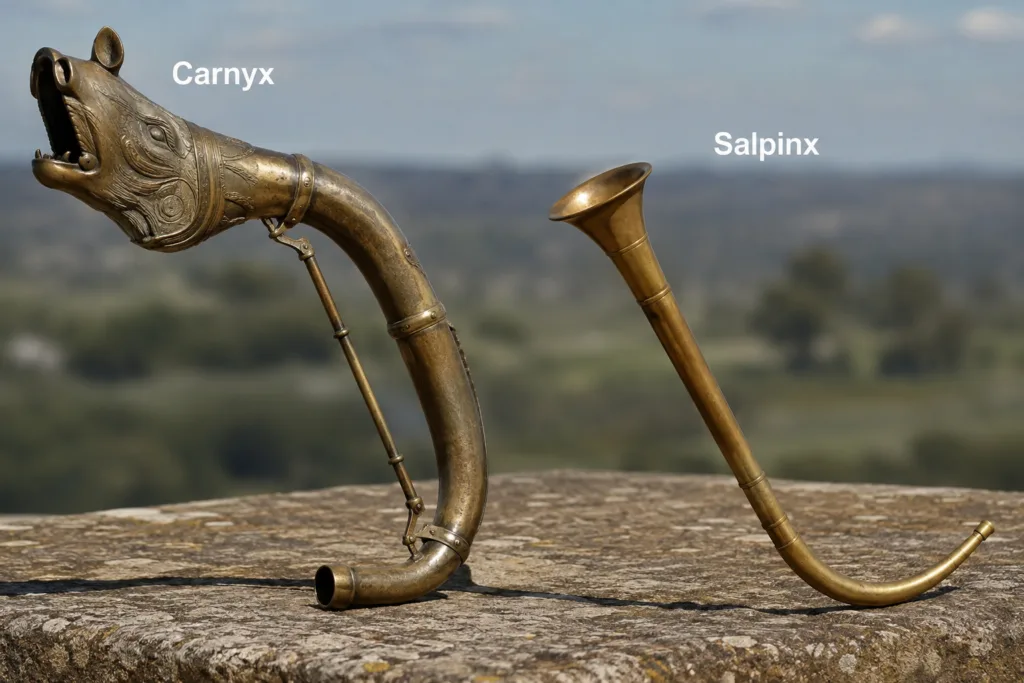
Instrument Comparison
The carnyx and salpinx were long lip-blown instruments associated with warfare, but they belonged to different musical and cultural traditions. The carnyx is best known for its tall profile and animal-headed bell in Iron Age Europe, while the Greek salpinx was usually a straighter, forward-facing trumpet used for signals, announcements, and organized calls.
The carnyx and salpinx solve a similar practical problem in very different ways: both could project a recognizable trumpet-like sound across open spaces, yet their shapes, cultural settings, and surviving evidence are not interchangeable. A carnyx was built so that its upper end rose above the player, often terminating in a stylized animal head. The salpinx was normally depicted as a long, narrow instrument aimed outward from the player.
This difference affects more than appearance. A raised carnyx could function as a visible object among groups of people as well as an acoustic one. The salpinx presents a more linear design suited to directing a strong signal ahead of the player. Ancient images and texts connect the salpinx with military commands, announcements, athletic settings, and other organized public uses, while archaeological finds and Iron Age imagery give the carnyx a strong association with warfare, display, ritual deposition, and elite metalwork.
Neither instrument should be treated as an ancient version of a modern orchestral trumpet. Both belong to older lip-reed traditions in which the player creates vibration with the lips and the tube reinforces particular resonances. Modern reconstructions can demonstrate what those physical principles are capable of producing, but they cannot reproduce every detail of an ancient performance tradition that was never recorded.
Carnyx vs Salpinx: The Main Differences
| Feature | Carnyx | Salpinx |
|---|---|---|
| Cultural Association | Iron Age European traditions, especially Celtic and Gallic contexts | Ancient Greek culture |
| Overall Form | Long tube rising upward above the player | Long, predominantly straight tube projecting forward |
| Terminal Section | Often an elaborate animal-headed bell | Usually a simpler flared or shaped bell |
| Visual Role | Highly visible and strongly decorative | Generally more restrained in profile |
| Military Use | Associated with battlefield sound, signals, display, and group identity | Closely associated with signalling and organized calls |
| Non-Military Context | Ritual and ceremonial interpretations occur in the archaeological record | Also connected with civic announcements and musical or athletic contests |
| Surviving Evidence | Metal fragments, near-complete finds, art, coin imagery, and reconstructions | Ancient art, written evidence, archaeological objects, and reconstructions |
Why the Carnyx Looks So Different
The carnyx is immediately recognizable because much of its design develops vertically. A long tube rises from the player’s mouth and curves toward an animal-shaped terminal section positioned above head level. Boar-like heads are among the best-known forms, although surviving finds show that the carnyx was not restricted to one standardized animal design.
The terminal head was not merely attached decoration. It formed part of the sounding end of the instrument, so its internal shape, opening, wall construction, and any movable components could influence how the air column terminated and how the tone radiated. Some reconstructed carnyces include features such as movable tongues or ears based on surviving components and archaeological interpretation.
Copper alloys were well suited to this form of construction. Sheet metal could be shaped into long tubing and worked into detailed zoomorphic forms without separating the acoustic structure from the visual design. Wall thickness, bore dimensions, joins, and terminal geometry would all affect response and resonance.
How the Two Horns Were Positioned
The tube rises from the player and places the animal-headed bell high above the body. This makes the instrument visually conspicuous and changes where the sound leaves the instrument relative to the performer.
The long tube is normally shown extending outward from the mouth. The resulting silhouette is closer to other straight ancient trumpets, with the bell directing sound away from the player.
How the Salpinx Was Built
The salpinx was a long trumpet associated with the Greek world. Ancient representations typically show a narrow tube, a mouthpiece at the player’s lips, and a terminal bell at the opposite end. Its overall form is much less elaborate than the most familiar carnyces, although surviving objects show that salpinx construction was not uniform.
Bronze is strongly associated with the instrument, but it is unsafe to describe every salpinx as a single-piece bronze tube. A well-known surviving example uses a segmented body with non-metal sections joined by bronze fittings, showing that Greek trumpet makers could combine materials rather than follow one fixed construction method.
The bore and length determine which resonances respond most easily when the player buzzes the lips. As with other natural trumpets, pitches can be produced by changing lip tension, airflow, and embouchure rather than pressing valves. The precise playable range would depend on the instrument and performer, so a modern fixed range should not be assigned to the entire historical category.
Animal Head vs Simple Bell
The animal head combines metal sculpture with the acoustic end of the tube. Open jaws, ears, snouts, and other modeled elements give surviving and reconstructed carnyces a highly recognizable profile.
The salpinx usually places less visual emphasis on the bell. Its terminal section expands the end of the bore without becoming the dominant symbolic feature of the instrument.
The bell of either instrument affects how resonances couple with the surrounding air. Exact results depend on dimensions and geometry, making broad claims about one design always being louder unreliable.
Common Confusion: The animal head of a carnyx should not be treated as a decorative cover placed over an otherwise complete trumpet bell. It is part of the instrument’s terminal acoustic structure.
What Did a Carnyx Sound Like?
Modern carnyx reconstructions can produce forceful natural-trumpet tones with a strong attack and a penetrating metallic edge. Skilled players can move between resonant pitches by adjusting the lips and airflow, and the unusual terminal form gives reconstructed instruments a character that differs from a simple cylindrical tube.
The Deskford carnyx from Scotland has played an especially important role in modern reconstruction work. The surviving object is incomplete, so a playable reconstruction required informed decisions about missing dimensions and components. Experiments with reconstructed instruments therefore demonstrate plausible acoustic behavior rather than preserving an untouched Iron Age sound.
What We Know: Archaeology can preserve tube sections, bells, fittings, and manufacturing details. Playable reconstructions can test resonance and response. The exact embouchure habits, performance conventions, ensemble balance, and preferred battlefield signals of ancient carnyx players are not preserved.
What Did a Salpinx Sound Like?
The salpinx also relied on lip vibration and tube resonance, giving it the basic acoustic behavior of a natural trumpet. Ancient descriptions and performance contexts point toward a sound suited to attention-getting signals rather than soft sustained accompaniment.
Its narrow, projecting form would favor a focused tone, but describing it as identical to a modern trumpet would be misleading. Modern orchestral trumpets use developed bore profiles, standardized mouthpieces, valves, and manufacturing tolerances that do not belong to the ancient salpinx tradition.
Ancient Greek art adds useful information that surviving objects cannot provide on their own. Salpinx players are shown holding the instrument outward, and some depictions include a phorbeia, a strap or band associated with wind performance. Such images help reconstruct posture and performance practice, although artistic images cannot be read as engineering diagrams.
Which Was Louder?
There is no dependable ancient measurement that establishes either the carnyx or salpinx as the louder instrument. A meaningful comparison would require instruments of known dimensions, comparable construction, similar playing effort, and the same acoustic environment.
Tube length, bore profile, bell geometry, metal thickness, mouthpiece form, player technique, and even wind direction can change how strongly a trumpet projects. A large animal-headed terminal does not automatically prove that the carnyx produced a higher sound-pressure level than a salpinx.
The safer distinction is one of presentation. The carnyx sends sound from a bell elevated above the player, while the salpinx directs its sound more horizontally. Both designs are suitable for making a sharp acoustic event easier to notice across an open space.
How Their Battlefield Roles Differed
Ancient battlefields created a communication problem. Spoken commands had to compete with movement, weapons, animals, shouting, and large groups of people spread across open ground. A trumpet signal does not need to transmit spoken language; it only needs to produce a recognizable pattern that listeners already understand.
The salpinx fits this signalling role clearly in Greek military tradition. It is associated with calls and commands as well as non-military announcements. Its function was therefore broader than simply creating noise during combat.
The carnyx also had strong military associations, but its unusual height and animal form add another dimension. A raised carnyx could remain visible among bodies and equipment, while its terminal sculpture gave it a symbolic presence that the straighter salpinx did not emphasize to the same degree.
| Question | Carnyx | Salpinx |
|---|---|---|
| Suitable for signalling? | Yes; strongly plausible from form and context | Yes; well associated with organized signals |
| Visually prominent? | Very strongly | Less strongly |
| Public use beyond warfare? | Ritual and ceremonial contexts are possible | Yes; announcements and contests are documented |
| Exact signal vocabulary preserved? | No complete system survives | No complete system survives |
The Carnyx as a Visual Signal
A carnyx does something unusual for a wind instrument: it places its most decorated component far above the player’s hands and mouth. The animal head can therefore be seen separately from the person producing the sound.
Iron Age coin imagery and later representations show that the carnyx had a recognizable visual identity. Roman art also used carnyces among representations of captured weapons and defeated northern peoples. These images do not reveal an exact performance technique, but they demonstrate that the instrument carried cultural meaning beyond its acoustic function.
This makes the carnyx difficult to describe simply as a Celtic equivalent of the salpinx. The two instruments could overlap in practical use while communicating different visual and cultural messages.
What Archaeology Reveals About the Carnyx
Carnyx fragments and artistic representations establish the instrument across several parts of Iron Age Europe rather than in one isolated local tradition.
The surviving animal-headed terminal became one of the most recognizable carnyx finds and later provided a basis for experimental reconstruction.
Multiple carnyces found in the same archaeological setting revealed greater variety in terminal forms and construction than a single surviving example could show.
A hoard discovered in West Norfolk included a near-complete carnyx along with parts attributed to another instrument. The discovery was publicly announced in 2026 while conservation and detailed study were still continuing.
The Norfolk instrument is especially useful because near-complete construction preserves relationships between components that isolated fragments cannot show. Its study may refine understanding of tube assembly, metalworking, terminal construction, and deposition practice.
The same hoard also contained other Iron Age metalwork, including a boar-headed object interpreted separately from the carnyx and several shield bosses. The association is archaeologically valuable, but it does not prove that every object in the deposit served the same function or belonged to a single named historical group.
The Salpinx Survives Differently
The salpinx is known through a different balance of evidence. Greek pottery and other ancient imagery repeatedly show long trumpets in performance, providing information about posture and social setting that a detached archaeological tube cannot preserve.
Physical examples are rarer and do not support the idea of one universal construction pattern. The combination of archaeological objects, artistic representations, and written descriptions therefore matters when reconstructing the instrument.
This imbalance explains why carnyx research often concentrates on metalwork and modern acoustic reconstruction, while salpinx studies can draw more heavily on Greek visual culture and descriptions of public performance.
What Ancient Art Can Show
Images can show whether an instrument was held upward, forward, or at an angle when surviving objects alone cannot establish normal performance posture.
Figures surrounding a player can connect a trumpet with soldiers, public events, ceremonies, or competitions.
Depictions can preserve details such as straps, dress, and the relationship between the instrument and other equipment.
Artistic evidence still has limits. Proportions can be compressed, symbolic objects can be exaggerated, and artists may repeat conventions rather than document every mechanical detail accurately.
Carnyx and Salpinx Were Not Direct Equivalents
Both instruments belong broadly to the family of lip-blown trumpets in which vibrating lips excite resonances inside a long tube. That acoustic similarity is real, but it does not make one a regional version of the other.
The carnyx developed a distinctive vertical profile and zoomorphic terminal design within Iron Age European metalworking traditions. The salpinx belongs to a Greek performance culture in which straight trumpets appear in military, civic, and competitive settings. Their surviving evidence also differs enough that their histories cannot be reconstructed in exactly the same way.
Contact between Mediterranean societies and Iron Age Europe makes cultural exchange a reasonable subject of study, yet a simple evolutionary line from salpinx to carnyx, or from carnyx to salpinx, is not established. Long lip-blown horns can also emerge because different societies face the same basic need for a loud, recognizable signal.
What Remains Uncertain
Reconstructions demonstrate plausible acoustic behavior, but no recording preserves an Iron Age player, embouchure, or performance tradition.
Surviving objects and images do not support one universal material recipe or identical tube design for every instrument called a salpinx.
No controlled ancient measurement allows a trustworthy claim that one instrument was always louder than the other.
Evidence confirms signalling roles more easily than it preserves the exact note patterns assigned to particular commands.
Mini FAQ
Were the carnyx and salpinx both war horns?
Both had strong military associations, but “war horn” does not describe their entire use. The salpinx also appears in public announcements and competitive settings, while carnyx finds can occur in contexts interpreted as ceremonial or ritual as well as martial.
Was the carnyx louder than the salpinx?
There is no reliable evidence that establishes a universal winner. Loudness and projection depend on bore dimensions, bell geometry, construction, player technique, and acoustic conditions.
Why did the carnyx have an animal head?
The animal head gave the instrument a strong visual identity while also forming part of its acoustic terminal. Its symbolic meaning probably mattered, but a single universal explanation for every animal form is not preserved.
Did the salpinx have valves?
No valve system like that of a modern trumpet is associated with the ancient salpinx. Players changed notes primarily through lip tension, airflow, and the natural resonances of the tube.
Can modern reconstructions reproduce the original sound?
They can test how reconstructed dimensions and materials behave acoustically. They cannot recover every detail of ancient mouthpieces, playing habits, preferred tone, performance spaces, or individual instruments that no longer survive.
Is the salpinx simply the Greek version of the carnyx?
No. The instruments share broad acoustic principles and some military functions, but their shapes, cultural settings, visual identities, and archaeological records are different enough that they should be treated as separate trumpet traditions.