
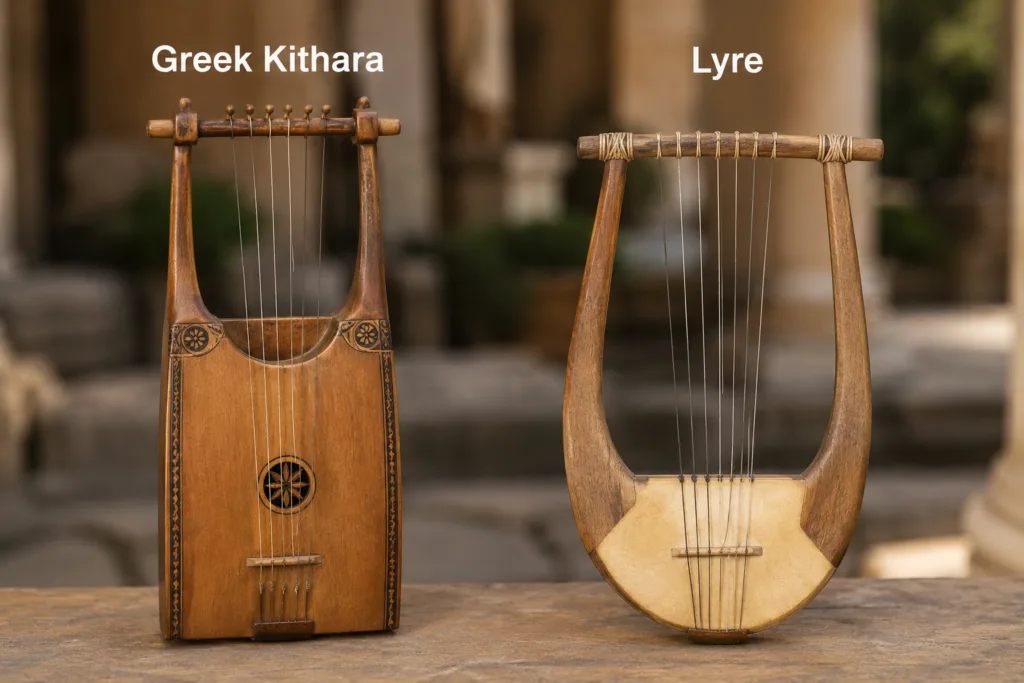
Kithara vs Lyre
The Greek kithara and lyre were closely related string instruments, but they were not simply two names for the same object. The kithara was a large, rigidly built form of lyre strongly associated with skilled public performance, while the smaller Greek lyra or chelys-type lyre was lighter and closely tied to musical education, song, and less formal settings. Both belonged to the wider lyre family and shared much of the same basic playing logic.
The most important point in a Greek kithara vs lyre comparison is that the kithara is itself a form of lyre. “Lyre” can describe the wider instrument family, while Greek lyra can also refer more narrowly to a smaller bowl lyre. For a useful comparison, the term lyre here mainly means the familiar Greek lyra or chelys-type instrument rather than every instrument in the lyre family.
The physical distinction is easier to see than the family terminology. A Classical concert kithara normally has a substantial wooden soundbox, a comparatively flat lower body, heavy arms, and a crossbar carrying the strings. The smaller lyra is associated with a rounded or bowl-shaped resonator, traditionally including tortoiseshell forms covered by a soundboard, with two lighter arms rising toward the crossbar.
Those construction differences also correspond to different musical associations. Kithara players appear prominently in public contests, formal performances, epic recitation, and scenes connected with Apollo. Smaller lyres appear in education, song accompaniment, social settings, and mythology as well. These patterns are useful distinctions, but they are not absolute rules about who was allowed to play each instrument.
Kithara and Lyre Are Part of the Same Instrument Family
A lyre is a yoke-shaped chordophone. Its strings run from the lower part of the resonating body toward a crossbar held between two arms. Unlike a lute, it does not depend on a fingerboard where a player shortens strings to create different pitches. Individual open strings supply the available pitches, with tuning and selective sounding of those strings shaping the music.
Ancient Greek lyres existed in several forms. Modern organological discussions commonly distinguish box-shaped lyres, including the concert kithara, from bowl-shaped lyres such as the lyra and chelys. Other related names include phorminx and barbitos.
Common Confusion: Saying “kithara or lyre” can make them sound like unrelated instrument families. A better distinction is “kithara versus the smaller Greek lyra.” Ancient terminology also changed over time, so modern categories should not be treated as perfectly fixed labels for every surviving image or written description.
Kithara vs Lyre: Physical Differences
| Feature | Kithara | Greek Lyra / Chelys |
|---|---|---|
| Family | Lyre family | Lyre family |
| Resonator | Large box-like soundbox | Smaller bowl-shaped resonator |
| Body Construction | Rigid, strongly built wooden structure | Lighter construction; chelys forms are associated with a tortoiseshell-shaped bowl |
| Lower Profile | Typically broad and comparatively flat | Usually rounded |
| Arms | Heavy, visually substantial supports | Generally lighter projecting arms |
| Relative Size | Usually larger | Usually smaller and easier to handle |
| Performance Association | Formal and professional public performance | Education, singing, social music, and broader personal use |
| Playing Principle | Plectrum with selective string control | Closely related lyre-family technique |
The difference is therefore more substantial than ornament or size alone. The kithara’s soundbox and arms form a comparatively rigid structure suited to a large performance instrument. The smaller lyra places the same basic string-and-yoke principle into a lighter body.
Why the Kithara Was Built as a Larger Box Lyre
The concert kithara had to function as more than a compact accompaniment instrument. Its broad wooden resonator provided a larger vibrating structure, while its heavy arms and crossbar supported the string system above it. Vase paintings often make the difference in scale immediately visible: a kithara may cover a large part of the performer’s torso.
The wooden body affects more than appearance. Soundboard dimensions, body stiffness, bridge behavior, string tension, and the enclosed resonating space all influence how string energy is transferred into audible sound. That does not allow the exact volume or timbre of an ancient instrument to be calculated from a vase painting, but it explains why body construction matters acoustically.
The smaller lyra took a different structural route. The familiar chelys form is associated with a bowl made from, or shaped in the tradition of, a tortoise shell. A covering over the opening created the vibrating face of the resonator. Its lighter arms and compact body made the instrument physically different from the large concert kithara even though their string layout followed the same wider lyre principle.
What the Difference Meant for the Player
A strong match for formal performance, musical competition, vocal accompaniment, and contexts where the performer was visibly presenting trained musical skill. Its larger body also required a different physical relationship between player and instrument.
A lighter instrument well suited to musical training, accompanying song, and settings where portability and a smaller body were practical. It was culturally important in its own right rather than merely being a beginner version of the kithara.
How the Kithara and Lyre Were Played
Both instruments used open strings stretched across a resonating body toward the upper crossbar or yoke. This arrangement separates them from necked instruments such as lutes, where the player presses strings against a fingerboard to change their sounding length.
In many Greek representations, the performer holds a plectrum in the right hand. The other hand interacts with the strings from behind or around the string plane. Selective damping could prevent unwanted strings from sounding while the plectrum moved across the string group. Individual strings could also be sounded as required.
Large kitharas could use a supporting band or wrist strap. Surviving vase imagery shows performers with the instrument held against the upper body while a loop helps stabilize it. This detail is useful when identifying a concert kithara in Greek art because it reflects the physical demands of managing a larger lyre.
Did the Kithara Have a Completely Different Technique?
No. Its scale and performance demands differed, but the basic mechanism remained recognizably lyre-like. Both instruments depended on tuned open strings, a resonating body, a bridge or equivalent string-support arrangement, a yoke, and plucking rather than a fretted neck.
Did Kitharas and Lyres Always Have Seven Strings?
Seven strings are strongly associated with Classical Greek lyre imagery, especially the concert kithara, but string count should not be turned into a rigid identification rule. Ancient representations and written traditions do not support the idea that every kithara in every period must have exactly seven strings.
An ancient vase in the British Museum, for example, describes a large kithara represented with eight strings. Greek musical practice also changed over time, and instruments represented under related names cannot always be separated by string number alone.
Identification Rule: Do not identify a kithara simply by counting seven strings. Resonator shape, overall scale, arm construction, support system, performance setting, and surrounding iconography usually provide stronger evidence when considered together.
The Main Social Difference: Musical Education vs Public Performance
The Lyre in Greek Education and Song
Lyre playing formed part of Greek musical education, particularly in the cultural ideal of training young male citizens in music and poetry. Singing and string accompaniment were closely linked. The compact lyra was well suited to this educational role and appears in artistic contexts beyond professional public performance.
That association should not be simplified into “lyre equals amateur.” Skilled musicians could use lyres, and Greek musical life did not divide instruments into rigid social categories. The educational connection describes a strong pattern rather than an exclusive rule.
The Kithara as a Performance Instrument
The concert kithara had a particularly strong association with trained performers, festivals, public concerts, choral music, and musical competitions. The player could accompany singing or perform within formal settings where musicianship itself was being displayed and judged.
A performer who sang while accompanying himself on the kithara is commonly associated with the term kitharode or kitharoidos. Ancient terminology surrounding performers can vary by period and text, but the connection between the concert kithara and specialist public musicianship is clear in Greek visual culture.
A Kithara Competition Preserved in Greek Vase Painting
A red-figure amphora attributed to the Berlin Painter and dating to about 490 BCE provides one of the clearest visual examples of the kithara’s performance role. One side shows a singer with a kithara. A figure on the reverse has been interpreted through his clothing and staff as a judge, making a competitive setting likely.
The instrument is not a small accessory. It dominates the performer’s upper body and forms part of his public identity as a musician. Scenes like this are valuable because ancient Greek instruments rarely survive in the same condition as later European instruments; pottery, sculpture, written descriptions, and archaeological fragments must often be read together.
Apollo, Hermes, and the Cultural Meaning of the Instruments
Greek mythology connects lyre-family instruments with several gods and legendary musicians. Hermes is linked with the invention of the lyre in the Homeric Hymn to Hermes, where the instrument is made using a tortoise. The story helped establish the tortoise-shell lyre as one of the most recognizable musical objects in Greek myth.
Apollo became especially closely associated with lyre music and is frequently represented with a kithara. Greek and later Roman images show him carrying or playing the instrument as an attribute of his connection with music. Large kitharas therefore appear in both human performance scenes and divine iconography.
Mythological association and everyday musical use should remain separate when interpreting these instruments. Apollo carrying a kithara tells us about cultural identity and symbolism; a competition scene can provide different evidence about posture, performance practice, clothing, support straps, and social context.
What Ancient Art Reveals About Kithara and Lyre Use
Greek vase painting is especially useful because it preserves details that instrument names alone cannot provide. Body proportions, the angle at which an instrument was held, the position of the hands, plectra, straps, clothing, surrounding figures, and the setting of a scene can all help identify what kind of lyre is represented.
A large flat-bottomed instrument with substantial arms, a broad box body, and a standing formally dressed performer is a strong candidate for a concert kithara. A smaller round-bodied instrument is more consistent with lyra or chelys forms. Apollo holding a large lyre also frequently points toward kithara iconography.
Context still matters. Greek artists did not produce technical construction drawings, and artistic conventions can distort scale or simplify strings. Instrument identification works best when several visual features agree rather than when one painted detail is treated as mechanically exact.
Kithara, Lyra, Chelys, Phorminx, and Barbitos
A strongly built box lyre, especially associated with formal and professional performance in Classical Greek culture.
A Greek term associated with a smaller bowl lyre, while “lyre” in modern English also names the wider instrument family.
A tortoise-shell or tortoise-shell-type bowl lyre. The term is closely connected with the familiar rounded Greek lyre form.
An early Greek lyre term found in literary sources and associated with instruments related to later box-lyre forms. Exact classification can vary by source and period.
A related lyre form recognizable for its long arms and long strings, particularly associated with Archaic Greek musical and social settings.
These words should not be treated as labels created under a single modern classification system. Ancient authors used musical terminology across different centuries, regions, and literary contexts. Modern researchers therefore combine textual evidence with archaeological objects and visual representations when separating individual lyre forms.
How the Kithara Became a Classical Greek Concert Instrument
Lyre-type instruments and terms such as phorminx appear in early Greek poetic traditions. Instrument names and forms were not yet identical to the neat categories used in modern museum descriptions.
Different bowl and box lyres become prominent in Greek imagery. The kithara develops a strong connection with public musical performance and skilled players.
Attic vase painting provides detailed images of large concert kitharas, performers, Apollo, plectra, support bands, and competitive musical settings.
Kithara performance forms part of an established culture of festivals, contests, song, and specialist musicianship, while smaller lyres remain connected with education and other musical settings.
Kithara imagery continues, particularly through representations of Apollo and professional or theatrical musicians. Later depictions also show that kithara-like instruments did not remain frozen in one Classical form.
Could the Kithara and Lyre Have Sounded Different?
Different construction makes some acoustic difference unavoidable, but the exact historical result cannot be recovered with certainty. A larger wooden resonator, different body stiffness, string length, bridge geometry, string material, and tension all affect attack, resonance, projection, and decay.
The kithara’s larger soundbox makes it reasonable to expect acoustic behavior different from that of a small bowl lyre. It is not safe, however, to reduce that difference to claims such as “the kithara was always louder” or to assign exact tonal qualities to every ancient example.
Modern reconstructions can test plausible materials and dimensions, but they depend on decisions made by modern builders. Ancient illustrations rarely preserve enough technical information to reproduce every thickness, joint, string property, and setup. A reconstruction is therefore an informed physical interpretation rather than a recording of a lost instrument copied without uncertainty.
How to Identify a Kithara in Ancient Greek Art
- Look for a large box-like resonator rather than a small rounded bowl.
- Check whether the bottom of the instrument appears broad or comparatively flat.
- Look for heavy arms rising from the body toward the crossbar.
- Compare the instrument’s size with the player’s torso.
- Check for a wrist loop, carrying band, or other support arrangement.
- Look for a plectrum in the player’s right hand.
- Consider whether the performer is shown in formal clothing or a competition setting.
- Look for Apollo, whose iconography is strongly associated with the kithara.
- Do not rely on the number of painted strings as the only identification feature.
The strongest identification combines construction and context. A single rounded line, missing string, or unusual arm shape can reflect artistic simplification, damage, restoration, or a less familiar instrument type.
Common Misconceptions About the Kithara and Lyre
The kithara was unrelated to the lyre.
The kithara belongs to the lyre family. The useful comparison is between the large concert kithara and smaller Greek lyra or chelys forms.
Every Greek kithara had exactly seven strings.
Seven-string depictions are common, but other string counts occur. An eight-string large kithara is documented in ancient Greek vase imagery.
The lyre was for amateurs and the kithara was only for professionals.
The kithara had a strong professional and competitive association, while the lyra had a strong educational role. These were cultural patterns, not absolute restrictions on every player or performance.
Mini FAQ
Is a kithara a type of lyre?
Yes. The kithara belongs to the lyre family. In Greek instrument comparisons, “lyre” often refers more narrowly to the smaller lyra or chelys-type bowl lyre, which is why the two names are frequently presented side by side.
What is the easiest way to tell a kithara from a Greek lyre?
Look first at the body. A Classical concert kithara normally has a large, rigid, box-like resonator and substantial arms. The familiar Greek lyra is smaller and has a rounded bowl-shaped body.
Were the kithara and lyre played with a plectrum?
Plectra are well documented in Greek lyre-family performance. The player could strike or pluck strings with the plectrum while the other hand controlled which strings were free to sound.
Did all kitharas have seven strings?
No fixed seven-string rule applies to every representation or period. Seven strings are common in Classical imagery, but other counts are documented, including a large eight-string kithara shown on an ancient Greek vase.
Why is Apollo shown with a kithara?
Apollo was closely associated with music, poetry, and lyre playing in Greek religion and art. The kithara became one of his recognizable musical attributes and appears with him in Greek and later Roman imagery.
Do modern kithara reconstructions reproduce the exact ancient sound?
No reconstruction can establish one exact historical sound. Builders can work from surviving images, texts, archaeological evidence, and acoustic testing, but details such as string material, tension, body thickness, and setup are not preserved equally for every ancient instrument.