
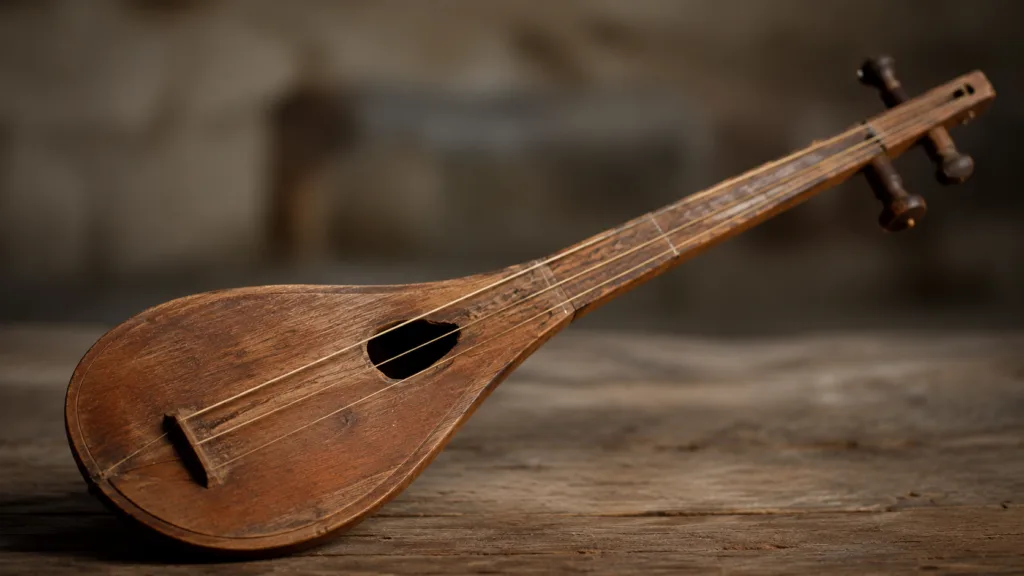
Instrument Snapshot
The pandura, also written pandoura, was a plucked long-necked lute known in the Greek and Roman Mediterranean. It was commonly associated with three strings and was sometimes described as a trichordon, meaning “three-stringed.” Unlike the lyre and kithara, its strings ran along a neck where the player could change pitch by stopping them with the fingers.
What the Pandura Was
The pandura was an ancient necked string instrument in which several strings stretched from a small resonating body along a projecting neck. The player plucked the strings and pressed them against the neck to shorten their sounding length. This basic action separates the pandura from Greek lyres, whose strings usually sounded at fixed open pitches.
The name appears in several forms, including pandoura, pandouris, pandurium, and later regional spellings. Ancient terminology was not always applied with the consistency expected from a modern instrument catalogue. One writer or workshop could use a familiar name for an instrument that differed in body shape, neck length, string attachment, or playing method from another example.
Three strings are closely associated with the Greek pandura, which explains the related term trichordon. The label does not prove that every necked lute represented in Greek or Roman art had exactly three strings. It does, however, describe one of the clearest models linked to the instrument.
The pandura matters to instrument history because it represents a different approach to pitch organization from the better-known lyre and kithara. A relatively small number of strings could produce many notes when the player stopped them at different points along the neck.
What We Know: Knowledge of the pandura comes mainly from reliefs, terracotta figures, mosaics, written names, and comparisons with related lute forms. No complete playable ancient Greek pandura survives to establish one universal body shape, tuning, fret system, or construction method.
Design Seen Through the Archaeological Record
Representations identified as panduras appear in Greek art by the fourth century BC. A well-known relief from Mantineia shows a seated Muse holding a long-necked instrument with a compact body. A Hellenistic terracotta figure from Cyprus, dated to around 300 BC, also shows a woman supporting and playing a small lute.
Later Roman and late antique images preserve related forms under names such as pandura and pandurium. These depictions do not present one fixed blueprint. Bodies may look oval, pear-shaped, narrow, angular, or almost paddle-like. Some instruments appear to have a distinct soundbox attached to the neck, while others may have been carved as a more continuous wooden structure.
Differences in artistic style also affect interpretation. A sculptor might simplify strings, tuning pegs, bridges, frets, or sound holes because they were too small for the medium. An apparently fretless neck may therefore represent an actual design, an omitted detail, or a surface feature that was once painted rather than carved.
| Feature | Likely Function | What Remains Uncertain |
|---|---|---|
| Long neck | Allowed the player to stop strings at different pitches | Exact scale length and neck thickness varied |
| Small resonating body | Amplified string vibration while keeping the instrument portable | Internal construction and soundboard material are not consistently known |
| Three strings | Supported melody, drones, or simple interval relationships | No standard tuning has been securely established |
| Bridge | Transferred string vibration to the soundboard or membrane | Bridge shape and placement are often unclear in artwork |
| Tuning fittings | Adjusted string tension | Pegs, ties, and other fastening methods may have differed |
| Frets or pitch markers | Could have guided stopped notes | Not every representation shows them clearly |
Anatomy and Construction
The Resonating Body
The pandura’s body was usually much smaller than the broad frame of a kithara. Its job was to receive vibration from the strings through the bridge and move enough air to make the notes audible. A compact chamber would tend to produce a direct response rather than the broad resonance of a larger lute.
Some reconstructions use a hollowed wooden body closed with a thin wooden soundboard. Others use a skin-covered face, drawing on related ancient lute traditions and certain visual interpretations. Both arrangements are plausible for parts of the wider necked-lute family, but they should not be treated as interchangeable proof of one Greek standard.
A thin wooden table can give notes a defined attack with a woody bloom. A membrane face may react more quickly and can add a drier, slightly nasal or percussive edge. Body depth, wall thickness, bridge mass, and the area of the vibrating face may change the result as much as the outer silhouette.
The Neck and Fingerboard
The neck is the feature that gives the pandura its broad melodic potential. Pressing a string against the neck shortens the vibrating section between the finger and bridge, raising the pitch. Even with only three strings, a player could reach a sequence of notes unavailable from three open strings alone.
It is not always possible to tell whether the playable surface was a separate fingerboard, the flat face of the neck, or a rounded wooden shaft. Some ancient images suggest visible divisions that have been interpreted as frets. Other images show a plain neck.
Modern makers sometimes install tied gut frets because they can be moved and adjusted. Others use fixed frets or leave the neck unfretted. Each choice produces a workable instrument, but it also reflects a reconstruction decision rather than a preserved factory specification.
Strings, Bridge, and Tail Attachment
Natural gut is commonly used on historically styled reproductions because it behaves like a low-tension pre-industrial string material. Synthetic gut and nylon are also used for stability and easier maintenance. The original pandura may have used animal-derived string material, yet the exact preparation, thickness, and tuning tension cannot be recovered from sculpture alone.
The bridge may have stood on a wooden soundboard or skin face. A low, light bridge would usually favor quick response, while a heavier bridge can soften the initial attack and alter sustain. The strings may have been secured to a tail fitting, tied near the lower edge, or attached through a construction now hidden or simplified in surviving images.
Reading a Pandura Image Like an Instrument Maker
A neck much longer than the body points toward melodic stopping rather than an instrument designed mainly for open-string chords.
Its position helps estimate the vibrating string length and may show whether the body face was intended to act as a soundboard.
Fingers placed along the neck support the interpretation of stopped pitches, even when fret lines are absent.
A pinched hand shape may suggest finger plucking, while a clearly held object may indicate a plectrum.
Thin strings are easily lost in damaged sculpture, worn paint, low-resolution photographs, and stylized carving.
A painted border, garment fold, or damaged edge can be mistaken for a sound hole, fret, string, or body seam.
How the Three Strings May Have Worked
A three-string instrument does not require three strings of equal purpose. One string may carry most of the melody while another supplies a drone. A third may widen the available register, reinforce a tonal center, or provide an interval that supports singing.
Another possibility is that all three strings were stopped melodically. This would let the player move between strings to avoid large hand shifts, change tone color, or reach notes outside the comfortable range of one string. String thickness and tension could also have separated them into lower, middle, and upper registers.
No single ancient tuning can be assigned safely to every pandura. Modern tunings in fourths, fifths, unisons, octaves, or mixed intervals show what a three-string necked lute can do, but they do not establish the tuning of the Mantineia instrument or the Cypriot terracotta example.
Player Tip: A historically styled reconstruction is best approached as an experimental instrument. Begin with moderate string tension, listen for uneven bridge pressure, and test several interval relationships before treating any tuning as permanent.
Sound Character and Playing Feel
The sound of a reconstructed pandura depends heavily on the maker’s interpretation. A small wooden body with gut strings may sound woody, dry, and centered, with a clear plucked edge. A membrane-faced version can produce a sharper attack with more nasal color and less lingering resonance.
The long neck gives the player direct control over pitch and articulation. Notes can be separated cleanly, linked with finger movement, decorated with slides, or allowed to ring against a drone. An unfretted version permits fluid pitch shading but demands careful intonation. A fretted version offers firmer pitch locations while reducing some of that flexibility.
The following bars describe common tendencies heard in modern reconstructions. They are listening impressions, not measurements of a surviving ancient instrument.
What Changes the Tone Most
- A thin soundboard usually responds faster than a thick, heavily braced face.
- A skin membrane can add dryness, snap, and a more percussive decay.
- Gut or gut-like strings tend to soften the brightest part of the attack.
- A longer vibrating string length can support lower pitches at moderate tension.
- A tall or heavy bridge changes pressure on the resonating face and may reduce immediacy.
- A deep body can strengthen lower resonance, though outer size alone does not predict tone.
Pandura vs Lyre and Kithara
A necked lute with strings running over a playable neck. The player changes pitch by stopping the strings at different positions. A few strings can therefore produce a wider melodic range.
A yoke-shaped instrument with strings stretched between a soundbox and crossbar. Each string normally carries its own open pitch rather than being shortened against a fingerboard.
A larger, more rigid member of the lyre family associated with trained performance. Its stronger frame supported greater projection, but its pitch system still relied mainly on separate open strings.
Why the Pandura Was Not an Ancient Guitar
The pandura can look guitar-like because it has a neck, a resonating body, and strings that can be stopped by the fingers. That resemblance is useful for explaining how it works, but calling it an ancient guitar hides major differences.
Modern guitars normally have six strings, a standardized fret layout, a broad waist-shaped body, established tuning systems, and construction methods developed through much later instrument traditions. The pandura had fewer strings, less uniform body forms, uncertain fret arrangements, and no surviving standard tuning.
It is more accurate to describe the instrument as an ancient long-necked lute. “Lute” in organology covers many instruments whose strings run parallel to a neck and soundboard. It does not refer only to the rounded European lute seen in Renaissance music.
Common Confusion: Similar names and body plans do not prove that the pandura directly became the modern bouzouki, tambouras, Georgian panduri, saz, or guitar. These instruments belong to related necked-lute traditions, but an uninterrupted maker-to-maker line cannot be assumed from appearance or vocabulary alone.
History Through Surviving Representations
Long-necked lutes existed in Mesopotamia, Egypt, Anatolia, and neighboring regions before their clear appearance in Greek art. The Greek pandura was part of this wider exchange of instruments and performance practices.
The Mantineia relief provides one of the best-known Greek representations of a Muse holding a pandura-type lute with a long neck and compact body.
A Hellenistic terracotta figure from Cyprus shows a standing woman playing a small necked lute, demonstrating the instrument’s presence beyond the Greek mainland.
Related instruments appear in sculpture, funerary art, and written terminology under forms such as pandura and pandurium. Designs continued to vary.
Mosaics and other images preserve three-string or narrow-necked lute forms. These depictions show continuity of the general instrument type without proving that every example retained the same tuning or construction.
Instrument makers now build playable interpretations using archaeological images, ancient terminology, related lute traditions, acoustic testing, and reversible design choices.
Musical and Cultural Context
The pandura appears less often in Greek visual art than the lyre, kithara, or aulos. That imbalance does not show that it was absent from daily music. Durable public monuments often favored instruments connected with mythology, education, civic ceremony, or formal performance, while domestic instruments could leave a smaller archaeological footprint.
Terracotta figures and funerary images place necked lutes in personal and social settings as well as symbolic ones. Female players appear in several surviving representations, but the evidence is too limited to assign the instrument exclusively to one gender, profession, or social class.
Its small body and narrow neck would have made it portable. It could plausibly support song, dance, informal entertainment, melodic practice, or ensemble playing. The exact balance of these roles likely changed by location and period.
The instrument also reflects contact across the eastern Mediterranean. Greek musicians did not develop in isolation from Egypt, Anatolia, Persia, Mesopotamia, Cyprus, and the Levant. Instrument forms, names, materials, and playing habits moved with traders, performers, settlers, armies, and courts.
What Modern Reconstructions Can Reveal
A reconstruction can test whether a body shape resonates, whether three strings fit the neck shown in an image, how a bridge behaves on wood or skin, and which playing positions feel practical. It can also reveal tensions between appearance and function. A visually accurate neck may bend under unsuitable strings, while a body copied directly from a relief may have too little internal volume to project well.
These experiments are valuable, but they do not turn an interpretation into a recovered original. Two responsible makers can study the same relief and produce different instruments because the image does not show internal bracing, wood species, wall thickness, peg shape, string gauge, tuning, or fret material.
| Element | Evidence May Show | Maker Must Decide |
|---|---|---|
| Body outline | Approximate outer shape and proportion | Depth, hollowing method, wall thickness, and internal support |
| Neck | Length relative to the body and player | Cross-section, reinforcement, fingerboard surface, and wood choice |
| Strings | Possible count when lines remain visible | Material, gauge, tension, tuning, and spacing |
| Frets | Possible divisions or markings | Fixed, tied, movable, painted, or omitted |
| Soundboard | Visible front surface and bridge area | Wood, skin, thickness, attachment, and bracing |
| Playing method | Hand position and instrument posture | Plectrum material, fingering system, articulation, and repertoire |
Buying or Commissioning a Pandura Reconstruction
Most playable panduras offered today are modern interpretations rather than copies of a complete surviving instrument. A good maker should explain which archaeological image, regional lute tradition, or construction experiment shaped the design.
Historical appearance should not come at the expense of basic stability. The neck must tolerate the intended string tension, the bridge should sit securely, and the soundboard or membrane should respond without severe distortion. Tuning pegs need enough grip to hold pitch without splitting the pegbox.
- You enjoy experimental archaeology or early Mediterranean music.
- You are comfortable testing tunings rather than following one fixed setup.
- You value responsive melody playing with a small number of strings.
- You accept that reconstruction details differ among makers.
- You need a fully standardized instrument with established teaching grades.
- You expect historically verified tuning for every surviving depiction.
- You want the volume and bass response of a large modern acoustic guitar.
- You prefer easily available replacement parts and strings without adjustment.
Collector’s Note: Ask the maker to separate observed evidence from personal design choices. Documentation of body dimensions, string length, materials, fret system, tuning range, and the archaeological model makes a reconstruction more useful for study and future comparison.
Collector and Player Inspection Notes
- Confirm that the instrument is described as a reconstruction, interpretation, or historically inspired build.
- Check whether the stated three-string design is based on a named depiction or on a broader lute model.
- Inspect the neck for forward bending, twisting, cracks, or an uneven playing surface.
- Test every tuning peg for smooth movement and reliable grip.
- Look for bridge leaning, membrane sinking, soundboard bulging, or gaps around glued seams.
- Ask which string material and tension range the maker intended.
- Check whether frets can be adjusted if the instrument uses tied or movable fretting.
- Listen for dead notes, rattling, unstable pitch, or excessive string contact with the neck.
- Distinguish decorative antiquing from genuine age; a newly made reconstruction is not an ancient artifact.
- Keep written build information with the instrument, especially when commissioning a custom model.
Mini FAQ
Did the ancient Greek pandura always have three strings?
Three strings are strongly linked with the instrument and the name trichordon. Surviving images are not detailed enough to prove that every pandura-type lute used the same string count.
Was the pandura fretted?
Some representations and modern interpretations support the use of frets or pitch divisions, but the evidence does not establish one fret layout. Ancient examples may have included tied, fixed, marked, or unfretted necks.
How was the pandura tuned?
No universal ancient tuning has been securely recovered. Modern players experiment with unisons, octaves, fourths, fifths, drones, and register-based tunings according to string length and musical purpose.
Is the pandura the ancestor of the guitar or bouzouki?
It belongs to the older history of necked lutes and shares structural ideas with many later instruments. A direct, uninterrupted line to the guitar, bouzouki, saz, tambouras, or Georgian panduri should not be claimed without stronger historical evidence.
What did the pandura sound like?
No ancient recording or complete original survives. Modern reconstructions often produce a focused, woody, dry, or slightly nasal tone with a quick plucked attack, but body construction and string choice can change the sound greatly.
Can a modern pandura be used for performance?
Yes. Reconstructions can support melody, drones, singing accompaniment, experimental ancient-music programs, and educational demonstrations. The performer should state that the tuning and technique are informed interpretations rather than fully preserved ancient practice.