
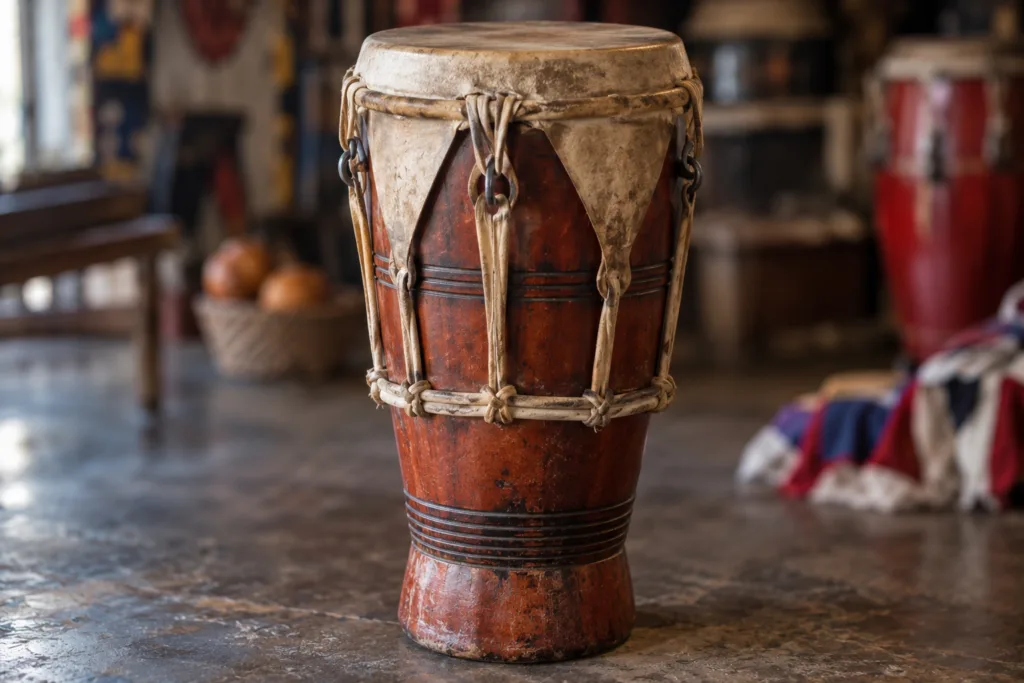
Batá Drum: Construction, Ensemble Roles, and Afro-Cuban Practice
Batá refers to a Yoruba double-headed drum tradition with important Nigerian, Beninese, Cuban, and wider diaspora histories. The name does not describe one unchanged shell or one universal set. Yoruba ensembles and Cuban Lucumí batá share historical connections, but their drum names, ensemble organization, construction details, playing methods, and ceremonial settings should be described separately.
Double-headed membranophone
Yoruba traditions of Nigeria and Benin
Lucumí batá, usually organized as a three-drum ensemble
Contrasting high and low heads, dry attacks, resonant tones, and speech-like rhythmic phrasing
Hands, straps, and beaters vary by regional tradition and drum role
Orisha repertory, secular performance, teaching, recording, and contemporary ensemble use
Common Confusion: the Cuban three-drum set of iyá, itótele, and okónkolo should not be treated as the only batá ensemble structure. Yoruba batá ensembles in West Africa can include additional supporting drums with different names and functions.
What a Batá Drum Is
A batá is a double-headed drum with heads of unequal size. Both membranes can contribute to the instrument’s voice, creating contrasting registers on a single shell. The larger head usually provides a lower and fuller response, while the smaller head gives a tighter, brighter articulation.
The shell profile varies between documented traditions. Some batá are often described broadly as hourglass-shaped, but Yoruba examples can have a more asymmetrical, conical, or truncated-conical body. Cuban Lucumí drums developed their own proportions and construction practices. For this reason, shell shape alone is not enough to identify the regional tradition.
Batá performance is ensemble-based. Individual drums have distinct roles, and the lead instrument interacts with supporting parts through repeating patterns, signals, accents, and rhythmic phrases. In Yoruba traditions, batá can also imitate aspects of spoken language through controlled combinations of pitch and timbre.
Yoruba Batá and Cuban Lucumí Batá
| Feature | Yoruba Batá | Cuban Lucumí Batá |
|---|---|---|
| Historical setting | Yoruba musical and religious traditions in Nigeria and Benin | Afro-Cuban tradition developed from Yoruba-derived religious and musical practices in Cuba |
| Set organization | Can include several supporting drums around a lead ìyáàlù; exact membership varies | Commonly organized as a trio: iyá, itótele, and okónkolo |
| Lead role | Ìyáàlù produces varied phrases, signals, and speech-surrogate patterns | Iyá leads and interacts with the itótele while the okónkolo maintains a more stable pattern |
| Playing method | Can combine hand strokes and a handheld beater, depending on drum and tradition | Primarily hand-played across the two heads of each drum |
| Repertory | Orisha-related and secular repertories, praise, social commentary, and other performance contexts | Lucumí ceremonial cycles, secular batá performance, concerts, recordings, and teaching |
The two traditions are historically connected, but matching names should not erase their differences. A construction description taken from a Nigerian ìyáàlù cannot automatically be applied to a Cuban iyá, and Cuban trio terminology should not be projected backward onto every Yoruba ensemble.
The Yoruba Ensemble and the Ìyáàlù
The ìyáàlù batá is the lead or “mother” drum in documented Yoruba ensembles. Museum examples show a double-headed shell with a larger lower-pitched head and a smaller, brighter head. The drummer can suspend the instrument horizontally with a strap, striking the larger head with a hand and the smaller head with a beater.
Supporting drums provide repeating patterns that establish the rhythmic field around the lead voice. Names and ensemble membership can vary, but documented supporting instruments include forms such as omele abo, omele ako, and kudì. Some ensembles include more drums than the three-part configuration familiar from Cuba.
The ìyáàlù is especially notable for its ability to produce speech-surrogate patterns. Yoruba is a tonal language, and skilled drummers can organize pitch, accent, rhythm, and timbre so that drum phrases evoke greetings, praise poetry, signals, and other verbal forms.
The Cuban Trio: Iyá, Itótele, and Okónkolo
The largest and most responsive member of the Cuban trio. It leads changes, develops variations, and exchanges phrases with the itótele.
The middle drum. Its part links the lead phrases of the iyá with the steadier rhythmic foundation of the ensemble.
The smallest drum. It commonly maintains a more repetitive pattern that helps stabilize the ensemble’s timing.
Each Cuban batá has two heads of different sizes and pitches. The ensemble therefore works through several interacting registers rather than through three identical drum voices. The rhythmic result depends on how the parts interlock, not on one player supplying a complete pattern alone.
In Lucumí ceremonial practice, batá repertory can address multiple orishas in ordered sequences. Changó is one important part of that repertory, but batá are not a separate “Changó drum” family. The same ensemble can perform music associated with Changó, Oyá, Eleguá, Yemayá, Oshún, and other orishas.
Construction and Sound-Producing Parts
Shell
Traditional batá shells are wooden and hollow. Construction varies by region and maker. Yoruba examples may be carved from a solid block, while Cuban and contemporary workshop instruments can use other established shell-making methods. Shape, wall thickness, wood density, and internal volume all affect projection and resonance.
Two Unequal Heads
The unequal membranes give each drum two contrasting registers. The larger head generally produces a lower tone with more body, while the smaller head responds with a brighter and shorter attack. Exact head names and playing techniques differ between traditions.
Lacing and Tension
Traditional drums can use hide or cord lacing to connect and tension the membranes. Modern workshop instruments may use modified tension systems, but a stable relationship between the two heads remains more important than simply making both surfaces as tight as possible.
Sound Modifiers
Some Yoruba ìyáàlù examples use additional sound-modifying elements such as bells or paste applied to a membrane. These details belong to particular constructions and should not be assumed to appear on every batá drum.
How Batá Produces Its Characteristic Voice
Batá sound depends on contrast. One head can provide weight while the other supplies sharper articulation, and the ensemble combines several drums with different registers. Short dry strokes, open tones, muted attacks, and paired-head combinations create a vocabulary much broader than a single bass-versus-slap distinction.
Shell dimensions and membrane tension shape how long each note lasts. A tightly controlled setup keeps fast patterns distinct, while excessive ringing can blur interlocking parts. The goal is not maximum sustain; batá needs enough resonance to carry tone without losing rhythmic definition.
These bars describe general listening tendencies rather than measured acoustic values.
Batá, Changó, and Other Orisha Repertories
Batá have a documented historical association with Ṣàngó, the Yoruba orisha associated with thunder and royal authority. That relationship is strong, but it is not exclusive. Archival Yoruba recordings include separate batá repertories for Shango, Oya, Egungun, Shapana, Orishanla, and Eshu.
This distinction matters when identifying instruments. “For Changó” can describe a piece, rhythmic cycle, praise repertory, dance, or ceremonial context without naming a different drum type. A batá used for Changó repertory remains a batá.
In Cuban Lucumí practice, the same principle applies. Batá can participate in ordered musical sequences addressing multiple orishas. Instrument name and repertory name should therefore remain separate.
Terminology Note: Ṣàngó, Shango, and Changó are forms of the same orisha’s name used in different linguistic and regional settings. They do not identify three different drum families.
Sacred and Secular Use
Batá have deep ceremonial associations, but not every batá performance is sacred. Yoruba documentation records religious use as well as later secular contexts. In Cuba and the wider diaspora, batá can also appear in stage performance, recordings, workshops, educational settings, and secular ensemble music.
It is useful to distinguish a drum’s construction and consecrated status from its general instrument family. Within Lucumí practice, ceremonial status can affect who plays a particular set, where it is used, and how it is treated. Those distinctions should not be reduced to appearance alone.
A modern concert or teaching batá can share the physical layout of a ceremonial instrument without carrying the same ritual status. Sellers and collectors should describe this difference carefully rather than using sacred terminology as a decorative sales label.
Playing Feel and Ensemble Coordination
Batá technique changes with regional tradition, so there is no single universal hand pattern that applies to every drum. Cuban players work across both heads with the hands, while documented Yoruba ìyáàlù technique can pair a bare hand on the larger head with a beater on the smaller one.
Learn One Part Before the Full Conversation
Start with the stable repeating figure of one ensemble role. Batá becomes difficult when a player tries to imitate the whole set on one drum.
Keep the Two Heads Distinct
Practice low and high articulations slowly enough that each register remains recognizable.
Listen Across the Ensemble
The musical phrase often exists between players. A part that sounds incomplete alone may fit precisely when the other drums enter.
Study Repertory With Its Context
Names, calls, responses, and variations are tied to particular traditions. Learning only isolated patterns can hide the role they perform within a larger sequence.
Batá Compared With Other Hand Drums
| Instrument | Head Layout | Main Structural Difference |
|---|---|---|
| Batá | Two unequal heads | Contrasting registers on each drum and strongly interlocking ensemble roles |
| Conga | One main playing head | Tall open-bottom shell with one primary membrane per drum |
| Djembe | One playing head | Goblet-shaped shell with strong bass, tone, and slap contrasts on one membrane |
| Talking Drum | Two heads connected by tension cords | Pitch changes continuously when the player squeezes the cords while striking |
Batá’s speech-like qualities should not be confused with the squeeze-tension mechanism of a talking drum. Yoruba batá can imitate speech through patterned pitch and timbre contrasts, while pressure drums physically alter membrane tension during performance.
Choosing and Inspecting a Batá Drum
The first buying question should be which batá tradition the instrument is built for. A Cuban iyá, a Yoruba ìyáàlù, and a modern stage batá may all carry the same family name while requiring different expectations about shell shape, head setup, playing position, and ensemble use.
- The shell is structurally stable with no active splits around the heads or waist.
- Both heads respond clearly and retain a useful contrast in pitch and timbre.
- Lacing or tension hardware is even and does not pull the heads visibly off-center.
- The bearing surfaces are smooth enough to avoid cutting or unevenly stressing the membranes.
- The drum’s regional style, role, and intended set position are identified clearly.
- Fresh repairs around highly stressed shell areas.
- Loose membrane edges or badly uneven tension.
- Replacement parts that prevent the drum from matching the rest of its set.
- Claims of ritual status without provenance or community context.
- A seller using “African batá” or “Cuban batá” without identifying the drum’s role or construction tradition.
Collector’s Note: provenance matters more than decorative age. A documented workshop or community instrument with clear regional identification is easier to interpret than an older drum carrying an unsupported claim of ceremonial use.
Care, Humidity, and Tension
Batá combines wood, membrane, and tensioning material, so changes in humidity and temperature affect both tone and structural stress. Natural heads can loosen in damp conditions and tighten as air becomes dry.
- Store the drum away from heaters, direct sunlight, damp walls, and rapid temperature changes.
- Let the instrument acclimate before making large tension adjustments.
- Adjust tunable systems gradually and evenly rather than tightening one area aggressively.
- Keep natural heads dry and avoid heavy oils unless a maker familiar with that specific tradition recommends them.
- Protect both membrane edges during transport; damage at either end can affect the relationship between the two voices.
- Use a case or padding that supports the shell without pressing hard against either head.
Care Warning: do not copy tuning tension from an unrelated batá type. Shell proportions, head construction, lacing, and intended pitch relationships differ between traditions and makers.
Recording and Live Sound
A batá drum has two active heads, so microphone placement should account for both. Close-miking only one side can exaggerate one register and hide the relationship that gives the drum its character.
For a full set, begin with room or overhead microphones before adding close microphones. The interlocking parts often make more sense at ensemble distance.
The smaller membrane can produce a sharp transient. Slightly off-axis placement can soften an overly aggressive attack.
The lead drum needs enough detail for variations and signals to remain audible without overwhelming the supporting patterns.
Control unwanted ringing carefully. Removing too much resonance can make the two heads sound disconnected and reduce the drum’s tonal contrast.
Mini FAQ
Are batá always played as a set of three?
No. The Cuban Lucumí tradition commonly uses the trio of iyá, itótele, and okónkolo. Yoruba batá ensembles in West Africa can include additional drums and use different role names.
Is a batá the same as a talking drum?
No. Batá can reproduce speech-like phrases, especially in Yoruba practice, but they do not use the squeeze-tension pitch-bending mechanism associated with many talking drums.
Is batá only used for Changó?
No. Batá have a strong historical association with Ṣàngó, but documented repertories also serve other orishas and include secular performance contexts.
Are Yoruba batá and Cuban batá identical?
No. Cuban batá developed from Yoruba-derived traditions, but ensemble organization, drum names, construction details, technique, and performance context differ.
Which drum leads the Cuban batá trio?
The iyá is the largest and leading drum. It develops variations and interacts especially closely with the itótele.
Can batá be used in contemporary music?
Yes. Batá appear in secular concerts, recordings, teaching, and cross-genre projects as well as ceremonial traditions. The performance context should be described accurately rather than treating every use as ritual.