
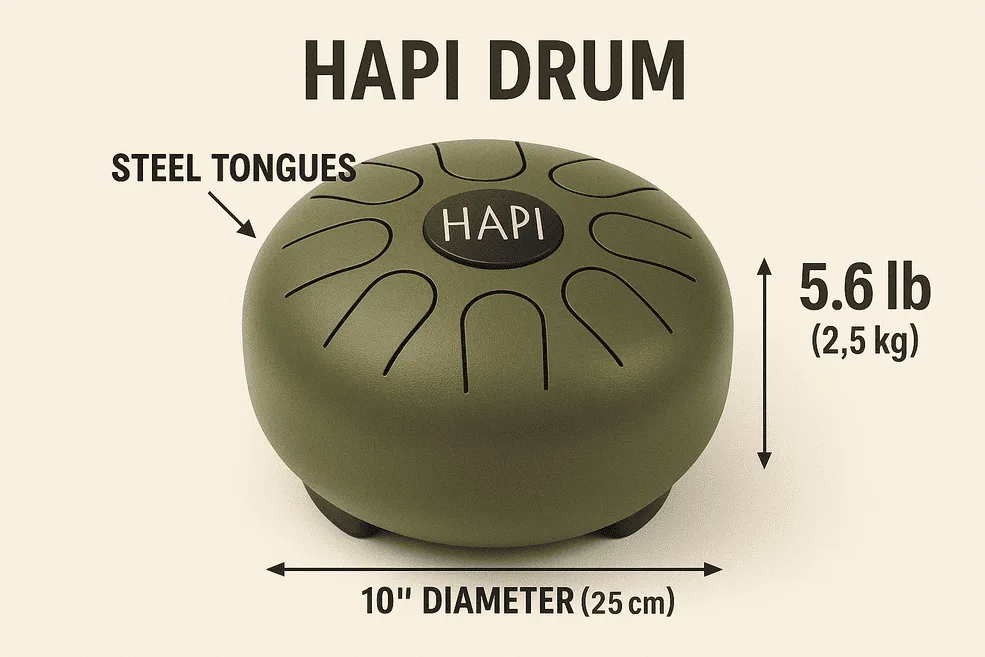
HAPI Drum Brand and Model Guide
HAPI Drum is a branded line of steel tongue drums introduced in 2008. It is not a generic name for every steel tongue drum. HAPI instruments use tuned steel tongues cut into resonant metal bodies and are offered in distinct models including the Tini, Mini, Aura, Slim, Origin, and Omni.
HAPI Drum
Steel tongue drum / plucked or struck idiophone
HAPI Origin
2008
Fingers or soft mallets
Tini, Mini, Aura, Slim, Origin, Omni, and additional HAPI models
HAPI Drum Models
The HAPI range is divided by body size, register, available scale, and intended playing feel rather than by generic categories such as “compact,” “standard,” and “large.” The official product line gives each design its own model name.
| Model | Dimensions | Weight | Current Scale Options | Listed Price (Oct. 2026) |
|---|---|---|---|---|
| HAPI Tini | 6.5″ wide × 3″ high | 2 lb | A Minor | $98 (out of stock) |
| HAPI Mini | 8″ wide × 5.5″ high | 3.4 lb | C Major or D Akebono | $159 |
| HAPI Aura | 10″ wide × 5″ high | 5 lb | B Akebono or A Minor | $224 |
| HAPI Slim | 12″ wide × 6″ high | 7 lb | A Akebono or G Major | $249 |
| HAPI Origin | 12″ wide × 8″ high | 12 lb | E Major or D Minor | $259 |
| HAPI Omni | 15″ wide × 5″ high | 7.5 lb | G Major or F Major | $335 |
Listed prices were checked in October 2026 and can change with sales and inventory. The Tini product page was out of stock when checked. Tuneable versions of the Slim and Origin are sold separately.
What a HAPI Drum Is
A HAPI Drum is a steel tongue drum made within the HAPI product line. Notes are created by flexible tongues cut into the steel body. When a tongue is struck with a fingertip or mallet, it vibrates at a tuned pitch while the enclosed body reinforces the sound.
The broader instrument category is steel tongue drum. Other makers produce steel tongue drums with different shell shapes, tongue layouts, tuning systems, finishes, and acoustic designs. Calling every steel tongue drum a “HAPI Drum” therefore confuses a specific brand with the instrument family.
Common Confusion: “HAPI Drum” and “steel tongue drum” are not interchangeable terms. HAPI Drum identifies a particular manufacturer’s product line, while steel tongue drum is the generic instrument category.
How the HAPI Line Developed
HAPI Drum began selling its first design, the HAPI Origin, in 2008. The makers describe experimenting with tongue shapes, body dimensions, sound ports, damping materials, and different types of steel before settling on the first production design.
The company states that it later received a U.S. design patent and a trademark for HAPI Drum. The product range expanded beyond the Origin into smaller and mid-sized drums, alternative body shapes, fixed-scale models, and versions that allow the player to change tuning with weighted magnets.
How HAPI Steel Tongue Drums Produce Sound
Each tongue is cut to a length and shape that allows it to flex when struck. The tongue returns rapidly toward its resting position, creating the main pitch. Nearby compatible notes can also respond sympathetically, adding additional resonance around the attack.
The drum body works as a resonating chamber. HAPI models also use a bottom sound port, while isolating rubber feet allow the shell to resonate when the instrument rests on a hard surface.
HAPI describes an internal damping method designed to control excessive interaction between the steel tongues and shell. This helps individual notes remain distinguishable while preserving sustain.
Choosing Between HAPI Models
The smallest HAPI steel tongue drum. Its 6.5-inch body and 2-pound weight make it the easiest model in the line to transport.
An 8-inch model offered in C Major or D Akebono. It provides more body than the Tini while remaining compact enough for travel.
A 10-inch mid-range model offered in B Akebono or A Minor. Its register sits between the smaller HAPI drums and the deeper Origin.
A 12-inch-wide design currently offered in A Akebono or G Major as a fixed-tuning model. Tuneable Slim versions are also sold separately.
The first HAPI design and one of the lower-voiced models. Its deeper body supports slower, lower-register playing and longer resonance.
A wider 15-inch design offered in G Major or F Major. Its large body provides a different resonance and playing layout from the conventional round HAPI models.
Fixed and Tuneable HAPI Drums
Most HAPI models are sold with a fixed scale. The tongues are tuned for the selected note set and are not intended for routine player adjustment.
HAPI also offers tuneable Slim and Origin models. These use removable weighted magnets to alter the vibrating behavior of individual tongues. The manufacturer provides scale layouts for changing among multiple pentatonic tunings within the supported pitch range.
Tuning Warning: Do not treat a fixed-scale HAPI Drum as though it were designed for routine mechanical retuning. If a fixed note drifts noticeably, service or maker guidance is safer than bending, grinding, or reshaping the tongue.
HAPI Drum vs Handpan
Produces notes from cut steel tongues. It can be played with fingers or soft mallets and is available in several compact body sizes and preset scales.
Uses shaped tone fields formed into a steel shell rather than cut tongues. It is normally played with the hands and has a different overtone structure and playing response.
Scale Selection
Scale choice changes what melodies and harmonic combinations are immediately available. HAPI models are sold in defined tunings rather than one universal scale across the entire product line.
Models including the Mini, Slim, Origin, and Omni are available in selected major tunings. These work well when the drum needs to combine with instruments using the same pitch center.
A Minor and D Minor appear on several HAPI models. Minor tunings provide a different interval set while retaining the same straightforward tongue layout.
Akebono-based options are offered on models such as the Mini, Aura, and Slim. Check the exact note set rather than assuming every Akebono-labelled drum has the same pitches.
Tuneable Slim and Origin drums support multiple scale layouts within defined pitch ranges, giving players more flexibility than a fixed-scale model.
Playing With Hands or Mallets
Finger Technique
Use the pads of the fingers with a quick, light rebound. Keeping the finger pressed against a tongue after impact shortens the vibration, so clean notes depend more on release than force.
Mallet Technique
Soft mallets produce a clearer and more consistent attack, particularly for beginners. HAPI supplies purpose-built mallets with its drums. Hard sticks are unnecessary and can produce a harsher metallic impact.
Building Simple Patterns
Start with two or three neighboring notes and keep the pulse even. Add another tongue only after each note rings clearly. On pentatonic models, short repeating figures can be moved around the available notes without requiring complex fingering.
Using a HAPI Drum for Recording
The instrument produces a strong direct attack followed by a longer steel resonance. A microphone placed too close to a single tongue can exaggerate one note and underrepresent the body resonance.
- Begin with a condenser microphone positioned above the drum rather than directly over one tongue.
- Adjust distance before applying heavy EQ.
- Keep the bottom sound port unobstructed unless a specific model benefits from a different playing position.
- Listen for sympathetic notes that continue ringing after the main strike.
- Use light damping only when overlapping sustain interferes with the arrangement.
Care and Maintenance
HAPI drums are steel instruments, so moisture control matters. Wipe fingerprints and moisture from the surface after playing and keep the drum dry during storage.
- Use a soft cloth for routine cleaning.
- Avoid harsh household cleaners on painted or finished surfaces.
- Keep the drum away from prolonged damp conditions.
- Use a padded bag during transport to protect tongues and finish.
- Avoid placing heavy objects on the tongue surface.
- Consult the maker if a fixed-tuning note develops an obvious pitch problem.
What to Check Before Buying
Buying a HAPI Drum means choosing between specific models rather than selecting an unspecified generic size. The useful comparison is the model’s register, scale, dimensions, weight, and tuning system.
| Area | What to Check |
|---|---|
| Model | Confirm whether the instrument is a Tini, Mini, Aura, Slim, Origin, Omni, or another named HAPI model. |
| Scale | Check the exact scale and note set because options differ by model. |
| Register | Smaller models generally occupy a higher range, while the Origin is designed for deeper pitches. |
| Portability | Compare actual dimensions and weight rather than relying on labels such as small or large. |
| Tuning System | Determine whether the drum is fixed-tuning or one of the tuneable Slim or Origin versions. |
| Included Equipment | Check the current product listing for mallets, travel bag, instruction material, and other included accessories. |
Mini FAQ
Is HAPI Drum another name for a steel tongue drum?
No. Steel tongue drum is the generic instrument category. HAPI Drum is a particular brand and product line of steel tongue drums introduced in 2008.
What was the first HAPI Drum?
The HAPI Origin was the company’s first design and entered the market in 2008.
What HAPI Drum models are available?
The line includes models such as the Tini, Mini, Aura, Slim, Origin, and Omni, along with other HAPI designs and tuneable versions.
Can a HAPI Drum be played by hand?
Yes. HAPI steel tongue drums can be played with the fingers or with soft mallets.
Can every HAPI Drum change scales?
No. Many models use fixed tuning. Dedicated tuneable versions of the Slim and Origin allow multiple supported scale configurations using weighted magnets.
Is a HAPI Drum a handpan?
No. A HAPI steel tongue drum produces pitch from cut vibrating tongues. A handpan uses formed tone fields in a shaped steel shell.