
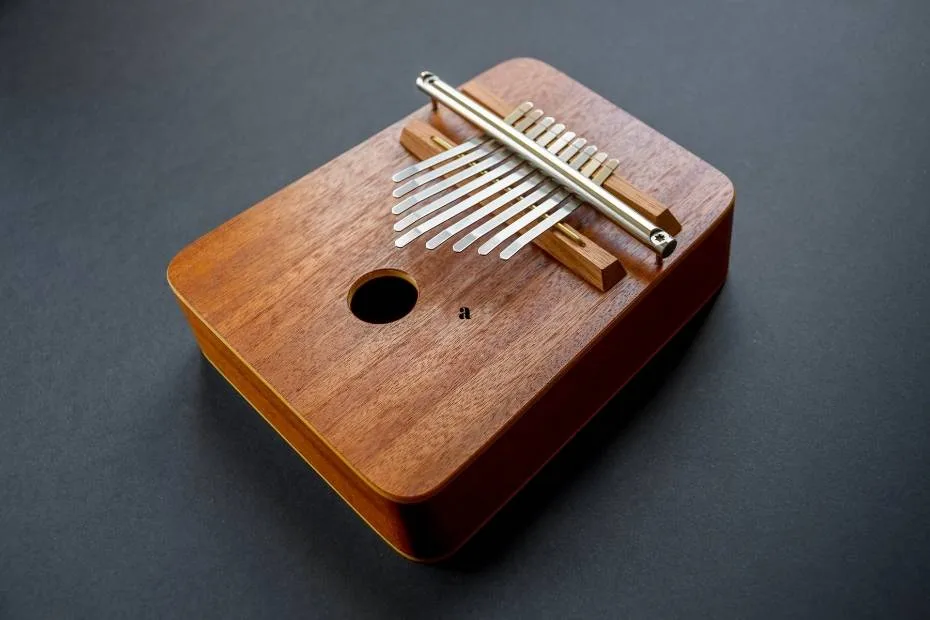
Kalimba Tuning and Playing Reference
To tune a kalimba, compare each tine with a chromatic tuner and move it in tiny steps with a tuning hammer. Raise a flat note by tapping the lower playing end upward toward the bridge; lower a sharp note by tapping the upper end toward the playing tip. A common 17-tine beginner model uses C major, with low C in the center and higher notes alternating left and right. Hold the body lightly at the sides, keep the sound hole uncovered, and release each tine with the thumbnail or firm edge of the thumb pad. Retest after every hammer tap.
What a Kalimba Is and How It Produces Sound
A kalimba is a handheld lamellophone played by plucking flexible metal tines fixed over a bridge. Each tine acts as a vibrating tongue. Longer tines produce lower notes, while shorter tines produce higher notes with a quicker attack and usually less sustain.
The tines transfer vibration through the bridge into a wooden board or hollow resonator. A flatboard kalimba produces a direct wood-and-metal response. A hollow box adds an enclosed air cavity that increases projection and allows the player to shape resonance by covering and uncovering the sound hole.
The nickname thumb piano describes the way the instrument is played, but the mechanism is not piano-like. A piano uses hammers and strings. A kalimba produces pitch through plucked metal tongues, placing it in the same broad instrument family as mbira, likembe, nsansi, sanza, and other African lamellophones.
| Part | Mechanical Role | What the Player Hears |
|---|---|---|
| Metal Tines | Vibrate at pitches set mainly by their free length, stiffness, thickness, and mass | Pitch, attack, sustain, metallic overtones, and note separation |
| Bridge | Supports each tine and transfers vibration into the body | Clean ring when contact is stable; buzz or weak response when seating is poor |
| Pressure Bar | Clamps the tines while still allowing them to slide during tuning | Tuning stability and evenness between neighboring notes |
| Wooden Body | Receives energy from the bridge and enlarges the audible vibration | Warmth, focus, projection, dryness, and decay |
| Sound Hole | Allows air movement in hollow-body models | More projection and a wah-like change when covered and uncovered |
| Tine Layout | Places low notes in the center and higher notes toward both sides | Alternating-thumb scales and easy chord shapes on adjacent tines |
Upper-register behavior: The shortest outer tines often sound drier and decay faster than the long center tines. A usable high note should still have a clear pitch, but it will rarely carry the same body or sustain as the low and middle register.
The Common 17-Tine C Major Note Layout
Many modern beginner kalimbas use 17 tines tuned to the notes of the C major scale. The lowest note, C4, sits in the center. The scale then rises by alternating from one side to the other: D4 to the left, E4 to the right, F4 farther left, G4 farther right, and so on.
This is a bidirectional layout. Notes do not run from low on the left to high on the right as they do on a piano. Both outer edges contain high notes, while the low register remains near the center.
B57•
G55•
E53•
C51•
A46
F44
D42
C41
E43
G45
B47
D52•
F54•
A56•
C61••
E63••
| Scale Step | Pitch | Usual Position | Thumb |
|---|---|---|---|
| 1 | C4 | Center | Either thumb |
| 2 | D4 | First tine left of center | Left |
| 3 | E4 | First tine right of center | Right |
| 4 | F4 | Second tine left | Left |
| 5 | G4 | Second tine right | Right |
| 6 | A4 | Third tine left | Left |
| 7 | B4 | Third tine right | Right |
| 8 | C5 | Fourth tine left | Left |
The same alternating pattern continues into the upper register. This arrangement makes adjacent tines on one side form scale degrees separated by thirds. For example, C, E, and G sit close together and form a C major chord. F, A, and C form an F major chord on the other side.
Layout warning: C major is common, not universal. Hugh Tracey models, pentatonic instruments, 21-tine kalimbas, chromatic kalimbas, regional lamellophones, and custom instruments may use different notes. Read the engraved markings, tuning chart, or maker instructions before moving any tine.
How Kalimba Numbers and Dots Work
Many tines carry both letter names and numbered notation. On a C major kalimba, the numbers represent scale degrees rather than fixed note names across every possible tuning.
In C major, 1 is C, 2 is D, 3 is E, 4 is F, 5 is G, 6 is A, and 7 is B.
A dot above or beside a number usually indicates the same scale degree one octave higher. For example, 1• is the next C.
Two dots indicate another octave above. On a standard 17-tine layout, the far outer notes may carry two-dot markings.
Scientific pitch labels such as C4, C5, and C6 distinguish notes that share the same letter but sit in different octaves.
Numbered tablature is useful because the same fingering pattern may be moved to another kalimba tuned to a different major key. Letter notation describes absolute pitches, while number notation describes each note’s role within the scale.
How to Tune a Kalimba
Tuning changes the free vibrating length of each metal tine. Moving a tine upward toward the bridge shortens the vibrating section and raises its pitch. Moving it downward toward the playing end lengthens the vibrating section and lowers its pitch.
Tools Needed
- A chromatic tuner or reliable tuning application
- The tuning hammer supplied with the instrument
- The correct note chart for the exact kalimba model
- A quiet room with little background noise
- A folded cloth to protect the wooden body while the kalimba rests on a table
For a modern diatonic instrument designed for standard concert pitch, set the tuner reference to A4 = 440 Hz unless the manufacturer specifies another reference. Traditional mbira tunings and some custom kalimbas may not follow Western equal temperament.
Confirm the Intended Notes
Compare the engraved tine labels with the maker’s tuning chart. Do not assume that every 17-tine instrument follows the same C major arrangement.
Place the Kalimba on a Protected Surface
Lay the body on a folded cloth with the tines accessible. Keep the bridge, pressure bar, pickup controls, and wooden edges away from direct impact.
Pluck One Tine Clearly
Play one note and let the tuner settle after the first metallic attack. Mute neighboring tines if sympathetic vibration causes the display to jump between pitches.
Read Flat, Sharp, or Centered
A flat reading means the note is too low. A sharp reading means it is too high. A centered tuner display indicates that the pitch matches the selected note.
Move the Tine with a Small Tap
For a flat note, tap the lower free end upward toward the bridge. For a sharp note, tap the upper end downward so the playing section becomes slightly longer.
Retest After Every Movement
Pluck the tine again after each tap. A tine can move farther than expected, especially in the short upper register, so repeated light taps are safer than one heavy strike.
Check the Full Scale
After individual notes are centered, play the scale slowly from the middle outward. Listen for notes that sound unsettled even when the tuner reading appears correct.
| Tuner Reading | Pitch Problem | Hammer Action | Result |
|---|---|---|---|
| Flat | The note is lower than its target | Tap the free playing end upward toward the bridge | Shorter vibrating length and higher pitch |
| Sharp | The note is higher than its target | Tap the upper end downward toward the playing tip | Longer vibrating length and lower pitch |
| Centered | The note matches its target | Do not move the tine | Pitch remains stable |
Tuning hammer safety: Strike the tine, not the bridge, pressure bar, wooden body, or neighboring tines. Hold the hammer close enough to control it, use light taps, and stop if the tine twists sideways or becomes difficult to move.
Which Tine Should Be Tuned First?
Starting with the long center tine gives the tuner a strong, stable signal. Continue outward one note at a time, following the ascending scale rather than tuning all tines on one side first. This order makes it easier to compare neighboring intervals and notice an incorrect target note.
Why the Tuner Display May Jump
A kalimba tine produces a sharp metallic attack followed by a more stable ringing pitch. The tuner may briefly show another note during the first fraction of a second. Pluck with moderate force, keep the instrument near the microphone, and wait for the reading to settle.
Sympathetic vibration can also confuse the tuner. Lightly touch nearby tines without pressing the tine being measured. Background music, conversation, fans, and handling noise can create unstable readings.
Retuning to Another Key
Many modern kalimbas can be moved into another scale by adjusting individual tines, but the available range is limited by tine length and bridge position. A tine pushed too far upward may lose secure contact. A tine moved too far downward may become uncomfortable to play or collide with the body.
Minor pitch corrections are safer than large changes. Before converting the whole instrument to another key or scale, confirm that the chosen model has enough tine travel for every target note.
Dead Notes, Buzzing Tines, and Weak Upper Notes
A note that sounds weak is not always out of tune. Pitch, mechanical contact, tine alignment, bridge pressure, body construction, and the short length of high tines all affect response.
Check whether the tine is touching a neighboring tine, sitting at an angle, or failing to make stable contact with the bridge. Dirt or oxidation near the contact area can also reduce vibration.
A slight buzz may come from loose contact, a rough tine edge, debris, or sideways alignment. Do not keep changing pitch when the real problem is mechanical seating.
The shortest tines naturally produce less sustain. Compare pitch clarity and usable volume rather than expecting them to match the long center notes.
The pressure bar may not be gripping the tine evenly, or the tine may be damaged. Repeated hammering will not correct loose clamping hardware.
Setup check: A weak tine may improve when it is centered, seated firmly, and tuned to the proper height. Do not force a tine sideways with pliers or insert objects beneath the bridge without instructions for that model.
How to Hold a Kalimba
Sit with relaxed shoulders and hold the kalimba in front of the torso. Support the body with the fingers while keeping both thumbs free. The grip should stop the instrument from slipping without squeezing the body hard enough to restrict resonance.
Hold the side edges and keep the front sound hole open. Rear sound holes may be covered and uncovered with the fingers to change the resonance.
Support the lower sides or corners with the fingers. Let the board vibrate instead of pressing the back tightly against both palms.
Rest the lower edge lightly against the lap or use a stable stand. Avoid bending the wrists inward to carry the full weight.
Keep the fingers positioned so the rear tines remain reachable without shifting the entire instrument during every accidental note.
Thumb and Nail Position
Place the thumbnail or firm edge of the thumb pad near the free end of a tine. Press slightly and let the thumb slide off so the metal tongue springs back. The motion should release the tine cleanly rather than pushing it against the body.
A short thumbnail often produces a clearer attack than soft skin alone. The nail does not need to be long. Sharp nail edges can catch on the tine, so keep them smooth with a fine nail file.
How Hard Should the Tines Be Plucked?
Moderate force is enough for most playing. Heavy plucking can create a harsh attack, tire the thumbs, and cause the nail to strike the tine edge. Very light plucking may fail to activate the body resonance.
Aim for an even volume across repeated notes. The outer high tines may require a slightly firmer release, but forcing them will not create the long sustain of the center register.
First Playing Exercises
Practice slowly enough that every note starts cleanly. The goal is steady alternation, controlled release, and awareness of where the scale changes sides.
Exercise 1: Ascending and Descending C Major
- Play the center C with either thumb.
- Play D with the left thumb.
- Play E with the right thumb.
- Continue outward by alternating left and right.
- Stop at the next C, then reverse the same path back to the center.
The scale follows this order:
CDEFGABC
Exercise 2: Even Alternating Notes
Choose two neighboring scale notes on opposite sides, such as D and E. Play left, right, left, right at a slow pulse. Keep both notes equal in volume and avoid rotating the instrument toward the active thumb.
Exercise 3: Three-Note Arpeggios
Play three adjacent tines on one side from the center outward. On a C major layout, C–E–G forms a C major chord. On the left side, D–F–A forms D minor. Play each note separately before trying to sweep across all three.
Exercise 4: Bass Note and Melody Reply
Play the center C as a low anchor, then answer with E and G on the right. Repeat the pattern with D as the anchor and F and A on the left. This introduces accompaniment without requiring a full song.
Exercise 5: Controlled Damping
Play a center tine and stop it gently with a spare finger after one beat. Repeat with two beats, then four. Damping prevents every note from ringing into the next and gives a melody clearer phrasing.
Beginner Chords on a 17-Tine C Major Kalimba
The alternating layout places every other scale note next to one another on the same side. This naturally creates groups such as 1–3–5 and 2–4–6, which form common diatonic chords.
| Chord | Notes | Typical Location | Playing Method |
|---|---|---|---|
| C Major | C–E–G | Center and lower right side | Play separately as an arpeggio or sweep with the right thumb |
| D Minor | D–F–A | Lower left side | Play three neighboring left-side tines |
| E Minor | E–G–B | Lower right side | Move one group outward from C major |
| F Major | F–A–C | Left side | Use the next three adjacent left-side notes |
| G Major | G–B–D | Right side | Use the next three adjacent right-side notes |
| A Minor | A–C–E | Upper left side | Use a light sweep so all three notes remain distinct |
A chord does not need to be struck as one block. Playing its notes in sequence creates an arpeggio and often sounds cleaner on a kalimba. Beginners can use a low chord tone at the start of a phrase and play a melody in the upper register with the opposite thumb.
Playing balance: Sweeping across three tines too hard can make the first note much louder than the last. Begin slowly, release each tine cleanly, and reduce the angle of the thumb until the chord sounds even.
Reading Kalimba Tablature
Kalimba tablature usually mirrors the physical layout of the instrument. Each vertical lane represents a tine, and the symbols show which tine should be played. Some systems are read from bottom to top, while simplified number tabs are read from left to right.
Number Tabs
A line such as 1 2 3 5 3 2 1 represents scale degrees. In C major, that sequence is C–D–E–G–E–D–C. Dots mark upper octaves, and a line or dash may indicate that a note should be allowed to ring longer.
Letter Tabs
Letter notation writes the pitch names directly. Octave labels may be added when the same letter appears more than once. Without octave information, the player must infer the register from the melody or arrangement.
Stacked Notes
Numbers or letters written vertically are usually played together as a chord. Notes written side by side are normally played in sequence. Brackets, bars, or spacing may divide beats and measures.
Tine Stickers and Engraved Labels
Stickers can help a beginner locate notes, but they should match the actual tuning. A mislabeled tine can make both practice and later tuning confusing. Verify each pitch with a tuner before applying permanent markings.
Box, Flatboard, and Membrane-Resonator Kalimbas
| Body Style | Sound Character | Playing Feel | Possible Limitation |
|---|---|---|---|
| Hollow Box | Rounded resonance, more air movement, stronger body coloration | Sound-hole effects and noticeable acoustic projection | Upper notes may feel less even; body resonance can color recordings |
| Flatboard | Direct attack, focused note edge, drier decay | Light, stable, and easy to position near a microphone | Less natural volume and no strong front-hole wah effect |
| Membrane Resonator | Soft attack, long bloom, floating decay | Expressive pressure and movement effects | Less dry precision than a plain board or box model |
| Acrylic Body | Clear, bright attack with less traditional wood coloration | Consistent shape and decorative transparency | Weight and tactile response differ from wooden models |
Box Kalimba
A hollow box amplifies the tines through both the wooden soundboard and the enclosed air. Covering and uncovering the sound hole changes the air resonance, creating a vocal-like wah effect. The effect is usually strongest on low and middle notes.
Flatboard Kalimba
A flatboard has no enclosed air chamber. Vibration travels directly through the solid board, producing a more focused attack and often clearer note separation. Flatboards are also less affected by accidental blocking of a front sound hole.
Sansula-Type Design
A Sansula-type instrument suspends a small lamellophone over a membrane. The membrane changes the attack and extends the decay, producing a softer and more spacious response. It is a modern branch with a different playing feel from a standard solid or hollow-body kalimba.
Kalimba and Mbira Are Related but Not Identical
Kalimba commonly refers to a modern, standardized branch of the African lamellophone family. Mbira refers to several regional instruments and musical traditions, especially those associated with parts of Southern Africa. The names are sometimes used loosely in shops, but the instruments can differ in tuning, construction, playing method, repertory, timbre, and social role.
| Point | Modern Kalimba | Traditional Mbira Family |
|---|---|---|
| Tuning | Often diatonic and aligned with a Western major scale | Varies by region, repertory, maker, and performer |
| Tine Layout | Frequently symmetrical with alternating scale notes | May use layered rows, irregular groupings, or tradition-specific patterns |
| Timbre | Often clean, bell-like, and separated | May include deliberate buzz, rattle, and dense overtone texture |
| Primary Use | Portable melody, harmony, solo practice, and modern arrangement | Regional repertory, cyclical patterns, ceremony, dance, and community music |
| Commercial Label | Widely used for modern export and beginner instruments | Usually identified by a regional instrument name |
Traditional buzz should not automatically be treated as poor construction. Some lamellophones use shells, metal rings, wire, or other attachments to create a deliberate rasp around the tine sound. A modern kalimba usually reduces this texture in favor of cleaner tuning and note separation.
Collector’s note: Older instruments may appear in catalogues under names such as mbira, sanza, likembe, nsansi, or regional spellings rather than kalimba. Original buzzing fittings, tine sets, bridge wear, and local construction details can carry more historical value than polished appearance.
Tine Length, Metal, Bridge Contact, and Body Wood
Key count and wood species do not determine the instrument’s voice by themselves. Tine stiffness, free length, bridge pressure, board thickness, body shape, and assembly quality work together.
Why Tine Length Changes Pitch
A long tine flexes more slowly and produces a lower note. A short tine is stiffer and returns more quickly, producing a higher note. Tuning changes the length of the section that is free to vibrate rather than stretching the metal like a string.
Tine Metal and Attack
Modern kalimbas commonly use springy steel designed to bend repeatedly and return to its resting position. The tine’s thickness, width, hardness, edge shape, and surface finish influence attack, comfort, pitch stability, and overtone texture.
A rough edge can catch the thumbnail. A permanently bent tine may produce unstable contact or uneven response. Replacement tines should match the dimensions and material behavior of the original set.
Bridge and Pressure Bar Contact
Each tine must be held firmly enough to remain stable while still being movable during tuning. Uneven contact can produce buzzing, drifting pitch, or a note that decays too quickly. A visually straight tine can still respond poorly if it is not seated correctly against the bridge.
Wood Species and Construction
Wood density and stiffness affect how vibration travels through the body, but species labels do not guarantee a particular sound. Board thickness, internal dimensions, bridge fit, grain direction, finish, and assembly quality can outweigh the name of the wood.
| Wood | Often Associated With | What Else Must Be Checked |
|---|---|---|
| Maple | Firm attack, clear upper-mid response, focused note edge | Board thickness, bridge seating, and tine quality |
| Mahogany | Rounded midrange and balanced general response | Whether the name refers to solid wood, veneer, or a related species |
| Koa or Acacia | Full middle register and decorative grain | Body construction, finish thickness, and internal cavity dimensions |
| Cherry | Smoother upper response and a less aggressive attack | Actual build quality and tine-to-bridge transfer |
| Kiaat | Woody, balanced tone associated with some Hugh Tracey builds | Age, hardware condition, provenance, and replacement parts |
Buying principle: A well-built instrument with stable tines and clean bridge contact is usually a better musical choice than poorly fitted hardware attached to an attractive or expensive wood.
Choosing Between 8, 10, 17, 21, and Chromatic Layouts
Compact layouts often use pentatonic or limited scales. They suit free play, simple motifs, travel, and players who do not need a wide melodic range.
The common beginner choice provides enough range for melodies, basic chords, and widely available tablature without making the surface overly crowded.
Extra notes extend arranging options and bass or upper range, depending on the design. The wider layout requires more navigation and adds more tines to tune.
A rear row or second layer supplies sharps and flats. This supports modulation and chromatic melodies but demands accurate finger placement and a reliable tuning chart.
Why 17 Tines Became Common
Seventeen tines provide a practical balance between range and hand reach. A C4-to-E6 layout covers more than two octaves, supports familiar major and minor chords, and works with many beginner arrangements.
When 21 Tines Help
A 21-tine model may add lower bass notes, higher melody notes, or both. The benefit depends on the exact layout. More tines do not automatically produce better tone, and the shortest added notes may have less sustain.
When Chromatic Tines Are Worth Learning
A diatonic kalimba omits accidentals outside its scale. A chromatic model is useful for music that changes key, uses frequent sharps or flats, or requires notes unavailable on a standard C major layout. It is less forgiving for a first-time player because the rear tines must be learned by touch.
Kalimba Care and Tuning Stability
Routine care keeps the tines comfortable, the body clean, and the bridge area free of debris. It also reduces sudden tuning changes caused by impact, poor storage, or corrosion.
- Wipe the tines and body with a dry microfiber cloth after playing
- Keep sweat and skin residue from collecting around the bridge
- Store the instrument in its case or protective bag
- Avoid damp rooms, direct sunlight, radiators, and hot vehicles
- Do not place heavy objects on the tines
- Check tuning after transport, impact, or a large environmental change
- Keep liquid away from pickup sockets and electronic controls
Cleaning the Tines
Use a dry, soft cloth and wipe along the tine rather than across sharp edges. If the manufacturer permits a lightly damp cloth for the finish, keep moisture away from the bridge and dry the instrument immediately.
Do not apply oil, metal polish, abrasive paste, or household cleaner without instructions for the exact tine coating and body finish. Residue can alter grip, collect dust, damage wood finish, or enter the bridge contact area.
How Often Tuning Should Be Checked
A stable instrument does not need to be hammered on a fixed schedule. Check it when a melody sounds wrong, after long transport, after a drop or impact, or when temperature and humidity have changed sharply. Frequent unnecessary adjustment can wear tine surfaces and make the player chase tiny tuner fluctuations that are not musically noticeable.
Storage
Place a clean cloth over the tines or use a fitted case so the metal tongues cannot catch on other objects. Do not close a damp instrument in a sealed bag. Allow a kalimba moved from a cold or hot environment to settle before tuning it.
What to Check Before Buying a Kalimba
| Inspection Point | Healthy Condition | Warning Sign |
|---|---|---|
| Tine Alignment | Even spacing with comfortable edges and no sideways contact | Crooked tines, sharp burrs, or tines touching one another |
| Tuning Stability | Notes remain centered after repeated playing | A tine shifts easily or repeatedly falls flat |
| Upper Notes | Short sustain but clear, identifiable pitch | Completely muted response, severe buzz, or no stable pitch |
| Bridge Area | Firm contact without visible gaps or movement | Loose hardware, lifted bridge, cracks, or deep corrosion |
| Wooden Body | Stable joints and a flat, undamaged soundboard | Cracks near the bridge, open seams, swelling, or warped panels |
| Sound Hole | Clean edge with no internal object rattling | Cracks, loose material, or unexplained internal noise |
| Pickup System | Clean output without intermittent signal | Loose jack, crackling controls, or strong handling noise |
Best First Layout
A 17-tine C major instrument is the safest starting point for access to note charts, exercises, and song arrangements. Choose a model with readable tine markings, stable tuning, a protective case, and a tuning hammer.
Box or Flatboard for a Beginner
Choose a box model for more acoustic volume and sound-hole effects. Choose a flatboard for direct response, lower weight, and fewer changes caused by covering the body. Both can be suitable when the tines are comfortable and evenly seated.
Vintage and Antique-Oriented Purchases
Older lamellophones should not be judged only by modern C-major tuning standards. Examine original tine material, bridge wear, regional layout, buzzing fittings, repairs, provenance, and whether replacement parts have altered the object.
Collector’s note: Mismatched replacement tines may tune correctly but differ in width, stiffness, attack, and color. Original hardware and wear patterns can be more informative than a freshly polished surface.
Kalimba Tuning and Playing FAQ
How do I tune a kalimba with a tuning hammer?
Pluck one tine and read it with a chromatic tuner. If the note is flat, tap the lower playing end upward toward the bridge to shorten the vibrating length. If it is sharp, tap the upper end downward toward the playing tip to lengthen it. Use small taps and retest after each movement.
What tuning does a beginner kalimba usually use?
A common beginner model has 17 tines tuned to C major, usually ranging from C4 in the center to E6 at the outer edge. Other layouts exist, so the tine markings and maker’s chart should be checked before adjustment.
Why are kalimba notes arranged left and right?
The low notes sit near the center and the scale alternates between the two sides as it rises. This lets the thumbs alternate during scales and places chord tones such as C, E, and G next to one another on the same side.
How should a beginner hold a kalimba?
Support the body lightly at the sides with the fingers and keep both thumbs free. Avoid squeezing the soundboard or blocking the front sound hole. Keep the wrists relaxed and the instrument centered in front of the torso.
Should I pluck with my thumbnail or thumb pad?
Either can work. A short, smooth thumbnail usually gives a cleaner attack, while the firm edge of the thumb pad produces a softer start. The tine should be released cleanly rather than pushed into the body.
Why does my highest kalimba tine sound quiet?
The outer tines are short and stiff, so they naturally have less sustain than the long center tines. Check alignment, bridge contact, and pitch, but do not expect the highest note to have the same depth as the low register.
What should I do if a tine buzzes?
Check whether it touches a neighboring tine, sits at an angle, has debris near the bridge, or lacks stable pressure-bar contact. Do not keep changing its pitch unless the tuner also shows that the note is out of tune.
Can a 17-tine kalimba play sharps and flats?
A standard diatonic C major model does not provide every sharp and flat. Some accidentals can be created by retuning, but frequent key changes are easier on a chromatic kalimba with a second row of tines.
Is a kalimba the same as an mbira?
They belong to the same broad lamellophone family, but the names are not fully interchangeable. Modern kalimbas often use standardized diatonic layouts, while mbira instruments may have regional tunings, layered tines, deliberate buzzing devices, and tradition-specific repertory.