
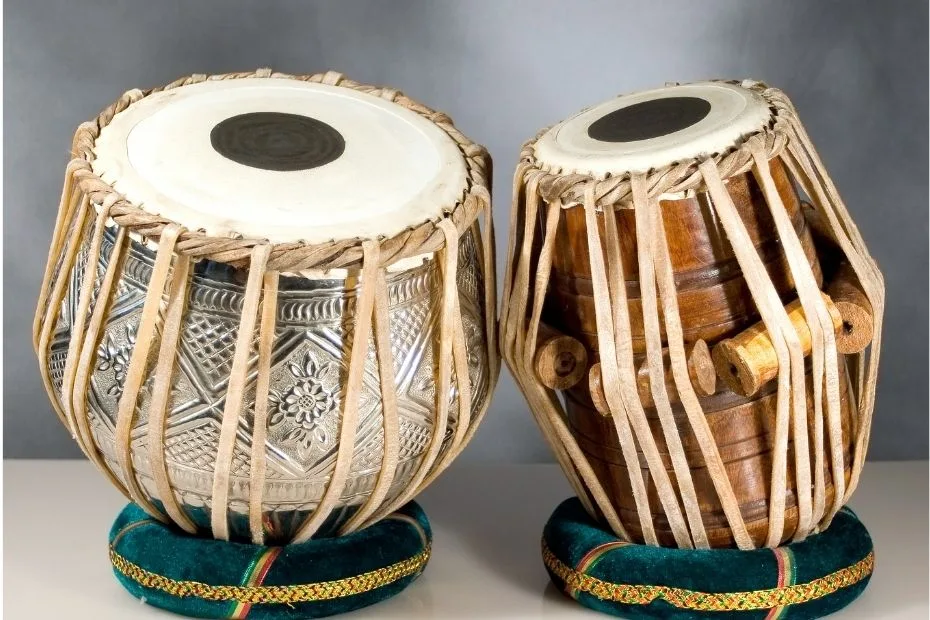
The tabla is one of the few drums that can feel both rhythmic and pitched at once. That strange balance does not come from decoration or prestige. It comes from build choices that are exacting: shell density, head layering, the shape and weight of the syahi, and the way the pair is matched to a singing tonal center.
| Part | Common Build | What It Changes in Sound |
|---|---|---|
| Dayan | Hardwood shell, usually around 5 to 6 inches across the head | Brings the clearer pitch, sharper attack, and the bell-like edge heard in strokes such as Na, Tin, and Tun |
| Bayan | Clay or metal kettle-shaped shell, often around 8 to 10 inches across the head | Adds bass bloom, sliding inflection, and that speaking low register that can swell under the hand |
| Syahi | Layered black loading at the center of the head | Pulls partials into a more ordered relationship, which helps the drum speak with a clearer pitch than many other hand drums |
| Gatta And Straps | Wooden dowels and leather tensioning | Control tuning stability, response, and how evenly the head speaks around the rim |
One detail gets blurred in many articles: tabla properly names the right-hand drum, while the pair is the tabla and bayan. In common use, of course, “tabla” stands for the set. Still, the distinction matters because the two drums are not mirror images. They do different acoustic jobs.
How the Pair Is Built to Speak
- Dayan: the smaller treble drum, carved from hardwood and tuned to a musical note.
- Bayan: the bass drum, usually metal in modern sets, shaped to allow pressure-driven pitch bends.
- Maidan: the main playing field around the center, where much of the tonal identity lives.
- Kinar: the outer ring, which gives drier edge strokes and cleaner articulation.
- Syahi: the black loaded area that changes the overtone behavior of the membrane.
- Gajara: the braided ring at the head edge, struck during fine tuning.
- Baddhi: the leather lacing that holds the head and shell in active tension.
- Gatta: tuning blocks used to shift overall tension on the dayan.
A fine pair does not merely sound “good.” It separates cleanly under the fingers. The dayan should give a focused center, a dry and readable edge, and enough ring that open strokes bloom without turning cloudy. The bayan should answer pressure smoothly. Not stiff, not floppy. Just enough give to let the bass note bend and return.
That balance is easy to hear and hard to build.
When judging a tabla, listen for what happens after the strike, not only at the strike. A quick attack can impress for one second. The better clue is the shape of the decay: does it stay centered and musical, or does it spread into a fuzzy wash?
Why the Syahi Changes Everything
The syahi is not a cosmetic black circle. It is the acoustic heart of the instrument. By loading the center of the membrane, it changes how the head vibrates, and that is why the tabla drum can project a much clearer sense of pitch than most drums. On a plain membrane, the overtones usually spread in a rougher pattern. On a well-made tabla head, those upper components sit closer to a musical order, so the ear hears more center, more note, more identity.
This is also why two drums with similar shell sizes can sound far apart. A head with a balanced syahi feels composed. A head with poor loading can sound papery, nasal, or oddly choked even when the shell itself is solid.
And yes, very small changes matter here.
Open Strokes Vs. Closed Strokes
Many surface-level articles list bols but stop there. What matters more is how each stroke uses a different part of the head and a different damping behavior.
- Open strokes such as Tun or Ge let the membrane ring longer and show the drum’s natural balance.
- Closed strokes such as Ta or certain muted center articulations shorten the sustain and expose clarity, control, and tonal discipline.
- Pressure strokes on the bayan reveal how smoothly the bass can bend. That “speaking” bass is one of the tabla’s most human traits.
If the dayan is the drum that states the syllable, the bayan is the drum that shades it.
Materials and What They Do to Timbre
| Material Choice | What Players Usually Hear | Where It Fits Best |
|---|---|---|
| Sheesham / Indian rosewood dayan | Balanced ring, controlled upper overtones, steady note center | General concert use, studio work, long-term ownership |
| Teak dayan | A bit drier in feel, often very stable, less lush in the upper sheen | Players who want a direct response and reliable structure |
| Copper bayan | Rounder bass bloom, smoother low-end response, more developed bass color | Concert playing, recording, nuanced accompaniment |
| Brass bayan | Brighter attack, firmer bass edge, good projection | Practice, stage use, players who like a more forward voice |
| Steel or plated entry-level bayan | Cleaner but simpler low end, less tonal color under pressure | Early study, travel, tighter budgets |
| Clay bayan | A less metallic response and an older material profile, though less practical to move and maintain | Specialist use, historical interest, careful home setup |
Sheesham Vs. Teak and Other Hardwoods
Sheesham has become a familiar choice for good reason. Many players like the way it keeps the dayan articulate without turning brittle. The note center stays readable, yet the ring does not feel thin. For accompaniment, that helps. For solo playing, too.
Teak tends to appeal to players who prefer a slightly drier and firmer speaking surface. It can feel neat under the hand. Less bloom, sometimes. Less clutter as well. Some denser woods can sharpen the impression of attack, but if the build leans too hard in that direction, the drum may sound more rigid than refined.
The shell wood does not work alone. A well-seasoned shell with a well-made head beats a fashionable wood with poor head work every time.
Copper Vs. Brass Vs. Steel Bayan
Copper bayan is often favored when bass color matters. The low register tends to spread more evenly, and pressure bends feel less abrupt. It is not only “deeper.” It is usually more pliant in tone.
Brass bayan often gives a brighter edge to the bass attack. There is punch there, and for some hands that extra front-end definition is welcome. In ensemble settings, that can help the bass speak through denser textures.
Steel and plated budget bayans do the job, but many of them sound more literal than lyrical. The bass arrives. It does not always linger with much color.
Not a flaw, exactly. Just a different ceiling.
Do not judge an older tabla set by engraving, plating, or darkened patina alone. The more telling clues are an even head braid, a centered syahi, straight shell walls, clean bearing edges, and repairs that respect the original geometry rather than merely making the drum look tidy.
Older Forms Vs. Modern Concert Forms
One of the more overlooked historical details is this: older sets, especially nineteenth-century examples, often show the two drums closer in size than many modern concert pairs. Today, the visual contrast is usually stronger — a smaller, focused dayan paired with a more expansive bayan. That shift changes more than appearance. It changes the bass footprint, the stage image, and how the pair balances in a room.
Earlier bayan construction also kept clay more present, while modern use leans heavily toward metal for reliability and transport. That move solved practical problems, but it also nudged the instrument toward a different tactile identity. Metal answers fast. Clay, when well kept, can feel less metallic in response. Older wooden bayans also appear in collections, a reminder that the instrument’s build history is not a single straight line.
Nineteenth-Century Form Vs. Modern Touring Form
- Older examples: often closer drum sizes, more visible regional variation, more material variety.
- Modern concert sets: more standardized proportions, more metal bayans, stronger emphasis on tuning stability and transport.
- Studio-minded modern builds: often chase a cleaner, centered note and a bass that records without excess wash.
For collectors, this matters. For players, it matters more. A beautifully preserved older pair may be historically lovely but less convenient for daily work. A modern pair may be plainer to look at and far easier to live with.
How the Tabla Sits in Music
The tabla drum is often introduced as accompaniment, but that description is too small. In khayal, thumri, instrumental performance, devotional settings, and solo playing, the pair can behave as timekeeper, commentator, colorist, and—at moments—nearly as a melodic partner. The dayan is tuned to the tonic or a closely related note, so it does not sit outside the tonal field. It sits inside it.
That is why a good dayan never feels like a neutral click source. It has contour. It has grain. The contact point of finger to skin changes the spoken vowel of the stroke, and the shell answers back with its own bias.
Short stroke. Long memory.
Tabla Vs. Pakhawaj in Feel
The comparison matters because both live near one another in the listener’s ear. A tabla usually offers more segmented articulation, more sharply carved syllables, and more pitch-aware treble behavior. A pakhawaj tends to give a broader, more continuous body of sound. One feels etched. The other, more rolled. Neither is “better.” They simply aim at different rhythmic textures.
What to Check Before Buying or Collecting
- Strike the same zone around the rim and listen for pitch consistency. If one side sags badly, the head or tensioning is uneven.
- Check the syahi shape. It should look intentional and stable, not lumpy, cracked, or oddly off-center.
- Press and release the bayan. The pitch bend should feel smooth, not jumpy.
- Inspect the shell mouth for chips, warping, or repairs that alter the seating edge.
- Look at the straps and gatta. If the structure is tired, stable tuning becomes a chore.
- Ignore excess ornament first. Good carving cannot rescue a blunt, lifeless drum.
For daily playing, stability wins. For collecting, original geometry wins. For recording, head quality wins sooner than most buyers expect.
Care, Climate, and Daily Use
- Keep the pair dry and temperate. Sudden humidity shifts can change response and tuning fast.
- Use the hammer with restraint. Fine tuning should be patient, not forceful.
- Cover the heads when not in use so dust does not settle into the active surface.
- Lift from the shell, not the straps. Leather tensioning is structural, not a carrying handle.
- Watch the decay over time. A tabla often tells on itself by losing shape in the ring before obvious damage appears.
Aging is normal. Deadness is not.
Well-kept tablas do not merely last longer; they stay more legible under the fingers. The difference shows up in the first ten seconds of play. A neglected head smears language. A cared-for one keeps each bol distinct, almost conversational.
FAQ
Is it hard to tune a tabla at home?
See The Answer
Tuning a tabla at home is very possible, but it takes a careful ear and a light touch. The dayan is adjusted with the hammer and tuning blocks, while the bayan changes pitch under hand pressure during playing. Small changes in tension make a real difference, so slow and even adjustments work better than force.
How do I know if a bayan sounds too metallic?
See The Answer
A bayan sounds too metallic when the bass attack is bright but the note body feels thin or short-lived. A better bayan keeps some softness under the strike and lets the low note spread before fading. The test is simple: press, release, and listen for color, not only volume.
What size should a dayan be for a clearer pitch?
See The Answer
There is no one size for every player because the target pitch changes with musical use. In general, smaller dayan sizes support higher tuning, while slightly larger ones favor lower pitch centers. Head quality, shell seasoning, and syahi balance matter just as much as diameter.
Does older always mean better with antique tabla sets?
See The Answer
No. Older can mean historically interesting, but age alone does not guarantee a better sound. A well-kept modern tabla set can outperform an older pair with damaged geometry, unstable heads, or poor repairs. For collectors, originality matters. For players, response and tuning stability matter more.
Why does the dayan sound almost like a note instead of just a drum hit?
See The Answer
The dayan can sound note-like because the layered head and central syahi change the overtone pattern of the membrane. That makes the pitch center easier for the ear to hear. It is one of the build features that gives the tabla its distinct voice.