
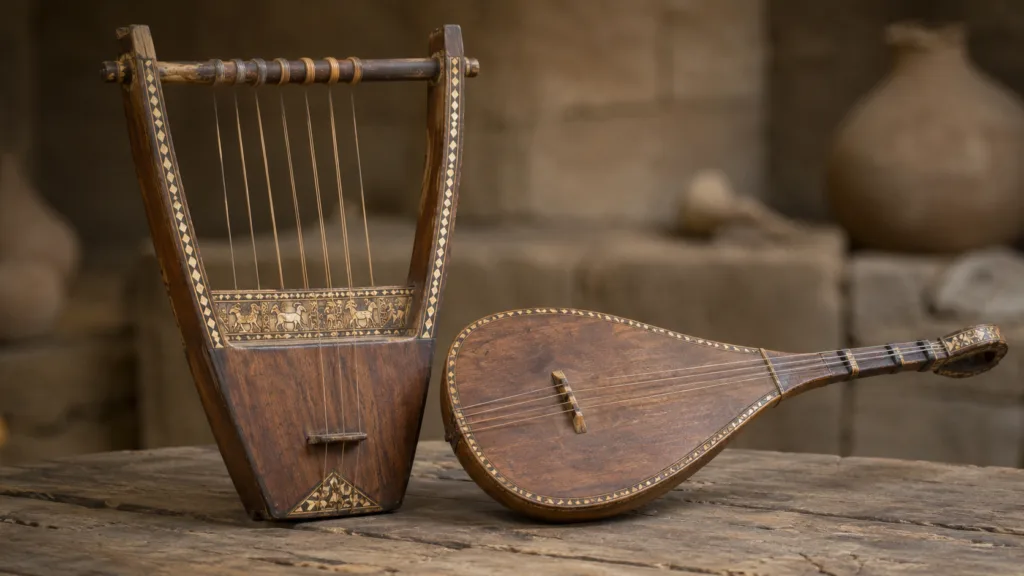
Ancient String Tradition
Mesopotamian lyres and long-necked lutes belong to the earliest strongly documented traditions of plucked string instruments. Lyres are preserved through excavated remains, especially at Ur, while knowledge of early lutes depends mainly on cylinder seals, plaques, reliefs, and later written evidence.
What Mesopotamian Lyres and Lutes Were
A lyre is a yoke-shaped chordophone. Two arms rise from a soundbox and meet at a crossbar, with a separate string running from the lower part of the instrument to the yoke. Each open string normally supplies its own pitch. The player selects, plucks, and sometimes damps strings rather than shortening them against a fingerboard.
A lute has a body and a projecting neck. Its strings extend along that neck, allowing a player to change pitch by stopping a string at different points. This makes a small number of strings capable of producing a wider sequence of notes. Ancient Mesopotamian examples appear to have been long-necked instruments with relatively small bodies, though exact shapes varied.
The two families therefore solve the same musical problem in different ways. A lyre spreads pitches across several open strings. A lute concentrates more melodic movement onto fewer strings controlled by the fretting hand. Mesopotamian evidence preserves both approaches early in the history of urban music-making.
Common Confusion: The words “lyre,” “harp,” and “lute” are not interchangeable. Their strings meet the body and supporting structure in different ways. Nor does every later lute, guitar, oud, or tanbur descend through one proven line from a single Mesopotamian instrument.
Lyre, Lute, and Harp Compared
| Feature | Lyre | Long-Necked Lute | Harp |
|---|---|---|---|
| Main Structure | Soundbox, two arms, and a crossbar or yoke | Soundbox with an extended neck | Soundbox and neck forming an angled or triangular string plane |
| Pitch Control | Separate open strings provide separate pitches | Strings can be stopped along the neck to change pitch | Separate open strings provide separate pitches |
| Typical Playing Logic | Plucking selected strings and damping unwanted resonance | Plucking with one hand while the other changes string length | Plucking strings arranged across an open frame |
| Mesopotamian Evidence | Strong physical and visual evidence | Mostly visual evidence; complete bodies have not survived | Physical remains and visual evidence, including finds from Ur |
| Main Research Limit | Original wood, strings, and setup are only partly preserved | Body construction, tuning, and string count often remain uncertain | Reconstructions depend on damaged and collapsed grave finds |
The Royal Cemetery of Ur and Its Lyres
The best-known Mesopotamian lyres come from the Royal Cemetery at Ur in southern Iraq. Excavations uncovered nine lyres and two harps in several burials. Most date to the Early Dynastic III period, around the middle of the third millennium BCE. The instruments entered the ground with elite grave goods, performers, attendants, and objects made for courtly display.
Wooden parts decayed, but metal sheathing, shell panels, lapis lazuli, red limestone, fasteners, and voids left in the soil preserved enough information to recover the outlines of several instruments. This is why the Ur lyres are more than images of instruments: they offer measurable evidence for soundbox dimensions, arm positions, string paths, decorative programs, and parts of the tuning system.
Several were fitted with bovine heads. The most famous examples use gold, silver, bronze, shell, and lapis lazuli to turn the front of the soundbox into a bull, cow, calf, or related animal form. Some bodies were shaped as standing or reclining animals; others used a box-like resonator with a sculpted head attached at the front.
What We Know: The Ur finds do not preserve untouched working instruments. Tomb collapse mixed fragments, early restorations sometimes joined pieces incorrectly, and later study separated objects once treated as a single “harp-lyre.” Every playable version is therefore a researched reconstruction rather than an original instrument returned to service.
Anatomy and Construction of a Mesopotamian Lyre
The hollow body receives vibration from the strings through a bridge or lower anchoring system. Its internal volume, wall thickness, and soundboard material influence attack, resonance, and projection.
Two structural arms rise from the body. They must resist the combined pull of every string without twisting enough to disturb tuning.
The upper crossbar carries the string attachments and tuning wraps. Marks on surviving parts suggest that cords, sticks, rods, or wrapped material helped control tension.
The bridge transfers string energy to the resonator. Small changes in height, mass, and contact area can alter response even when the outer shape remains the same.
Bovine and stag imagery gave the instrument a ceremonial identity. The ornament also added weight to the front, so a working replica must consider balance as well as appearance.
Original strings rarely survive. Organic materials such as sinew or gut are plausible, but diameter, twist, tension, and preparation cannot be recovered with certainty for every instrument.
How Materials Could Change the Response
| Element | Archaeological or Reconstructed Choice | Likely Effect on Sound |
|---|---|---|
| Wooden Body | Boxwood, pistachio, or another locally available or imported timber | Density and thickness affect how quickly the body responds and how much energy remains after the pluck |
| Metal Covering | Silver, gold, or copper sheathing over selected wooden parts | Adds mass and may alter reflection or damping, though decoration and preservation often reveal more than acoustics |
| Bridge | Light or heavier bridge with a narrow or broad footprint | A lighter bridge may speak faster; a heavier one may soften the first attack and shift energy into the body |
| String Gauge | Different organic diameters under different tensions | Changes pitch range, resistance under the hand, brightness, and decay |
| Soundbox Volume | Small hand-held form or large floor-standing body | Larger bodies can support lower registers and fuller low-frequency resonance |
These relationships are acoustic principles, not laboratory readings from intact Sumerian instruments. A replica’s sound also depends on modern substitutions, workmanship, room acoustics, playing technique, and the maker’s interpretation of damaged evidence.
Bull-Headed Lyres as Musical and Visual Objects
The bull-headed lyre joined sound, animal symbolism, precious materials, and royal ceremony in one object. Bull imagery in Mesopotamia could express strength, fertility, divine force, or royal authority, but the meaning of a particular instrument depends on its archaeological and visual setting. A carved head should not be treated as a simple label for pitch or function.
Some scholars have proposed that the animal type marked register, with larger bull-headed instruments assigned lower voices. Size and string length do support broad differences in register, yet the animal-to-register system remains an interpretation rather than a securely preserved tuning chart. The safest link is physical: larger frames can carry longer strings, and longer strings can produce lower pitches when material and tension are comparable.
The decorated front panels also placed music inside a wider mythic and courtly scene. Animals act like people, carry vessels, play instruments, or take part in banquets. Such imagery does not transcribe a performance, but it shows that string music belonged to a visual language of ritual order, feasting, status, and the boundary between human and divine life.
The Earliest Mesopotamian Lutes
The earliest possible Mesopotamian lute appears on a Late Uruk cylinder seal dated to about 3100 BCE. A seated figure in a boat may be holding a long-necked instrument, but the object could also be a paddle. The image is important because it may push lute evidence far earlier than clearer examples, yet its identification must remain open.
More secure lute-like imagery appears in the Akkadian period. A cylinder seal dated roughly 2400–2200 BCE shows a kneeling, bearded figure playing a necked string instrument. Later plaques and reliefs from Mesopotamian cities show lutenists seated, standing, dancing, or participating in informal and ceremonial scenes.
The typical visual form has a small resonating body and a long neck. Some depictions suggest only a few strings, possibly two or three, though the images are often too small to support an exact count. The player commonly supports the body near the torso while one hand works along the neck and the other plucks, sometimes with what appears to be a plectrum.
Organology Note: “Lute” is used here as a structural category for a necked chordophone. It does not mean that these instruments were identical to the later European lute or to the oud. The ancient Mesopotamian forms were generally long-necked and small-bodied.
Mesopotamian Lyre vs Long-Necked Lute
Open-string tuning, multiple fixed pitches, larger ceremonial instruments, animal-headed soundboxes, and the excavated tradition of Ur. Lyres offer the better physical record because parts of actual instruments survive.
Stopped strings, compact bodies, melodic flexibility from a small string count, and portable necked chordophones. Lutes offer a wider range of hand positions but a thinner archaeological record.
How the Two Families Shaped Musical Possibilities
Lyre: Arrange Pitches Across Open Strings
The musician prepares a set of string pitches before playing. Melody and accompaniment emerge by moving across the string row, repeating notes, combining intervals, and controlling resonance.
Lyre: Use Register Through Scale and Body Size
A small lyre can favor a higher, lighter register, while long strings on a large floor-standing body can support lower notes. The exact range depends on string material and tension.
Lute: Change Pitch Along the Neck
Stopping a string shortens its vibrating length. This lets one string produce several notes and gives the player more continuous melodic movement without a large string array.
Lute: Balance Portability and Resonance
A compact body is easy to hold and move, but it offers less air volume than a large lyre. Makers must balance projection, warmth, string tension, and physical comfort.
Music, Ritual, Court Life, and Everyday Use
Mesopotamian string instruments appear in royal, divine, military, festive, and private settings. Museum evidence links lyres with songs of praise, processions, conquering armies, and personal recreation. Cuneiform texts refer to temple musicians, singers, lamenters, and other trained performers who worked within organized institutions.
Banquet scenes place musicians beside drinkers, dancers, and attendants. Grave contexts at Ur connect instruments with elite burial ceremony, though the exact sequence of music performed at the funerals cannot be reconstructed. The presence of instruments in tombs may reflect status, ritual service, an imagined afterlife, or several meanings at once.
Lute imagery often feels less monumental than the great animal-headed lyres. Small necked instruments appear with individual players and in scenes that may suggest entertainment, dance, or mobile performance. That contrast should not be turned into a strict social rule: surviving art favors particular patrons and objects, and absence from elite graves does not prove absence from elite music.
Tuning Systems and the Limits of Musical Reconstruction
Old Babylonian cuneiform tablets, dating from around the early second millennium BCE, preserve technical language for strings, intervals, tuning procedures, and seven related scales. Instructions describe tightening or loosening strings and refer to intervals such as fourths and fifths. These texts show that trained musicians and scribes used an ordered tuning practice rather than an improvised collection of unrelated pitches.
The tuning texts are later than the Royal Cemetery of Ur by many centuries. They can help researchers test playable lyres with eleven or thirteen strings, but they do not prove that every Early Dynastic instrument used the same scale system. Earlier Sumerian roots are possible, especially where later Akkadian terms have Sumerian counterparts, yet a direct line must be argued rather than assumed.
Pitch organization is only one part of music. Surviving evidence rarely fixes tempo, rhythm, ornament, ensemble balance, vocal style, plectrum material, string tension, or the exact timbre of a performance space. A replica can demonstrate what a construction and tuning choice allows; it cannot replay a single certified Sumerian performance.
Evidence Timeline
A boat scene on a cylinder seal may show a seated lute player, although the object may instead be a paddle.
Bovine lyres, harps, and other instruments are documented through the Royal Cemetery at Ur and related Mesopotamian finds.
Cylinder seals provide clearer images of musicians playing lute-like necked chordophones.
Clay plaques broaden the visual record of lutenists, while cuneiform texts preserve tuning terminology and interval procedures.
Lyres and necked chordophones continue across Mesopotamia and neighboring regions, with forms changing through court, temple, military, and local traditions.
Why “Cradle of String Instruments” Needs Care
Mesopotamia deserves a central place in the history of string instruments because it preserves an unusually dense combination of excavated objects, images, and writing. The Ur lyres are among the earliest surviving string instruments whose forms can be reconstructed in detail, and Mesopotamian texts offer some of the oldest technical discussions of tuning.
The phrase “cradle of string instruments” should not imply that every chordophone was invented in one city or carried outward through a single family tree. Early harps and other string traditions also developed in Egypt, Iran, Central Asia, and elsewhere. Movement between Mesopotamia, Elam, Syria, Anatolia, and the eastern Mediterranean makes exchange at least as important as isolated invention.
Mesopotamia’s strongest claim is documentary. It allows the history of string instruments to be studied through construction, imagery, language, social setting, and music theory together. Few early regions preserve all of those evidence types in comparable depth.
Evaluating a Modern Reconstruction
- Does the maker identify the archaeological object, image, or museum record used as the model?
- Are original measurements separated from estimated or newly designed dimensions?
- Does the description explain which wood, string, bridge, and tuning choices are modern substitutions?
- Is the instrument described as an archaeological replica, a playable reconstruction, or a Mesopotamian-inspired design?
- Are disputed details, such as the earliest lute image or exact string material, presented as uncertain?
- Does the maker avoid claiming that one setup reproduces the exact sound of all Sumerian or Babylonian music?
Collector’s Note: Decorative accuracy and musical playability are separate goals. Heavy metal facing, fragile inlay, historically modeled tuning wraps, and organic strings may create a convincing object but make regular tuning difficult. A performance replica may need reversible modern solutions that should be clearly disclosed.
Mini FAQ
Which appeared first in Mesopotamia, the lyre or the lute?
A possible lute image dates to around 3100 BCE, but the object may be a paddle. The earliest securely documented physical lyres are later, especially the third-millennium BCE instruments from Ur. The answer changes depending on whether uncertain imagery or excavated instruments are given more weight.
How many strings did Mesopotamian lyres have?
The number varied by instrument. Several reconstructed Ur instruments carried enough strings for broad tuning systems, with examples interpreted as having eleven or thirteen strings. Smaller lyres could have fewer.
Were Mesopotamian lute strings stopped like guitar strings?
The necked structure indicates that players could shorten strings with the hand to change pitch. Ancient depictions do not always show frets, so it is safer to speak of stopped strings than to assume a modern fretted fingerboard.
Did the Lyres of Ur sound like modern guitars or cellos?
Playable replicas have reminded researchers of guitars, cellos, or bass viols in register and resonance. These are listening comparisons, not proof that the original instruments had the same tone, volume, or playing technique.
Are the oud and tanbur direct descendants of Mesopotamian lutes?
They belong to later necked-chordophone traditions and offer useful structural comparisons. A direct, uninterrupted line from one Mesopotamian type to a named modern instrument has not been demonstrated.
Can ancient Mesopotamian music be performed accurately today?
Researchers can test documented intervals, tuning procedures, instrument dimensions, and plausible playing methods. Rhythm, expression, ensemble practice, string preparation, and many performance details remain open, so every performance includes interpretation.