
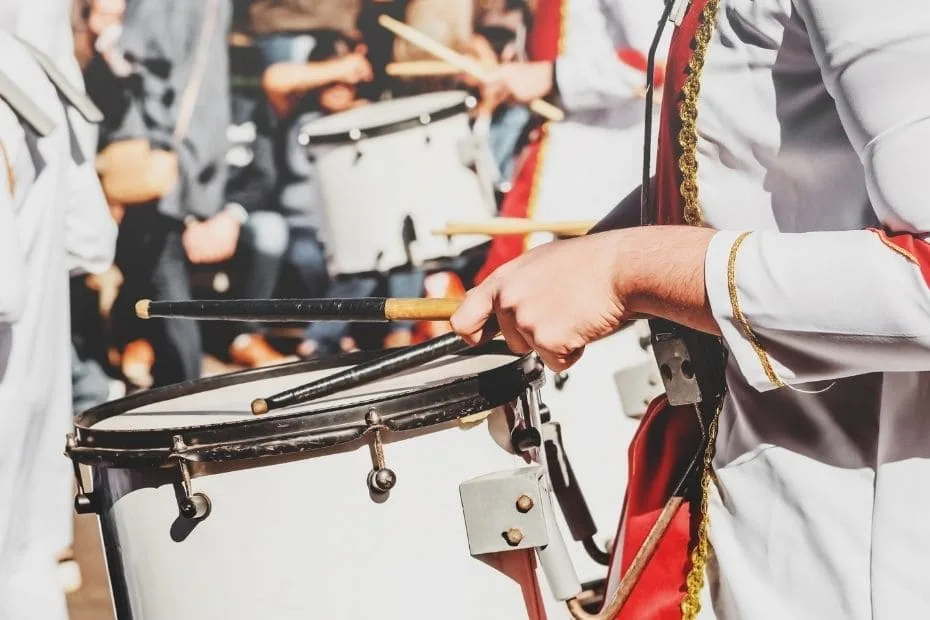
The military drum is not one single drum design. The term refers to several drums used for signaling, cadence, marching, ceremonial music, and organized military-band performance. Historical field drums form one branch of this family, while modern military ensembles may also use side drums, marching snares, bass drums, and tenor drums. The instruments differ in construction and pitch because they perform different musical and practical roles within an ensemble.
Types of Military Drums
| Type | General Form | Sound Role | Typical Setting |
|---|---|---|---|
| Field Drum | Deep snare drum; historical models often use rope tension and wood hoops | Broad snare voice, cadence, historical signaling | Fife-and-drum corps, historical units, ceremonial performance |
| Military Side Drum | Snare drum carried at the side or front | Sharp rhythmic articulation and marching pulse | Military bands, guards, parade formations |
| Modern Marching Snare | High-tension snare with reinforced hardware | Precise attack and detailed rudimental writing | Modern marching formations and drumlines |
| Marching Bass Drum | Large double-headed drum carried vertically | Low pulse, accents, weight, and ensemble timing | Military bands, parades, marching ensembles |
| Tenor Drum | Medium-pitched drum without the snare response of a side drum | Intermediate rhythmic and tonal layer | Military and ceremonial bands, pipe-band traditions |
| Marching Tenors | Multiple tuned toms carried as a set | Moving melodic-rhythmic lines across several pitches | Modern marching and drum-corps settings |
What Does “Military Drum” Mean?
Military drum is best understood as a functional and historical category rather than the name of a single standardized instrument. A drum enters this category through its use in military signaling, marching, ceremony, or military-band music.
This distinction matters because a field drum and a military drum are not exact synonyms. A field drum is a specific deep-snare type with its own construction, dimensions, tuning practices, and concert uses. A military drum may be a field drum, but it may also be a side drum, modern marching snare, bass drum, or tenor drum.
Detailed information about field-drum shell depth, rope tension, heads, snares, tuning, and modern concert configurations is covered separately in the Field Drum article.
Why Drums Were Used by Military Units
Before electronic communication, loud acoustic signals were useful for organizing groups moving over open ground. Drums could project repetitive rhythmic patterns across distances and did not depend on spoken language being clearly heard over surrounding noise.
Different beats could mark routines, movements, assemblies, marches, and ceremonial actions. The exact calls and their meanings varied by period, country, branch, and local practice. Drummers therefore served a practical communication role as well as a musical one.
As battlefield communication methods changed, the drum’s role shifted. Signaling became less central, while parade, ceremonial, commemorative, and band performance remained. Modern military ensembles consequently preserve some older drum traditions while also using percussion designed around contemporary ensemble writing.
Field Drum
The field drum is one of the instruments most closely associated with historical military drumming. Its relatively deep shell produces more low-mid body than a shallow snare, and historical versions commonly used rope lacing, wood hoops, natural heads, and gut snares.
Field drums were suited to outdoor cadence and signaling, particularly when paired with fifes. Their military history explains why they remain common in reenactment, heritage units, fife-and-drum corps, and some ceremonial formations.
The field drum also developed a separate concert identity. Modern versions may use rod-lug tensioning and conventional snare hardware while retaining the deeper shell. Because of that wider musical use, technical questions about field-drum construction and tuning belong to the dedicated Field Drum guide rather than to the broader military-drum category.
Military Side Drum
The side drum is a snare drum historically carried from a sling at the player’s side. The term is closely connected with military drumming and remains common in British and European terminology.
Its purpose differs somewhat from the deep field drum. Side drums favor a clear snare response suitable for rolls, accents, rhythmic calls, and coordinated marching. Depending on period and tradition, the instrument may use rope or mechanical tensioning.
Modern ceremonial side drums are often shallower and more mechanically precise than older field drums. Decorative shells, military insignia, and regiment-specific finishes may appear on service instruments, although these visual details do not define the drum acoustically.
Modern Marching Snare
The modern marching snare developed toward high head tension, strong hardware, rapid snare response, and very clear articulation. It shares ancestry and playing vocabulary with older military side drums but is mechanically different from a traditional rope-tension field drum.
Modern marching snares commonly use reinforced shells, tension rods, rigid hoops, synthetic heads, and harness systems. Their sound is usually tighter and higher than that of a historical field drum. This makes them suited to dense rudimental writing where individual strokes must remain distinct outdoors.
A marching snare may appear in military-style performance without being an historical military drum. The category is therefore based partly on ensemble use rather than on a single construction method.
Marching Bass Drum
The marching bass drum occupies the low register. Rather than producing a snare response, it supplies pulse, weight, accents, and large rhythmic markers that can support an entire marching formation.
Historical military bass drums also served ceremonial and processional roles. In modern ensembles, one large drum may provide the low part, while some marching groups divide bass writing among several drums of different sizes.
The bass drum’s role makes it clearly different from the field or side drum even though all may appear in the same military ensemble.
Tenor Drums
The term tenor drum has been used for medium-pitched drums placed between the side drum and bass drum in range and function. Their construction varies by tradition. Some are single drums, while contemporary marching ensembles may use multi-drum tenor configurations.
Tenor parts can add rhythmic movement, pitched contrast, and visual elements to a formation. Unlike snare-based military drums, they generally rely on the open tone of the drumhead rather than a snare mechanism.
Modern multi-drum configurations are covered separately in the Marching Tenor article.
How Military Drum Roles Differ
| Role | Drum Commonly Used | Musical Function |
|---|---|---|
| Historical Signal | Field drum or side drum | Repeating recognizable calls and commands |
| March Cadence | Side drum, field drum, marching snare | Maintaining rhythmic movement and pace |
| Low Pulse | Bass drum | Providing weight, beat placement, and large accents |
| Rhythmic Detail | Side drum or marching snare | Rolls, flams, drags, accents, and articulated figures |
| Mid-Range Color | Tenor drum or marching tenors | Adding tonal contrast between snare and bass parts |
| Ceremonial Effect | Several types | Supporting formal processions, honors, and public ceremonies |
Military Drumming and the Fife
One of the best-known historical combinations is the fife and drum. The fife supplied a penetrating melodic line while drums supplied rhythm, cadence, and signals. Their contrasting frequency ranges allowed both instruments to remain audible outdoors.
Field drums are especially associated with this tradition. Modern fife-and-drum corps often preserve aspects of historical instrumentation, repertoire, marching style, and rudimental technique, although present-day performance practices may vary from those of earlier military units.
From Signaling to Military Bands
As armies adopted newer communication systems, percussion became less dependent on battlefield signaling. Drummers remained part of ceremonial formations, military bands, honor guards, parades, public events, and commemorative performances.
This change also widened the percussion section. A modern military band may use orchestral percussion alongside instruments derived from marching practice. Side drums and bass drums can therefore appear next to cymbals, timpani, mallet percussion, and other concert instruments depending on the ensemble and repertoire.
The phrase military drum can consequently describe both historical signal drums and drums used by present-day military musical organizations. Context usually indicates which meaning is intended.
Rope Tension and Mechanical Tension
Military drum history spans several tensioning systems. Traditional field and side drums often use rope running between hoops. Leather ears or braces alter the tension by changing how tightly the rope pulls the hoops toward one another.
Later drums adopted mechanical hardware such as tension rods and lugs. These systems allow each point around the head to be adjusted separately and are standard on most modern marching and concert snares.
The difference is useful for identifying broad periods and instrument families, but rope tension should not be treated as the definition of every military drum. Bass drums, tenor drums, modern snares, and contemporary ceremonial instruments may use very different hardware.
Shells, Heads, and Hardware Across the Category
There is no single military-drum material specification because the category contains several drum types.
- Wood shells: Common in historical field drums, side drums, bass drums, and many modern marching instruments.
- Metal shells: Used on some side drums and marching snares where a brighter attack is wanted.
- Wood hoops: Closely associated with rope-tension drums and many bass drums.
- Reinforced modern hoops: Used where higher tension and repeated rim playing place greater stress on the instrument.
- Natural heads: Historically used on drums before synthetic materials became common.
- Synthetic heads: Favored on many current instruments because their response is more stable across changing weather conditions.
These construction choices should be read in relation to the drum type. Detailed field-drum head selection or rope-tension adjustment, for example, does not apply equally to a modern marching bass drum or multi-tenor setup.
Snare and Non-Snare Military Drums
Another useful division is whether the instrument has snares.
Field drums, side drums, and marching snares normally use strands or wires against one head to produce a buzzing or rattling response. This gives them the articulation associated with rolls and military-style rudimental figures.
Bass and tenor drums normally depend on open head and shell resonance instead. Their job is not to imitate the snare voice. They fill lower or intermediate parts of the ensemble’s range.
This is one reason treating “military drum” as another name for “field drum” can be misleading. A military percussion section can contain both snared and unsnared instruments.
Military Drum Sound by Type
- Field Drum: Deep, broad, resonant snare voice with a lower tonal center.
- Side Drum: Clear snare attack suited to rolls, calls, and marching patterns.
- Modern Marching Snare: Tight, bright articulation with short and controlled response.
- Bass Drum: Low-frequency pulse and strong accents.
- Tenor Drum: Open mid-range tone without the sustained snare buzz of a side drum.
- Multi-Tenors: Several pitches arranged for moving rhythmic figures across the set.
Rudimental Playing and Cadence
Military drumming is closely associated with rudiments: recurring sticking patterns used to organize rolls, accents, ornaments, and rhythmic figures. Flams, drags, rolls, and related patterns appear in many military-derived drumming traditions.
The repertoire and execution are not identical across every military tradition. Historical fife-and-drum playing, pipe-band drumming, ceremonial side-drum performance, and modern drum-corps technique developed different approaches even when they share some rudimental vocabulary.
A cadence is a recurring rhythmic pattern used while marching or moving in formation. In contemporary performance, cadences may also serve musical and display purposes beyond their earlier practical role.
Military, Pipe Band, and Drum Corps Terminology
These categories overlap, but they should not be treated as interchangeable.
- Military band: A musical organization associated with an armed service or military tradition. Instrumentation may resemble a concert wind band, marching band, ceremonial unit, or a mixture of these forms.
- Fife-and-drum corps: An ensemble centered on fifes and drums, often preserving historical repertoire or presentation.
- Pipe band: An ensemble built around bagpipes and drums, with its own side-drum, tenor-drum, and bass-drum traditions.
- Drum corps: A modern marching-performance tradition whose battery percussion can include high-tension snares, multi-tenors, and tuned bass drums.
Modern marching instruments may descend from military traditions without being used by a military organization.
Where Military Drums Are Heard Today
- Armed-forces bands: Ceremonies, formal events, parades, public performances, and commemorations.
- Honor guards: Processional and ceremonial duties where drums provide measured rhythmic support.
- Fife-and-drum corps: Historical and heritage repertoire centered heavily on field and side drums.
- Pipe bands: Side, tenor, and bass drums working with bagpipes.
- Marching ensembles: Modern snare, tenor, and bass batteries that retain elements of military-derived technique.
- Concert performance: Military-style percussion colors may appear in wind-band, orchestral, theatre, and ceremonial repertoire.
Choosing the Right Type
The first decision is not rope versus rod tension or one head material versus another. It is deciding which military-drum type matches the intended role.
- Choose a field drum when a deep snare voice, historical construction, fife-and-drum use, or concert field-drum sound is required.
- Choose a side drum for traditional snare-based ceremonial or military-band playing.
- Choose a modern marching snare when tight articulation and high-tension rudimental performance are the priority.
- Choose a marching bass drum for low pulse and large ensemble accents.
- Choose a tenor drum or multi-tenor set when the percussion section needs an intermediate or multi-pitched voice.
Once the type has been selected, dimensions, heads, tuning, carrying hardware, and materials can be chosen for that particular instrument. For field-drum-specific setup and tuning information, see Field Drum: construction, sound, heads, snares, and tuning.
Military Drum Terminology FAQ
Is a military drum the same as a field drum?
No. A field drum is one type of drum historically associated with military use. Military drum is a broader category that can also include side drums, modern marching snares, bass drums, and tenor drums.
Is every military drum a snare drum?
No. Field drums, side drums, and marching snares normally use a snare mechanism, while bass and tenor drums generally do not.
Why are field drums associated so strongly with military history?
Their deep shells, portable construction, strong outdoor projection, and snare articulation suited historical signaling and marching. Rope-tension field drums consequently became closely associated with military drummers and fife-and-drum traditions.
Do modern military bands still use historical rope-tension drums?
Some ceremonial, heritage, and historically styled units do. Other military bands use modern side drums, marching snares, bass drums, tenor drums, and concert percussion. Instrumentation depends on the ensemble and occasion.
What is the difference between a military side drum and a modern marching snare?
Both are snare drums used for clear rhythmic articulation, but modern marching snares are commonly designed for much higher tension and use reinforced contemporary hardware. A traditional side drum may follow older proportions, carrying methods, and construction practices.
Does “military drum” describe a specific size?
No. The category contains drums ranging from relatively compact side drums to large marching bass drums. Size should be identified by the individual drum type rather than by the term military drum alone.
Military Drums as an Instrument Family
The term military drum covers several instruments connected by their use in signaling, cadence, marching, and ceremony rather than by one fixed shell design. The field drum represents the deep-snare branch of that history, the side drum and modern marching snare provide articulated upper percussion, bass drums supply the low pulse, and tenor drums fill additional rhythmic and tonal roles. Keeping those types separate makes the terminology clearer and preserves the Field Drum as its own instrument rather than treating it as another name for the entire military percussion family.