
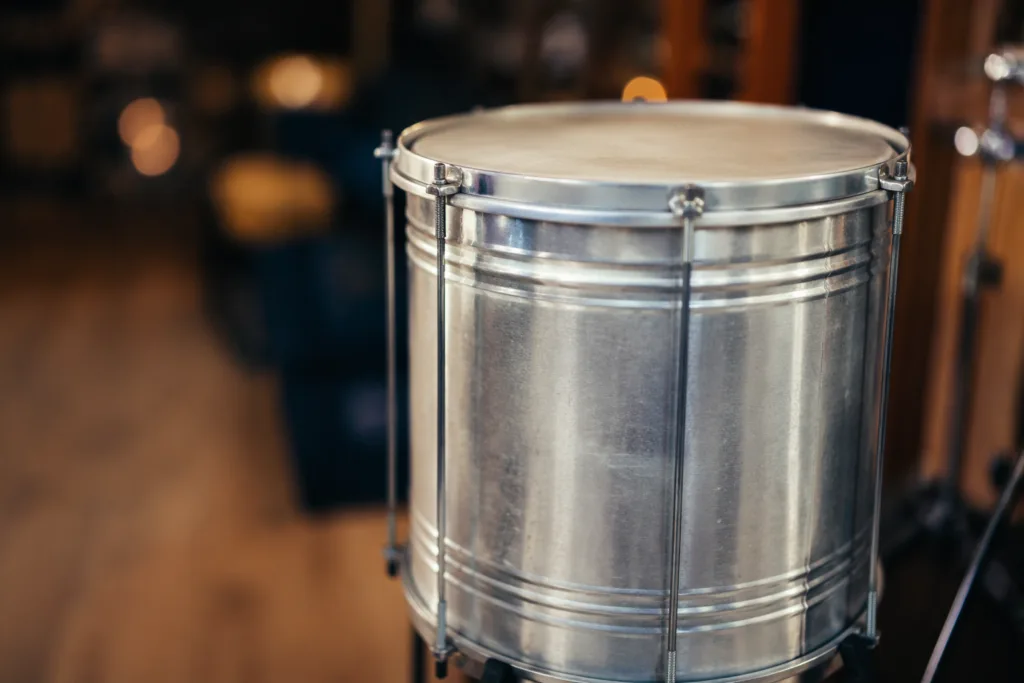
The surdo does not sit on top of samba. It sits under it—quietly, firmly, and with that broad low-frequency push that tells every other drum where the floor is.
- The surdo is the large bass voice of samba and several other Brazilian styles.
- Its sound changes a lot with shell material, body depth, and head choice.
- A Rio-style setup, a Bahia-style setup, and a modern parade build may all say “surdo” on paper—yet they do not feel or speak the same way.
| Part | Common Size Range | Main Job | Typical Sonic Feel |
|---|---|---|---|
| Primeira / Marcação | Usually 22"–26" | Anchors the pulse | Round, low, weighty |
| Segunda / Resposta | Usually 20"–22" | Answers the pulse | Tighter, quicker reply |
| Terceira / Cutador | Usually 14"–18" | Adds syncopation and lift | Drier attack, more bite, more motion |
Why The Surdo Holds The Whole Groove Together
Many drums help the groove. The surdo declares it. In a bateria, that matters because the ear usually locks onto the lowest stable voice first. Once that bottom layer is steady, the sharper instruments—caixa, tamborim, agogô—can dance around it without the ensemble sounding loose.
That is why a well-built surdo drum feels less like decoration and more like architecture. The shell has to project, the head has to bloom without turning cloudy, and the rebound has to stay usable even when the player damps the head with the free hand. A weak low note does not just sound smaller. It changes the way the whole rhythm stands up.
How The Body and Head Shape The Voice
Wood Shell Vs. Aluminum Shell
🪵 Wood-shell surdos usually speak with a warmer, fuller low end. The note tends to feel more rounded at the edge, with a little more body in the middle of the sound. For studio work, smaller ensembles, or players who want a bass note that sits thick rather than bright, wood can feel very satisfying.
🔩 Aluminum-shell surdos, by contrast, often give a more direct attack and a cleaner push through a noisy ensemble. They are also lighter on the body, which matters in rehearsals, parades, and long standing sets. In practical terms, wood often sounds softer around the edges, while aluminum tends to speak faster.
If the drum will live in a large samba group, shell weight and projection often matter more than romance. A beautiful warm shell is lovely—until the player has to carry it for two hours.
Goatskin Vs. Synthetic Head
Natural goatskin is loved for good reason. It usually gives the surdo a warmer, fuller note with longer sustain and a softer edge at impact. On a deep low-pitched drum, that can sound broad and noble rather than boomy. The note spreads.
Synthetic heads often bring a sharper attack, more overtone presence, and a more stable response in changing weather. On higher surdo voices, especially where the line needs to cut and answer quickly, that extra definition can help a lot. Not prettier. Just more pointed.
There is also the napa-style option, which many players reach for when they want a shorter, darker bass note with very little ring. This can make the low end feel compact and punchy rather than open. In the right ensemble, it sounds superb. In the wrong one, it can make the section too muffled.
Deep Rio Body Vs. Short Bahia Body
Body depth changes more than comfort. It changes the sentence the drum speaks. A deeper Rio-style surdo tends to give a broader low note and a slightly more expanded bloom after the strike, while the shorter Bahia-style body usually feels quicker, drier, and easier to carry—especially when the drum hangs lower on the body.
That difference is easy to miss in short gear write-ups. It should not be missed. A player may think they are choosing only between sizes, but they are also choosing between how long the note hangs in the air and how fast the drum gets out of the way.
How The Three Main Surdo Voices Speak To One Another
| Voice | What The Ear Hears | What The Body Feels |
|---|---|---|
| Primeira | The ground note | Weight and direction |
| Segunda | The answer | Balance and forward motion |
| Terceira | The cut across the pulse | Swing, lift, tension-release |
The classic Rio battery logic is elegant: one low surdo marks, another answers, and a higher drum cuts through with syncopation. The primeira and segunda create a call-and-response floor. The terceira gives the line its living edge.
And that edge is where taste shows. A terceira that is tuned too low loses agility. One that is too tight can sound detached from the rest of the section. The best setups leave enough contrast for the part to lift the groove, but not so much that it stops sounding like a surdo.
Short sentence, but it matters: pitch separation is not the same thing as musical separation.
Where The Instrument Came From—and Why That Origin Still Matters
The modern surdo is tied to Rio de Janeiro’s early samba-school culture and is commonly linked to Alcebíades Barcelos, known as Bide, one of the musicians around the first samba school, Deixa Falar. That history matters because the instrument did not appear as a museum piece or a polite salon drum. It arrived to solve a rhythmic and acoustic need.
Even the word surdo carries a useful hint. In Portuguese, it can point toward the sense of deaf or a muted, hollow quality. That does not mean the drum sounds dead. Far from it. It means the voice is low, thick, and less about sparkle than physical presence.
Another point often skipped: Bide is associated not only with the drum’s early use, but with the accented second beat that became central to popular samba phrasing. So when listeners talk about the surdo as “just the bass drum,” they flatten the story too much. This is not merely a lower drum. It is a lower drum with a very specific job in shaping how samba breathes.
Rio-Style Surdo Vs. Bahia-Style Surdo
Rio-style surdos often favor a broader, lower pulse and a section logic built around marcação, resposta, and the higher cutting voice. The deeper shells and the way the parts interlock give the ensemble a rolling floor with lots of body.
Bahia-style surdos, especially in samba-reggae settings, often use shorter shells, stronger visual presence, and a playing style that can feel more vertical and immediate. The attack speaks sooner. The drum sits differently on the body. The choreography changes the relationship between player and instrument too.
Neither approach is “better.” That is the wrong question. A better question is this: Do you want the note to spread, or do you want it to strike and clear?
Vintage Deep-Shell Surdo Vs. Modern Lightweight Parade Build
An older deep-shell surdo drum can offer a bass note with real breadth, especially when paired with natural heads. The sound often feels less trimmed, less standardized, and a little more human around the edges. Small inconsistencies—shell age, hoop wear, head seating—can become part of the charm rather than a defect.
Modern parade-oriented builds often trade some of that looseness for lighter weight, faster setup, and cleaner hardware. Threads are more reliable. Tuning tends to be easier. Synthetic options also make the instrument far less temperamental outdoors.
Collector ears and working-player ears do not always chase the same thing.
On an older surdo, look first at shell roundness, bearing-edge wear, lug alignment, and hoop stability. Cosmetic marks may add character. A shell that no longer seats a head properly will add headaches.
Surdo Vs. Zabumba
These two drums can both live in the low register, but they are not built for the same sentence. The surdo is usually asked to anchor ensemble pulse in samba and related settings, often with one main striking surface doing the public speaking while the other head supports resonance. The zabumba, by contrast, is a more compact bass drum tied closely to northeastern styles such as forró and baião, and it often creates contrast between a softer low stroke and a sharper answering stroke on the opposite head.
So while both can deliver bass, the surdo feels more like a communal floor under multiple percussion voices. The zabumba often behaves more like a self-contained rhythmic engine inside a smaller groove cell.
What A Good Surdo Feels Like In The Hands
- A clean low note appears without having to strike too hard.
- The head accepts damping without choking completely.
- The rebound feels usable, not gummy.
- The shell does not rattle when the drum is played with intent.
- The strap position makes the instrument feel balanced rather than fought.
Those details sound plain. They are not. A surdo that asks for too much force will tire the player and flatten the groove. One that speaks easily lets the drummer save weight for the places where the music actually needs emphasis.
And yes—beater choice changes the conversation. A softer beater rounds the attack and lets the bass speak in a more cushioned way. A firmer beater adds edge and definition. On higher voices, that can help the line read clearly. On low voices, too much hardness can make the drum sound more click than body.
Buying Advice That Makes Sense For Real Use
- Choose by musical role first, not by diameter alone.
- Choose by carrying comfort second, especially for street playing.
- Choose head type by ensemble texture: warm and open, sharp and direct, or short and dark.
- Check hardware honestly. Fine threads and stable rims save time and temper.
- Do not ignore body depth. It changes both sound and posture.
A player buying a first surdo drum often thinks only in inches: 18, 20, 22. Fair enough. But inches do not tell the whole story. Shell depth, head material, strap position, and the role the drum must play in the section often decide whether the instrument feels alive after six months—or ends up hanging on the wall.
That last point is worth keeping short.
The best surdo is the one whose voice matches its job.
FAQ
Is It Hard To Learn The Surdo If I Already Play Drums?
Answer
If you already play drums, the basic coordination will feel familiar, but the musical role is different. The surdo asks for pulse control, tone control, and restraint. In samba, playing fewer notes with better weight usually matters more than showing a lot of technique.
How Do I Know Whether I Need A Primeira, Segunda, or Terceira?
Answer
Choose by function. A primeira gives the deepest grounding note, a segunda answers that pulse, and a terceira adds the higher syncopated voice. If you play alone or in a small group, the middle size is often the easiest starting point because it balances depth and control.
Which Head Sounds Better On A Surdo: Goatskin or Synthetic?
Answer
Neither is always better. Goatskin often sounds warmer and fuller with longer sustain, while synthetic heads usually give a more direct attack and steadier response in changing weather. The better choice depends on whether you want roundness, cut, or easier maintenance.
What Size Surdo Should I Buy For Rehearsals and Street Playing?
Answer
Many players start with a medium-size surdo because it is easier to carry and easier to fit into different ensemble roles. Large drums give more low-end weight, but they also ask more from the body. For street use, comfort and balance matter almost as much as sound.