
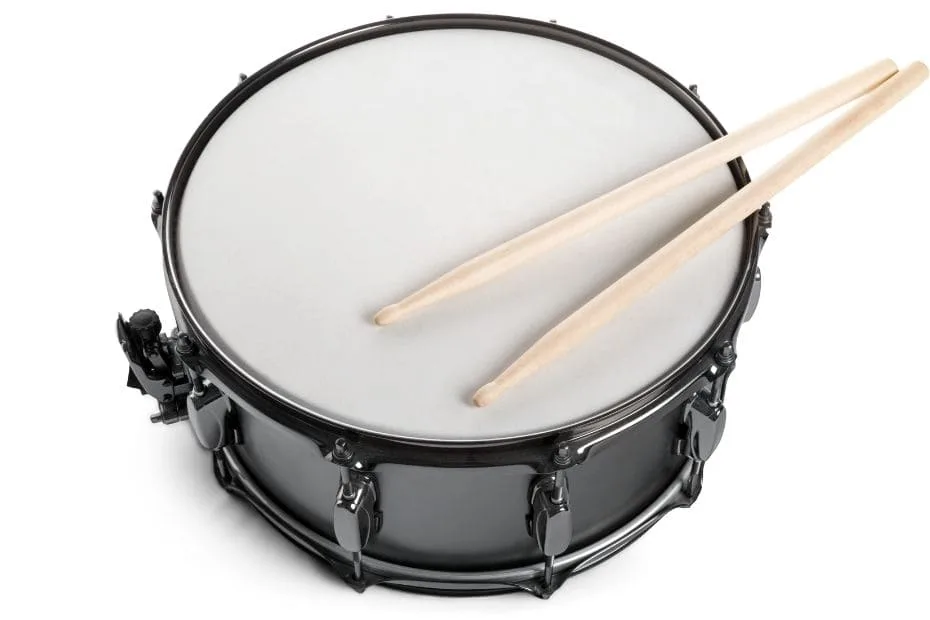
Piccolo Snare: What the Shallow Shell Actually Changes
A piccolo snare is a shallow snare drum built for a short, immediate response rather than the fuller shell contribution of a standard-depth snare. Common examples are around 3–4 inches deep, often with 12-, 13-, or 14-inch diameters. Its defining characteristic is depth, not one mandatory diameter, shell material, or musical genre.
| Variable | Piccolo Effect | What the Player Notices |
|---|---|---|
| Shell depth | Less internal air volume and less shell contribution to the decay | Fast, compact note with less low-frequency body |
| Diameter | Controls much of the available pitch range independently of depth | A 12- or 13-inch drum usually reaches a higher voice more naturally than a 14-inch model |
| Snare response | Shallow geometry can make wire response feel immediate, but setup remains decisive | Ghost notes and short strokes can speak with very little delay |
| Tuning range | Usually strongest from medium-high upward; very low tuning can lose definition quickly | Small lug changes become easy to hear |
| Kit role | Strong tonal contrast beside a deeper primary snare | Useful as an auxiliary or side snare for alternate backbeats and accents |
Shallow Shell Geometry and the Shorter Note
The most important difference is the reduced distance between the batter and snare-side heads. A piccolo shell holds less air than a 5.5-, 6.5-, or 8-inch-deep snare of the same diameter. The drum therefore contributes less low-frequency body and usually settles more quickly after the initial strike.
This does not mean that shell depth alone determines pitch. Head diameter, head tension, membrane type, snare-wire setup, bearing edges, hoops, and shell material all affect the result. A 14 × 3.5 piccolo and a 12 × 4 piccolo can behave very differently even though both are shallow.
Common Confusion: A shallow shell does not automatically create a higher fundamental pitch. Smaller diameter and higher head tension are major reasons many piccolo snares sound high. Reduced depth mainly changes body, decay, and the relationship between the two heads.
Why Piccolo Snares Feel So Immediate
A well-set-up piccolo often gives the impression that the snare wires respond almost at the same instant as the stick attack. The short shell contributes little lingering body, so the transient and wire response remain exposed rather than being surrounded by a longer resonant envelope.
This is especially noticeable on ghost notes, drags, short rolls, accented taps, and tight backbeats. Quiet strokes can remain clearly separated when the snare-side head and wires are balanced correctly.
Sensitivity is not guaranteed by depth alone. A poor snare bed, stretched resonant head, bent wires, excessive wire tension, or uneven tuning can make a shallow drum less responsive than a properly set up standard snare.
Pitch: Depth and Diameter Do Different Jobs
Piccolo snares are often described simply as “high-pitched,” but that description hides two different variables. Diameter has a strong influence on the pitch range available from the heads, while shallow depth reduces the amount of low body and resonance behind that pitch.
A classic piccolo proportion. The small diameter and very shallow shell naturally favor a compact, high, dry voice with strong stick definition.
Keeps the familiar playing area of a 14-inch snare while removing much of the deeper shell body. It can sound broad in diameter but short in decay.
The smaller head area pushes the usable voice higher and can create greater separation from a 14-inch main snare. Exact depth varies by maker.
The term piccolo is not applied with perfect consistency by every manufacturer. Some deeper small-diameter snares are marketed with the label even though their geometry overlaps with drums described elsewhere as soprano or auxiliary snares. Actual dimensions are more informative than the product name.
Articulation Is the Main Reason to Choose One
A piccolo snare is most useful when the arrangement needs a note that begins and ends quickly. Its compact decay leaves space between strokes, helping dense subdivisions remain distinct.
Quiet strokes can remain easy to distinguish because the previous note does not leave as much low shell resonance behind it.
The shallow voice produces a hard, immediate rim-and-head attack. Hoop choice changes how focused or open that attack feels.
A 13- or 14-inch model retains enough rim length for a usable cross-stick, while very small diameters can feel physically different under the hand.
The short envelope prevents closely spaced strokes from accumulating into as much wash, which can help intricate parts stay separated.
The Piccolo as a Side Snare
The piccolo works especially well as an auxiliary snare because its job can be clearly separated from the primary drum. A deeper 14-inch main snare may provide body and a broad backbeat, while the piccolo supplies a shorter, higher secondary voice.
Common placements include beside the hi-hat, to the left of the main snare for a right-handed player, or on the opposite side of the kit when the setup allows it. Position should follow reach and musical function rather than one required layout.
Move selected sections of a groove to the piccolo to create contrast without changing cymbals or tuning the main snare.
Use it for fills, displaced backbeats, short responses, or isolated rimshots that need to sound clearly different from the primary snare.
A tight, short tuning can imitate the compact envelope associated with sampled or programmed snare sounds while remaining fully acoustic.
A piccolo does not need to be louder than the main snare to separate effectively. Differences in pitch, decay, articulation, and rim character can create enough contrast on their own.
Tuning a Piccolo Has a Narrower Margin for Error
A shallow snare reacts noticeably to small tension changes because there is less shell resonance available to soften unevenness between the heads. One lug that is substantially different from its neighbors can become obvious in both pitch and wire response.
Start with Even Head Seating
Bring the batter head up gradually in opposing lug pairs. Before chasing a target pitch, make the tension around the circumference as even as possible.
Keep the Snare-Side Head Controlled
A dedicated thin snare-side head should remain evenly tensioned. It does not need to be forced to an extreme pitch to create sensitivity.
Raise the Batter in Small Steps
Piccolo snares generally respond well in medium-high and high ranges. Quarter-turn or smaller adjustments are often enough once the drum is close.
Set Wire Tension Last
Tighten only until soft strokes speak clearly. Extra tension can shorten the wire response too far and make the drum sound choked.
Tuning Constraint: Lowering a piccolo does not necessarily turn it into a deeper-sounding standard snare. Once head tension drops too far, the drum may lose articulation and wire response before it develops convincing low-frequency body.
Snare Wires: More Is Not Always More Sensitive
Wide snare-wire sets are often sold as a way to increase sensitivity, but a very shallow drum can become dominated by wire sound if the strand count is excessive for the shell and snare bed.
A conventional 20- or 24-strand set is a useful reference point because it leaves room for both membrane tone and wire articulation. Wider assemblies can increase the amount of snare contact and quiet-stroke response, but they may also produce more sympathetic buzz and shorten the audible shell note.
Wire tension matters just as much as strand count. A piccolo often sounds clearer when the wires are centered and moderately tensioned rather than pulled as tight as possible.
When a Piccolo Sounds Too Thin
A high, compact voice is normal. A papery or weak sound usually indicates a setup problem rather than proof that every piccolo lacks body.
| Symptom | Likely Area to Check |
|---|---|
| Sharp attack but almost no drum tone | Excessive batter tension, heavy dampening, or overly tight wires |
| Weak ghost-note response | Snare-side head condition, wire centering, snare-bed contact, or wire tension |
| Persistent sympathetic buzz | Wire tension, nearby drum tuning, resonant-head pitch, or overly wide wire set |
| Uneven rimshots | Hoop seating, head tension around individual lugs, bearing edge, or playing position |
| Low tuning feels loose and unfocused | The drum may be below its most usable tuning range |
Shell Material Matters Less Than Geometry at First
Wood, brass, steel, aluminum, and other shell materials still influence overtones, attack, weight, and decay. On a piccolo, however, diameter, depth, head choice, and tuning can dominate the first impression because the shell is so shallow.
A 13 × 3 steel drum and a 13 × 3 maple drum can have different overtone structures and rimshot characters, but both retain the rapid envelope created by the same basic shallow geometry. Material selection should refine the piccolo voice rather than replace the decision about dimensions.
Piccolo Snare vs Standard Snare
Usually around 3–4 inches deep. Short decay, exposed attack, limited low-shell body, fast-feeling articulation, and strong suitability as an auxiliary voice.
Common depths around 5–6.5 inches provide more internal air volume and shell contribution, giving the player a wider balance between crack, body, sustain, and lower tuning.
The piccolo is therefore not simply a normal snare tuned higher. Its physical proportions change how much resonance follows the attack and how narrow the useful low-tuning range can become.
Choosing a Piccolo for a Two-Snare Setup
- Choose a diameter that creates audible separation from the main snare; a 12- or 13-inch model usually separates more clearly from a 14-inch primary drum.
- Use shell depth to control how short and compact the secondary voice should feel.
- Check that ghost notes remain clear without excessive wire tension.
- Test rimshots at realistic playing volume; a piccolo can become harsh when tuned high and struck heavily.
- Confirm that the stand and surrounding hardware allow comfortable access without changing normal hi-hat or main-snare technique.
- Judge the drum at the tuning you will actually use rather than buying only from its lowest possible pitch.
Terminology
Piccolo snare: A snare drum distinguished primarily by an unusually shallow shell, commonly around 3–4 inches deep.
Side snare: An auxiliary snare placed beside the primary drum to provide a contrasting pitch, decay, or articulation.
Batter head: Upper drumhead struck by the stick.
Snare-side head: Thin lower membrane that transfers vibration to the snare wires.
Snare wires: Metal strands resting against the snare-side head and producing the characteristic buzzing response.
Snare bed: Shallow shaping in the shell’s bottom bearing edge that helps the wire assembly contact the resonant head correctly.
Choking: Loss of open response caused by excessive head, wire, or damping restraint.
Sympathetic buzz: Snare-wire vibration triggered by another drum, instrument, or nearby frequency rather than by direct striking.