
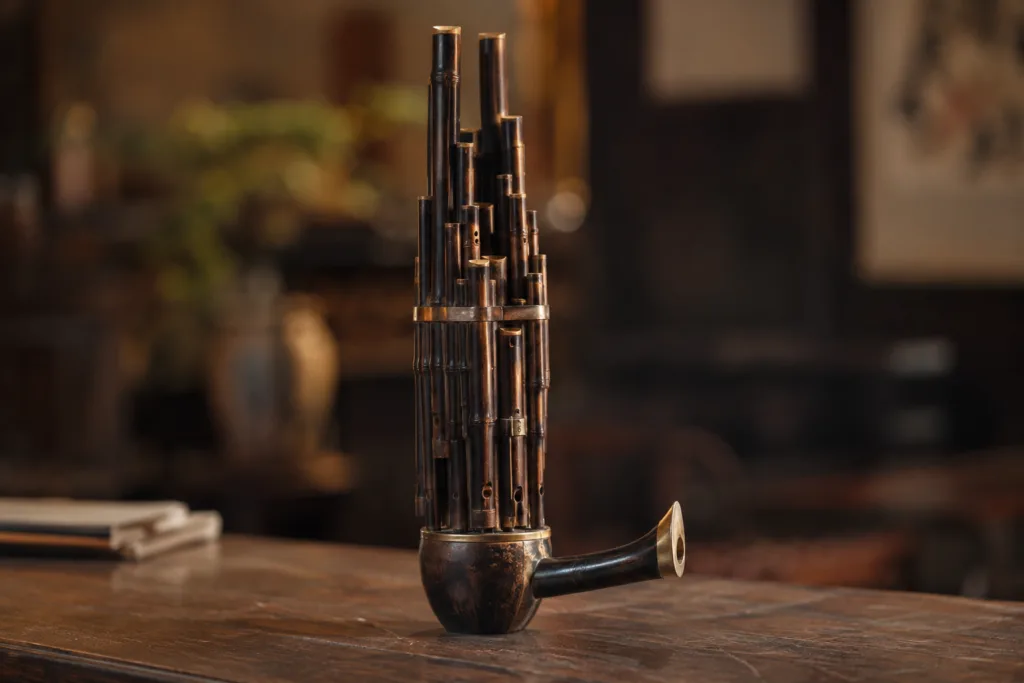
The sheng is a Chinese free-reed mouth organ in which a cluster of pipes shares one wind chamber. Its sound does not come from the bamboo tubes alone, and it does not come from the metal reeds alone. Each playable pipe forms a coupled acoustic system: breath sets a thin free reed into motion, the attached pipe reinforces that vibration, and the player selects which pipe can operate by controlling its vent or key.
A Sheng Is a Reed-and-Pipe System, Not a Set of Simple Flutes
A traditional sheng typically places multiple bamboo pipes into a common wind chamber fitted with a mouthpiece. Near the lower end of each sounding pipe is a small metal free reed. The reed is a flexible tongue fixed at one end and able to swing through a closely fitted opening without beating against another reed or a hard surface.
That distinction separates the sheng from single-reed instruments such as the clarinet and double-reed instruments such as the oboe. In those instruments, a reed interacts with a mouthpiece or another reed. In the sheng, the tongue moves freely through its frame as air passes it.
The pipe therefore does more than carry sound away from the reed. Acoustic measurements of Asian free-reed mouth organs show strong coupling between the reed’s vibration and the resonance of its pipe. In a sheng pipe, the played frequency normally sits close to the natural tendencies of both parts rather than being set by only one of them.
What Happens When One Sheng Pipe Sounds
Breath Changes the Pressure in the Wind Chamber
The player blows into the mouthpiece or draws air through it. Either action creates a pressure difference across the reed system.
The Player Activates a Pipe
On many traditional pipes, this means covering a finger hole. On keyed designs, pressing a key may open or close a vent instead. The exact mechanical action varies with the sheng type.
Airflow Drives the Metal Tongue
Once the pipe has the right vent condition, air can interact with the reed in a stable way. The thin tongue repeatedly moves through its frame, interrupting and modulating the airflow.
The Pipe Reinforces the Oscillation
The reed and the air column in the pipe influence each other. When their acoustic relationship supports stable oscillation, the note settles into a sustained pitch.
The Pipe Radiates the Finished Tone
The resulting sound carries both the metallic reed excitation and the filtering effect of the pipe. This is why a sheng note has a focused, reedy character rather than the dry buzz of an exposed reed by itself.
Why Covering a Finger Hole Can Make a Pipe Speak
A sheng finger hole can confuse players who approach the instrument with flute fingering in mind. On a flute, opening and closing tone holes changes the effective length of one main air column. On many traditional sheng pipes, the small hole has a different job: it helps determine whether that individual reed-and-pipe system can sustain a note at all.
With the finger hole open, the pipe is vented in a way that prevents the normal reed-pipe interaction needed for that note. Covering the hole changes the acoustic condition of the pipe, allowing the reed and resonator to work together. The player is therefore selecting a complete pipe unit rather than shortening one shared melodic tube.
| Condition | What Changes | Musical Result |
|---|---|---|
| Hole open | The pipe remains vented. | The selected reed-pipe pair normally does not sustain its intended note. |
| Hole covered | The pipe reaches the acoustic condition required for normal coupling. | The pipe can sound when pressure is supplied through the chamber. |
Common Confusion: Not every sheng uses the same control logic. Some modern pipes use mechanical keys and vents, and a keyed pipe may sound when a key opens a hole rather than when a finger closes one. The fingering mechanism should not be generalized from a single model.
Why the Sheng Can Sound on Both Blowing and Drawing
One of the sheng’s unusual playing properties is that a note can continue when the player changes the direction of airflow. Traditional Asian mouth-organ reeds are approximately symmetrical, unlike many Western free reeds whose tongues are offset for efficient operation in one airflow direction.
Because of that geometry, the sheng reed can be driven when air moves through the system in either direction. The player can blow into the chamber and later draw air back through it while maintaining selected pitches. The response and loudness need not be perfectly identical in both directions, but the mechanism supports both.
Blow and Draw Use the Same Basic Acoustic Chain
Air pressure rises in the chamber, the active reed oscillates, and the connected pipe reinforces the note.
Air moves in the opposite direction, but the approximately symmetrical reed can still oscillate with the resonating pipe.
This bidirectional response affects phrasing. A player is not forced to stop every sounding pipe simply because the lungs need to switch between exhalation and inhalation. Breath direction can become part of sustaining a continuous line.
Why Pipe Length Alone Does Not Tell You the Note
The sheng’s tall and short pipes invite a simple assumption: the longest pipe must always be the lowest note and the shortest must always be the highest. Pipe length matters, but a sheng is not governed by tube length alone.
Each note depends on the relationship between the reed and its resonator. The reed has its own natural vibration behavior, while the pipe has one or more resonances determined by its effective acoustic length, bore profile, openings, and any added resonator. The played pitch emerges from their interaction.
Length, width, thickness, stiffness, and added tuning mass affect how readily the metal tongue vibrates and where its natural resonances lie.
Bore length and shape alter the resonant behavior of the air column. Sheng pipes may include cylindrical and tapered sections rather than acting as perfectly uniform tubes.
Slots, windows, and vents can alter effective resonance and radiation. Their position and form depend on the pipe design.
Some modernized shengs use attached resonators that increase projection and change spectral balance while also affecting the pipe’s acoustic response.
Traditional reed tuning may also use a small wax mass on or near the free end of the tongue. Changing that mass changes the reed’s vibration behavior. Fine setup therefore involves more than cutting every bamboo pipe to a target length.
How One Wind Chamber Produces Chords
A sheng does not have one reed that is redirected to different notes. It has multiple reed-and-pipe units sharing the same air reservoir. Activating several compatible pipes at once allows several reeds to oscillate together.
This architecture makes intervals and chords possible without adding strings, multiple mouthpieces, or a keyboard-controlled bellows. The player’s fingers determine which pipe units are acoustically active while the mouth supplies one shared pressure system.
The practical result is a tone that can be both melodic and harmonic. Single notes can sound focused and penetrating; clustered notes become denser, with several reedy spectra combining into a sustained sonority.
Traditional and Modern Shengs Do Not Share One Fixed Layout
The familiar image of a sheng often shows a compact circular group of bamboo pipes rising from a bowl-shaped wind chamber. Seventeen-pipe instruments are well documented and remain an important traditional form, but 17 pipes should not be treated as the universal definition of a sheng.
Twentieth-century development produced larger instruments with more pipes, expanded chromatic ranges, mechanical keys, folded or extended low resonators, and designs intended for modern ensemble and orchestral writing. Acoustic studies have examined performance shengs with 24 pipes in which different registers use different pipe structures.
| Design Area | Traditional Forms | Expanded or Keyed Forms |
|---|---|---|
| Pipe count | Often compact, with 17-pipe examples especially familiar. | May use more pipes to extend chromatic range and register. |
| Note control | Direct finger holes are common. | Keys may operate vents that would be difficult to reach directly. |
| Low register | Limited by the physical scale of a compact mouth organ. | Long, folded, or augmented resonators can extend lower pitches. |
| Projection | Depends strongly on pipe and chamber construction. | Added resonators may increase radiated sound and alter tone color. |
These differences matter when describing how a particular sheng works. A statement that is accurate for a small traditional instrument may be wrong for a modern keyed bass or alto model.
What Shapes the Sheng’s Tone
The sheng’s characteristic sound comes from several interacting parts. The metal tongue gives the attack a reedy edge, while the pipe filters and reinforces selected frequencies. Chamber sealing, reed setup, pipe geometry, breath pressure, and the number of simultaneously sounding pipes all change what reaches the listener.
A well-set reed can speak quickly because the tongue is light and directly driven by airflow. Poor reed alignment or leakage can make the response slower or unstable.
As long as airflow and the reed-pipe relationship remain stable, a note can continue without the natural decay heard from plucked or struck instruments.
The combination of metallic reed excitation and narrow pipe resonance creates a focused, bright-to-reedy tone with a clear harmonic structure.
When several pipes speak at once, their spectra overlap. The texture becomes fuller and more organ-like without changing the instrument’s basic breath-driven mechanism.
The material of the wind chamber also matters mechanically. Historical instruments use materials such as gourd, wood, and metal in different forms. The chamber must hold the pipe feet and reeds securely while remaining sufficiently airtight; leaks reduce pressure control and can make reeds difficult to start.
The Phoenix Shape Is Symbolic, but the Pipe Arrangement Is Functional
The rising bamboo cluster is traditionally associated with the folded wings of the phoenix, and historical museum descriptions preserve that symbolism. The visual interpretation belongs to the instrument’s cultural history, but it should not be used as the mechanical explanation for the layout.
Pipe placement must also solve practical problems. Each tube needs access to the shared chamber, enough room for the reed assembly, a usable vent or key position, and a physical arrangement that the player can hold and finger. Larger modern instruments modify the familiar silhouette because added range places new demands on resonator length and key access.
How Far Back Can the Sheng Be Traced?
The sheng belongs to a very old East and Southeast Asian mouth-organ tradition, but statements about a single exact invention date should be treated carefully. Written traditions, archaeological objects, later museum instruments, and present-day shengs do not all provide the same kind of evidence.
Mouth organs identified with the sheng tradition appear in early Chinese musical history and became associated with ritual and court settings.
Surviving wood-and-gourd mouth-organ pieces dated to this period provide physical archaeological evidence for an early Chinese form of the instrument.
Bamboo-pipe instruments with enclosed metal free reeds developed into forms recognizable as members of the sheng family, including compact circular pipe arrangements.
Makers created chromatic, keyed, enlarged, and register-specific designs suited to new ensemble roles and wider pitch ranges.
What We Know: Archaeology supports an early Chinese mouth-organ tradition, while the wider history of free-reed mouth organs also reaches across Southeast and East Asia. It is safer to describe the sheng as an ancient Chinese instrument within that broader regional family than to assign the entire free-reed principle to one person or one exact year.
How the Sheng Differs from Western Free-Reed Instruments
The sheng, harmonica, accordion, concertina, and harmonium all belong to the broad free-reed family, but they do not use identical acoustic systems. The sheng couples individual reeds to tuned pipe resonators. Western free-reed instruments commonly use offset reeds that operate efficiently in one airflow direction and do not require long tuned pipes for every note.
| Feature | Sheng | Harmonica | Accordion or Concertina |
|---|---|---|---|
| Air supply | Mouth-blown and drawn | Mouth-blown and drawn | Bellows |
| Reed relationship | Each active reed is coupled to a pipe resonator. | Reeds work in compact chambers without sheng-style long resonating pipes. | Reeds are mounted in reed blocks and driven by bellows pressure or suction. |
| Airflow direction | The same reed can commonly operate on blow and draw. | Blow and draw commonly activate different reeds. | Behavior depends on reed arrangement and instrument system. |
| Polyphony | Several pipe units can sound together. | Several reeds can sound together. | Designed for multiple simultaneous notes and chords. |
The sheng later became part of European awareness of free-reed instruments, and early nineteenth-century experiments such as Charles Wheatstone’s symphonium show a clear visual and mechanical interest in mouth-operated free reeds. That history is better understood as transmission and experimentation than as a simple claim that one instrument was copied directly into another.
The Complete Sound Path in One Breath
Pressure Is Created
The mouthpiece connects the player’s breath to a shared wind chamber.
A Pipe Is Made Acoustically Active
A finger hole or key changes the vent condition of the selected pipe.
The Free Reed Oscillates
The metal tongue moves through its frame as air crosses the reed assembly.
The Reed and Pipe Settle into a Coupled Vibration
The pipe resonance interacts with the reed rather than merely amplifying a pitch that was already fixed.
One or Several Notes Radiate
Each active pipe contributes its own sustained tone. Selecting several pipes turns the same breath into an interval or chord.
This combination of bidirectional breath, free reeds, individually resonating pipes, and simultaneous note selection explains why the sheng can behave like a compact mouth organ while retaining the physical immediacy of a wind instrument.