
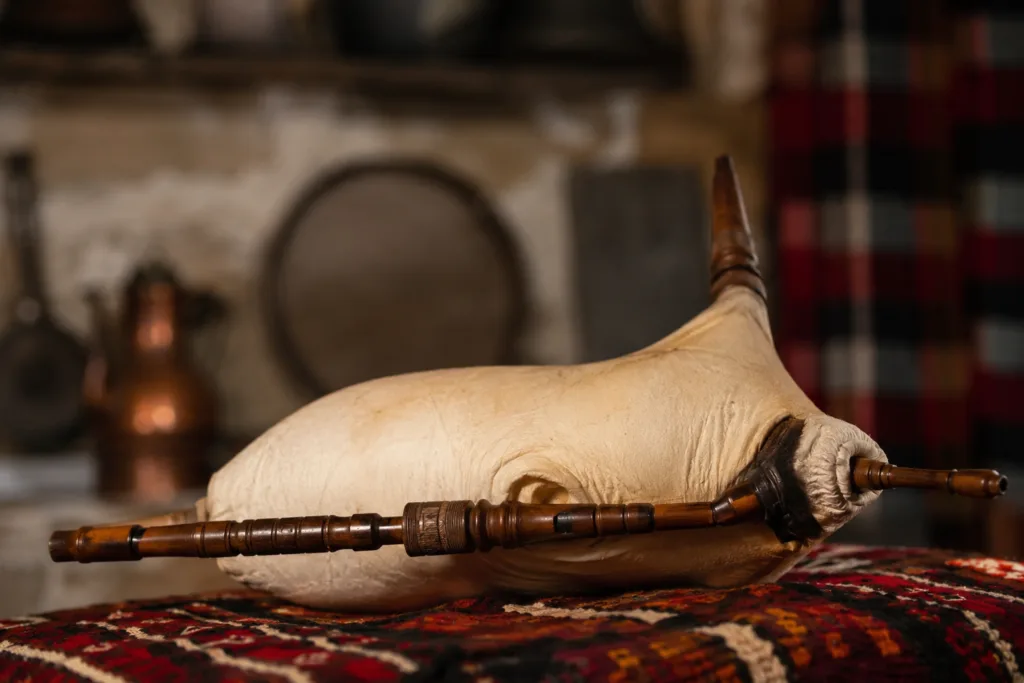
Instrument Snapshot
The Bulgarian gayda, more often transliterated as gaida, is a mouth-blown bagpipe with a leather airbag, a fingered melody pipe, a single drone, and separate reeds. Its sound ranges from the bright, penetrating voice of the djura gaida to the low, rounded tone of the Rhodope kaba gaida. In 2025, UNESCO inscribed Bulgarian bagpipe making, playing, and knowledge transmission on the Representative List of the Intangible Cultural Heritage of Humanity.
The Bulgarian gaida produces melody and drone at the same time. Air stored in the hide bag passes through reeds fitted inside the melody pipe and drone. The player maintains pressure with the arm while taking another breath, so the musical line can continue without the interruption expected from an ordinary flute or reed pipe.
The instrument is not a Bulgarian version of the Scottish Highland bagpipe. Both belong to the bagpipe family, yet their pipe arrangement, reed behavior, fingering, tuning logic, regional repertories, and social uses differ. A Bulgarian gaida normally has one melody pipe and one drone rather than the multiple shoulder drones associated with Highland pipes.
The name appears in English as gaida, gayda, or gajda. Bulgarian uses the Cyrillic spelling гайда. Similar names occur elsewhere in the Balkans, but shared terminology does not make every regional instrument identical. Construction details and playing styles can change across Bulgaria, North Macedonia, Greece, Türkiye, Serbia, and neighboring areas.
Anatomy and Airflow
A gaida can look simple because its visible structure has only a few main parts. Each part must nevertheless work as part of a carefully balanced air system. A leak in the bag, an unstable reed, or a poorly matched drone can make an otherwise well-made instrument difficult to control.
| Part | Bulgarian Term | Function | Construction Notes |
|---|---|---|---|
| Airbag | Meh | Stores air and smooths the flow to both reeds | Traditionally made from animal hide; size and preparation vary |
| Melody pipe | Gaidanitsa or gaidunitsa | Produces the changing notes controlled by the fingers | Made from turned and bored wood with carefully positioned holes |
| Drone | Ruchilo | Produces a continuous reference tone beneath the melody | Often assembled from several wooden sections for adjustment and storage |
| Blowpipe | Duhalo | Allows the player to refill the bag | May contain a simple non-return valve to reduce escaping air |
| Reeds | Piskuni | Convert airflow into vibration | The chanter and drone use separate reeds that must respond at compatible pressures |
| Stocks and connectors | Terms vary | Secure pipes to the hide and form airtight joints | Wood and horn are common in traditional examples |
How Continuous Sound Is Maintained
The player blows through the duhalo until the bag reaches a workable pressure. Air then passes to the chanter reed and drone reed. The left arm compresses the bag while the mouth takes another breath, preventing a noticeable break in the tone.
This is not the same as circular breathing. Circular breathing stores a small reserve of air inside the mouth. A gaida stores air in the external bag, which gives the player more time to coordinate breathing, pressure, fingering, and ornamentation.
The melody reed and drone reed must operate within a similar pressure range. A drone that needs far more pressure than the chanter can cause sharpness, instability, or hand fatigue. A weak reed may shut off when the player presses the bag firmly enough to support the other pipe.
How a Bulgarian Gaida Is Made
Traditional construction combines hide preparation, woodworking, reed making, sealing, and acoustic adjustment. Measurements help a maker repeat a familiar model, but finished performance still depends on hand fitting and testing. Two instruments built to similar dimensions may react differently because wood density, bore finish, reed stiffness, and hide elasticity are never perfectly uniform.
Preparing the Hide
The skin is removed and prepared with as few unwanted openings as possible. Natural leg and neck openings can become attachment points for the pipes. Unused openings are tied or sealed so that the bag holds pressure.
Turning the Wooden Parts
The chanter, drone, blowpipe, and stocks are shaped from seasoned wood. Exterior decoration matters less acoustically than the straightness, taper, diameter, and finish of the internal bores.
Drilling and Voicing the Chanter
Finger holes are positioned to work with the bore and reed. The maker may enlarge, undercut, or refine individual holes during voicing rather than relying only on equal visual spacing.
Making the Reeds
Separate reeds are prepared for the gaidanitsa and ruchilo. Their tongues, openings, binding, and insertion depth affect pitch, response, air demand, and tonal grain.
Joining Pipes to the Bag
Stocks are secured to the hide with airtight bindings. The pipes must sit firmly without placing damaging stress on the skin around each opening.
Leak Testing and Final Tuning
The maker closes the pipe openings, pressurizes the bag, and checks how quickly it loses air. Chanter and drone are then tested together and adjusted for stable response.
The Hide Is an Acoustic and Mechanical Part
The bag does more than hold air. Its volume affects how often the player must breathe, while its flexibility changes how pressure feels under the arm. A smaller bag can feel responsive and compact. A larger bag may provide a broader air reserve but must still fit the player’s body and arm position.
Whole goatskin is common in Bulgarian bagpipe making. Some makers and regional traditions also use sheepskin, especially where a larger bag is desired. These choices should not be treated as fixed rules for every djura or kaba gaida. Maker practice, available material, local custom, and intended pitch all influence the result.
Wood Selection and Bore Geometry
Plum, cornel, boxwood, and other dense woods appear in Balkan pipe making. A wood must be stable enough to hold a clean bore and resist splitting around finger holes and joints. Drying quality matters more than decorative grain. Unseasoned wood may warp or crack after the instrument has been tuned.
The chanter bore governs the relationship between reed vibration and the effective length of the air column. Bore taper, wall thickness, hole size, and the profile near the lower end all influence response. A chanter with an attractive exterior can still play poorly when the bore is rough, off-center, or poorly matched to its reed.
Materials and Their Effect on Sound
| Element | Common Choices | Effect on Performance | What Matters Most |
|---|---|---|---|
| Bag material | Goatskin, sheepskin, or modern airtight material | Changes flexibility, moisture behavior, air reserve, and pressure feel | Airtightness, suitable size, clean preparation, and secure bindings |
| Chanter wood | Plum, cornel, boxwood, or another stable hardwood | Can affect attack, surface noise, durability, and tonal focus | Bore geometry and seasoning usually matter more than wood name alone |
| Drone construction | Two-piece or multi-section wooden pipe | Controls the depth, steadiness, and tuning range of the drone | Sound joints, straight bores, and a well-matched reed |
| Natural reed | Cane, elder, or locally preferred plant material | Often gives a lively, grainy response but reacts to moisture and temperature | Tongue thickness, opening, binding, and maker adjustment |
| Synthetic reed material | Plastic or composite components | May offer steadier response under changing conditions | Compatibility with the chanter and the intended regional sound |
| Horn fittings | Cow horn or another prepared horn | Provides hard-wearing sockets, bells, or decorative transitions | Secure fitting without cracks or sharp edges against the hide |
Why the Reed Controls So Much
The reed is small, but it determines whether the note speaks easily, resists pressure, changes pitch under the arm, or shuts off without warning. A heavier reed tongue may produce a stronger and more stable tone while requiring more air. A lighter tongue can respond quickly but may become unstable when moisture accumulates.
Temperature and humidity alter natural reeds. Warm, moist conditions can soften a tongue and change its opening. Dry air can make a reed stiffer or cause fine splits. Players often learn minor reed adjustments from a maker or teacher because an aggressive cut can permanently damage the balance between chanter and drone.
Reed Warning: Trimming or bending a reed without understanding its original setup can change pitch, air demand, and stability at the same time. A tuning problem may also come from leakage, moisture, or an incorrectly seated pipe rather than the reed itself.
Djura Gaida and Kaba Gaida
The best-known Bulgarian categories are the djura gaida and kaba gaida. They are not merely the same instrument in two sizes. Their pitch, bore design, repertory, tonal balance, and regional associations lead players toward different musical functions.
UNESCO’s description also recognizes Bulgarian bagpipes by high, medium, and low pitch. This wider wording is useful because actual instruments do not always fit a strict two-box classification. Makers may build for a local pitch tradition, a solo player, a dance ensemble, or a standardized stage group.
Kaba Gaida vs Djura Gaida
The kaba gaida is strongly associated with the Rhodope Mountains. It has a lower register, a larger physical scale, and a broad drone that supports slow songs as well as regional dance melodies. Its chanter often has a bent lower profile and may be faceted rather than completely round.
The tone is dark, reedy, rounded, and dense. Large kaba gaida ensembles create a wide band of drone resonance, while solo players can use small pressure changes and ornamentation to shape long vocal-style phrases.
The djura gaida is smaller and higher in pitch. It is used across a wider part of Bulgaria and appears in dance settings, mixed folk ensembles, celebrations, and solo performance. Its focused tone can remain clear beside kaval, gadulka, tambura, tupan, and singing.
The sound is brighter, sharper, and more agile. The smaller air system usually responds quickly, supporting compact ornaments and rhythmically active melodies.
The Rhodope Kaba Gaida
The kaba gaida is closely tied to the central Rhodopes and should not be described only as a bass version of the djura. Its chanter design, low pitch, ornament language, and relationship with local singing form a regional practice of their own.
Many kaba chanters have a slight bend near the lower end and an exterior that can be round, angular, or hexagonal. The internal bore may narrow or widen in ways that differ from higher-pitched models. Those details affect how the instrument holds its low register and how readily notes respond to bag pressure.
Djura Does Not Mean One Fixed Model
The word djura generally points toward a higher-pitched and more compact Bulgarian gaida, yet regional examples may differ in scale, hole placement, ornamentation, and repertory. An instrument prepared for ensemble playing may also be adjusted toward a standardized pitch that is not identical to older village practice.
Regional identity therefore comes from more than the label on the instrument. The player’s fingering, preferred tunes, rhythmic treatment, teacher lineage, and reed setup can reveal as much as bag size or nominal pitch.
Fingering, the Flea Hole, and Ornamentation
Many Bulgarian gaida chanters have seven finger holes on the front and one thumb hole on the back. The exact arrangement can vary. Hole size and spacing work with the bore rather than following a purely visual pattern.
A distinctive feature is the very small upper opening often called the flea hole. It can alter selected notes by roughly a semitone and expand the player’s modal and ornamental options. Its exact effect depends on the chanter, reed, pressure, and fingering being used.
Traditional gaida technique often uses tight fingering. Instead of lifting several fingers to form each note as on a recorder, the player may keep most holes closed and release one finger at a time. This helps separate notes against the unbroken drone and supports short cuts, taps, and grace-note figures.
Pressure Is Part of the Fingering System
Bag pressure does not simply make the gaida louder. It can shift pitch, alter reed color, change the strength of an ornament, or help a note speak cleanly. Skilled players coordinate the fingers and arm so closely that pressure changes sound like part of the melodic language rather than a mechanical correction.
Overpressure may sharpen the chanter, disturb the drone, or close an unstable reed. Insufficient pressure can produce a weak attack or cause notes to sag. Learning to hold a steady pressure is therefore one of the first technical tasks, even before fast tunes become practical.
Melody Against a Fixed Drone
The drone provides a continuous tonal center while the chanter moves through a limited but flexible scale. This creates intervals that remain audible for longer than they would in a chordal accompaniment. Small tuning differences, ornaments, and pressure-shaped notes become part of the instrument’s character.
Western equal temperament is not always the best standard for judging a traditional gaida. An instrument may be internally coherent and suited to its repertory while some notes differ from a tuner set to twelve equal semitones. Problems become more apparent when the drone and resting notes clash, when pitch changes unpredictably under stable pressure, or when the instrument cannot play with its intended ensemble.
Sound Character and Musical Function
The Kaba Gaida Sound
A kaba gaida has a low, earthy drone and a chanter tone that can feel broad without becoming soft. The attack remains reedy, but the lower register gives each note more weight. Slow Rhodope songs allow the player to sustain long lines, place ornaments around the voice, and use the drone as a continuous tonal floor.
Several kaba gaidas playing together do not behave like a conventional harmony section. Their closely related drones and chanters create a dense field of beating, grain, and resonance. Minor tuning differences can add movement, though uncontrolled differences can also blur the melody.
The Djura Gaida Sound
A djura gaida has a more pointed attack and brighter projection. It can articulate uneven dance rhythms clearly and remain audible in a mixed instrumental group. Short ornaments cut through the continuous tone, helping dancers hear the shape and pulse of the melody.
The distinction should not be reduced to “sad kaba” and “happy djura.” Either instrument can carry dance music, ceremonial material, or expressive song. Region, repertory, tempo, and player style determine mood more reliably than instrument size alone.
Playing with Other Bulgarian Instruments
Djura gaida can appear with the kaval, a rim-blown flute; the gadulka, a bowed fiddle; the tambura, a long-necked plucked lute; and the tupan, a double-headed drum. The gaida contributes a fixed drone and a strong melodic edge, while the other instruments add rhythmic weight, contrasting attacks, or moving accompaniment.
Kaba gaida is closely identified with solo playing, singing, and groups of other kaba gaidas. Modern arrangements may place it in broader ensembles, but the regional tone can be lost when the instrument is forced into a texture that leaves no space for its drone and long melodic phrasing.
Regional Traditions Across Bulgaria
Regional gaida practice cannot be mapped as a set of rigid borders. Players move, teachers work outside their home districts, and stage ensembles bring repertories together. Even so, several musical areas remain useful for understanding differences in sound and use.
Low-pitched kaba gaida, long song melodies, heavy drone resonance, and close links with Rhodope vocal style. Smolyan, Shiroka Laka, Gela, Stoykite, and surrounding communities are strongly associated with the tradition.
Higher-pitched gaidas support active dance repertories and can work in mixed folk ensembles. Clear rhythmic articulation is important where melodies follow asymmetric meters.
Local dance forms, phrasing, and ornament choices shape the use of higher bagpipes. The label djura may cover instruments and styles that are not acoustically identical.
Regional repertories sit near wider Balkan contact zones. Shared instrument names and musical features should not erase local differences in playing technique, tuning, and social setting.
A performer’s regional identity is often heard in ornament placement and phrasing rather than in a single physical measurement. Formal music education can make ensemble coordination easier, yet it may also encourage standardized fingering and repertory. Older local variants can disappear even while the number of active performers remains healthy.
The Gaida in Bulgarian Social Life
The gaida has served as a dance instrument, a companion to singing, a solo voice, and a marker of communal events. It appears at weddings, festive meals, seasonal customs, masquerade events, village gatherings, folklore festivals, and staged concerts.
For dancing, the player does more than repeat a tune. Tempo, accents, phrase length, and ornament density can respond to the movement of the group. A gaidar may extend a phrase, intensify the pulse, or move into another melody without stopping the drone.
When accompanying a singer, the relationship changes. The drone establishes the tonal center while the chanter may answer the voice, support its contour, or leave space around important lines. The instrument is especially well suited to outdoor settings because its reeds produce a concentrated tone that carries without electrical amplification.
Large gaida gatherings are now highly visible, especially in Rhodope kaba gaida culture. Such events can strengthen teaching networks and public interest. They also differ from small-scale village performance, where one player may know the dancers, singers, rituals, and local variants personally.
UNESCO Recognition in 2025
In December 2025, the UNESCO Intergovernmental Committee inscribed “Bagpipes and bagpipe playing in Bulgaria: transmission of knowledge and skills” on the Representative List of the Intangible Cultural Heritage of Humanity.
The inscription covers more than the physical instrument. It recognizes knowledge of making and playing Bulgarian bagpipes, learning by observation and ear, family transmission, teaching by skilled makers and performers, formal and non-formal music education, community groups, festivals, competitions, and the gaida’s role in social life.
The Bulgarian bagpipe tradition was entered in the national Living Human Treasures inventory.
It was added to the Representative List of the Intangible Cultural Heritage of the Republic of Bulgaria.
UNESCO inscribed Bulgarian bagpipe making, playing, and knowledge transmission on its international Representative List.
What UNESCO Recognized: The inscription concerns a living practice maintained by makers, players, teachers, families, ensembles, schools, community cultural centers, festivals, and local groups. It is not an award for one antique instrument, one performer, or one village.
What the Inscription Does Not Claim
The gaida became a UNESCO World Heritage Site.
The recognized element is intangible cultural heritage. It is a practice and body of knowledge, not a monument or geographic site.
UNESCO declared that Bulgaria invented all bagpipes.
The decision recognizes Bulgarian communities and their living bagpipe tradition. It does not settle the ancient origin of the bagpipe family or grant exclusive cultural ownership.
The physical gaida alone received recognition.
Instrument making, performance, teaching, repertory, social use, and intergenerational transmission are treated as connected parts of the tradition.
A Separate Balkan Bagpipe Inscription
UNESCO also inscribed “Traditional bagpipe (Gayda/Tulum) making and performing” for North Macedonia and Türkiye in 2024. That is a separate multinational element. The Bulgarian inscription followed in 2025 under its own nomination and description.
The two decisions show that related bagpipe traditions can share instrument names and construction principles while remaining locally defined. One listing should not be used to merge Bulgarian gaida, Macedonian gajda, Thracian gayda, and Black Sea tulum into a single standardized instrument.
How Gaida Knowledge Is Transmitted
Learning by Ear and Observation
Traditional learning often begins by listening, watching the fingers, copying short phrases, and repeating a tune until its ornaments become natural. Written notation can preserve melodic outlines, but it rarely captures every pressure change, grace note, local tuning shade, and timing choice.
A learner also needs to hear how the drone relates to resting notes. This is difficult to absorb from finger charts alone. The teacher may adjust the reed, correct bag position, demonstrate a phrase slowly, and then ask the student to imitate the sound rather than explain it through abstract theory.
Families, Makers, and Apprentices
Bagpipe knowledge was once passed largely from fathers to sons in many communities. The living tradition now includes women and girls as players, teachers, and ensemble members. Family transmission remains active, but it is no longer the only route into gaida playing.
Makers carry a separate layer of knowledge. They must judge hide quality, season wood, cut bores, prepare reeds, seal joints, and match an instrument to the player. Some techniques are learned through repeated workshop practice because written dimensions cannot explain how a reed should feel under the knife or how a finished bag should respond under the arm.
Chitalishta, Music Schools, and Universities
Bulgarian community cultural centers, known as chitalishta, support local ensembles, lessons, rehearsals, and public performances. Music schools and universities add formal training, notation, ensemble discipline, and professional pathways.
Formal teaching can help more students gain access to the instrument. It can also favor standardized pitch and stage-ready repertory. Preservation therefore involves teaching shared technique without erasing older regional fingerings, tune variants, and maker practices.
Festivals and Bagpipe Gatherings
Festivals allow young players to hear instruments from other districts, meet makers, compare repertories, and perform in large groups. Competitions can raise technical standards, though judging systems may reward speed, volume, or polished stage presentation more readily than understated local style.
What Can Disappear While the Instrument Survives
A tradition can lose detail even when more instruments are being sold and more students are learning. Standardized chanters may replace local pitch systems. A small group of stage tunes may displace village-specific repertory. Recorded arrangements may become models for students who no longer hear older players in person.
Fragile elements include maker-specific reed methods, regional terms, unusual chanter scales, local ornament patterns, dance variants, song accompaniment practices, and the ability to adjust a melody to a particular singer or group of dancers.
Preserving a gaida in a museum protects the object. Preserving a tradition also requires playable instruments, active makers, skilled teachers, social occasions, and listeners who recognize regional style.
The Rhodope Sound on the Voyager Golden Record
NASA’s Voyager Golden Record includes the Bulgarian song “Izlel je Delyo Hagdutin”, sung by Valya Balkanska. The recording was placed aboard Voyager 1 and Voyager 2 in 1977 as part of a selection of music and sounds from Earth.
The song belongs to the Rhodope musical environment closely associated with the kaba gaida. Its inclusion helped bring worldwide attention to Bulgarian mountain singing and the sustained bagpipe sound heard around that repertory.
No physical gaida was sent into space. The Voyager spacecraft carry a recorded performance. The distinction matters because the instrument’s fame is sometimes retold as though an actual Bulgarian bagpipe were installed on the spacecraft.
Modern Instruments and Changing Materials
Modern makers may use synthetic reed components, hidden valves, machined fittings, or non-animal bag materials. These choices can improve stability, reduce leakage, and help an instrument tolerate travel between climates. They can also change pressure response and tonal texture.
A synthetic component is not automatically inferior, and a natural component is not automatically traditional in every detail. The better question is whether the materials suit the intended sound, pitch, repertory, and maintenance routine.
Stage ensembles often need instruments that start reliably, hold a shared pitch, and remain stable under lighting and temperature changes. A solo player focused on older regional style may prefer a less standardized setup with a more flexible natural reed. Neither choice should be judged without considering musical use.
Buying or Evaluating a Bulgarian Gaida
A decorative gaida and a dependable musical instrument can look almost identical in photographs. External carving, polished horn, and new hide do not prove that the chanter and drone are acoustically matched.
Collector’s Note: Historical age, visual decoration, regional attribution, and playability are separate forms of value. An older gaida may deserve preservation even when its hide or reeds are no longer suitable for performance. Replacing original parts can improve playability while reducing historical integrity.
- Confirm whether the instrument is a djura, kaba, or another regional and pitch variant.
- Ask for the actual sounding pitch rather than relying only on a letter name used by the seller.
- Check whether the bag holds pressure with the pipe openings closed.
- Inspect the hide around stocks for tearing, hard folds, loose bindings, or old repair residue.
- Look for cracks in the chanter, drone joints, blowpipe, and horn fittings.
- Make sure the drone sections fit firmly without becoming impossible to move.
- Test whether the chanter and drone reeds speak at similar bag pressure.
- Listen for stable resting notes rather than judging only loudness.
- Check whether the flea hole and other finger holes respond clearly without excessive pressure changes.
- Determine whether replacement reeds are available from the maker or an experienced gaida reed maker.
Decorative Instruments and Tourist Pieces
Some gaidas are assembled mainly for display. Common warning signs include unfinished bores, reeds that cannot sustain a stable note, open leaks around the stocks, roughly drilled finger holes, and drone sections that do not tune.
A display piece can still have decorative or cultural value. It should not be represented as a professional instrument unless it can maintain pressure, produce a stable scale, and balance its chanter with its drone.
Care and Storage
Natural hide, wood, horn, and reeds respond to moisture. A gaida should not be sealed in a damp case immediately after playing. Surface moisture around the reed seats and pipe joints needs time to disperse, but aggressive heat can shrink hide, warp wood, or split a reed.
- Allow the instrument to return gradually to room conditions after outdoor playing.
- Remove standing moisture from accessible pipe sections without scraping the bores.
- Keep reeds protected from crushing and uncontrolled trimming.
- Avoid radiators, direct sun, hot vehicles, and very dry storage rooms.
- Inspect bindings and hide openings before a small leak becomes a tear.
- Separate tightly stuck drone joints only with controlled twisting, never sideways force.
- Ask the maker before applying oil, dressing, wax, or chemical treatment to the hide or wood.
- Store historically valuable instruments with their original parts even when modern replacements are used for playing.
Care methods vary because a whole-hide traditional bag, a treated skin bag, and a modern airtight substitute do not react in the same way. Products intended for Highland bagpipes, leather clothing, or wooden furniture may be unsuitable for a Bulgarian gaida.
Mini FAQ
Is it spelled gayda or gaida?
Both spellings appear in English. Gaida is a common transliteration of the Bulgarian word гайда, while gayda helps some English readers approximate the pronunciation. Gajda is common in other Balkan language contexts.
What is the difference between a kaba gaida and a djura gaida?
The kaba gaida is lower, larger, and closely associated with the Rhodope Mountains. The djura gaida is smaller, higher in pitch, and used more widely across Bulgaria, including dance and mixed-ensemble settings.
Does every Bulgarian gaida use goatskin?
No. Whole goatskin is common, but sheepskin and modern airtight materials also occur. Material choice depends on the maker, region, desired bag size, maintenance needs, and intended sound.
How does the gaida keep sounding while the player breathes?
The bag stores air. While the player inhales, the arm continues pressing the bag and sends air through the chanter and drone reeds. This differs from circular breathing performed with air stored inside the mouth.
What did UNESCO recognize in 2025?
UNESCO recognized Bulgarian bagpipe making, playing, teaching, repertory, social use, and transmission between generations. The inscription concerns a living cultural practice rather than one physical instrument.
Was the Bulgarian gaida itself sent into space?
No. The Voyager Golden Record carries a recording of the Bulgarian song “Izlel je Delyo Hagdutin,” sung by Valya Balkanska. A physical bagpipe was not placed aboard Voyager.