
Instrument Snapshot
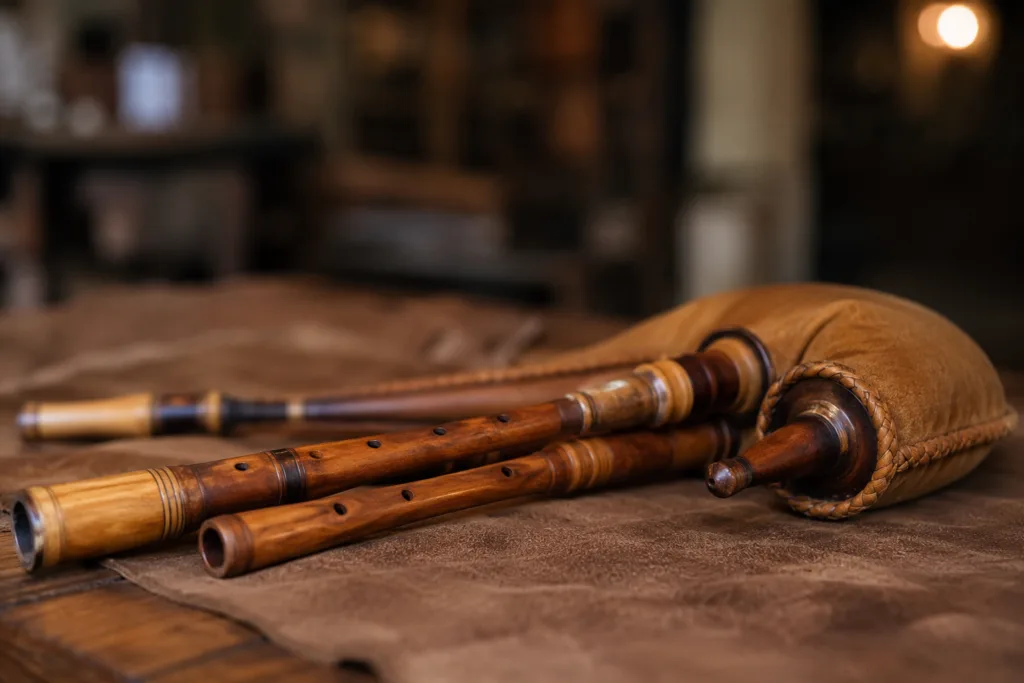
The launeddas is a Sardinian mouth-blown reed instrument made from three cane pipes played simultaneously. A drone pipe and two fingered pipes create an interlocking polyphonic texture sustained through circular breathing.
What the Launeddas Is
The launeddas is often described in English as a Sardinian triple clarinet. That label refers to its three cylindrical pipes and single beating reeds, not to the keyed concert clarinet. It has no modern mouthpiece, keywork, or detachable manufactured reed. Each pipe carries a small cane section called a cabitzina, from which an idioglot reed tongue is cut directly.
All three reeds sit inside the player’s mouth and respond to one shared stream of air. The longest pipe, the tumbu, has no finger holes and supplies a pedal note. The mancosa manna is tied to the drone and usually supports the left-hand accompaniment. The separate, shorter mancosedda is held by the right hand and commonly carries the more mobile melodic line.
The result is not a melody placed over a passive background. Drone, accompaniment figures, and melodic phrases remain active together. A skilled player controls rhythm, harmony, ornament, tension, and release without stopping the air column. This combination makes the launeddas both an instrument and a complete small ensemble in the hands of one performer.
Common Confusion: “Triple clarinet” is an organological shortcut. The launeddas does not work like three modern clarinets strapped together; its cane reeds, finger system, tuning practice, and continuous polyphony belong to a separate Sardinian tradition.
Anatomy and Pipe Functions
| Part | Construction | Musical Function | Played With |
|---|---|---|---|
| Tumbu | Longest cane pipe, normally without finger holes | Holds the continuous drone and tonal base | Supported with the left-hand pipe group |
| Mancosa Manna | Fingered chanter tied to the tumbu to form the croba | Creates accompaniment figures and part of the polyphony | Left hand |
| Mancosedda | Separate, usually shorter fingered chanter | Carries many of the more mobile melodic phrases | Right hand |
| Cabitzina | Small cane section containing the cut reed tongue | Starts vibration when air pressure reaches the reed | Enclosed inside the mouth |
| Crais and Arrefinu | Four playable holes plus a lower tuning or vent opening on each chanter | Set the usable notes and the pipe’s acoustic behavior | Holes covered mainly with the finger phalanges |
The mancosa manna and tumbu are bound together, creating the croba. This pairing stabilizes the left side of the instrument and preserves the relationship between drone and accompaniment pipe. The free mancosedda allows the right hand to shape its line independently.
Cane, Reeds, and Tuning
Traditional makers select cane by more than diameter. Internode length, wall thickness, straightness, maturity, and dryness affect the finished pipe. A dense, stable wall can give a focused response, while a lighter or less even tube may speak differently under the same breath pressure. Regional makers may distinguish cane used for the drone, chanters, and reed-bearing sections.
The reed tongue is cut from the same small piece of cane that forms its support. This idioglot construction gives the instrument a direct, grainy attack and a persistent buzz. Reed length, tongue thickness, opening, and the mass added with beeswax alter response and pitch. Small changes can affect all three pipes because they must start reliably under a shared pressure.
Beeswax may be used to refine reed behavior and the effective opening of the arrefinu. It is not merely a repair material. Moving or adding wax can change pitch, balance, and speaking resistance, so an unfamiliar set should not be adjusted casually.
A pipe that seems sharp, flat, or slow may have a moisture, reed-gap, wax, or pressure problem rather than a simple pitch problem. Altering wax before checking the whole set can disturb the relationship among the three pipes.
How the Three-Pipe Sound Is Organized
The drone establishes a fixed tonal floor. Above it, the two chanters produce limited but carefully related note sets. Their pitches are not arranged as a fully chromatic keyboard system. Instead, each set is built for a particular modal and harmonic behavior, with characteristic intervals and phrase shapes.
The sound can feel close to a bagpipe because it is uninterrupted and drone-based, yet the air reservoir is the player’s mouth rather than a skin bag. It can also recall double clarinets from North Africa and the eastern Mediterranean, though the Sardinian three-pipe layout and repertoire remain distinct.
The following bars describe common listening impressions, not laboratory measurements. Reed setup, pipe dimensions, player pressure, and room acoustics can change the result.
Origins and Historical Continuity
The launeddas belongs to the wider family of Mediterranean multi-pipe reed instruments. Ancient Egyptian and Mesopotamian double-pipe clarinets show that cylindrical cane pipes with beating reeds were known far beyond Sardinia. Similarity alone does not establish a straight line of descent, but it places the Sardinian instrument within an old Mediterranean reed-pipe tradition.
A small bronze figure found near Ittiri is often interpreted as a musician playing three pipes. It is regularly discussed in accounts of the launeddas, yet the object cannot prove that the modern pipe lengths, reeds, tuning, or repertoire already existed in the same form. It is safer to treat it as evidence for an early Sardinian triple-pipe idea rather than a complete blueprint of the present instrument.
Written and visual documentation becomes firmer in later periods. By the seventeenth century, launeddas practice is associated with several central-southern Sardinian communities. Strong local traditions developed in areas such as Sarrabus, Trexenta, Campidano, and the Cabras and Sinis area, each preserving repertory choices, named sets, and teaching lineages.
Double and multiple single-reed pipes appear in neighboring Mediterranean cultures, offering a broad organological context rather than a proven direct ancestry.
The Ittiri bronze figure is commonly read as a triple-pipe player, though its exact connection to the current instrument remains debated.
Clearer records connect launeddas performance with Sardinian village life, religious events, processions, and dance.
Ethnomusicological documentation recorded players, repertoires, construction knowledge, and regional styles during a period of social change.
The instrument remains active in traditional events, teaching, staged performance, recordings, and newer musical collaborations.
The Cuntzertu as a Musical System
A launeddas set is often called a cuntzertu. The term means more than three pipes that happen to be tuned together. It describes a working combination whose drone, left chanter, and right chanter have a planned interval structure and a repertoire suited to that structure.
Named forms include mediana, fiorassiu, and punt’e organu, along with other regional or derived combinations. The names do not function like simple concert-pitch labels. Changing the chanter pairing can alter the playable interval network, the comfortable phrase shapes, and the traditional pieces associated with the set.
This explains why swapping one pipe for another is not always a neutral substitution. A pipe may sound on its own yet fail to balance the drone, resist at a different pressure, or produce intervals that do not fit the expected repertory. For players and collectors, the musical identity of the complete set matters more than the condition of any single tube.
Playing Position and Air Seal
The player places the three cabitzinas inside the mouth and closes the lips around them to prevent leaks. The reeds need enough space to vibrate, but the mouth must still form a stable pressure chamber. Biting or squeezing the reed-bearing sections can choke the tone or damage the cane.
The left hand supports the bound croba, while the right hand holds the free mancosedda. The pipes angle downward and outward according to their lengths and the player’s anatomy. The hands should seal the holes without twisting the pipes or pulling the reeds apart inside the mouth.
Traditional fingering often uses the soft middle sections of the fingers rather than only the fingertips. The rectangular holes can be wider than those on many modern woodwinds, and phalange coverage gives a broad seal while allowing rapid patterned movement.
How Circular Breathing Works
Circular breathing keeps the reeds sounding while the player renews lung air through the nose. The cheeks briefly act as a pressure reserve, but they do not replace normal exhalation for long. The hard part is hiding the changeover so the drone and chanters do not sag, surge, or stop.
Establish a Stable Reed Tone
Begin with even lung pressure and a leak-free lip seal. The reeds should speak without hard overblowing.
Store a Small Air Reserve
Allow the cheeks to expand slightly while the lungs continue supplying the instrument. Excessive cheek inflation makes pressure harder to control.
Push Air With the Cheeks
Close the path from the lungs momentarily and use the cheek muscles to keep air moving through the reeds.
Inhale Through the Nose
Take a short nasal breath while cheek pressure maintains the sound. The inhale must be relaxed and timed before the cheek reserve runs out.
Reconnect Lung Pressure
Resume exhalation smoothly, matching the pressure already created by the cheeks. A clean transition should not produce a pulse in the drone.
Player Tip: Practice the pressure handoff on one easy-speaking reed before attempting the full set. Once the changeover is smooth, add the bound pipes and then the complete fingering texture.
Finger Coordination and Phrase Building
Circular breathing solves only the airflow problem. Launeddas technique also requires two independent fingering roles above the drone. The left hand often maintains repeating accompaniment figures while the right hand shapes a more active line. Their rhythms may lock together, answer one another, or create changing interval patterns.
Because the sound does not depend on frequent breath breaks, musical punctuation comes largely from fingering, accent, density, register emphasis, and patterned repetition. Traditional performances can develop through families of short phrases rather than through a fixed sequence comparable to a written concert score. The player learns how one phrase may lead into another while preserving dance pulse and the identity of the piece.
Clean technique depends on closing every hole fully. A tiny leak can weaken a note, distort an interval, or cause one reed to dominate the set. Fast ornaments should grow from accurate seals and relaxed movement, not from striking the holes with force.
Beginner Practice Order
- Learn the names and roles of the three pipes before changing reeds or wax.
- Produce an easy, stable tone on a single reed without biting.
- Practice cheek pressure and nasal inhalation away from complex fingering.
- Hold the croba comfortably and cover the left-hand holes without strain.
- Add the mancosedda only after the pressure remains steady.
- Work with short traditional phrase cells before attempting long performances.
- Record the drone to hear pressure dips that may be missed while playing.
Reed Balance, Pressure, and Common Technique Problems
The reed may require more pressure, carry too much wax, be too closed, or contain moisture. Forcing the whole set harder can make the other reeds sharp or harsh.
The cheek reserve is running out before lung pressure returns, or the pressure levels on either side of the handoff do not match.
A finger hole may be leaking. Check phalange placement and hand angle before blaming the reed.
The lip seal may be tighter than necessary, the pipes may be poorly supported, or the reeds may demand too much pressure for a beginner.
Traditional Use and Repertoire
Launeddas music has long served both sacred and social settings. Players accompany processions, feast days, religious observances, and Sardinian dances. The instrument is closely linked with group dance traditions such as su ballu, where pulse and phrase length respond to dancers rather than to a fixed concert duration.
Some repertories are associated with particular cuntzertus. Processional pieces, dance forms, and local styles may require different interval layouts or characteristic phrase families. This is why learning only a fingering chart does not provide the full tradition. Timing, variation, ceremonial function, and local style are carried through listening and apprenticeship.
Modern players also use launeddas in composed music, amplified ensembles, intercultural projects, and experimental settings. These uses can extend its range of context, but the instrument’s response still depends on matched reeds, continuous airflow, and the internal logic of the chosen set.
How It Differs from Related Reed Instruments
| Instrument | Air Supply | Pipe Layout | Main Difference |
|---|---|---|---|
| Launeddas | Direct mouth pressure with circular breathing | One drone and two fingered single-reed pipes | Three-pipe Sardinian polyphony played by one musician |
| Modern Clarinet | Direct mouth pressure | One keyed cylindrical bore with a separate reed | Broad chromatic range and no permanent drone |
| Mediterranean Double Clarinet | Direct mouth pressure, often with circular breathing | Two parallel reed pipes | Two-pipe construction rather than drone plus two chanters |
| Bagpipe | Air stored in a bag | Chanter with one or more separate drones | The reservoir maintains pressure outside the mouth |
Choosing and Inspecting a Launeddas Set
A playable set should be judged as one pressure-balanced instrument. Three attractive pipes are not enough. The drone must remain steady while both chanters speak cleanly, and the interval relationships should suit the stated cuntzertu.
- Straight, seasoned cane without active splits
- Reeds that start under similar breath pressure
- Secure bindings that do not twist the croba
- Stable drone and clear chanter response
- Maker information and identified cuntzertu
- Heavy wax used to hide unstable tuning
- Crushed reed tongues or cracked cabitzinas
- Pipes assembled only for decoration
- Large pressure differences among reeds
- No clear relationship between the chanters and drone
Collectors should separate age, rarity, provenance, and playability. An old set may be culturally valuable yet too fragile to sound. A newer set made by a skilled maker may be the better choice for study and regular performance.
Care and Storage
- Allow moisture to leave the reeds and pipe entrances after playing.
- Keep the set away from radiators, hot vehicles, direct sun, and sudden humidity changes.
- Protect reed tongues from pressure, snagging, and accidental bending.
- Do not scrape, oil, or reshape a reed without understanding its original setup.
- Store the pipes in a protective case that does not trap damp air.
- Check bindings and wax before travel, since heat can soften wax and alter its position.
- Ask an experienced maker or player to diagnose tuning instability before making permanent changes.
Mini FAQ
Is the launeddas really a clarinet?
It belongs to the single-reed, cylindrical-bore family and is often called a triple clarinet, but it does not share the modern clarinet’s mouthpiece, key system, chromatic layout, or separate manufactured reed.
Why does the instrument have three pipes?
The three pipes divide musical roles. The tumbu supplies a drone, while the mancosa manna and mancosedda form the fingered polyphonic layer above it.
Is circular breathing required?
It is central to traditional launeddas performance because it keeps all three reeds sounding continuously. Short interrupted sounds are possible during practice, but they do not reproduce the normal performance texture.
Are all launeddas tuned the same way?
No. Pipe lengths, reed setup, interval relationships, and named cuntzertus vary. A set should be understood through its complete drone-and-chanter combination rather than through one universal fingering chart.
Can a beginner learn without a teacher?
Basic circular-breathing exercises can be practiced alone, but guidance from a player or maker helps prevent poor pressure habits, reed damage, incorrect wax adjustments, and loss of repertory context.
Is the launeddas still played in Sardinia?
Yes. It remains present in festivals, processions, dance events, teaching, recordings, concerts, and newer ensemble settings, with especially strong historical ties to central-southern Sardinian communities.