
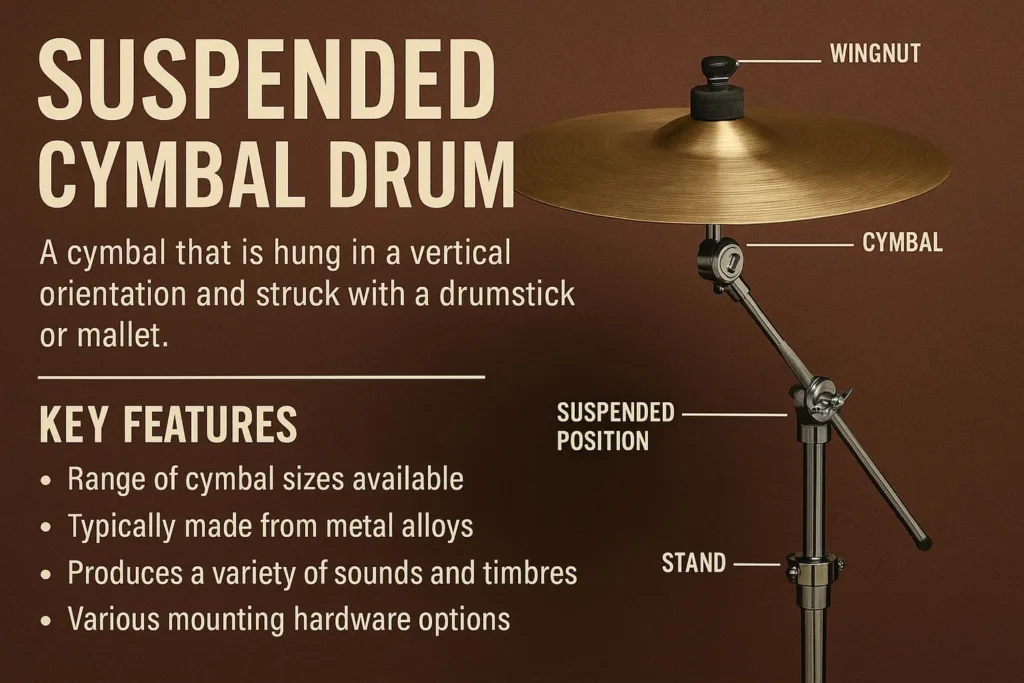
Suspended Cymbal: Complete Guide
A suspended cymbal is a single cymbal mounted so it can resonate freely. It is used for crescendo rolls, sustained swells, soft accents, crashes, and special effects in orchestral, wind-band, theater, studio, and contemporary ensemble settings. The phrase “suspended cymbal drum” appears in some searches and inventories, but the instrument is a cymbal, not a drum.
Specifications
| Feature | Typical Options | Best For | Why It Matters |
|---|---|---|---|
| Size | 16″, 18″, 20″, 22″ | Ensembles, studio, theater | Larger cymbals generally offer lower pitch, longer sustain, and a broader swell. |
| Alloy | B20 bronze, B8, B10, B12, and other manufacturer-specific alloys | Professional, educational, and budget ranges | Alloy works with hammering, lathing, thickness, and profile to shape overtone content and projection. |
| Weight / Thickness | Thin, medium-thin, medium | Rolls, swells, accents | Thinner cymbals usually respond more easily at low dynamics; heavier models require more energy and can project a firmer attack. |
| Finish | Traditional, brilliant, partially lathed, or raw areas depending on model | Varies by series and tonal goal | Finish is one part of the overall design and should not be treated as the sole predictor of brightness or sustain. |
| Mounting | Protected cymbal stand or suspended strap system | Orchestral, band, studio | Free movement helps the cymbal resonate and protects the center hole from metal-on-metal wear. |
| Mallets / Sticks | Soft yarn or felt mallets, brushes, light sticks, and specialty implements | Texture and articulation control | Mallet hardness and striking position strongly affect attack, roll smoothness, and buildup. |
| U.S. Retail Snapshot | About $125–$700 for many current dedicated suspended models | Student through professional lines | September 2026 snapshot; prices vary by brand, size, alloy, series, retailer, and availability. |
What Is a Suspended Cymbal?
A suspended cymbal is mounted so its edge and body can move and vibrate freely after a stroke. Dedicated suspended cymbals are made for this role, although selected crash cymbals can also be mounted and used for suspended-cymbal techniques.
Instead of serving only as a short accent, the instrument can build sound gradually from a quiet roll into a broad peak. It is also used for isolated mallet strokes, crashes, scraped textures, bowed sounds, and controlled chokes.
Common Confusion: “Suspended cymbal drum” is an alternative or mistaken search term, not the standard organological name. The instrument is a cymbal and should be labeled suspended cymbal in instrument descriptions and catalogs.
- Crescendo rolls: sustained builds from very soft to strong dynamics.
- Textural swells: gradual color changes beneath dialogue, melody, or ensemble passages.
- Soft accents: rounded attacks made with mallets, brushes, or other suitable implements.
- Special effects: bowing, scraping, rubbing, or other controlled techniques specified by the music.
Sizes, Alloys, and Weights
Choosing the Right Size
- 16″: quicker response and easier handling in compact setups.
- 18″: a versatile size for wind band, theater, studio, and general ensemble use.
- 20″: usually offers a broader, lower swell with longer sustain.
- 22″: can produce a wide, slower-developing wash but requires more space and careful dynamic control.
For general ensemble use, 18-inch and 20-inch suspended cymbals are common choices, but model design matters as much as diameter. Two cymbals of the same size can respond very differently because of weight, profile, hammering, lathing, bell shape, and alloy.
Alloy and Craft
- B20 bronze: nominally about 80% copper and 20% tin; widely used in professional cymbal lines.
- B8 bronze: nominally about 92% copper and 8% tin; common in brighter and often lower-priced series.
- B10 and B12 bronze: intermediate tin percentages used by some manufacturers in selected ranges.
Alloy alone does not determine quality or tonal character. Hammering, lathing, thickness, taper, profile, bell design, and manufacturing consistency can change the response as much as the nominal bronze formula.
Weight and Thickness
- Thin: usually responds quickly to soft mallets and can open into a broad swell with relatively little force.
- Medium-thin: balances roll response with stronger articulation and projection.
- Medium: often needs more energy to develop but can provide firmer attacks and greater projection.
For smooth orchestral rolls, thin and medium-thin models are commonly chosen because they respond readily across a wide dynamic range.
Mounting and Setup
- Use a cymbal stand with a plastic or nylon sleeve and suitable felts so the center hole does not contact bare metal.
- Leave enough clearance for the cymbal to move freely rather than clamping it tightly between felts.
- A slight playing angle can make repeated mallet strokes more comfortable, but the exact position depends on the stand, player, and repertoire.
- If a suspended strap system is used, hang the cymbal from a stable support and allow enough space for controlled movement.
- Use damping only when the score or recording requires it; tape, chains, clips, and other modifiers change both sustain and overtone behavior.
Mounting Warning: a bare metal post rubbing against the cymbal’s center hole can cause keyholing and long-term damage. A proper sleeve is part of the setup, not an optional accessory.
Playing Techniques: From Soft Rolls to Strong Accents
Crescendo Rolls
Use a matched pair of soft yarn or felt mallets and alternate strokes on separated areas of the cymbal. Begin with light, even contact and increase stroke energy and density gradually. The goal is to hide the individual attacks inside a continuous swell rather than simply striking harder from the start.
The most responsive playing area depends on the cymbal. Rolls are commonly developed away from the bell and toward the outer playing area, where the cymbal can flex more freely. Moving the stroke position can change both attack and buildup.
Accents and Articulation
- Mallet taps: rounded accents with less initial brightness than a stick attack.
- Light sticks: clearer articulation when the part calls for a defined attack.
- Brushes: soft scraping and swishing textures for theater, studio, and contemporary writing.
- Chokes: stopping the vibration by safely gripping the cymbal after the attack when the music requires a sudden cutoff.
Texture and Special Effects
- Bowing: a rosined bow on the edge or other responsive area can excite sustained high partials.
- Friction mallets: specialty rubber or similar implements can create rising or unstable friction tones.
- Scrapes and rubs: brushes, sticks, and other appropriate implements can produce quiet transitional textures.
Special-effect techniques should be tested on the specific cymbal. Hard scraping, unsuitable tools, or excessive pressure can mark the finish or damage the edge.
How to Choose the Right Suspended Cymbal
A larger thin or medium-thin cymbal can provide a wide dynamic range and long, gradual swells. Listen for an even buildup without one pitch or overtone dominating too early.
An 18-inch model is often manageable and versatile. Choose durability and predictable response before assuming one alloy is automatically better for students.
A controlled cymbal with a smooth decay can be easier to place in a mix. Test the instrument at both close and distant microphone positions before deciding that a smaller size is required.
A responsive thin or medium-thin cymbal can produce swells at lower stage volumes and sit beneath voices without requiring heavy strokes.
Player Tip: bring the mallets you normally use when auditioning cymbals. A model that responds beautifully to soft yarn may feel very different with medium felt or a harder implement.
Recording and Miking
The suspended cymbal radiates a complex wash rather than a single point source, so microphone distance changes the balance between attack and bloom. A close microphone emphasizes stick or mallet detail, while greater distance allows the overtone field to combine more naturally.
- Overhead or room microphones: useful for capturing the full decay and the way the cymbal sits in the surrounding space.
- Spot microphone: adds definition when the suspended cymbal needs more presence inside a larger ensemble recording.
- Off-axis placement: can reduce an overly sharp attack without relying immediately on heavy equalization.
- High-pass filtering: may remove stage or stand rumble, but set the cutoff by listening rather than using a fixed frequency for every cymbal.
- Dynamic processing: preserve the natural rise of a crescendo when possible; excessive compression can flatten the musical shape of the roll.
Care and Maintenance
- Use a protective sleeve and felts whenever the cymbal is mounted on a metal post.
- Do not overtighten the wingnut; the cymbal needs room to move.
- Wipe fingerprints and moisture with a soft cloth after handling.
- Use only cleaning products suitable for the cymbal’s finish if cleaning is necessary.
- Avoid aggressive polishing when preserving an existing patina or manufacturer-applied surface is important.
- Transport the cymbal in a padded bag or case and protect the edge from impacts.
- Inspect the center hole periodically for developing keyholing, cracks, or abnormal wear.
Example Setups and Pairings
An 18-inch thin or medium-thin suspended cymbal with soft yarn mallets and brushes covers rolls, soft accents, and many theater or band textures.
A 20-inch or larger responsive model paired with soft or medium-soft mallets can produce a slower buildup and broader peak.
A responsive 16-inch or 18-inch model can work where space and microphone separation are limited, provided its decay and overtone balance fit the arrangement.
Mini FAQ
Is a suspended cymbal the same as a crash cymbal?
Not necessarily. Some crash cymbals work well in a suspended setup, and dedicated suspended cymbals are also manufactured specifically for concert and ensemble use. The playing role emphasizes free resonance, rolls, swells, and controlled accents.
Is “suspended cymbal drum” the correct instrument name?
No. It is an alternative or mistaken search term found in some inventories and casual descriptions. The standard name is suspended cymbal.
What size works well for schools?
An 18-inch model is a common practical choice because it balances handling, projection, and roll response. The actual cymbal should still be tested for weight and ease of response.
Can a ride cymbal be used as a suspended cymbal?
Yes, but many ride cymbals are heavier and designed for clear stick definition. They may require more force to develop a smooth roll than a thin crash or dedicated suspended cymbal.
Which mallets work best?
Soft yarn and felt mallets are common for even crescendos. Medium mallets can add articulation. The best choice depends on the cymbal, dynamic level, and musical role.
How much does a suspended cymbal cost?
In a September 2026 U.S. retail snapshot, many dedicated suspended cymbals were listed from roughly $125 to $700, with price varying by brand, size, alloy, series, and retailer. Current listings should be checked before purchase.
How do I avoid damage?
Use a sleeve and felts, avoid overtightening the mount, protect the edge during transport, and inspect the center hole for wear. Do not use aggressive scraping techniques unless the instrument and implement are suitable for them.