
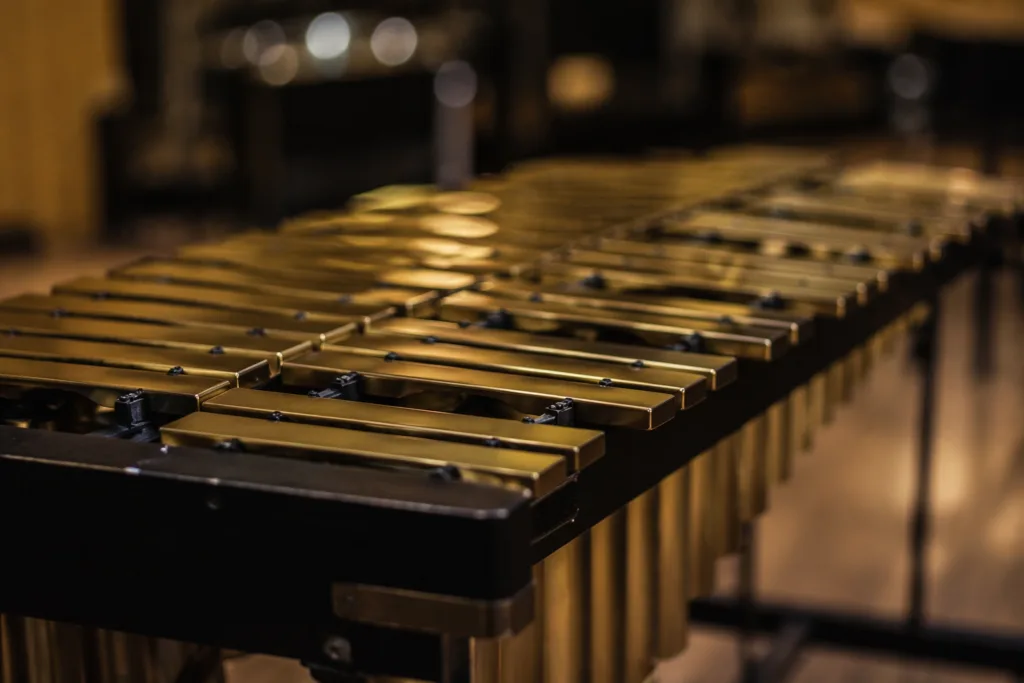
| What Defines the Instrument | Why It Matters in Real Playing |
|---|---|
| Aluminum-alloy bars over tuned resonators | Gives the vibraphone its long sustain, glassy edge, and that floating decay jazz players lean into. |
| Motor-driven fans inside the resonators | Adds the pulsing motion people hear as the classic vibes shimmer. |
| A piano-style damper pedal | Lets phrases connect, bloom, or stop cleanly; without good pedal control, the instrument never really speaks in full. |
| Usually 3 octaves, with 3.5- and 4-octave modern versions | Changes voicing options, left-hand harmony, and how close the instrument feels to piano writing. |
| Matte or glossy bar finish | Affects the attack more than players expect: matte tends to feel warmer, glossy tends to cut more. |
- The timbre lives in the overlap of metal, felt, air, and pedal timing.
- On vibraphone, a note is never just struck; it is also released, damped, or left to glow.
- That is why the instrument can sound velvet-soft in one chorus and almost bell-like in the next.
The first thing worth saying is this: the vibraphone does not charm the ear by volume alone. It wins by after-sound. The note blooms, hangs for a moment, then leaves behind a thin halo of overtone that no wooden keyboard percussion instrument produces in quite the same way. That halo is the whole game.
And the name can mislead a little. Players often talk about the motor as if it simply adds vibrato, but the ear also catches a pulsing change in volume. On a good instrument, with the fans turning evenly and the damper felt lifting cleanly, the sound does not wobble in a cheap way. It breathes.
🏛️ Origins, Trade Names, and the Design That Stuck
- Early 1920s: experiments at Leedy turned the steel marimba idea into a motorized instrument with rotating discs.
- 1924: the instrument reached the market in recognizable form.
- 1927: Deagan helped set the pattern that still feels modern today—aluminum bars and a foot pedal.
The vibraphone is not an old folk relic dressed up for jazz. It is a 20th-century instrument, born from workshop problem-solving and stage practicality. The early Leedy versions used steel bars and did not yet offer the pedal response modern players take for granted. Useful, yes. Finished, not quite.
Then the instrument found its real shape. When aluminum bars entered the picture, the voice changed. Steel can sound firmer and more direct, but aluminum opened the door to the mellow, sustained, singing tone that jazz players came to love. Add the pedal, and phrasing changed with it. The vibraphone stopped being only a novelty color and became something a soloist could actually shape note by note.
That shift matters more than many short writeups admit. The true dividing line in vibraphone history is not just date or brand. It is the point where material choice and damping control joined into one expressive system.
Collector’s Note: If an early vibraphone feels more metallic, more abrupt, or less pedal-shaped than expected, that is not always a flaw. It may reflect the design language of the period. Pre-pedal or early steel-bar examples belong to a different chapter of the instrument’s voice.
🛠️ How the Bars, Pedal, and Motor Shape the Sound
| Part | What the Ear Hears |
|---|---|
| Bar alloy and bar thickness | Changes attack, projection, body, and the length of the note’s tail. |
| Bar finish | Matte usually feels warmer and less pointed; glossy often sounds brighter and more forward. |
| Resonator length and fan motion | Adds projection, pulse, and the signature moving shimmer. |
| Damper bar and pedal setup | Controls clarity between harmony and blur; poor damping makes even a fine instrument feel clumsy. |
| Mallet hardness | Soft mallets bring out bloom and warmth; harder heads sharpen the front edge of each note. |
Matte Bars Vs. Glossy Bars
- Matte bars usually favor a softer front edge and a more old-school jazz color.
- Glossy bars usually project faster, with a brighter bite in bigger rooms or larger ensembles.
- The difference is heard most clearly in the attack, not only in the long ring afterward.
This is where builders and players start speaking the same language. A vibraphone does not respond to surface finish the way a casual buyer may expect. The color itself is not the point; the finish is. A matte set of bars can make medium mallets feel rounder and less brittle. A glossy set often helps the line cut through brass, reeds, or a full rhythm section. Same instrument family. Not the same conversation in the air.
Pedal and Damping Are Half the Instrument
- Full sustain gives legato lines and wide harmony.
- Short pedal or hand damping keeps fast passages clean.
- Uneven felt contact can make one register ring too long while another chokes.
Many articles treat the pedal as a simple accessory. It is not. On vibraphone, the pedal is part of the phrasing grammar. A player who controls release well can turn metal into song. A player who pedals carelessly gets wash, smear, and harmonic fog. Sometimes lovely. Often not.
Listen closely to strong players and the secret becomes obvious: they do not merely sustain notes; they choose where the note stops living. That choice shapes swing lines, chord color, and space between phrases.
That is the craft.
Motor Speed Is Not Decoration
- Slow fan speed tends to feel wide, relaxed, and vocal.
- Faster settings create a tighter shimmer and more motion in held notes.
- Some passages sound better with the motor off, especially when the line needs plain, centered pitch.
The motor is one of the easiest places to overdo things. Used with care, it adds life. Used all the time, it can flatten contrast. The best vibraphone playing often moves between still tone and moving tone rather than parking on one setting for the entire tune.
Pro Tip: Before judging a vibraphone as too bright, too dark, or too dry, hear it with two mallet types and with the motor both on and off. Many instruments reveal their real voice only after that small test.
🎼 Technique on the Stand and Under the Hands
- Two-mallet playing favors line, bounce, and direct melodic speech.
- Four-mallet playing opens harmony, inner motion, and piano-like voicings.
- Pedaling and damping decide whether those notes stay elegant or turn cloudy.
- Mallet choice changes the instrument almost as much as bar finish does.
Two Mallets Vs. Four Mallets
The older jazz image of the vibraphone is often a two-mallet image: a singing line, rhythmic lift, and phrasing that behaves almost like a horn. The note starts clean. The swing feel sits forward. There is little clutter. It is a fine way to understand the instrument because it puts time, articulation, and tone right out in the open.
Four-mallet technique changed the harmonic room the instrument could occupy. Chords became wider. Counter-lines became possible. The vibraphone could comp, voice-lead, and shadow the harmony with far more detail. A good four-mallet player does not simply add notes; the player changes the instrument’s job inside the ensemble.
Different, too, is the touch. Four mallets ask for balance in the hand, interval control, and an ear for voicing. A block chord struck carelessly on vibes turns hard and flat very fast. A chord voiced well—low note supported, top note singing, inner notes tucked in—sounds almost lit from within.
What Good Vibraphone Touch Actually Feels Like
- The mallet has to rebound freely. Forcing the stroke kills ring.
- The wrist must stay loose enough to shape repeated notes without stiffening the line.
- The ear has to judge overtones, not just written pitch.
- The player must hear release as part of the note.
That last point gets ignored all the time. On snare drum, the end of the sound is often simple. On vibraphone, the end carries character. A short, dry damping stroke can sound conversational and close. A fully pedaled chord can sound open, almost suspended. Same bars. Same room. New mood.
And yes, mallet hardness matters. Soft to medium mallets usually help the instrument keep body and warmth. Harder models can be useful when the part must speak through a denser ensemble, but they also expose every weakness in touch, pedaling, and tuning. No hiding there.
🎹 Vibraphone Vs. Its Nearest Relatives
| Instrument | Main Material | Typical Voice | What Sets It Apart |
|---|---|---|---|
| Vibraphone | Aluminum-alloy bars | Warm metal sustain, moving shimmer | Motor fans and pedal make the sound shapeable after the strike. |
| Marimba | Wood or synthetic bars | Dryer, earthier, more immediate warmth | No pedal; sustain is shorter and phrasing depends more on stroke and roll control. |
| Xylophone | Hard wood | Bright, dry, pointed attack | Sharper articulation and much less floating decay. |
| Glockenspiel | Metal bars | Brilliant, bell-like, compact | Far more piercing attack and a very different role in ensemble color. |
Vibraphone Vs. Marimba
Players often compare these two because the layout looks familiar under the hands. The ears tell a different story. A marimba carries warmth in the bar itself. A vibraphone carries warmth in the ring that follows the strike. One glows from wood and resonance. The other glows from alloy, air column, pedal, and overtone bloom.
That difference changes writing. On marimba, rolled texture and contour do a lot of work. On vibraphone, sustained harmony and damping choices become part of the line. Put simply, a marimba phrase often speaks in carved edges; a vibraphone phrase often speaks in light trailing behind the note.
Vintage 3-Octave Models Vs. Modern Extended-Range Builds
- A standard 3-octave layout still feels nimble and centered for straight-ahead playing.
- A 3.5-octave instrument adds low notes that open fuller left-hand voicings.
- A 4-octave model moves even closer to piano-style spacing and newer concert writing.
This is not merely a matter of “more notes.” Extended-range instruments shift how the harmony sits under the hands. The low added notes matter most for jazz comping, modern chamber writing, and solo repertoire that wants broader spacing without forcing awkward compromises. For some players, that extra low end is the point where the vibraphone stops feeling like a melodic color and starts behaving like a true harmonic instrument.
Early Steel-Bar Thinking Vs. Later Aluminum-Bar Thinking
Steel belongs to the instrument’s origin story, but aluminum belongs to the voice most listeners now think of as “vibes.” Warmer is the word players often use, though that word can hide a lot. What they usually mean is this: the note has more body, the decay feels less severe, and the overtone spread is friendlier to jazz harmony.
A small change on paper. A large change in the room.
🎵 Players Who Changed the Ear
| Player | What Changed | What to Listen For |
|---|---|---|
| Lionel Hampton | Brought the instrument into public jazz life with force, swing, and showmanship. | Direct attack, rhythmic drive, and the sense that the instrument can lead a room. |
| Milt Jackson | Made blues language and warm sustain feel native to the vibraphone. | Fat center to the note, singing lines, and beautifully judged pedal release. |
| Gary Burton | Expanded four-mallet harmony and a fuller, more piano-like approach in jazz. | Open voicings, inner movement, and the instrument used as melody plus harmony at once. |
| Bobby Hutcherson | Turned resonance, overtone color, and post-bop freedom into a new language. | Chiming decay, floating harmony, and lines that seem to hover before they land. |
Lionel Hampton did more than popularize the vibraphone; he made audiences feel that it belonged at the front of a jazz performance. The instrument had shimmer already. Hampton gave it public muscle. Rhythm first, then color, then charisma.
Milt Jackson moved the story inward. His sound was less about surface sparkle and more about a rounded, blues-shaped vocal line. On the page, the notes can look ordinary. In the air, they land with weight and warmth. That is a much harder achievement than flash.
Gary Burton changed the instrument’s grammar by making four-mallet harmony feel natural rather than ornamental. Chords stopped sounding like interruptions. They became part of the line itself. That shift pulled the vibraphone toward a more orchestral and more pianistic future—yet still unmistakably metallic, still unmistakably itself.
Then Bobby Hutcherson widened the color field. His playing showed just how much emotional material sits inside decay, overtone, and suspended harmony. With him, the vibraphone could sound cool, open, and searching without losing shape.
Collector’s Note: When buyers say they want a “classic jazz vibraphone sound,” they often mean different things without realizing it. Some mean Hampton’s attack, some mean Jackson’s warmth, some mean Burton’s spread voicings, and some mean Hutcherson’s overtone cloud. Those are not tiny shades of one color. They are different listening goals.
🔎 What Buyers, Collectors, and Restorers Notice First
- Damper felt condition: uneven contact makes the instrument feel older than its badge suggests.
- Motor noise and belt health: a rough motor can distract from the very shimmer it is supposed to support.
- Bar dents or tuning drift: damaged bars lose focus and can speak with an unpleasant edge.
- Resonator alignment: if the setup is off, projection and balance suffer.
- Frame stability: wobble changes touch, confidence, and even perceived tone.
- Range choice: 3-octave for classic compact use, extended range for wider voicings and newer repertoire.
An old vibraphone can still be a lovely daily instrument. But age alone is never the story. What matters is whether the mechanical life of the instrument still supports the musical life of the instrument. A vintage frame with a clean damper and healthy bars may feel wonderfully alive. A younger instrument with a tired damping system can feel oddly lifeless.
That is why good restoration work rarely chases cosmetics first. The real heart of the instrument sits in the bar response, the pedal lift, the evenness of damping, and the quiet reliability of the motor assembly. Get those right and the instrument starts talking again.
FAQ
Is It Hard to Learn Vibraphone if I Already Play Drums?
Open Answer
Drummers often adapt well to the time feel and rebound side of the instrument, but vibraphone adds pitch, pedaling, damping, and mallet choice. So the rhythm side may come quickly, while the harmonic and tonal side takes longer. The learning curve is real, just not the same as starting from zero.
How Do I Know if I Want a Vintage or Modern Vibraphone?
Open Answer
Choose vintage if period feel, older design character, and collector value matter more to you. Choose modern if you want steadier mechanics, broader range options, quieter motors, and easier day-to-day reliability. For regular playing, the damper system and bar condition matter more than the age stamped on the frame.
Why Do Some Vibraphones Sound Warmer While Others Cut More?
Open Answer
The main reasons are bar finish, bar design, mallet hardness, pedal use, and the room itself. Matte bars often feel warmer and less pointed. Glossy bars often project faster and sound brighter. Soft mallets and careful pedaling can make the same instrument seem fuller and less sharp.
Do I Need Four Mallets to Play Jazz Vibraphone?
Open Answer
No. Two mallets still make perfect musical sense for melodic jazz playing and for learning touch, phrasing, and time. Four mallets become useful when you want fuller harmony, comping, and wider voicings. Many players grow into four mallets after the basic sound and pedal control are already stable.