
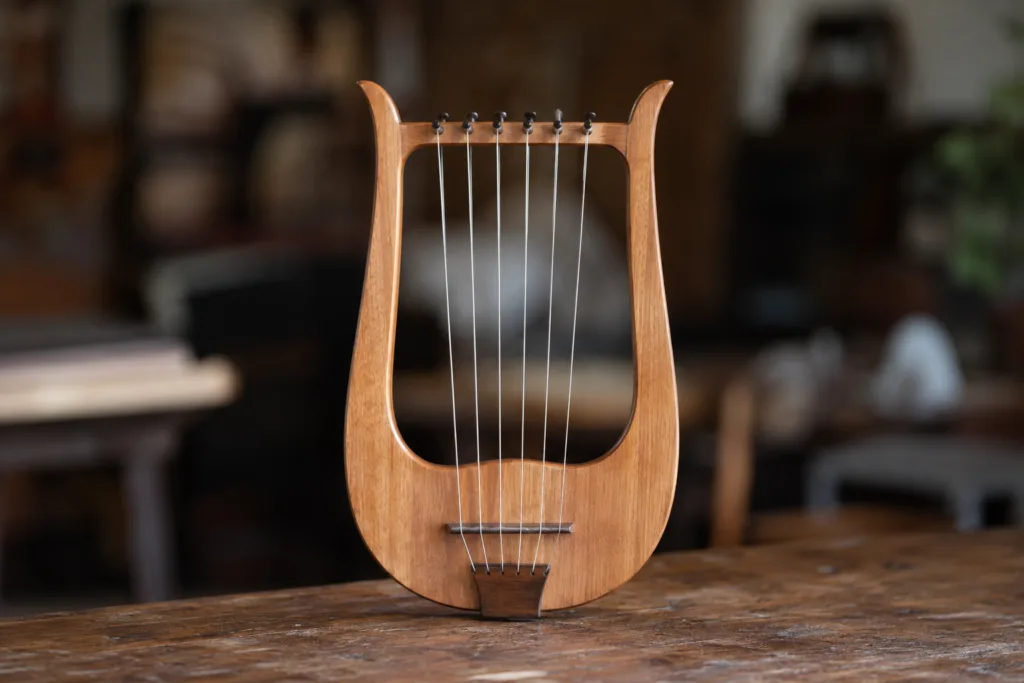
Merovingian Lyre · Trossingen Grave 58 · 6th Century
The Trossingen Lyre is an almost completely preserved six-string lyre from an early medieval burial at Trossingen in southwestern Germany. Its maple body, soundboard, willow bridge, all six tuning pegs, carved decoration, repairs, wear marks, and unusual sound holes survived; only the strings and tailpiece are missing. That combination makes the instrument unusually informative about how a 6th-century Germanic lyre was built, handled, maintained, and used.
The instrument itself is dated to around AD 560, while dendrochronology places the burial of the man in Grave 58 in AD 580. It belongs to the Merovingian-period Alemannic setting of southern Germany rather than the Viking Age, although its form belongs to the wider family of early medieval Germanic lyres also represented by finds from places such as Oberflacht, Sutton Hoo, Prittlewell, and Cologne.
Trossingen Grave 58
Baden-Württemberg, Germany
About AD 560
AD 580
80.3 × 19.5 × 2 cm
6
Maple
Willow, 8.8 cm long
4 ash, 2 hazel
Archaeological State Museum of Baden-Württemberg
Why So Much of the Trossingen Lyre Survived
Wooden musical instruments rarely enter the archaeological record intact. Thin soundboards split, organic strings disappear, joints separate, and wooden bridges may decay without leaving an obvious trace. Trossingen was different because the cemetery’s heavy clay soil maintained wet, low-oxygen conditions that favored the survival of wood and other organic material.
The cemetery had been known since the 19th century, but Grave 58 emerged during a rescue excavation in the winter of 2001–2002. Preservation was good enough that much of the burial could be lifted in a block and examined under controlled laboratory conditions rather than completely excavated outdoors.
The lyre was found with the deceased in a richly furnished chamber containing weapons, riding equipment, wooden furniture, textiles, and other possessions. Dendrochronological analysis of timbers associated with the grave fixed the burial to AD 580. The instrument lay close to the man’s body rather than appearing as an isolated object elsewhere in the chamber.
What Survived: The body, soundboard, yoke, arms, six tuning pegs, bridge, sound holes, carved decoration, repair features, and playing wear can all be examined on the original object. The strings and tailpiece did not survive.
A Maple Lyre Carved as an Integrated Frame
The Trossingen Lyre follows the open yoke form associated with early medieval lyres. Its resonating body continues upward into two arms joined by a crossbar, leaving a large open space through which the strings ran. The soundbox, arms, and yoke were formed as one integrated maple structure, while a separate thin maple soundboard closed the hollowed resonating area.
The body and soundboard were originally joined with animal-derived bone glue. Small iron nails found in part of the soundboard attachment belong to a later intervention rather than the original construction. This distinction matters because the instrument preserves not only its maker’s woodworking choices but also changes made during its working life.
| Part | Preserved Detail | What It Tells Us |
|---|---|---|
| Body, arms and yoke | Maple, formed as an integrated structure | The open frame and resonator were conceived as one structural unit |
| Soundboard | Thin maple cover | Provides the vibrating wooden surface driven through the bridge |
| Original joint | Bone glue | Shows that adhesive construction was part of the original build |
| Tuning pegs | Four ash, two hazel | Six pegs establish a six-string layout; the mixed woods also reveal replacement |
| Bridge | Willow, 8.8 cm long | Preserves the string-to-soundboard transfer point |
| Strings | Not preserved | Horsehair or gut has been proposed, but the material cannot be inspected directly |
| Tailpiece | Missing | Its exact form and string attachment method must be reconstructed |
Maple was used for both the principal frame and the soundboard. In acoustic terms, the thin board matters more than the name of the wood alone. String energy reaches the bridge, the bridge drives the soundboard, and the flexibility of that board determines how readily the structure turns string vibration into audible sound. The shallow body and open-frame layout also separate the instrument acoustically from deep-bodied later lutes and harps.
Ten Sound Holes Change What the Surviving Body Can Tell Us
The soundboard contains eight small sound holes arranged around the central bridge area, with four positioned to either side of the bridge zone. One additional hole appears in each hollow arm, giving ten preserved openings associated with the resonating structure.
This feature answered a problem created by less complete early lyre finds. A thin wooden soundboard is especially vulnerable around drilled or cut openings, so damage can remove exactly the area needed to prove whether a fragmentary instrument once had sound holes. The Trossingen soundboard survived well enough to preserve them directly.
Small openings are distributed around the bridge area rather than merged into one large circular sound hole.
Each hollow arm also carries an opening, showing that the resonating cavity extended beyond the lower body.
The bridge could sit between the central groups without covering either the holes or the main carved decoration.
It would be too precise to assign a measured tonal effect to each opening without acoustic testing of the original instrument. What can be said is that openings alter the interaction between the moving soundboard and the enclosed air. Faithful replicas therefore treat the Trossingen hole pattern as part of the acoustic construction, not as ornamental drilling.
Six Strings but Seven Notches on the Original Bridge
All six tuning pegs survived. This gives unusually direct evidence for the string count: the Trossingen Lyre was built as a six-string instrument.
The willow bridge creates an apparent contradiction because it carries seven notches. The extra notch does not provide evidence for a seventh string. A seven-string reconstruction may be inspired by the bridge, but it no longer reproduces the surviving peg layout of the excavated instrument.
Six Strings, Not Seven: Six preserved tuning pegs establish the original string count. The seventh bridge notch is a construction feature, not proof of another string.
The museum interpretation proposes that the additional notch may have helped accommodate forces associated with the lowest and therefore potentially heavier string. Whatever its exact mechanical purpose, the important point is that the bridge and peg count have to be read together.
The bridge itself is rare evidence. It measures about 8.8 cm long and is made from willow. Its straight feet appear to have rested flat on the soundboard between the sound holes. Because the bridge survives with the instrument it served, its dimensions, notch pattern, and probable placement can be studied as one system rather than assembled from unrelated finds.
Repairs and Uneven Wear Record Years of Playing
The Trossingen Lyre does not look like an unused object made solely for burial. Several physical details point toward prolonged use.
Four tuning pegs are ash and two are hazel. The difference has been interpreted as replacement of damaged pegs during the instrument’s working life. The repairer did not necessarily have matching material available, leaving a visible record of maintenance in the surviving set.
The soundboard provides another clue. Its original glued attachment was later reinforced in one area with small iron nails. A repair of this type makes sense on an instrument whose thin vibrating cover had begun to loosen or required local strengthening.
Wear is also uneven across the two arms. Viewed from the player’s side, the decoration and edges on one arm are markedly more abraded while those on the opposite arm remain sharper. The wear pattern has been interpreted as consistent with a player supporting the lyre with the left hand while using the right hand more actively to sound the strings.
| Surviving Trace | Interpretation |
|---|---|
| Two hazel pegs among four ash pegs | Damaged pegs were probably replaced rather than discarding the instrument |
| Secondary iron nails | The originally glued soundboard received a later repair |
| Unequal arm abrasion | Repeated contact occurred in a consistent playing position |
| Rounded and flattened decorated areas | Handling continued long enough to wear carved surfaces |
Leather Remains Help Reconstruct the Holding Position
Fragments of leather survived around the lower ends of the lyre arms. They have been interpreted as remains associated with wrist straps. Comparable straps appear in early medieval lyre imagery and have also been proposed for other archaeological instruments, but Trossingen provides direct organic material in the relevant area.
A wrist strap would solve a practical problem. A player must stabilize the instrument without permanently occupying all the fingers of the supporting hand. Suspending part of the frame from the wrist can leave those fingers freer to touch, damp, or manipulate strings while the opposite hand plucks or strums.
The abrasion pattern strengthens the reconstruction of a right-handed player, but it does not preserve an instruction manual. Exact hand movements, plectrum use, damping patterns, and individual technique still have to be explored through comparison and experimental playing.
Twelve Warriors Dominate the Front of the Lyre
The front is not decorated with a simple border. Its main carved scene shows two groups of six warriors facing toward a central upright lance. The figures carry round shields and weapons, creating a deliberately organized procession rather than a random collection of human forms.
The central lance separates and connects the two groups. Small elements associated with its head have been interpreted as pennants or similar attachments. Comparisons have been drawn with warrior-procession imagery from Vendel and Valsgärde and with compositional ideas known from late antique imperial or Christian art. Those parallels help place the image within a broader visual language, but they do not identify one certain historical event.
The safest reading is therefore descriptive before it is symbolic: twelve armed figures, arranged as two groups, structured around a central lance. Interpretations involving retinue identity, ceremony, heroic representation, religious symbolism, or elite authority remain interpretations rather than labels carved into the object itself.
The burial context makes the imagery especially interesting. Grave 58 also contained weapons and riding equipment, while the lyre appears to have been a personally used instrument. Musical performance and warrior status were therefore not necessarily separate identities in this social setting.
Animal Interlace Covers the Arms and Back
The reverse and arms use a different visual language from the warrior scene. They carry numerous interlaced bands terminating in or incorporating animal forms, classified in the Germanic Animal Style II tradition, more specifically Style II B1 in the published analysis.
The carving technique is unusually readable because the incised lines were darkened. Fine cuts made into the light maple were filled with charcoal, increasing the contrast between the pattern and the wood around it. The result would originally have made the dense interlace much easier to see than bare shallow cuts on pale timber.
This decoration also gives the object’s wear marks more value. Abrasion can be compared against sharp surviving cuts, allowing researchers to see where repeated contact physically flattened a design that had once been crisp.
Two Decorative Systems on One Instrument
Two groups of six warriors arranged around an upright lance. Human figures, shields, weapons, and procession-like organization dominate the composition.
Interlaced bands and animal forms in Germanic Animal Style II create a denser, more abstract surface pattern.
The Man in Grave 58 Was Buried with Both Lyre and Weapons
The deceased was an adult man, approximately 30 to 40 years old. His burial equipment included weapons, riding gear, wooden furniture, fine textiles, and the lyre. The combination has led to Grave 58 being discussed as a burial belonging to a high-ranking retinue leader rather than simply the grave of a specialist entertainer.
The instrument was positioned with the body and shows extensive wear from actual use. This supports a personal relationship between the man and the lyre. It does not prove that his formal occupation was “bard,” “scop,” court musician, or any other narrowly defined role.
The frequently used idea of a “singer’s grave” is useful as a descriptive shorthand, but the grave itself allows a more interesting reading. An elite warrior could also play a lyre. Musical skill, oral performance, social memory, ceremonial participation, and martial status could exist within the same individual rather than belonging to separate professional categories.
The Original Tuning Has Not Survived
The six pegs tell us how many strings the instrument carried. They do not tell us the exact pitches of those strings.
No original string survives with a measurable sounding length under tension, known gauge, or secure material specification. There is also no written tuning instruction attached to the find. The missing tailpiece adds another variable because its geometry would affect the string path and setup.
Six tuning pegs, six-string arrangement, bridge position, physical dimensions, open yoke layout, and much of the vibrating structure.
The missing strings may have been made from gut or horsehair, both plausible organic materials for the period.
Exact pitches, interval arrangement, pitch standard, string gauges, string tension, tailpiece form, and the tuning used by its owner.
Modern reconstructions therefore use practical tunings chosen by their makers or players. Diatonic, modal, and other six-note arrangements can all produce workable instruments. A modern tuning such as G–A–B–C–D–E may be useful for a replica, but it should not be described as the documented tuning of the Grave 58 lyre.
How Six Open Strings Could Be Used Musically
The Trossingen Lyre has no neck or fretted fingerboard. Its six strings run across an open frame between the lower attachment area and the tuning pegs on the yoke. This gives it a different pitch logic from a guitar, lute, or bowed fiddle where a player repeatedly shortens a string against a neck.
Each lyre string can provide a stable open pitch. Musical variety can then come from selecting individual strings, sounding several together, controlling resonance, and stopping unwanted strings from ringing. Experimental early-lyre performance often combines strumming or plucking with damping techniques, allowing a player to articulate selected tones without requiring a large number of strings.
A wrist-supported holding position would make this approach practical because the supporting hand could do more than simply grip the frame. Fingers could interact with strings while the other hand supplied the main attack.
These techniques fit the physical design and wider early medieval lyre tradition, but no surviving Trossingen notation identifies the owner’s repertoire. Claims that a particular melody, scale, heroic poem, or song was played on this individual instrument go beyond what Grave 58 preserves.
What a Trossingen Lyre Reconstruction Can and Cannot Reproduce
A carefully made reconstruction can copy much of the surviving geometry. The overall dimensions, six-peg arrangement, maple structure, bridge dimensions, sound-hole distribution, and decorative layout provide unusually detailed starting points.
Other choices remain experimental. A maker must decide what to use for strings, how to reconstruct the missing tailpiece, what tension to apply, and how to tune the six strings. Small differences in soundboard thickness, bridge mass, peg fit, cavity carving, string diameter, and final setup can also change the response.
| Element | Original Trossingen Evidence | Replica Decision |
|---|---|---|
| Overall dimensions | Closely measurable | Can be reproduced with high geometric fidelity |
| String count | Six pegs establish six strings | Faithful reconstructions retain six |
| Sound holes | Preserved directly | Position and distribution can be copied |
| Bridge | Willow bridge survives | Shape and dimensions can be closely modeled |
| String material | Strings are lost | Gut, horsehair, or modern substitutes may be chosen |
| Tailpiece | Missing | Must be reconstructed |
| Tuning | Unknown | Selected by maker or player |
| Absolute pitch | Unknown | Depends on stringing and tension |
The sound of a modern copy should therefore be treated as an acoustic experiment rather than an audio recording of the 6th century. Maple construction, a thin wooden soundboard, distributed sound holes, a light bridge, and organic strings can produce a direct, resonant, woody response with a clear attack. Exact sustain, brightness, bass weight, projection, and pitch depend on choices that the archaeological find does not completely fix.
Why Modern Seven-String “Trossingen” Lyres Are Different Instruments
Modern builders sometimes make Trossingen-inspired lyres with seven strings because the original bridge has seven notches or because seven notes are convenient for modern scale layouts. Others change the soundboard wood, body wood, tuning pegs, string material, tailpiece, or bridge while retaining the recognizable Trossingen outline.
Such instruments can be musically useful, but their historical relationship should be described accurately. A seven-string version with seven pegs is a Trossingen-inspired reconstruction or modern adaptation, not a literal reconstruction of the preserved six-peg instrument.
The same distinction applies to synthetic strings and standardized modern tunings. They may improve stability or make the instrument easier to integrate with contemporary musicians, yet they answer modern playing needs rather than filling an archaeological gap with certainty.
Trossingen Among Other Early Medieval Lyres
The Trossingen instrument belongs to a broader northern European yoke-lyre tradition rather than standing as an isolated design. Finds from southern Germany and early medieval England share the basic arrangement of a wooden resonating body, two arms, a crossbar, and a relatively small set of open strings.
| Find | Region | General Period | Useful Point of Comparison |
|---|---|---|---|
| Trossingen | Southern Germany | 6th century | Near-complete body with bridge, six pegs, sound holes, decoration, repairs, and wear |
| Oberflacht lyres | Southern Germany | 6th century | Close continental parallels from another cemetery with exceptional wood preservation |
| Sutton Hoo | England | Early 7th century burial | Elite Anglo-Saxon context and closely related yoke-lyre architecture |
| Prittlewell | England | Late 6th to early 7th century | High-status burial where advanced excavation and conservation recovered the form of a decayed lyre |
| Cologne | Germany | Early medieval | Another continental comparison for construction within the same broad lyre tradition |
The comparison also prevents a common naming problem. Trossingen is sometimes labeled a “Viking lyre” or “Anglo-Saxon lyre” because modern replicas are sold beside instruments inspired by Scandinavian and English finds. Archaeologically, the Trossingen instrument comes from a Merovingian-period Alemannic burial in what is now southwestern Germany.
“Germanic lyre” is useful as a broad structural and cultural family description. “Trossingen Lyre” is more precise when discussing this particular archaeological object.
What Trossingen Reveals That Fragmentary Lyres Cannot
Many early medieval lyres have to be reconstructed from incomplete bodies, stains in the soil, detached fittings, surviving fragments, or comparison with better-preserved examples. Trossingen brings several normally separated categories of information together in one instrument.
Six surviving tuning pegs establish the number of strings without relying on manuscript imagery.
The preserved willow bridge can be studied together with the body, sound holes, string path, and decoration.
The intact soundboard shows eight central sound holes and additional openings in the hollow arms.
Abrasion, replacement pegs, and a repaired soundboard preserve traces of repeated real-world use.
Uneven wear and surviving leather around the lower arms help test reconstructions of wrist-supported playing.
Warrior imagery and animal interlace survive on the same object that preserves its musical construction.
The result is not a complete recovery of early medieval music. Tuning, repertoire, string specifications, tailpiece design, and the exact voice of the instrument remain partly or wholly unknown. What survives is something different: an unusually detailed physical record of one lyre that was built, played, worn, repaired, decorated, kept, and finally placed beside its owner in Grave 58.
Where the Original Trossingen Lyre Is Kept
The original instrument belongs to the collection of the Archaeological State Museum of Baden-Württemberg in Konstanz, Germany. The lyre and other objects from Grave 58 are presented within the museum’s early medieval material.
Modern replicas can reproduce its outline closely, but the archaeological object is recognizable by far more than shape: the six original peg positions, seven-notched willow bridge, distributed sound holes, charcoal-darkened incisions, mismatched replacement pegs, repaired soundboard, and worn arm preserve the individual history of the instrument itself.